







































Description
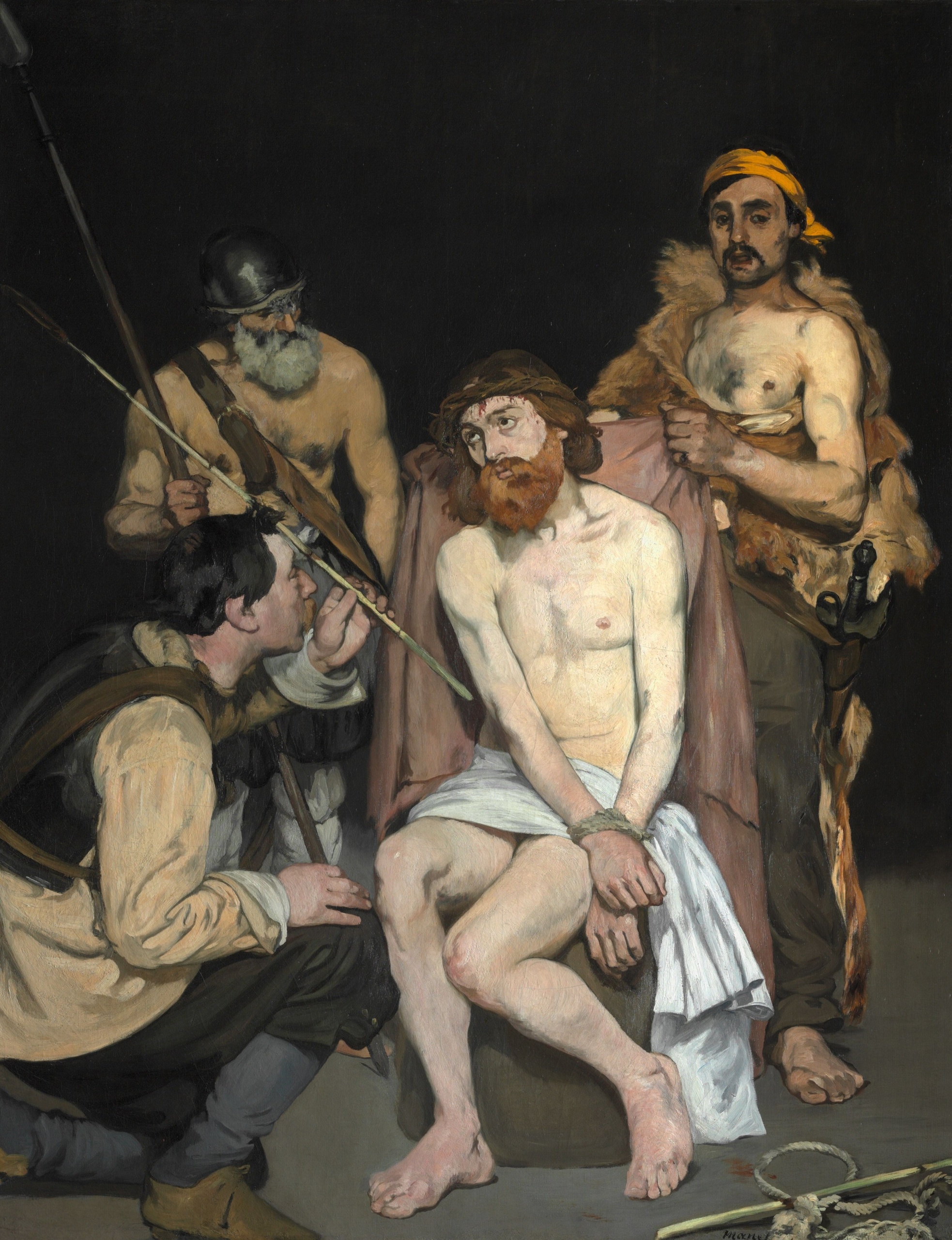
Jesus Mocked by the Soldiers is a large oil by Édouard Manet from 1865 and his last religious work: Christ, bound and crowned with thorns, sits among three soldiers and raises his eyes upwards. The original measures 190.8 x 148.3 cm and belongs to the Art Institute of Chicago. Our painter paints the scene for you by hand in oil on canvas, in one of 8 portrait sizes from 30 x 40 to 156 x 200 cm, or made to measure. Before the parcel sets off, you receive a photograph of the finished work.
| Title: | Jesus Mocked by the Soldiers |
| Other titles: | Jésus insulté par les soldats (French title) · Jesus Insulted by the Soldiers |
| Painter: | Édouard Manet (1832–1883) |
| Year painted: | 1865 |
| Original size: | 190.8 cm x 148.3 cm (height x width) |
| Original technique: | Oil on canvas |
| Painting style: | Realism and Impressionism |
| Located at: | Art Institute of Chicago, Chicago, United States |
| Our reproduction: | Hand-painted in oil on canvas, 8 sizes or made to measure |
Jesus Mocked by the Soldiers – Édouard Manet
What does Jesus Mocked by the Soldiers show?
At the centre of the canvas sits Christ, bare to the waist, a white cloth over his hips and lap. He wears the crown of thorns, drops of blood mark his forehead, and a reddish-brown beard falls to his chest. His wrists are tied with a thick rope and his hands rest quietly on his knees. Head tilted, he looks upwards, not at the soldiers.
On the left a younger soldier in a pale shirt and leather jerkin kneels before him, holding a long, thin reed. Behind him an old man with a grey beard and a dark metal helmet leans in, bare-chested, a spear in his hand. On the right stands a man with a yellow headscarf and an animal skin over his shoulder, a sword at his side. He holds a pale violet cloak behind Christ’s back and looks straight out at us.
The background is almost black, so the pale body at the centre glows as if under a spotlight. At the lower right a coiled rope and a stick lie on the ground, and Manet’s signature sits just beside them.
Which older paintings inspired Manet?
The subject comes from the Gospel account of the Passion, when soldiers mocked Jesus before the Crucifixion.
The critic Théophile Thoré-Burger wrote that the picture draws on Christ Crowned with Thorns by the Flemish painter Anthony van Dyck. That canvas was destroyed in Berlin in 1945, though a version of it survives in the Princeton University Art Museum.
Other authors point to Titian’s work of the same title (1542–43) in the Louvre. Michel Leiris (1959) saw an engraving by Schelte Adams Bolswert behind it, Theodore Reff Van Dyck’s Ecce Homo in the Prado, Julius Meier-Graefe the influence of Velázquez and Ann Coffin Hanson that of Hendrick ter Brugghen.
The trail makes sense: as a young painter Manet copied Titian and Velázquez in the Louvre.
Why is the painting well known?
Born in Paris, Édouard Manet (1832–1883) was among the first 19th-century painters of modern life and a pivotal figure between Realism and Impressionism. He seldom painted religious scenes, and this is the last of his works on a biblical theme.
Critics and public judged it, together with his Dead Christ with Angels of 1864, violent and not academic enough. Paul de Saint-Victor called it “the horrible Ecce Homo by Monsieur Manet”, and caricaturists such as Bertall, Cham and André Gill lampooned it in Le Charivari and other papers.
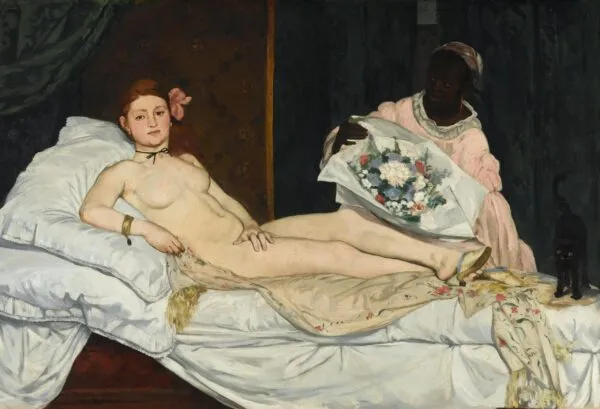
In the same year, 1865, his Olympia caused an uproar at the Paris Salon. For more on its sources and its travels, read the Wikipedia article on the painting, which is in English.
Where is the original, and how did it reach Chicago?
The original, oil on canvas measuring 190.8 x 148.3 cm (height x width), belongs to the Art Institute of Chicago under accession number 1925.703.
In 1883 the canvas was offered for sale but withdrawn. In 1893 the art dealers Boussod and Valadon bought it from Léon Leenhoff, and a year later Durand-Ruel acquired it jointly with Jean-Baptiste Faure.
Faure exhibited it in New York, and Durand-Ruel then sold it to James Deering, heir to the Deering Harvester Company. Deering left it to the Chicago museum in 1925.
Jesus Mocked by the Soldiers or another Manet?
To be honest, this is a grave, quiet and solemn picture, not cheerful decoration. As a canvas painting it belongs in a study, a home chapel or on the wall of a collector who values old Christian painting and Manet’s bold hand.
If you are after a calmer Manet, look at Fishing, a broad river landscape with a rainbow and anglers in boats, or Effect of Snow on Petit-Montrouge, a winter view made during the Siege of Paris. Everyday life fills The Waitress, a young woman with glasses of beer in front of the stage of a Paris venue, and Young Boy Peeling a Pear, a boy in a white shirt peeling a green pear with a knife.
All our famous Manet paintings are on the Édouard Manet page.
How do we hand-paint Jesus Mocked by the Soldiers?
Manet’s original is oil on canvas, almost 191 cm tall. Here it becomes an oil painting reproduction on new canvas: the painter works it in oil on canvas, in the size you pick, building it up layer by layer.
He first lays in the dark ground and the four figures, keeping their spacing as Manet set it; then come the pale body, the white cloth and the violet cloak, and last the fur, the yellow headscarf and the thorns.
Manet painted the soldiers’ clothes and the floor with broad, quick strokes. Our painter does not smooth them away, so the scene keeps its gravity even at a smaller size.
Which size suits which wall?
In short: 30 x 40 or 36 x 48 cm for a small home altar or a shelf, 48 x 60 and 60 x 81 cm above a desk, 77 x 100 and 99 x 125 cm for the wall of a study or hallway, and 123 x 160 or 156 x 200 cm for a tall wall the work should command.
We paint it in 8 portrait sizes (width x height): 30 x 40, 36 x 48, 48 x 60, 60 x 81, 77 x 100, 99 x 125, 123 x 160 and 156 x 200 cm. The original measures 148.3 x 190.8 cm (width x height), so all seven sizes up to 123 x 160 cm are smaller than it, while 156 x 200 cm is a little larger than the original.
As a painting for the living room it needs a calm wall with no other works crowding it; there the 99 x 125 cm size above a low sideboard shows all four faces clearly.
Can I order another size or a frame?
Yes. If your wall calls for other proportions, we keep Christ and all three soldiers whole and adjust only the dark edge of the background. Tell us the size you need, and we will reply with a price and a date.
We ship the scene rolled, stretched on a stretcher bar or ready framed; our workshop in Slovenia does the stretching and framing. You choose the moulding for this Passion scene in our 3D app, which serves only to pick the frame; seeing the painting on your own wall is a separate service.
When will the painting arrive?
The painter starts as soon as you confirm the order, and the painting is ready to leave within 15 to 45 working days. Before we pack it, we send you a photograph of the finished painting, and if you want anything changed, we correct it.
The parcel with this Passion scene travels within Slovenia and across the EU with no customs duties, and every order is covered by our returns policy.
As a gift it suits someone close to Christian art or a collector of old subjects. Unsure of the wall? Give a wall art voucher instead and let the recipient choose the size.
Frequently asked questions
Where can I see the original?
At the Art Institute of Chicago, under accession number 1925.703.
Who are the three men around Christ?
Soldiers of the Passion: one kneels with the reed, one has a helmet and spear, one a fur and yellow headscarf.
Is it a print?
No. Our painter sets down every stroke with a brush in oil on canvas, so you receive a hand-painted copy, not a print.
How large is the original?
It is 190.8 cm tall and 148.3 cm wide; our largest size, 156 x 200 cm, slightly exceeds it.
Can I order this Passion scene in a size that is not listed?
Yes. Tell us how much space your wall offers, and we will make an offer for the scene of Jesus and the soldiers.
How long does it take to make?
From 15 to 45 working days; before it ships you see it in a photograph.
Is it right for a bedroom, or as a gift?
It is too serious for a bedroom; it does better in a study or chapel, and pleases a believer or collector as a gift.
Why did the critics attack it?
Together with the Dead Christ with Angels, it struck them as violent and not academic enough.
- Subject: Christ, bound and crowned with thorns, among three soldiers before a near-black ground.
- Original: oil on canvas, 1865, 190.8 x 148.3 cm, Art Institute of Chicago.
- Ours: an Édouard Manet reproduction hand-painted in oil on canvas; choose one of 8 portrait sizes (30 x 40 to 156 x 200 cm) or a size made to measure.
- Worth knowing: Manet’s last religious work; James Deering left it to the museum in 1925.