







































Description
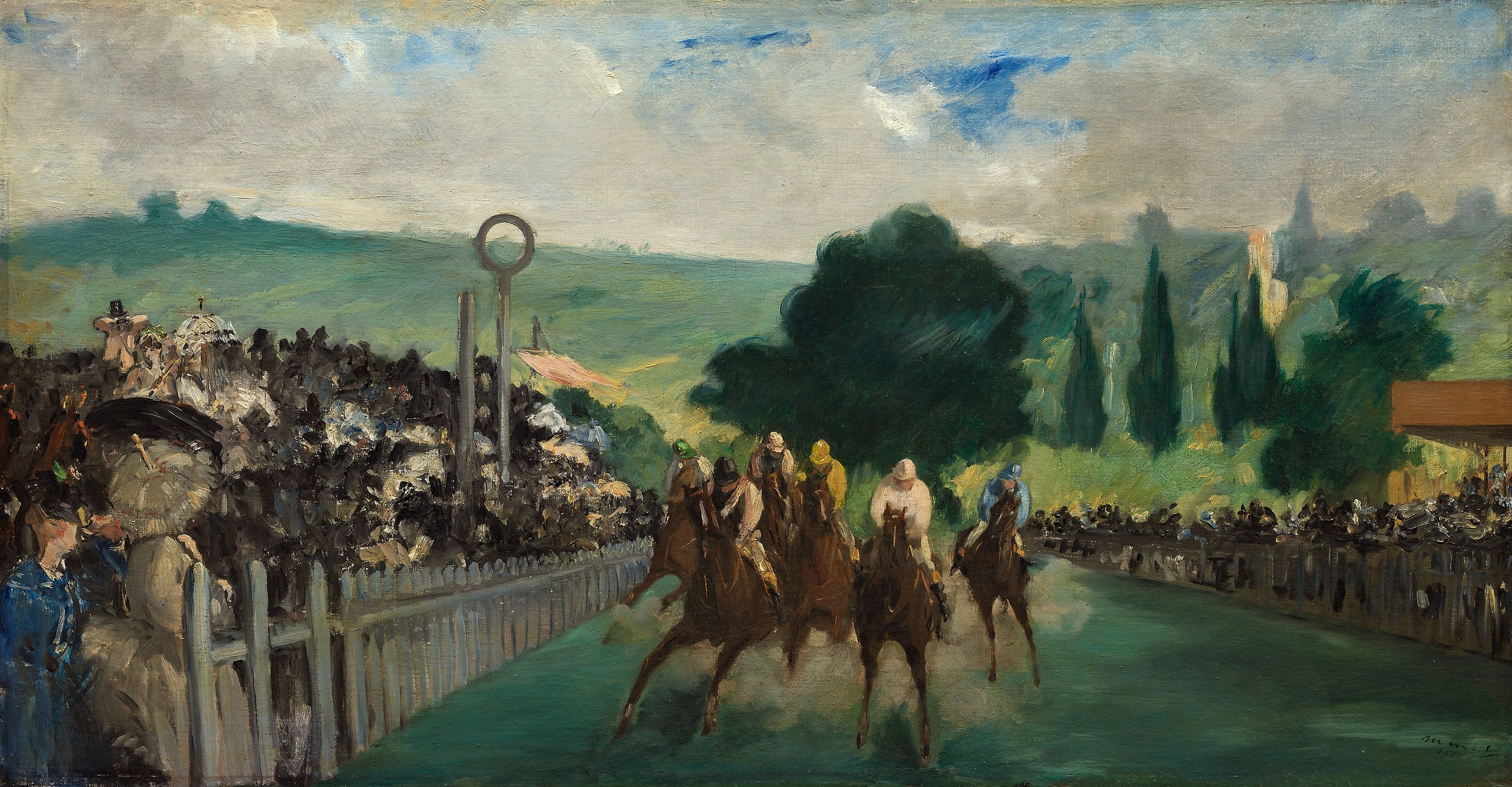
The Races at Longchamp is an 1866 painting by Édouard Manet: a pack of jockeys on brown horses gallops down a green track straight towards us, while behind white rails on both sides a crowd with parasols and carriages presses forward. The original is oil on canvas, 44 x 84 cm, and belongs to the Art Institute of Chicago. Our painter paints it for you by hand in oil on canvas, in 8 wide landscape sizes from 50 x 25 to 190 x 100 cm, or made to measure. Before the horses set off to you, you get a photograph of the finished canvas.
| Title: | The Races at Longchamp |
| Other titles: | Les Courses à Longchamp (French title) |
| Painter: | Édouard Manet (1832–1883) |
| Year painted: | 1866 |
| Original size: | 44 cm x 84 cm (height x width) |
| Original technique: | Oil on canvas |
| Painting style: | Realism and Impressionism |
| Located at: | Art Institute of Chicago, Chicago, United States |
| Our reproduction: | Hand-painted in oil on canvas, 8 sizes or made to measure |
The Races at Longchamp – Édouard Manet
What does The Races at Longchamp show?
We stand on the track itself. Between two white wooden rails a group of horses and riders charges head-on at the viewer, the jockeys in caps and silks of green, black, yellow, white and blue, pale dust rising under the hooves. The brown horses’ legs are set down in a few quick strokes, as if caught in a passing glance.
On the left an elegant crowd packs in behind the fence: a woman in blue at the front, another with a light parasol beside her, then top hats, carriages and sunshades. In the middle rises a tall post with a ring on top, marking the finish. On the right stands a roofed grandstand above another dark line of spectators.
Beyond the track climb green hills, a dark tree and slender, cypress-like trees under a sky of white cloud and patches of blue. Manet signed at the lower right.
Which race did Manet paint?
The scene shows the finish of the second Grand Prix de Paris at Longchamp, run on Sunday 5 June 1864 before about a hundred thousand Parisians, Manet among them. The English favourite Blair Athol, winner of the Epsom Derby, never led; the French horse Vermouth won by two full lengths.
The painting also records a fashion of its day. Racing took hold in France from the 1830s under British influence, and Longchamp opened in the Bois de Boulogne in 1857, soon a meeting place for well-off Parisians. Many came to socialise more than to watch, Manet and Degas among them; Degas sketched Manet there.
Manet painted the subject four times over four years, probably starting while at work on Le Déjeuner sur l’herbe, which may have prompted it.
Why does this race matter in the history of painting?
It is thought to be the first painting to show horses running straight at the viewer. Until then races were painted from the side, and Manet himself went back to that view in 1872 with a race in the Bois de Boulogne. The art historian Juliet Wilson-Bareau wrote that the horses seem to burst out of a distant mass of trees.
Manet deliberately flattened the depth. For Wilson-Bareau the ring on the finishing post pins the far hills to the front of the canvas; Françoise Cachin compared the effect to a photographer zooming in, so the area in focus grows as the depth of field shrinks.
Édouard Manet (1832–1883) was among the first nineteenth-century artists to paint modern life and a pivotal figure between Realism and Impressionism. Critics first dismissed this work as a sketch; today it is accepted as a finished painting. The Wikipedia article on this work, in English, covers the race, the versions and the composition.
Where is the original, and how many versions are there?
The original, oil on canvas measuring 44 x 84 cm (height x width), belongs to the Art Institute of Chicago, accession number 1922.424. It is the best-known version of the subject.
The smudged date was once read as 1865 or 1867; a microscopic examination pointed to 1866. Manet cut up his first oil version of 1864 in 1865, and only two pieces are known to survive. A watercolour of two joined sheets is at the Fogg Art Museum; the version shown in 1867 is lost.
The Races at Longchamp or another Manet?
This canvas painting suits anyone who loves horses, movement and summer days outdoors; its long, low format fills a wide wall above a sofa, bed or sideboard.
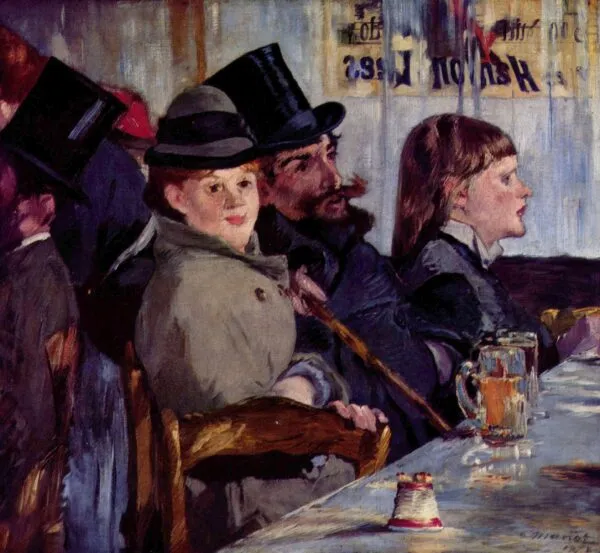
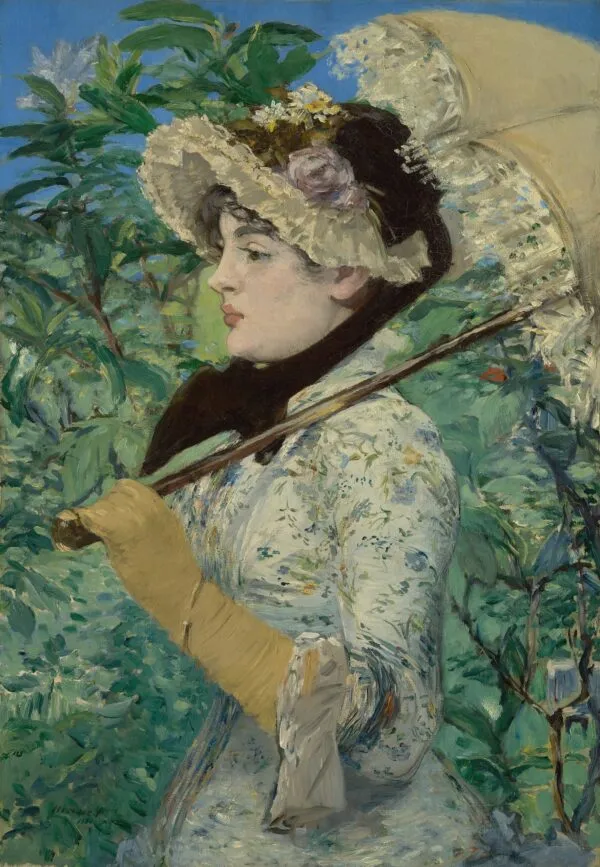
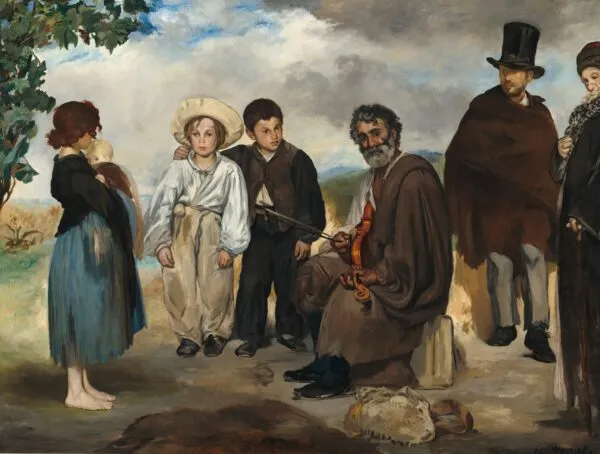
If you prefer a quieter portrait, see Boy Blowing Bubbles, a boy blowing a large clear soap bubble, or Le Bon Bock, a bearded man with a pipe and a glass of beer. Manet’s model Victorine Meurent is the subject of Young Lady in 1866 and of Mademoiselle V. in the Costume of an Espada, where she poses in a bullring dressed as a bullfighter, sword in hand.
From racecourses to portraits, the famous Manet paintings we paint to order are gathered on our Édouard Manet page.
How do we hand-paint The Races at Longchamp?
Manet’s original is a small oil on canvas, only 84 cm wide. Our oil painting reproduction is hand-painted in oil on canvas, layer by layer, at the size you pick.
He first lays in the two rails, the finishing post and the pack of horses, the axis the whole scene hangs on. Then, as Manet did, he paints the track in horizontal strokes, hills and trees in diagonal ones, the thin trees and fence in vertical ones.
Sky and crowd are built from small dabs of colour; last come the silks, the dust and the blue dress at the rail. The strokes stay loose, so the race keeps its speed on your wall.
Which size suits your wall?
In short: 50 x 25 or 60 x 30 cm above a door or on a shelf, 80 x 40 and 90 x 45 cm above a desk or chest of drawers, 110 x 60 and 130 x 65 cm above a sofa or bed, and 170 x 85 or 190 x 100 cm for a long wall or hallway.
We paint it in 8 wide landscape sizes (width x height): 50 x 25, 60 x 30, 80 x 40, 90 x 45, 110 x 60, 130 x 65, 170 x 85 and 190 x 100 cm. The original measures 84 x 44 cm (width x height), so 50 x 25, 60 x 30 and 80 x 40 cm are smaller than it, 90 x 45 cm is almost the same and just a little larger, and every size from 110 x 60 cm up is larger than the original; the biggest is more than twice as wide.
As a painting for the living room it works best at 130 x 65 or 170 x 85 cm above the sofa, where the horses charging towards you and the bright crowd at the rail read clearly.
Can I order another size or a frame?
Yes. For other proportions we keep the horses, the finishing post and the woman in blue whole and adjust the sky or the crowd’s edge. Send us the size you need for a price and a making time.
The race scene travels rolled, stretched on a stretcher bar or framed; our Slovenian workshop does the stretching and framing. The moulding is picked in our 3D app, made for frame choice alone; a view of the painting on your own wall is a separate service. Thin gold suits the pale sky, dark wood the green turf.
How long do making and delivery take?
Work on the horses starts once you confirm, and your canvas is ready to leave within 15 to 45 working days. A photograph of it reaches you before packing, and we adjust whatever you ask.
No customs duties apply to the racecourse scene within Slovenia or the EU, and our returns policy covers the order.
A day at the races makes a fine gift for riders and horse lovers. Unsure of their wall? A wall art voucher lets them choose the size of their racecourse.
Frequently asked questions
Where can I see the original?
At the Art Institute of Chicago, under accession number 1922.424.
What is happening in the scene?
The finish of the second Grand Prix de Paris at Longchamp in 1864, with the horses racing for the line.
Is this a print?
No. Horses, crowd and sky are brushed by hand: a hand-painted copy in oil on canvas.
How large is the original?
It measures 44 x 84 cm (height x width); all our sizes from 110 x 60 cm up are larger.
Can I get The Races at Longchamp in an unlisted size?
Certainly. Send the width and height, and we quote a price and a date.
How soon will my painting arrive?
It is ready in 15 to 45 working days, and before it ships you see it in a photograph.
Would it hang well in a bedroom or make a good present?
Yes. The wide format sits well above a bed, and racing fans love it as a gift.
Why do the horses run straight at the viewer?
Manet painted the race from the track, not from the side; it is thought to be the first painting of horses seen this way.
- Subject: jockeys on brown horses galloping head-on at the viewer, a crowd with parasols behind white rails.
- Original: oil on canvas, 1866, 44 x 84 cm, Art Institute of Chicago.
- Ours: an Édouard Manet reproduction painted by hand in oil on canvas, 8 sizes from 50 x 25 to 190 x 100 cm, or made to measure.
- Worth knowing: thought to be the first painting of racehorses coming straight towards the viewer.