







































Description
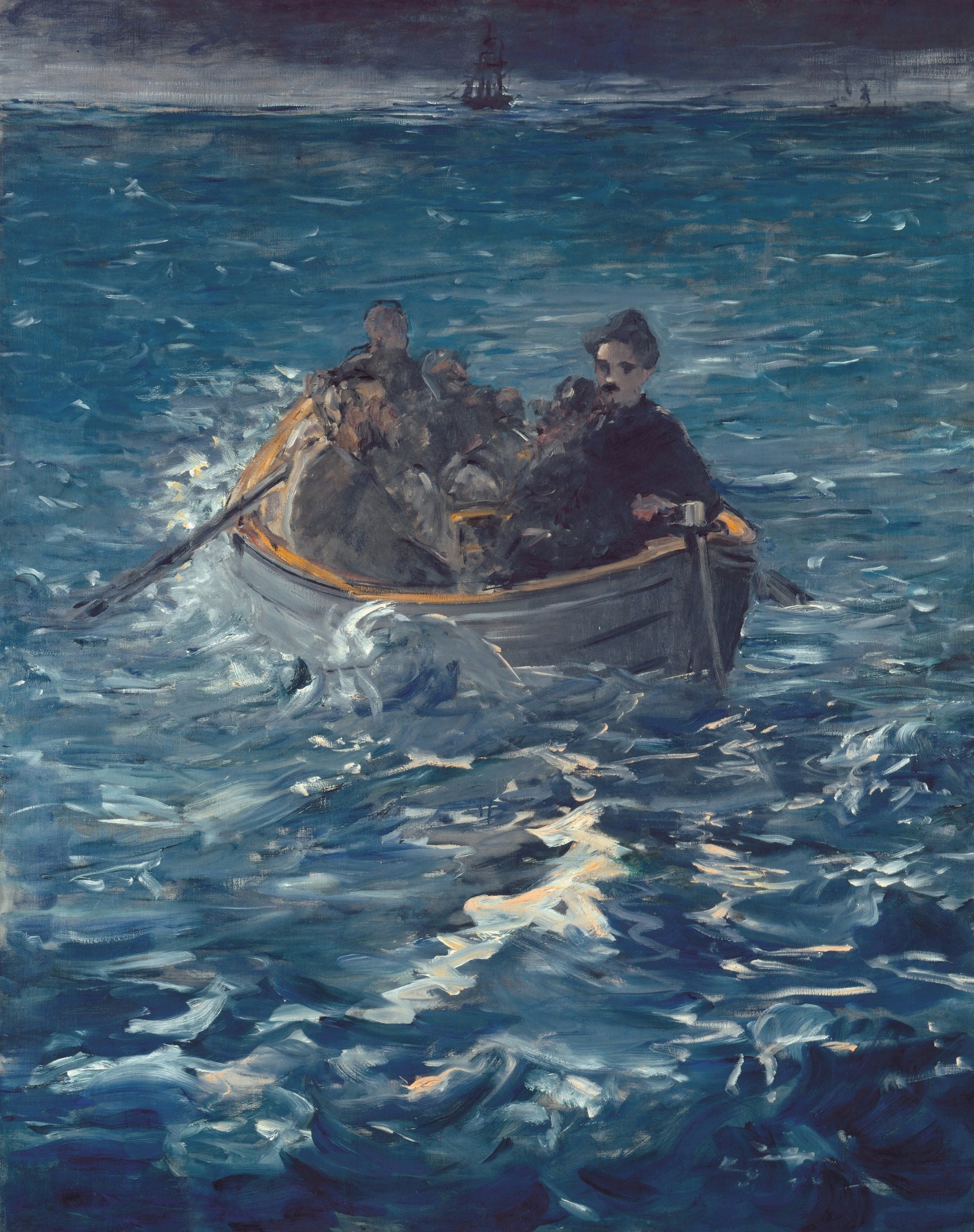
Rochefort’s Escape is a late work by Édouard Manet, painted around 1880–81: a wooden boat full of dark rowing figures cuts across a wide, deep blue sea flecked with white foam, while far off on the horizon, under the night sky, a tiny sailing ship is barely visible. The scene refers to the 1874 escape of the journalist Henri Rochefort from New Caledonia. The original is oil on canvas, 143 x 114 cm, and it belongs to the Kunsthaus Zürich. Our painter paints it for you by hand in oil on canvas, in 8 portrait sizes from 33 x 42 to 150 x 195 cm, or made to measure. Before the boat and its sea leave us, you receive a photograph of your finished painting.
| Title: | Rochefort’s Escape |
| Other titles: | L’Évasion de Rochefort (French title) |
| Painter: | Édouard Manet (1832–1883) |
| Year painted: | about 1880–1881 |
| Original size: | 143 cm x 114 cm (height x width) |
| Original technique: | Oil on canvas |
| Painting style: | Realism and Impressionism |
| Located at: | Kunsthaus Zürich, Zurich, Switzerland |
| Our reproduction: | Hand-painted in oil on canvas, 8 sizes or made to measure |
Rochefort’s Escape – Édouard Manet
What does Rochefort’s Escape show?
The sea takes up almost the entire canvas. Its waves are dark blue and greenish blue, laid down by Manet in broad, quick strokes, with white and pale grey flecks of foam flashing between them. Across the lower half a band of pale, almost silver light runs over the water.
In the middle of all this water travels a wooden boat with a grey hull and an orange-yellow rim. Several dark figures are crowded inside, pulling at the oars, their faces barely suggested. At the near end sits a man with a moustache, dressed in dark clothes, one hand on the tiller, looking towards us. White water churns along the side of the boat.
The sky is only a narrow, dark, night-blue strip along the top of the canvas. On the horizon stands a tiny sailing ship, so small that you notice it only after a moment. Between the boat and the ship there is nothing but waves.
What happened in 1874?
Henri Rochefort, in full Victor Henri Rochefort, Marquis de Rochefort-Luçay, was a French journalist. For his role in the Paris Commune he was sentenced and sent into captivity in New Caledonia. In 1874 he managed to escape.
From this story Manet chose neither a courtroom nor a prison nor any pursuers. The canvas holds only the boat, the people in it, the dark sea and a distant ship; everything else stays outside the frame.
When the painter was working on it, around 1880–81, the escape was just six or seven years in the past, and people in Paris still remembered it well.
Why does this painting matter?
History painting traditionally dealt with historic and mythological subjects. Manet put an event still fresh in public memory onto a large canvas, and this is exactly why the work is considered highly significant.
Édouard Manet (1832–1883) was one of the first nineteenth-century artists to paint modern life, and a pivotal figure in the move from Realism to Impressionism. His Le Déjeuner sur l’herbe and Olympia caused a great scandal in the 1860s. In 1881 he received the Légion d’honneur, and he died two years later after a long illness.
The key facts are gathered in a short Wikipedia article on the painting, which is written in English.
Where is the original, and is there a second version?
The original is a large oil on canvas, 143 cm high and 114 cm wide. It belongs to the Kunsthaus Zürich in Switzerland, under inventory number 1955/0009.
Manet intended the canvas for the Paris Salon of 1881, the same year he received the Légion d’honneur.
A second, smaller version also exists and is held by the Musée d’Orsay in Paris. Our painting follows the larger Zurich version.
Rochefort’s Escape or another Manet?
This is a canvas painting for anyone drawn to the sea at night, to deep blues and to true stories from the nineteenth century.
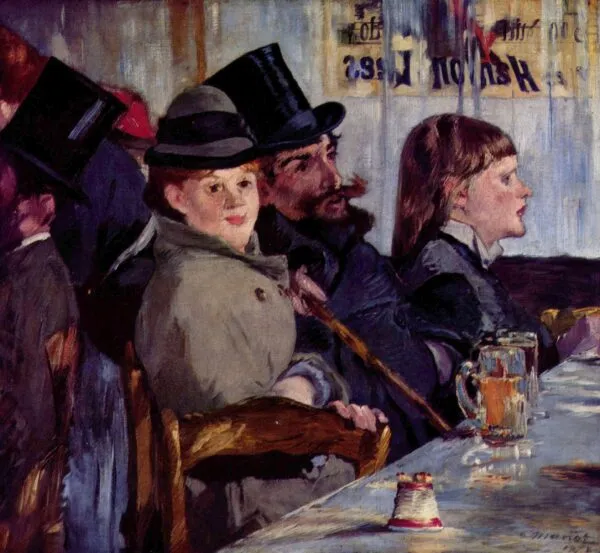
A bright, festive Paris fills The Rue Mosnier with Flags, a street hung with tricolours for the celebration of 30 June 1878. An evening among people is the subject of The Café-Concert: a gentleman in a top hat, a young woman and a waitress at a marble table. The poet leaning back on a sofa with a cigar appears in Portrait of Stéphane Mallarmé, and carnations and clematis from Manet’s last years in Flowers in a Crystal Vase.
More famous Manet paintings, all painted to order, are gathered on our Édouard Manet shelf.
How do we hand-paint Rochefort’s Escape?
Manet’s original is oil on canvas and stands almost one and a half metres tall. Ours is an oil painting reproduction on fresh canvas: the painter works it by hand in oil on canvas, in the size you have chosen, building it up layer by layer.
He first fixes the high horizon line and the position of the boat, then covers the canvas with the dark and middle blues of the water. Only after that does he drag in, with thicker paint, the white and silvery strokes of foam, the orange rim of the boat and the tiny ship in the distance.
Manet painted the waves fast and broadly and only hinted at the figures in the boat. Our painter does not smooth those strokes into fine detail, because it is the lively brushwork that sets the sea moving in this painting.
Which size suits which wall?
In short: 33 x 42 and 43 x 53 cm for a narrow wall or a hallway, 55 x 66 and 60 x 78 cm above a chest of drawers or in a bedroom, 78 x 95 and 97 x 122 cm above a sofa, and 120 x 155 or 150 x 195 cm for a tall wall or a stairwell.
We paint Rochefort’s boat on the open sea in 8 portrait sizes (width x height): 33 x 42, 43 x 53, 55 x 66, 60 x 78, 78 x 95, 97 x 122, 120 x 155 and 150 x 195 cm. The original measures 114 x 143 cm (width x height), so all six sizes up to 97 x 122 cm are smaller than it. The 120 x 155 cm size is slightly larger than the original, and 150 x 195 cm clearly exceeds it.
As a painting for the living room it works best at 97 x 122 or 120 x 155 cm, where the waves keep almost the same force as on the original; the upright format also suits a wall beside a window.
Can I order another size or a frame?
Of course. If your wall calls for different proportions, we keep the boat, the rowers and the sailing ship and adjust only the band of sea around them. Send us the size you need for this sea scene, and we reply with a price and a date for completion.
Your night sea leaves us rolled, stretched on a stretcher bar or framed. Stretching and framing are done by our workshop in Slovenia, which prepares every painting for a safe journey. The moulding for the boat scene is chosen in our 3D app, used only to pick the frame; seeing the painting on your own wall is a separate service.
A slim dark moulding leaves all the room to the sea, while warmer wood or a gold moulding brings out the orange rim of the boat.
When will my painting arrive?
Painting takes 15 to 45 working days from your order confirmation. Once it is finished we send you a photograph of it, and if you would like anything changed, we do it before dispatch.
The parcel with your night sea travels within Slovenia and to every other EU country without customs duties, and the purchase is covered by our returns policy.
Rochefort’s Escape makes a fine gift for anyone who loves the sea, sailing or history. If you do not know the recipient’s wall, give a wall art voucher and let them choose the painting and the size.
Frequently asked questions
Where can I see the original?
At the Kunsthaus Zürich in Switzerland, under inventory number 1955/0009.
Which event does the painting refer to?
The escape of the journalist Henri Rochefort from captivity in New Caledonia in 1874.
Do I get a print?
No. You get a hand-painted copy, worked by our painter with a brush in oil on canvas.
How big is the original?
It measures 143 x 114 cm (height x width); our 120 x 155 and 150 x 195 cm sizes (width x height) are larger.
Can I order Rochefort’s Escape in a size that is not listed?
Yes. Give us the width and height of your wall space, and an offer with a price and a delivery date follows.
How long does it take to make?
15 to 45 working days; before the parcel leaves, a photograph shows you the finished boat and sea.
Does it suit a bedroom or an office?
Yes. The calm blues of the sea sit well in a bedroom, a home office or a workplace.
What does the painting mean for art history?
It treats a real, recent event with the seriousness that history painting had kept for the past and for myth.
- Subject: a wooden boat with rowers on a wide, dark blue night sea, a tiny sailing ship on the horizon.
- Original: oil on canvas, about 1880–81, 143 x 114 cm, Kunsthaus Zürich.
- Ours: an Édouard Manet reproduction hand-painted in oil on canvas after the Zurich original, 8 sizes from 33 x 42 to 150 x 195 cm, or made to measure.
- Worth knowing: a smaller version of the same subject is held by the Musée d’Orsay in Paris.