







































Description
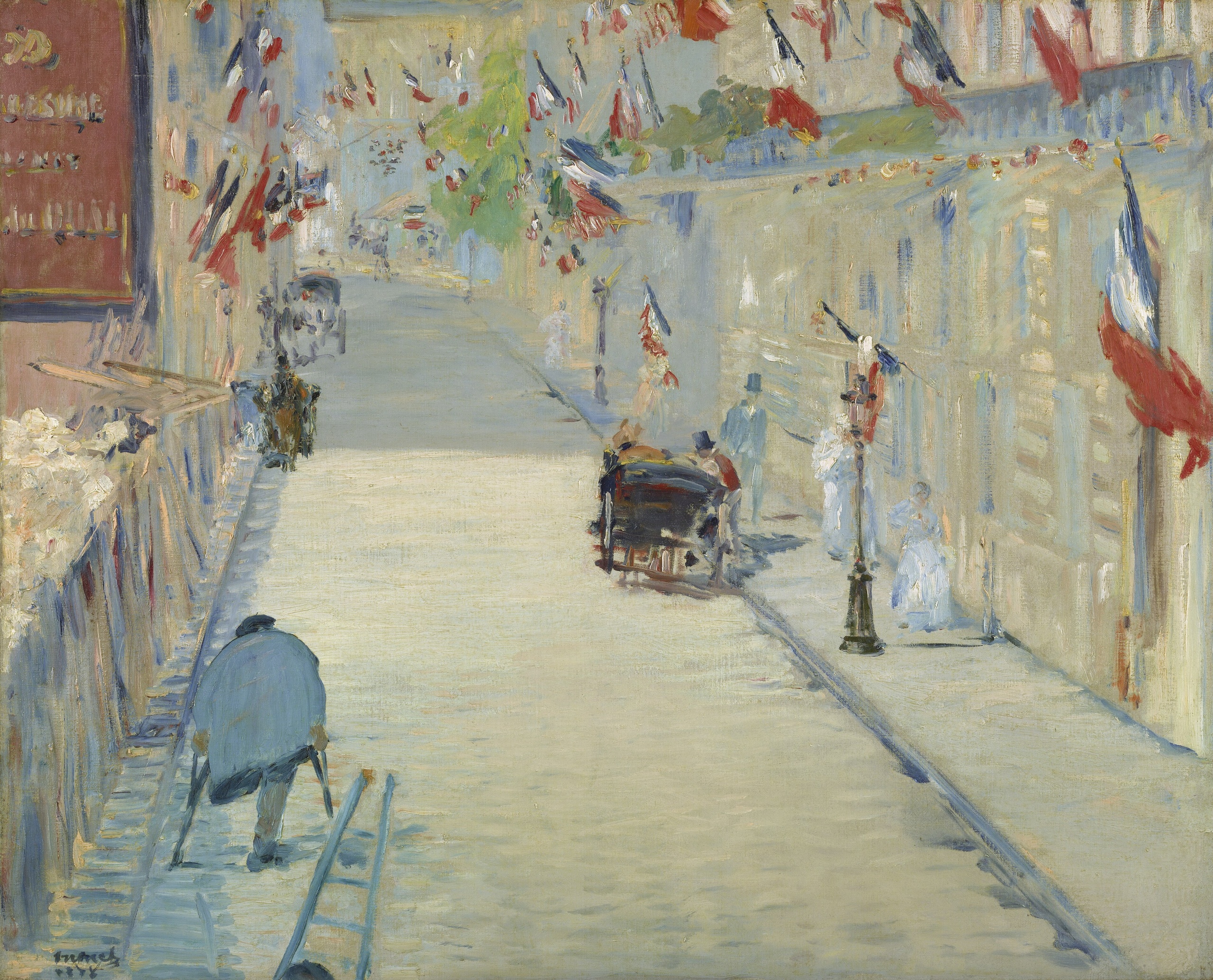
The Rue Mosnier with Flags is a Paris street scene painted by Édouard Manet in 1878: a pale, sunlit street runs diagonally away, French tricolours hang from the house fronts, and at the lower left a one-legged man makes his way on crutches along a fence. The original is oil on canvas, 65.4 x 80 cm, and it belongs to the J. Paul Getty Museum in Los Angeles. Our painter recreates it for you by hand in oil on canvas, in any of 8 landscape sizes between 40 x 32 and 190 x 150 cm, or made to measure, and you see a photograph of it before it ships.
| Title: | The Rue Mosnier with Flags |
| Other titles: | La Rue Mosnier aux drapeaux (French title) · The Rue Mosnier Dressed with Flags |
| Painter: | Édouard Manet (1832–1883) |
| Year painted: | 1878 |
| Original size: | 65.4 cm x 80 cm (height x width) |
| Original technique: | Oil on canvas |
| Painting style: | Realism and Impressionism |
| Located at: | J. Paul Getty Museum, Los Angeles, United States |
| Our reproduction: | Hand-painted in oil on canvas, 8 sizes or made to measure |
The Rue Mosnier with Flags – Édouard Manet
What does The Rue Mosnier with Flags show?
We look down on the street as if from an upper window. The broad, sunny roadway cuts diagonally towards the top left and disappears between the houses; its far stretch lies in bluish shade, the near part is pale and full of light.
Blue, white and red flags hang from the facades on both sides, some large and tilted over the pavement, others mere dabs of colour down the street. On the right stands a dark street lamp, with two women in light dresses behind it and a man in a top hat ahead. A carriage moves down the middle of the road; further up are a second carriage, a few passers-by and a green tree.
In the bottom left corner a one-legged man in a blue coat leans on his crutches by a wooden fence. A ladder lies on the ground in front of him. Pale building rubble lies behind the fence, and a red shop sign hangs at the top left. Manet signed at the lower left with his name and the year 1878.
What is the flag-decked street celebrating?
Paris dressed its streets for the Fête de la Paix, the Celebration of Peace, on 30 June 1878. It was the first national holiday, held during that year’s Exposition Universelle; together, fair and holiday marked France’s recovery after the Franco-Prussian War and the Paris Commune. In 1880 the holiday moved to 14 July and became Bastille Day.
The Rue Mosnier is today the Rue de Berne. The rooms where Manet worked, at 4 Rue de Saint-Pétersbourg, looked out over it, and he painted the scene from an upstairs window.
The man on crutches, a quiet figure among the flags, has lost a leg and is often read as a war invalid, possibly a veteran wounded in the Franco-Prussian War. Set beside Monet’s views of the same holiday, Manet’s canvas is often described as sober and almost bare.
Why is Manet’s flag-hung street so well known?
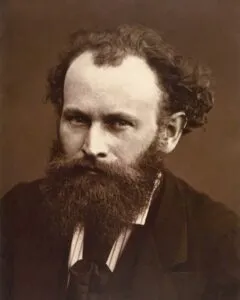
Édouard Manet (1832–1883) ranks among the first nineteenth-century painters of modern life and was a pivotal link between Realism and Impressionism. A friend of Monet, Degas and Renoir, he still never exhibited with the Impressionists and preferred the Salon.
Claude Monet painted the flag-filled Rue Montorgueil on the same day, and the Rue Saint-Denis that year; in 1917 the American Childe Hassam echoed these flag scenes in a picture of a New York avenue in the rain.
Manet liked to paint the events of his own day. In The Kearsarge at Boulogne of 1864, the American warship lies at anchor off Boulogne a few weeks after sinking the CSS Alabama. For more on the holiday and the other versions, read the Wikipedia article on the painting, which is in English.
Where is the original, and how did it get there?
The original, oil on canvas measuring 65.4 x 80 cm (height x width), belongs to the J. Paul Getty Museum in Los Angeles, accession number 89.PA.71.
In the 1890s the canvas passed through the hands of Jean-Baptiste Faure; Auguste Pellerin owned it until 1910, then the Hungarians Marcell Nemes and Baron Mór Lipót Herzog. Before 1932 the German banker Jakob Goldschmidt bought it. After his death in 1955 his estate sold it in London in 1958 to Paul Mellon, and in 1989 the Getty acquired it.
The same street also appears in a road menders scene of that year with a similar layout, and another flag-decked version is in a private collection.
The Rue Mosnier with Flags or another Manet?
This canvas painting suits anyone drawn to a city in holiday dress and the small stories of people in the street.
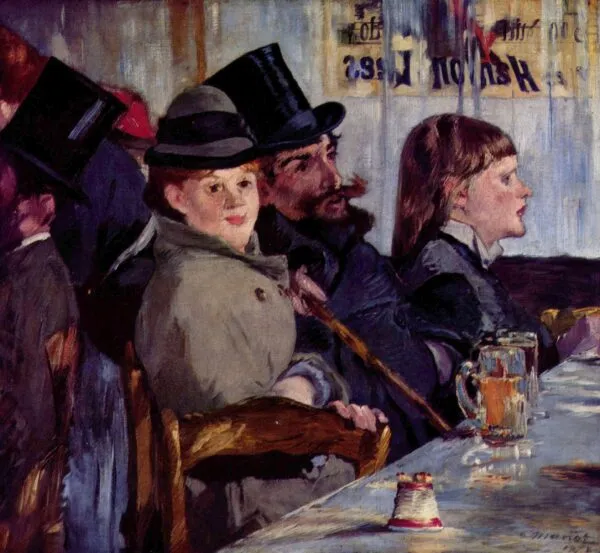
If Manet’s Parisians interest you, see The Café-Concert: a gentleman in a top hat, a young woman and a waitress drinking beer at a marble table in the Brasserie Reichshoffen. The poet Manet saw almost daily appears in Portrait of Stéphane Mallarmé, and a flower still life from his last years, carnations and clematis, in Flowers in a Crystal Vase.
Browse more famous Manet paintings, all painted to order in oil, on our Édouard Manet page.
How do we hand-paint The Rue Mosnier with Flags?
Manet’s original is oil on canvas, 80 cm wide. Ours is an oil painting reproduction on new canvas: the painter works it in oil on canvas, in the size you pick, one layer at a time.
First he draws the diagonal street, the kerb and the fence that give the scene depth, then lays in the pale roadway, the bluish shade and the facades, and finally adds the flags, the lamp, the carriage and the man on crutches.
Manet’s flags are only a few quick strokes of red, white and blue, and our painter keeps them that light rather than working them up.
Which size suits which wall?
In short: 40 x 32 or 50 x 42 cm for a narrow wall or a shelf, 65 x 52 and 74 x 59 cm above a chest of drawers or in a hallway, 95 x 75 and 120 x 95 cm above a sofa, and 150 x 120 or 190 x 150 cm for a large wall.
The Rue Mosnier comes in 8 landscape sizes (width x height): 40 x 32, 50 x 42, 65 x 52, 74 x 59, 95 x 75, 120 x 95, 150 x 120 and 190 x 150 cm. The original measures 80 x 65.4 cm (width x height): the first four sizes, up to 74 x 59 cm, are smaller than it, with 74 x 59 cm already close; 95 x 75 cm is slightly larger, and 120 x 95, 150 x 120 and 190 x 150 cm are well beyond it.
As a painting for the living room it looks best at 120 x 95 or 150 x 120 cm above the sofa, where flags and figures read from across the room.
Can I order another size or a frame?
Yes. For other proportions we adjust the edge of the facades and keep the street, the man on crutches and the flags intact. Tell us the size you need and we will quote a price and a date for your street scene.
The flag-hung street travels rolled, stretched on a stretcher bar or framed; our workshop in Slovenia handles the stretching and framing itself. Pick a moulding in our 3D app, built solely for choosing the frame; a view of the painting on your own wall is a separate service.
When will the painting reach you?
The painter starts on the tricolours and the carriage once you confirm, and the street is ready to leave within 15 to 45 working days. Before packing, we send you a photograph of the finished painting so you can ask for changes.
The parcel crosses Slovenia and the EU without customs, and every order falls under our returns policy.
This festive Paris street is a fine present for a lover of Paris or a new home. Unsure of the wall? With a wall art voucher, the person you give it to picks the size.
Frequently asked questions
Where can I see the original?
At the J. Paul Getty Museum in Los Angeles, accession number 89.PA.71.
Why are there flags in the street?
Paris was decorated for the Fête de la Paix of 30 June 1878, the first national holiday.
Is this a print?
No. It is a hand-painted copy, brushed by our painter in oil on canvas from first stroke to last.
How big is Manet’s original?
It measures 65.4 x 80 cm (height x width); our sizes from 95 x 75 cm upwards are larger.
Can I order a size that is not listed?
Of course: give us the width and height, and you get a price and a lead time back.
How long do painting and delivery take?
15 to 45 working days to dispatch, with a photograph of the finished painting first.
Does it suit a bedroom or an office?
Yes. Its light tones and calm street suit a bedroom or office, and the small sizes a hallway.
Who is the man on crutches?
The one-legged man is often read as a war invalid, perhaps wounded in the Franco-Prussian War.
- Subject: a Paris street hung with tricolours, carriages, passers-by and a man on crutches in the foreground.
- Original: oil on canvas, 1878, 65.4 x 80 cm, J. Paul Getty Museum, Los Angeles.
- Ours: an Édouard Manet reproduction brushed by hand in oil on canvas; eight sizes from 40 x 32 to 190 x 150 cm, or a size of your own.
- Worth knowing: painted from an upstairs window on the day of the Fête de la Paix, 30 June 1878.