







































Description
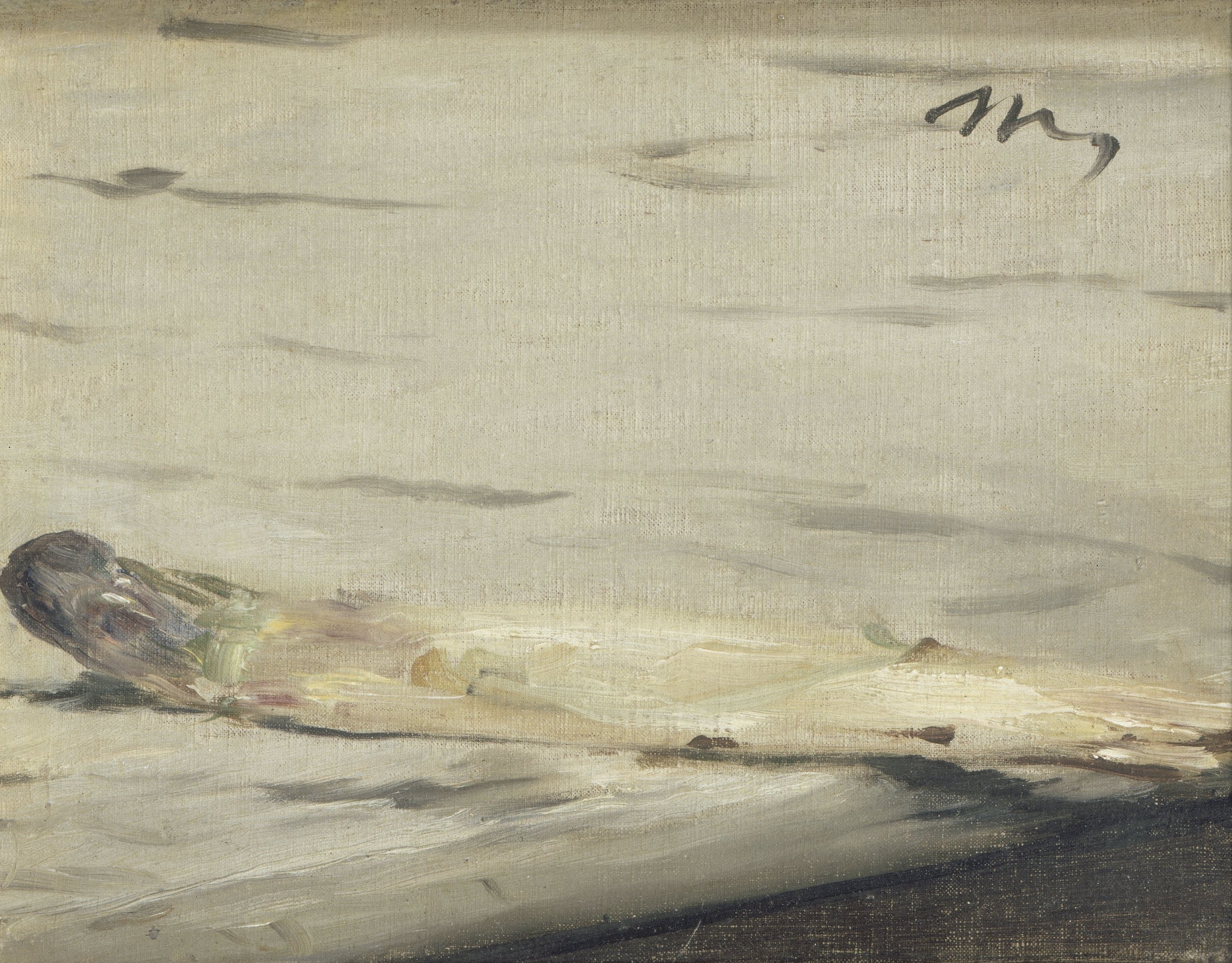
The Asparagus is a small still life by Édouard Manet from 1880: a single white asparagus spear with a violet tip lies on a pale marble slab, and the painter’s initial M sits at the upper right. The original is oil on canvas, only 16 x 21 cm, and it belongs to the Musée d’Orsay in Paris. Our painter paints it for you by hand in oil on canvas, in 8 landscape sizes from 40 x 30 to 190 x 150 cm, or made to measure, and every one of them is larger than the original. Once it is finished, we send you a photograph of it before it ships.
| Title: | The Asparagus |
| Other titles: | L’Asperge (French title) · A Sprig of Asparagus |
| Painter: | Édouard Manet (1832–1883) |
| Year painted: | 1880 |
| Original size: | 16 cm x 21 cm (height x width) |
| Original technique: | Oil on canvas |
| Painting style: | Realism and Impressionism |
| Located at: | Musée d’Orsay, Paris, France |
| Our reproduction: | Hand-painted in oil on canvas, 8 sizes or made to measure |
The Asparagus – Édouard Manet
What does The Asparagus show?
Almost the full width of the canvas is taken up by one asparagus spear, white and plump, its violet tip lifted slightly at the left. Violet, greenish and yellowish tones mix in the tip; the stalk is painted in cream-white and pale yellow, with a few brown flecks towards the cut end, which runs to the right edge.
The spear rests on a light grey marble slab. Its front edge runs on a diagonal from the lower left corner towards the right edge, leaving a dark brown wedge of shadow below. The veining of the marble is no more than a few horizontal grey strokes repeated across the whole background.
At the top right Manet signed with dark paint and a single flick of the brush: the letter M. Nothing else is there, no plate, no knife, no bundle, only a vegetable, stone and light.
Why did Manet paint just one spear?
In 1880 the art collector and patron Charles Ephrussi commissioned a larger still life from Manet, A Bundle of Asparagus. When it was done, Ephrussi sent him more money than they had agreed.
Manet did not return the difference. Instead he painted this small canvas with a single spear and sent it to Ephrussi with a playful note: one was missing from his bunch.
Art historians see Manet’s wit in the episode: he turned an ordinary sale into a symbolic exchange and set a painted asparagus in place of a real one. It has become one of the best-known anecdotes in art history.
Why is such a small painting so famous?
Édouard Manet (1832–1883) was a Paris-born painter, one of the first 19th-century artists to paint modern life and a pivotal figure in the move from Realism to Impressionism. This work belongs to his late still lifes, alongside paintings of a lemon and a ham, in which he isolated single objects to study their form.
The art historian Carol M. Armstrong describes it as an exercise in reduction that openly declares itself to be paint. Georges Bataille found it motionless, certainly, yet full of life.
The writer Sheila Heti names it as her favourite painting in two of her novels. For more on the work and its story, see the English Wikipedia article, written in English, which calls it A Sprig of Asparagus.
Where is the original, and how did it get there?
The original, oil on canvas measuring only 16 x 21 cm (height x width), belongs to the Musée d’Orsay in Paris, under accession number RF 1959 18.
After Ephrussi’s death it was bought by the art dealers Bernheim-Jeune and then passed into the private collection of Gaston Bernheim-Jeune. In 1951 the dealer Sam Salz acquired it and in 1959 gave it to the Louvre; it hung in the Jeu de Paume until 1986 and has belonged to the Musée d’Orsay ever since.
The larger Bundle of Asparagus, with a dark background that recalls 17th-century Dutch still lifes, is now in the Wallraf-Richartz-Museum in Cologne. After Ephrussi died in 1905 the two works were rarely shown together, most recently in Washington in 2017–2018 and in Chicago in 2019.
The Asparagus or another Manet?
This is a canvas painting for anyone who loves quiet and simple things: one object, a little light and plenty of space around it.
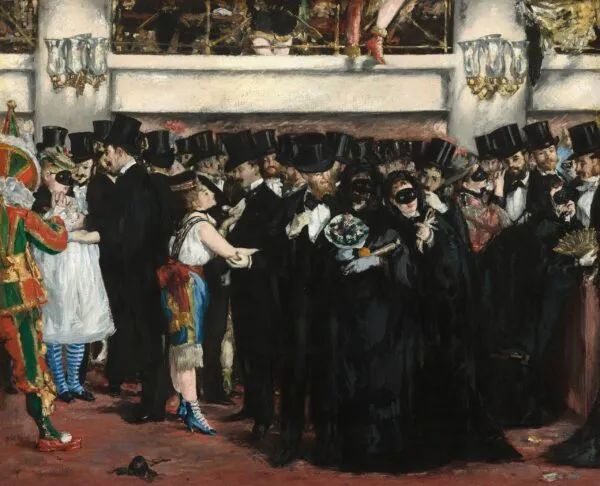
If Manet’s people appeal to you more, look at The Spanish Singer, a guitarist on a green wooden bench, or Lola de Valence, a dancer in a white lace mantilla in the theatre wings. A young woman with a paper cone of cherries steps out in The Street Singer, and a crowd of top hats and masks fills Masked Ball at the Opera.
Our full range of famous Manet paintings, each one painted to order, waits on the Édouard Manet page.
How do we hand-paint The Asparagus?
Manet’s original is an oil on canvas smaller than a sheet of A4 paper, painted quickly and loosely.
What we send you is an oil painting reproduction on new canvas, worked by our painter in oil on canvas, layer by layer, and enlarged to the size you pick.
He first lays in the pale grey ground and the slanting table edge with the dark wedge at the lower right. Then he shapes the stalk in cream and yellow strokes and joins violet, greenish and yellow tones in the tip. Because the asparagus is almost the same colour as the marble, he separates one white from the other only by the warmth of the tone, and the brushstrokes stay visible, as in Manet’s own.
Which size suits which wall?
In short: 40 x 30 or 50 x 40 cm for a kitchen, a shelf or a narrow wall, 60 x 45 and 75 x 58 cm above a dining table or a chest of drawers, 95 x 75 and 120 x 95 cm above a sofa, and 150 x 120 or 190 x 150 cm for a large empty wall.
There are 8 landscape sizes (width x height):40 x 30, 50 x 40, 60 x 45, 75 x 58, 95 x 75, 120 x 95, 150 x 120 and 190 x 150 cm. The original measures just 21 x 16 cm (width x height), so every one of our sizes is larger: even the smallest is nearly twice as wide, and the largest about nine times as wide.
As a painting for the living room it works best at 120 x 95 or 150 x 120 cm, where every brushstroke shows.
Can I have another size or a frame?
Yes. For other proportions we keep the spear and the table edge whole and adjust only the marble around them, so the quiet emptiness survives. Send us the size you need and we will quote a price and a date.
It travels to you rolled, stretched on a stretcher bar or already framed. Our Slovenian workshop stretches and frames your asparagus.
You choose the moulding in our 3D app, which is only for picking the frame; viewing the painting on your own wall is a separate service. A slim white or natural wood moulding suits the pale greys and creams, while a darker one picks up the brown wedge under the table.
When will your painting arrive?
The painter starts on your asparagus as soon as you confirm the order, and the painting is ready to ship within 15 to 45 working days. Before packing we send you a photograph of the finished work, and anything you want changed, we correct.
Within Slovenia and the rest of the EU it travels without customs duties, and every order falls under our returns policy.
The Asparagus is a witty gift for food lovers, for a cook or for a new kitchen, and the story of the missing spear makes it a natural thank-you present. Unsure of the size? A wall art voucher lets them choose.
Frequently asked questions
Where can I see the original?
At the Musée d’Orsay in Paris, under accession number RF 1959 18.
What does the M at the top right mean?
It is Manet’s signature: he signed the work with just the initial of his surname.
Is this a print?
No, it is a hand-painted copy, made by our painter with brushes in oil on canvas.
How small is the original?
Only 16 x 21 cm (height x width), so every size we offer is larger.
Can I order a size that is not listed?
Yes. Give us the width and height, and we will quote a price and a delivery time.
How long does it take?
15 to 45 working days, and before it ships you receive a photograph of the finished painting.
Does it suit a kitchen or a dining room?
Yes. A white spear on pale marble sits well in a kitchen or dining room, and its story makes it a fine thank-you gift.
What is this little painting saying?
It is Manet’s playful thank-you to a collector who paid more than agreed: he added a painted spear to the bunch the man had already bought.
- Subject: a single white asparagus spear with a violet tip on a pale marble slab, the initial M at the top right.
- Original: oil on canvas, 1880, 16 x 21 cm, Musée d’Orsay, Paris.
- Ours: hand-painted in oil on canvas as an Édouard Manet reproduction in 8 sizes from 40 x 30 to 190 x 150 cm, or to your measurements.
- Worth knowing: Manet gave it to Charles Ephrussi as the spear missing from his bunch.