


Description
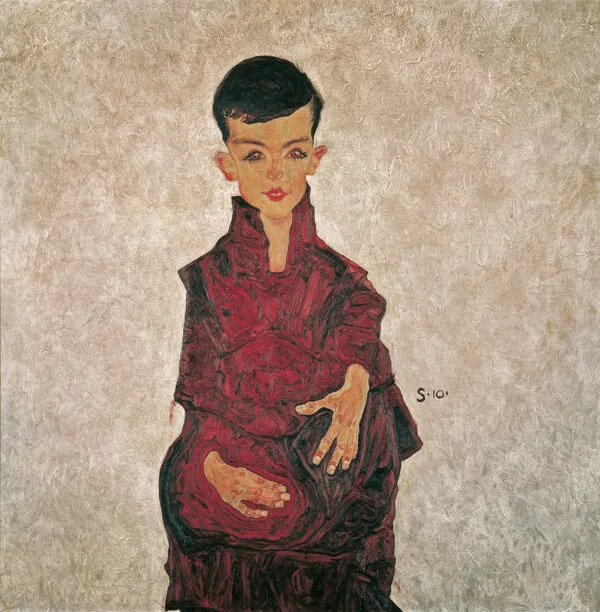
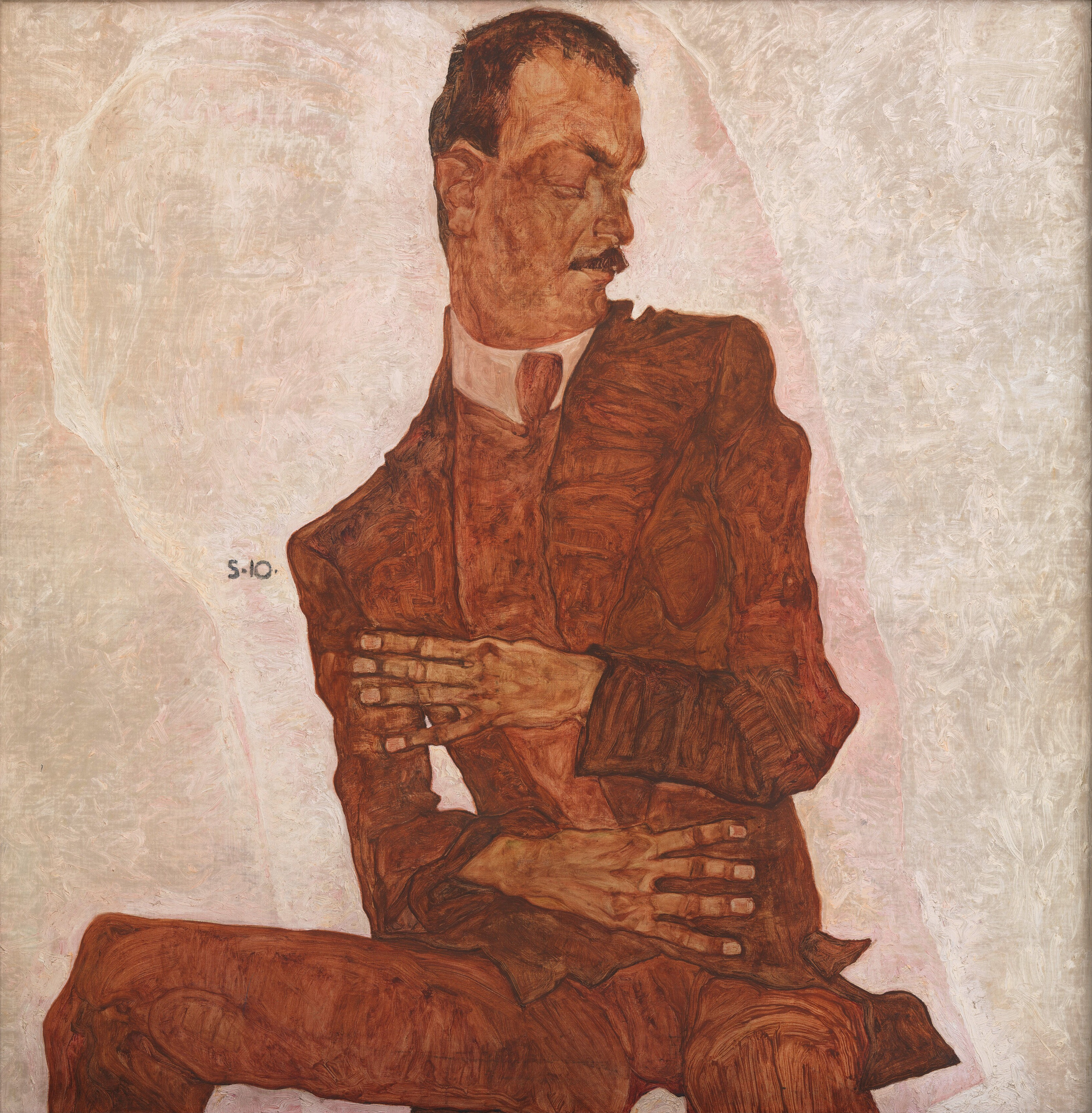
Portrait of Arthur Roessler is a 1910 work by Egon Schiele: the Viennese art critic and early supporter of the young artist, seated in a rust-brown suit with his head turned sharply aside, eyes lowered and hands pressed against his body, before a pale ground. The original is held by the Wien Museum in Vienna under inventory number 78951 and measures 99.5 x 100 cm. We paint it by hand in oils on canvas at the size you choose, and before dispatch we send you a photograph of the finished work for approval.
| Title: | Portrait of Arthur Roessler |
| Other titles: | Porträt Arthur Roessler |
| Painter: | Egon Schiele (1890–1918) |
| Year: | 1910, monogrammed and dated centre left “S.10” |
| Original size (width × height): | 99.5 cm x 100 cm |
| Original technique: | Oil on canvas |
| Style: | Expressionism |
| Location: | Wien Museum, Vienna (inv. 78951) |
| Our reproduction: | hand-painted oil on canvas, 13 sizes from 50 x 50 cm to 160 x 160 cm, or a made-to-measure size |
Portrait of Arthur Roessler – Egon Schiele
What does the painting show?
The Austrian painter shows Arthur Roessler (1877–1955), the Viennese art critic who championed him, seated and cut off at the thighs. The body faces us, but the head is turned hard to the right, the eyes lowered and almost shut; he has short dark hair and a small moustache. He wears a rust-brown suit with a waistcoat, a white collar and a reddish tie. One hand lies flat across his chest, the other across his waist, both with long fingers. Around the figure runs a pale, almost white band, and the rest of the ground is a light pinkish grey. At the left, in dark letters, stand the monogram and date “S.10”.
Why do people love it?
Because it is a portrait with no sweetness in it: the stiff pose, the averted face and the hands pressed to the body show a man who seems wholly turned in on himself. The colour does a lot with very little – one warm rust brown against a cool pale ground – so the work reads clearly from across a room. And the square format, almost exactly one metre each way, gives the figure a calm, monumental field.
Where does it sit among Schiele’s works?
Among his portraits of people from his Vienna circle. Roessler met Schiele in 1909 and became his mentor and patron, and Schiele portrayed him more than once; in 1912 he also painted Roessler’s wife Ida, whose portrait is likewise in the Wien Museum. Other portraits in our selection are Trude Engel, Portrait of Paris von Gütersloh and Portrait of Eduard Kosmack. The full selection is in the Egon Schiele gallery, with more on his life in our article about Egon Schiele.
How is our hand-painted version made?
A painter works every canvas in oils, stroke by stroke: a hand-painted painting made for your order, not a machine print. Two passages are the hardest here. The first is the hands: the long, bent fingers are drawn with a few dark lines, and anyone who smooths them takes the tension out of the whole pose. The second is the pale band around the figure, which has to stay lighter than the ground without turning into a flat outline. Like the original, our copy is oil on canvas. When it is finished we photograph it and send you the photograph for approval, and only then does it ship. This work has not yet been photographed in our workshop, so there are no workshop photographs of it on this page yet.
Which size for which wall?
The original is almost exactly square, 99.5 cm high and 100 cm wide, so all 13 of our sizes are square too, from 50 x 50 cm to 160 x 160 cm; closest to the original is 100 x 100 cm. Above a desk, a chest of drawers or in a hallway, 50 x 50 cm or 60 x 60 cm; above a sofa in the living room, 80 x 80 cm or 100 x 100 cm; on a large wall, in a stairwell or a tall room, 140 x 140 cm or 160 x 160 cm. A canvas painting of this size needs a few steps of distance, so that the figure and the pale ground read as one. Hang it with the centre at eye level, about 145–150 cm from the floor.
Custom size, stretcher bar and frame
If none of our sizes suits your wall, we paint the work to your own measurement. If you choose “YES” under the Stretcher option, the canvas comes stretched on a wooden stretcher bar, ready to hang. Our 3D application is for choosing a frame only, not for showing the work on your wall. The frame is chosen separately and need not be part of the order.
Delivery and guarantee
We paint to order and deliver to sixteen countries in the European Union, among them Slovenia, Croatia, Austria, Italy, Hungary, Germany and France; the United Kingdom and Ireland are not currently among them. The painting arrives protectively packed and, if you chose “YES” under Stretcher, stretched on the stretcher bar; before dispatch we send you a photograph of the finished work to approve. Production time depends on the size and on the studio’s workload. Every order is covered by our Returns and Refund Policy.
Frequently asked questions
Who was Arthur Roessler?
A Viennese art critic and writer (1877–1955). He met Schiele in 1909 at an exhibition of the Neukunstgruppe and became his mentor and patron. Writing for the Arbeiter-Zeitung, he was the first critic to recognise and defend Schiele in print.
When was the portrait painted?
In 1910. Schiele marked it at the centre left with his monogram and the date, “S.10”.
Where is the original?
In the Wien Museum in Vienna, under inventory number 78951. It is painted in oils on a canvas of 99.5 x 100 cm.
Did Schiele paint Roessler’s wife as well?
Yes. In 1912 he painted Ida Roessler, born Lange (1877–1961), in a small portrait on wood that is also held by the Wien Museum.
What is unusual about the pose?
The body faces the viewer while the head turns sharply to one side, with the eyes lowered. The hands are pressed flat against the chest and waist, and the figure sits before a pale ground with a lighter band around it.
Does it work as a gift?
Yes; if you are unsure which size to choose, there is a gift voucher.