


Description
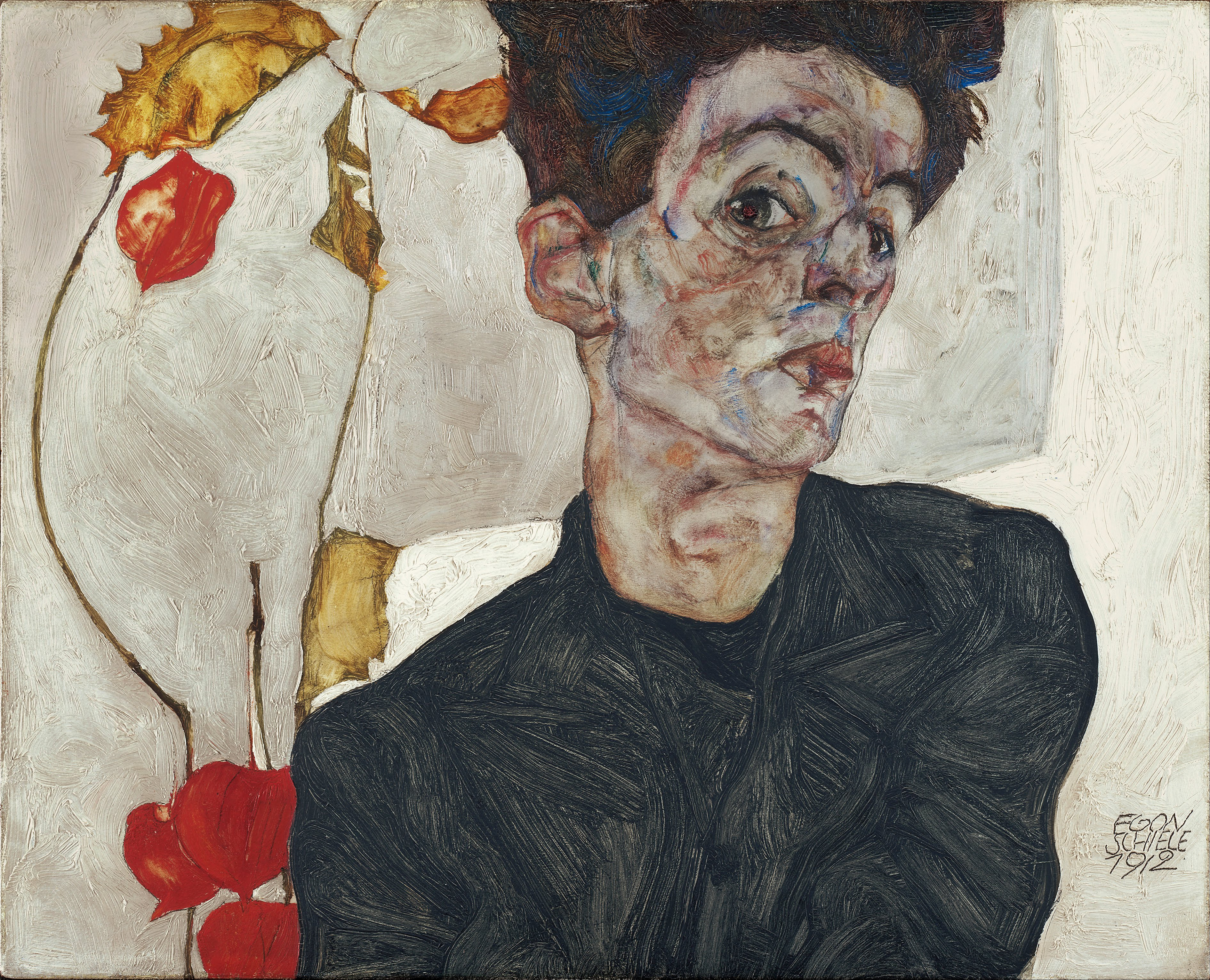
Self-Portrait with Physalis is a work of 1912 by Egon Schiele: the painter’s head and dark jacket cut by the upper and lower edges, and at the left a thin stem of physalis with red lantern fruits and dry yellow leaves. The original is in the Leopold Museum in Vienna under inventory number 454; it measures 39.8 x 32.2 cm — 39.8 cm wide and 32.2 cm tall, a small horizontal panel. We make it as a hand-painted oil painting on canvas, in fifteen sizes or to your own measurement, and we send you a photograph of the finished work for approval before it ships.
| Title: | Self-Portrait with Physalis |
| Other titles: | Self-Portrait with Chinese Lantern Plant · Selbstbildnis mit Lampionfrüchten · Avtoportret z lampijonkami |
| Painter: | Egon Schiele (1890–1918) |
| Year: | 1912; signed and dated lower right “EGON SCHIELE 1912” |
| Original size (width × height): | 39.8 cm x 32.2 cm |
| Original technique: | Oil and opaque colour on wood |
| Style: | Expressionism |
| Location: | Leopold Museum, Vienna (inv. 454) |
| Our reproduction: | hand-painted oil on canvas, 15 sizes from 43 x 35 cm to 205 x 164 cm, or a made-to-measure size |
Self-Portrait with Physalis – Egon Schiele
What does the work show?
The painter from the chest up, set right of centre against a pale, silvery-white ground. The upper edge cuts through his dark hair and the lower edge through his jacket, which is near-black with a green cast and laid on in broad strokes. The head sits on a long neck, turned to one side, and the face is built from small strokes of pink, ochre, blue and green, with red lips and dark brows. Behind the head a grey, box-like shape stands out against the lighter ground. At the left a thin stem rises and bends up to the top edge, carrying dry yellow-brown leaves and red lantern fruits — one near the top, a cluster at the bottom edge. Lower right, in three short lines, is the signature.
Where is the painter looking?
Straight at you. Per the museum record, the head is turned to the right while the gaze fixes directly on the viewer in a contrary movement, and the museum reads that as the artist presenting himself as fragile and self-confident at the same time. That is the reading of the house that holds the work, and we give it as theirs: the head turns one way, and only the look comes back.
Why does the composition sit so far off centre?
Because the work was made as one of a pair. Per the museum, Schiele conceived it as a counterpart to the Portrait of Wally Neuzil — a portrait of his partner at the time, painted in the same year — and that explains the strangely eccentric composition of both paintings. The record adds that nothing in the balanced composition is left to chance and that every line finds its continuation or a counterpart: head and body are cut by the horizontal edges, and the weight of those dark areas is answered by the bold red of the lantern plant.
Why is this self-portrait so well known?
The museum record counts it among Schiele’s best-known works and says it shows him at the height of his creativity. It gives the wider reason too: no artist in Vienna around 1900 explored his own face, body and personality as intensively, and that made Schiele’s name a byword for Viennese Modernism and its central theme, the crisis of the individual.
What is the original painted on?
On wood. Per the record the technique is oil and opaque colour on a wooden panel, signed and dated lower right. Our reproduction is painted in oils on canvas. We do not present those as the same thing: a small panel and a stretched canvas are different supports.
Is the format upright or horizontal?
Horizontal. Its companion piece, the portrait of Wally Neuzil, is the same width and almost the same height. Our steps follow the original in a landscape format, from 43 x 35 cm to 205 x 164 cm. For this subject the width leaves the whole left side to the plant, which is the counterweight the museum describes.
Can I have it at the size of the original?
At the size of the original, no: the panel is 39.8 x 32.2 cm, and our smallest step, 43 x 35 cm, is 3.2 cm wider and 2.8 cm taller. In proportion it depends on the step. The original’s ratio of sides is 1 : 1.236; 43 x 35 cm and 130 x 105 cm come within about two millimetres of it in height, and 80 x 65 cm within about three. The other steps are cut more squarely or more widely, by up to nearly three centimetres at 90 x 70 cm, so if the exact proportion matters, choose one of those three or a made-to-measure size.
Where does the work come from and where is it now?
The provenance note this page already carried follows directly below, kept word for word and unaltered. The museum’s chain names the same three owners and adds the fourth station: from 1994 the Leopold Museum Private Foundation. It gives a source for each station, and the reading is ours. For Heinrich Mayer the source is a letter from Peter Parzer to Patricia Spiegelfeld of 21 June 2002; for Josef and Richard Parzer, a dossier by Sonja Niederacher of 30 April 2011; for Rudolf Leopold, a purchase contract of 24 April 1956. So the last private step is documented as a sale. The first owner is dated only “before 1918”, and the record does not say when he acquired the work, nor how it passed to the Parzers in 1938. The work is today in the Leopold Museum under inventory number 454; the museum’s whole Schiele holding is on the Leopold Museum’s Egon Schiele page.
Provenance
The painting was owned by Heinrich Mayer in Vienna (before 1918 to 1938), then by Josef and Richard Parzer in Vienna (1938–1956) and by Rudolf Leopold (1956–1994); it is now at the Leopold Museum in Vienna.
Where does this work sit among Schiele’s works?
Among the self-portraits of 1912, and next to its companion piece. From the same year is the Self-Portrait with Lowered Head, also painted on a wooden panel; from the year before is Self-Seers II, a large square canvas from the same collection. The full selection is in the Egon Schiele gallery, with more on his life in our article about Egon Schiele. Schiele was a younger contemporary of Gustav Klimt and the Vienna Secession was the milieu he came out of; Viennese Expressionism is the movement he helped define, and Austrian art of the period is still read through those two names. As an expressionist painting it is the self-portrait the museum counts among his best known. Self-Seers II is oil on canvas; this panel is not.
How is our hand-painted version made?
Every canvas is painted by an artist in oils, stroke by stroke — not a machine impression but a hand-painted copy made for your order. Two places are the hardest here. The first is the face: it is made of small separate strokes of pink, ochre, blue and green, and they have to stay separate; blend them into one skin tone and the face loses the unsettled, flickering quality that makes it Schiele’s. The second is the red of the lantern fruits: it is the strongest colour in the work and the only answer to the dark mass of the jacket, so it must be exactly that red — too orange or too weak, and the balance the museum describes falls apart. When the work is finished we photograph it and send you the photograph for approval, and only then does it ship. For this family we hold no studio photographs — it has not been photographed in our workshop yet, and nothing has been removed; when it is next painted it will be photographed and the images added here. As a canvas reproduction it arrives stretched on a wooden bar, ready to hang.
Which size suits which wall?
Short answer: a horizontal work follows a long piece of furniture. For a narrow space or a desk wall 43 x 35 cm and 50 x 40 cm work; above a sofa or a sideboard 100 x 80 cm or 110 x 90 cm; for a large room 170 x 136 cm and 205 x 164 cm. Our smallest size is 43 x 35 cm. A canvas painting of so small a face changes character when enlarged: the lower steps keep the intimacy of the panel, the larger ones show its strokes from across the room.
How do I order a made-to-measure size, stretcher bar and frame?
If none of the fifteen sizes suits your wall, we paint the work to your own measurement. The canvas comes stretched on a wooden bar; our 3D application is for choosing a frame only, not for showing the work on your wall. The frame is chosen separately and need not be part of the order.
How is it delivered and what do we guarantee?
We paint to order and deliver to sixteen countries in the European Union, among them Germany, France, Italy, the Netherlands and Poland; the United Kingdom and Ireland are not currently among them. Before dispatch we send you a photograph of the finished work for approval, and if you are not satisfied we correct the work or paint it again. Production time varies with the size and the studio’s workload.
Frequently asked questions
What plant is in Schiele’s Self-Portrait with Physalis?
Physalis, also called the Chinese lantern plant: a thin stem at the left carries dry yellow-brown leaves and red, lantern-shaped fruits. Many writers read the plant as a sign of the fragility and transience of life, set against the pale, gaunt face; the museum itself stresses its role in the composition, where the bold red balances the dark hair and jacket. In Italian the work is known as Autoritratto con alchechengi, in German as Selbstbildnis mit Lampionfrüchten.
When did Schiele paint Self-Portrait with Physalis?
In 1912: the panel is signed and dated lower right “EGON SCHIELE 1912”. It is painted in oil and opaque colour on wood and is small, 39.8 cm wide and 32.2 cm tall.
Why is Self-Portrait with Physalis so famous?
The Leopold Museum counts it among Schiele’s best-known works and says it shows him at the height of his creativity. The painter’s head is turned to the right while his gaze fixes directly on the viewer, and the museum reads that contrary movement as the artist presenting himself as fragile and self-confident at once. No artist in Vienna around 1900 explored his own face and body as intensively as Schiele did.
How is Self-Portrait with Physalis connected to Portrait of Wally Neuzil?
Schiele conceived the two as counterparts in the same year: Wally Neuzil was his partner and model at the time. According to the museum, this is what explains the strangely eccentric, off-centre composition of both panels, which are the same width and almost the same height. Both hang in the Leopold Museum, the portrait of Wally under inventory number 453.
Where is Self-Portrait with Physalis today?
In the Leopold Museum in Vienna, under inventory number 454. It was owned by Heinrich Mayer in Vienna until 1938, then by Josef and Richard Parzer, and from 1956 by Rudolf Leopold. Since 1994 it has belonged to the Leopold Museum Private Foundation.
Does it work as a gift?
It does; if you are unsure which size to choose there is a gift voucher.
- Subject: a self-portrait cut by the upper and lower edges, with a stem of red lantern fruits at the left.
- Original: 1912, oil and opaque colour on wood, 39.8 x 32.2 cm, signed lower right, Leopold Museum, Vienna, inv. 454.
- Ours: hand-painted in oils on canvas, 15 sizes or a made-to-measure size.
- Worth knowing: per the museum, it was conceived as a counterpart to the Portrait of Wally Neuzil.