







































Description
Egon Schiele – Seated Woman, Back View, 1917
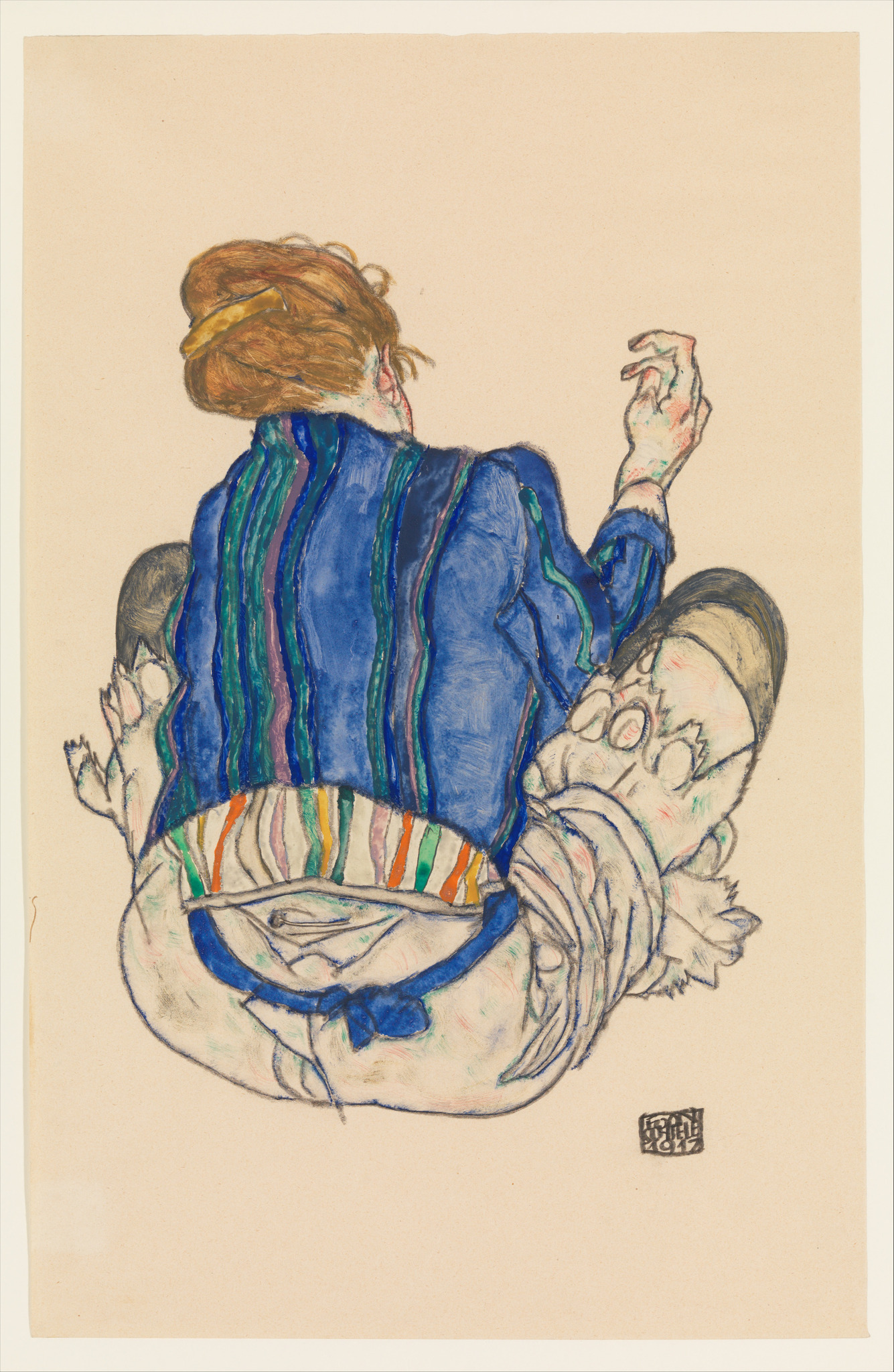
This hand-painted Egon Schiele painting, Seated Woman, Back View, is our copy in watercolour and gouache on paper of a watercolour from 1917. The original is held at the Metropolitan Museum of Art in New York.
What the sheet shows
The sheet shows a woman seated, seen from behind, her hair pinned up and tied with a yellow band. Her blue jacket is run through with vertical green, red and violet stripes, broken at the waist by a narrow banded sash. A cream skirt spreads around her and fills the lower half of the sheet; her right hand is raised, the fingers lightly spread.
The original’s medium and format
The original is watercolour and gouache on paper — the museum records it as “Watercolor, gouache, and graphite on paper” — measuring 29.8 × 46 cm (width × height) (inv. 1984.433.294).
Where it is
The work is today in the collection of the Metropolitan Museum of Art in New York, which received it through the Scofield Thayer bequest (inv. 1984.433.294).
Our hand-painted copy
Our copy is hand-painted in watercolour and gouache on paper, the same medium as the original, and painted in the size you choose. We send you a photograph of the finished work for approval before it ships.
Frequently asked questions
What does Schiele’s Seated Woman, Back View show?
A woman seated with her back to the viewer, her hair pinned up and tied with a yellow band. Her blue jacket is run through with green, red and violet stripes and broken at the waist by a narrow sash, while a cream skirt spreads out and fills the lower half of the sheet. Her right hand is raised, the fingers lightly spread.
Who is the woman in Schiele’s Seated Woman, Back View?
The Metropolitan Museum does not name her, and the title describes only the pose. The museum counts the sheet among Schiele’s many studies of young women, often set alone on the page with no surroundings. In such sheets the figure serves above all as a study in line, composition and gesture.
When did Schiele make Seated Woman, Back View?
In 1917, the year before his death. Called up for military service in 1915, by 1917 he had routine duties at the military supply depot in Vienna, which let him take up his work again. His late drawings show a calmer, more realistic line than those of his early years.
What technique did Schiele use for Seated Woman, Back View?
Watercolour, gouache and graphite on paper, as the Metropolitan Museum records it. Graphite is the pencil drawing, watercolour the transparent colour and gouache the opaque, covering paint. The upright sheet is kept among the museum’s drawings.
How did Seated Woman, Back View come to New York?
Through the American collector Scofield Thayer, who lived in Vienna from 1921 to 1923. According to the Metropolitan Museum, he probably bought many or all of his thirty Schiele drawings there, when Schiele was virtually unknown in the United States. The sheet came to the museum with his bequest in 1982 and carries inventory number 1984.433.294.