







































Description
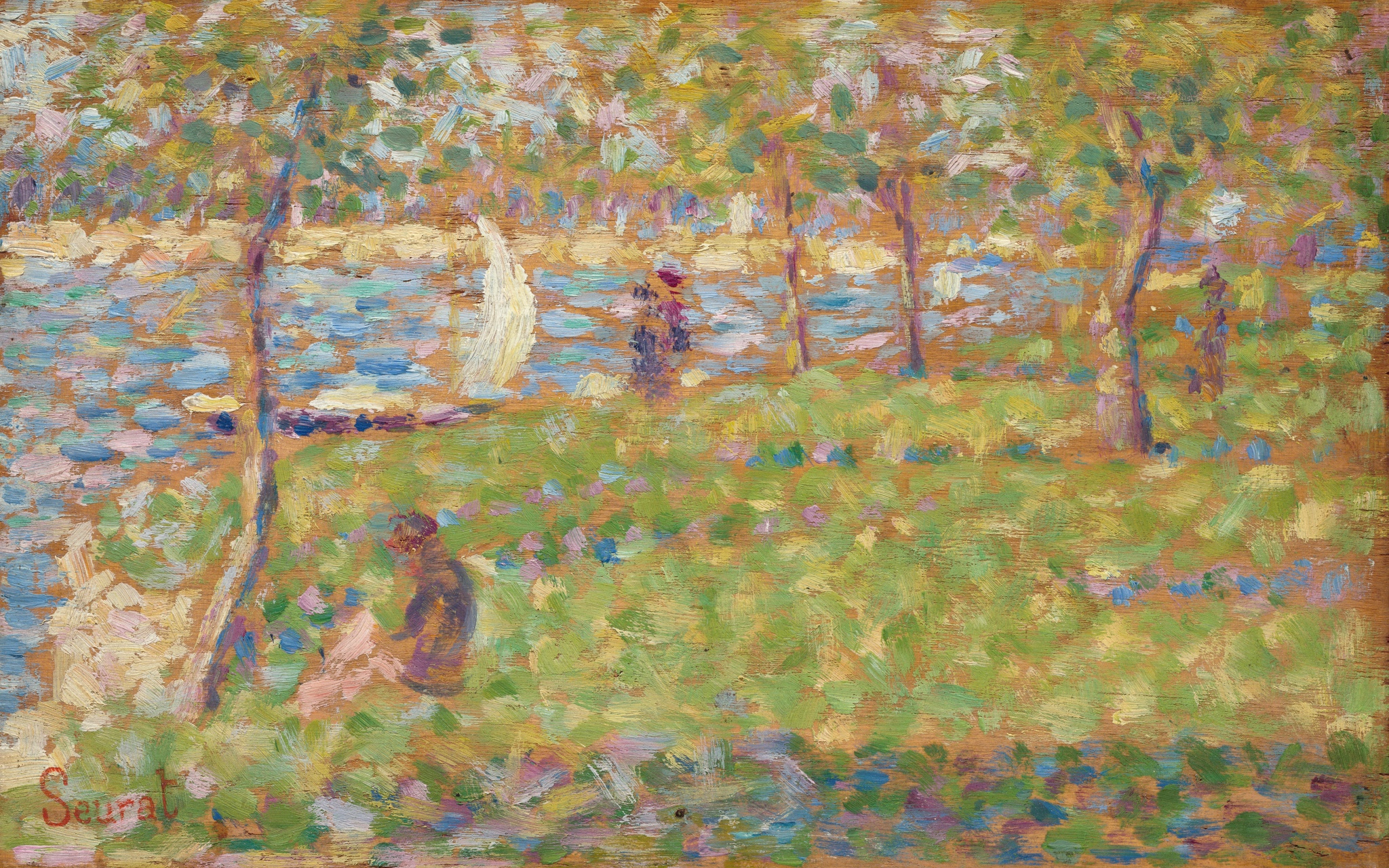
Study for La Grande Jatte (Washington) is an oil study that Seurat painted on a small wooden panel in 1884–1885: on a sunny lawn of the island of La Grande Jatte on the Seine a figure sits partly in shade in the foreground, townspeople stroll between the tree trunks, and a white sail gleams on the river. The original, 25 x 15.9 cm, is held by the National Gallery of Art in Washington under number 1970.17.81. We make it as a canvas painting, hand-painted in oils, in eight sizes or to your own measurements, and before dispatch you receive a photograph of the finished work for approval.
| Title: | Study for La Grande Jatte (Washington) |
| Other titles: | Study for »La Grande Jatte« |
| Painter: | Georges Seurat (1859–1891) |
| Year painted: | 1884–1885; stamp lower left: Seurat |
| Original size: | 25 cm x 15.9 cm |
| Original technique: | Oil on wood |
| Painting style: | Oil study – small strokes before the finished painting |
| Located at: | National Gallery of Art, Washington (inv. no. 1970.17.81) |
| Our reproduction: | hand-painted in oils on canvas, 8 sizes from 25 x 16 cm to 150 x 100 cm, custom sizes on request |
Study for La Grande Jatte (Washington) – Georges Seurat
Who is in the painting?
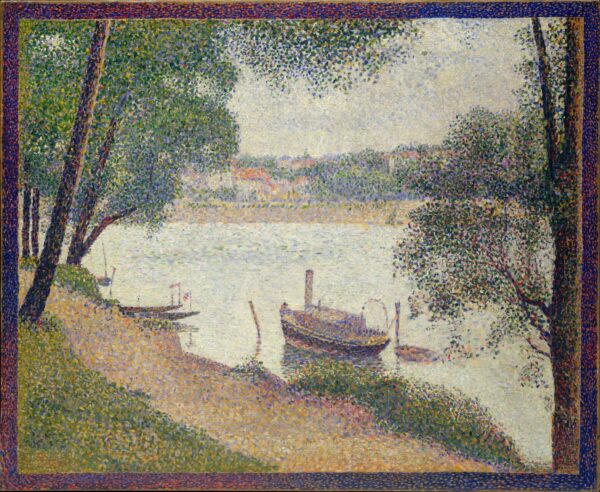
Visitors to the island of La Grande Jatte, none of whom the museum record names. In the centre of the foreground a figure in dark clothes sits on the grass, facing the river and partly in the shade of the trees. Further back, on a brighter stretch of lawn, a woman in a pink dress is standing, and further to the right small figures stroll between the trunks. At the upper left the Seine opens out, a boat with a tall white sail moves across it, and a row of trees is sketched in on the far bank. These are not sitters for portraits but Sunday guests of the island, the kind of people the painter saw there and collected for his large painting.
What is on the panel?
A horizontal wooden panel only 25 cm wide. The lawn is built up from small, dense strokes of yellow, green and blue that brighten in the sun and cool into bluish tones in the shade. The water at the upper left is laid down in horizontal patches of blue and pink, and the sail is a single bright white shape. Thin tree trunks divide the scene into vertical bands, and we look at the river through the gaps between them. The strokes are short and in places almost turn into dots, but they are not yet even, as they later became on the large canvas. At the lower left there is a stamp reading Seurat, just as the museum record lists it.
Why does this study matter?
Because it catches the moment when Seurat was still searching for the shape of his best-known work. For the big canvas of the island, the French painter prepared a whole series of panels like this one, and on each he tested something: where the figures should stand, how the shadow falls and how much room the river gets. On this study you can already see the strokes growing shorter and denser: the pointillism he is known for today is only just being born here. Neo-impressionism grew out of that search a few years later. It is a small, lively scene that says a great deal about how a work of art comes into being.
What does the scene mean?
A Sunday by the river, seen calmly and without flattery. In the 1880s Parisians spent their free time on the island of La Grande Jatte, and Seurat painted it again and again. There is no story here: a figure sits, a woman stands, a sail slides across the water. It is exactly this quiet that gives the scene its particular charm. On a wall at home it feels fresh and summery, and the green lawn and blue water bring light into the room.
What happened to the original?
The museum publishes the panel’s history. It was first with the dealers Bernheim-Jeune in Paris, then with Alex Reid & Lefèvre in Glasgow and London. Percy Moore Turner had it in London at least from 1933 to 1937 and lent it to exhibitions during those years. The Wildenstein gallery followed, and from Wildenstein, according to the accounts the museum summarises, Captain Edward H. Molyneux acquired it in 1943. On 15 August 1955 he sold it to Ailsa Mellon Bruce of New York, who bequeathed it to the National Gallery of Art in 1970. Every detail here is taken from the museum’s record.
What place does this study have among Seurat’s works?
It is one of the preparatory studies for the large painting Sunday Afternoon on the Island of La Grande Jatte, held by the Art Institute of Chicago. We also offer other studies for the same canvas, each from a different museum: Oil Sketch for La Grande Jatte (Chicago), Study for La Grande Jatte (London) and Study for A Sunday on La Grande Jatte, which is in New York. Together they show how the painting grew from one panel to the next.
How is our hand-painted version made?
With a brush and oil paint, never with a printer. Our painter works from a high-resolution image of the original and keeps what makes this study special: short, dense strokes that are only beginning to turn into dots. A fully developed pointillist technique would be wrong here, because it would turn a lively study into a different, more orderly work. Because everything is done by hand, no two canvases are ever quite the same, and every hand-painted copy remains one of a kind. We do not yet have our own photographs of a finished canvas of this subject; the first time we paint it, we will photograph it and publish the photographs here.
Which size for which wall?
If you are not sure which to choose, take 60 x 40 cm. Our smallest size, 25 x 16 cm, is exactly as wide as the original, which measures 25 x 15.9 cm, and 1 mm taller, so it is the size in our range closest to the original. The format is horizontal, with proportions close to 8 : 5, so it sits well above a narrow chest of drawers, above a bed or in a group of smaller works. 50 x 30 and 60 x 40 cm are the most everyday choices for a hallway or bedroom; 70 x 45 and 80 x 50 cm hold their own above a desk; 90 x 60 cm is the size for a living room, while 120 x 75 and 150 x 100 cm turn the small study into a large summer scene for a big wall. Every oil painting reproduction of this subject is made to order.
Custom size, stretcher bar and frame
If none of the eight sizes suits your wall, we paint to your measurements and keep the proportions of the original, so the lawn, the trunks and the river stay in balance; that is our custom size painting service. You can order the painting in three forms: as a rolled canvas without a stretcher, stretched on a wooden stretcher bar and ready to hang, or framed; you choose the form when you order. You choose a frame in our 3D frame viewer, which shows gold, silver, black, white and wooden profiles on this subject; it is meant only for choosing the frame. For a view of the painting on your own wall there is our room-visualisation service, which is ordered separately.
Delivery and guarantee
Each copy is painted to order in our studio in Slovenia, so allow 15 to 45 days depending on the size. We send it in the form you chose when ordering — rolled, stretched or framed — protected for transport, within Slovenia and across the EU with no customs duty. Before dispatch you receive a photograph of the finished work for approval, and our returns policy applies to every order. You will find all of Seurat’s subjects in the Georges Seurat gallery, and our article about Georges Seurat also explains what makes a good fine art reproduction.
Frequently asked questions
Where is the original?
In the National Gallery of Art in Washington, under number 1970.17.81, in the Ailsa Mellon Bruce Collection.
Who are the people in the study?
Unnamed visitors to the island of La Grande Jatte; the museum record identifies none of them.
Is this the same work as Sunday Afternoon on the Island of La Grande Jatte?
No. This is a small preparatory study on wood, 25 x 15.9 cm; the finished painting is a large canvas in Chicago. We offer both, as separate products.
Is this a print?
No. The work is painted by hand in oil on canvas; you can see and feel the brushstrokes.
Which size should I choose?
For a hallway or bedroom, 60 x 40 cm; for the size closest to the original, 25 x 16 cm. The detailed guide is above.
Can I have a size that is not on the list?
Yes. We paint to measure and keep the side ratio of the original.
What is the mark at the lower left?
The museum record lists it as a stamp reading Seurat.
What does the study say in one sentence?
That one of the best-known paintings of the 19th century was born from small, quick observations of summer light by a river.
Is the original for sale?
No. The panel belongs to the public collection of the museum in Washington and is not for sale. What we offer is a version painted by hand from it, for your own wall.
How high should I hang it?
With its centre at eye level, about 145–150 cm from the floor. Hang the smaller sizes lower, closer to where you sit.
Is it suitable as a gift?
Yes, a summer scene by the river pleases almost everyone. If you would rather leave the choice to the person receiving it, there is our gift voucher.
- Subject: visitors on a sunny lawn of the island of La Grande Jatte, with a white sail on the river – 1884–1885
- Original: 25 x 15.9 cm, oil paint on wood, National Gallery of Art, Washington (inv. no. 1970.17.81)
- Ours: Seurat’s small study for a famous painting, recreated by hand in oils on canvas, eight sizes from 25 x 16 to 150 x 100 cm, as a rolled canvas, stretched or framed — your choice
- Worth knowing: here the strokes are only beginning to turn into the dots that made Seurat famous