







































Description
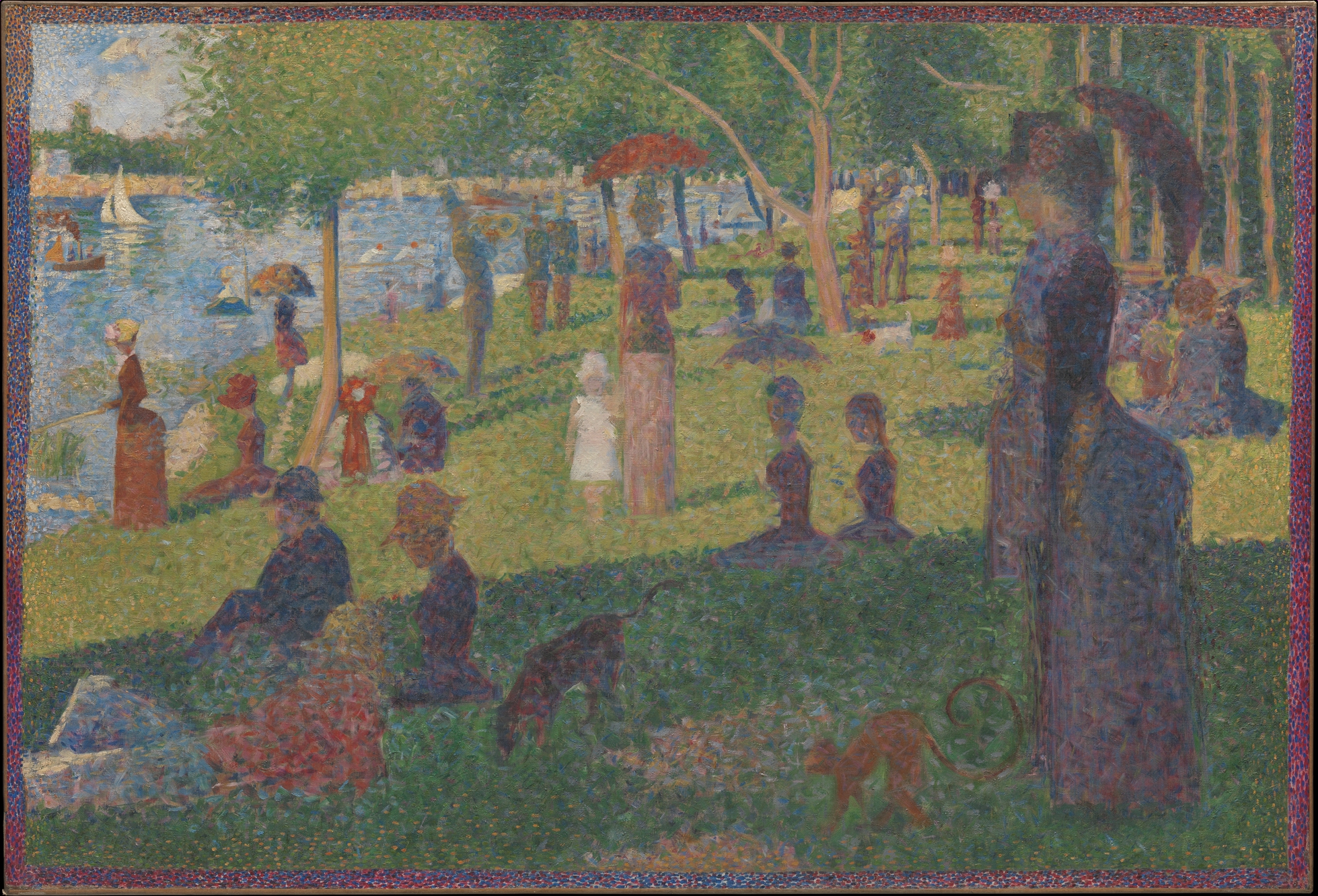
Study for A Sunday on La Grande Jatte is the last large colour study for Seurat’s best-known canvas, painted in 1884. The original measures 104.1 x 70.5 centimetres and is held in New York by the Metropolitan Museum of Art under inventory number 51.112.6. From us it is painted entirely by hand, oil on canvas, in six sizes or to your own measurements, up to 200 x 140 cm, and before dispatch you receive a photograph of the finished work for approval.
| Title: | Study for A Sunday on La Grande Jatte |
| Other titles: | Study for “A Sunday on La Grande Jatte” · Étude pour « Un dimanche à la Grande Jatte » |
| Painter: | Georges Seurat (1859–1891) |
| Year painted: | 1884 |
| Original size: | 104.1 cm x 70.5 cm |
| Original technique: | Oil on canvas |
| Painting style: | Divisionism, before the dots of the final canvas |
| Located at: | The Metropolitan Museum of Art, New York (inv. no. 51.112.6, Gallery 099) |
| Our reproduction: | hand-painted oil on canvas, 6 sizes from 100 x 70 cm to 200 x 140 cm, custom size up to 200 x 140 cm on request |
Study for A Sunday on La Grande Jatte – Georges Seurat
What is on the canvas?
The same scene as the celebrated canvas, but not yet brought into focus. The same bank, the same line of trees, the same river with sails – only the figures are still summaries. The band of shadow in the foreground and the lit stretch of grass behind it are already placed, the distribution of light is already decided, the faces and the clothes are not. The museum describes the work as Seurat’s final study for his monumental painting of Parisians at leisure on an island in the Seine, held today by the Art Institute of Chicago.
Where was the island of La Grande Jatte, and who went there?
In the middle of the Seine, just to the north-west of central Paris. The museum notes that by the 1880s the island had become a popular place for fashionable urbanites to spend their Sunday afternoons. The scene is therefore not an invented ideal but the record of a habit: people in their best clothes, by the water, in a leisure that was only then coming into being. It is exactly that ordinariness that interested the painter – and that later, on the large canvas, became almost ritual.
How does the stroke differ from the finished canvas?
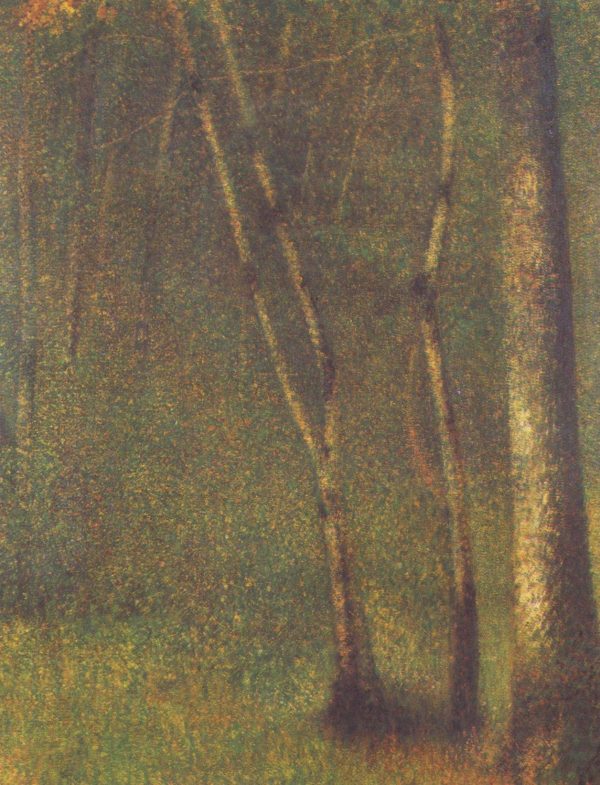
This is the difference that makes the study a work in its own right. The museum says it outright: in this preparatory sketch Seurat had not yet reduced his stroke to a uniform point. He applied his paint more freely, in a series of mostly diagonal, crisscross, hatching strokes that one scholar likened to “chopped straw”. Contrasting pigments are woven together with small, patchy brushstrokes – whereas in the mural-sized park scene, which appeared two years later at the Impressionist exhibition of 1886, he used tighter, dot-like dabs.
So this study is not a poorer version of the finished canvas but a different thing. The museum adds one detail worth knowing: the method we know Seurat for was named after the French word for a dot, while he himself preferred the term Divisionism – the principle of separating colour into small touches placed side by side, meant to blend only in the eye of the viewer. In this sketch there is no single expanse of unbroken colour; there are only clearly distinct hues. A canvas painting put together that way only assembles itself at a distance.
How did it reach the Metropolitan?
By bequest. The museum gives the mode of acquisition as the bequest of Sam A. Lewisohn in 1951, which is where the inventory number 51.112.6 comes from. The work hangs in Gallery 099 among the European paintings and is in the public domain, so the museum publishes its image without restriction. The route before 1951 the museum does not publish on either surface we are able to read, and so we do not describe it: we state what the museum states.
Where does this study sit in Seurat’s work?
Immediately before the summit. The finished canvas is held by the Art Institute of Chicago, and here you will find it as Sunday Afternoon on the Island of La Grande Jatte – a separate product in our Seurat gallery, not this study. Before them stands Bathers at Asnières, the first large canvas, and after them the coastal works such as Evening, Honfleur and the night scene Invitation to the Sideshow. Pointillism is still forming on this study, and neo-impressionism as a movement took its name around exactly this moment.
How is our hand-painted version made?
By hand and with a brush, never with a printer. Our painter works in oil paint on linen and on this subject imitates precisely what separates the study from the finished canvas: broad, crossing strokes rather than uniform dots. Reduce the stroke to a dot and you would have a small copy of the Chicago canvas, not this work. Every hand-painted copy is therefore one of a kind and no two are quite alike; this is not an oil painting reproduction printed onto canvas but a painting made from scratch. Before dispatch we photograph the piece and send you the photograph for approval.
We hold no studio photographs of the finished work for this subject at present. When it is next painted we will photograph it and the shots will appear on this page.
Which size for which wall?
If you do not know which: 140 x 95 cm. Two things are worth knowing on this subject. Our smallest size, 100 x 70 cm, is the closest of them all to the original study, which measures 104.1 x 70.5 cm – if you want the work at the size it was made, that is the right choice. The top rung is 200 x 140 cm; the finished canvas in Chicago is larger still, roughly 308 x 208 cm. In between: 120 x 80 and 140 x 95 cm for a living room, 160 x 110 and 180 x 120 cm want a wall of their own, and 200 x 140 cm is for large rooms. Every fine art reproduction of this subject is made to order.
Custom size, stretcher bar and frame
If none of the six sizes fits your wall, we paint the work to your measurements, up to 200 x 140 cm, and keep the ratio of the original so the scene is never stretched; that is our custom size painting service. You can order the painting in three forms: as a rolled canvas without a stretcher, stretched on a wooden stretcher bar and ready to hang, or framed; you choose the form when you order. You choose the frame in our 3D frame viewer: on this subject it shows every frame profile we carry, so you can compare gold, silver, black, white and natural wood — it is for choosing a frame and nothing else. To see how the work will look on your own wall, use our separate room-visualisation service.
Delivery and guarantee
Every copy is made to order in our studio in Slovenia, so allow 15 to 45 days depending on the size you choose; at the largest sizes the time is nearer the upper end. We ship it in the form you chose when ordering — rolled, stretched or framed — protected for transport, across the EU, customs-free. Before dispatch you receive a photograph of the finished work for approval, and our returns policy applies to every order. The full range by this painter is in the Georges Seurat gallery, and the road from the study to the finished canvas is described in our article about Georges Seurat, which also explains what separates a good famous painting copy from a poor one.
Frequently asked questions
Where is the original of this study?
In New York, at the Metropolitan Museum of Art, under inventory number 51.112.6. The museum shows it in Gallery 099 and records it under the title Study for “A Sunday on La Grande Jatte”.
Is this the same painting as the one in Chicago?
No. This is the last large study for it. The finished canvas is held by the Art Institute of Chicago and is a separate product with us; this page sells the study from the Metropolitan Museum of Art.
What year is it from?
The museum dates it to 1884 — a single year, with no “circa” and no span, and that is how we give it.
How large is it really?
The museum gives a height of 70.5 and a width of 104.1 centimetres, so 104.1 x 70.5 cm in our width-by-height notation.
Why does the style row not say the dotted movement?
Because the museum states expressly that in this sketch Seurat had not yet reduced his stroke to a uniform point; the dots are on the finished canvas. He himself preferred the term Divisionism, and that is how we have written it.
What does “chopped straw” mean?
That is how one scholar, in the museum’s own citation, described the strokes of this study: mostly diagonal, crisscross hatching rather than round dots.
Which size should I choose?
For a living room, 140 x 95 cm; if you want the size closest to the original study, choose 100 x 70 cm. The largest size is 200 x 140 cm; the finished canvas in Chicago is larger still, roughly 308 x 208 cm.
Can I have a size that is not listed?
Yes. We paint to measure, up to 200 x 140 cm, keeping the side ratio of the original.
Is this a print?
No. The work is painted by hand in oil on linen; the strokes are visible and can be felt, which a print cannot imitate.
How is it delivered?
In the form you chose (rolled, stretched on a stretcher or framed), 15 to 45 days after you approve the photograph of the finished work.
Is it suitable as a gift?
Very, especially for someone who knows the celebrated canvas — the study shows how it came about. If you would rather leave the choice to the person receiving it, there is a gift voucher.
- Subject: the same Sunday scene as the famous canvas, but with the figures still unresolved and the stroke broad
- Original: 104.1 x 70.5 cm, oil paint on canvas, Metropolitan Museum of Art, New York (51.112.6), Gallery 099
- Ours: hand-painted in oil on linen, six sizes from 100 x 70 to 200 x 140 cm, as a rolled canvas, stretched or framed — your choice
- Worth knowing: this French painter preferred the term Divisionism – in this study he had not yet reduced the stroke to a dot