

















Description
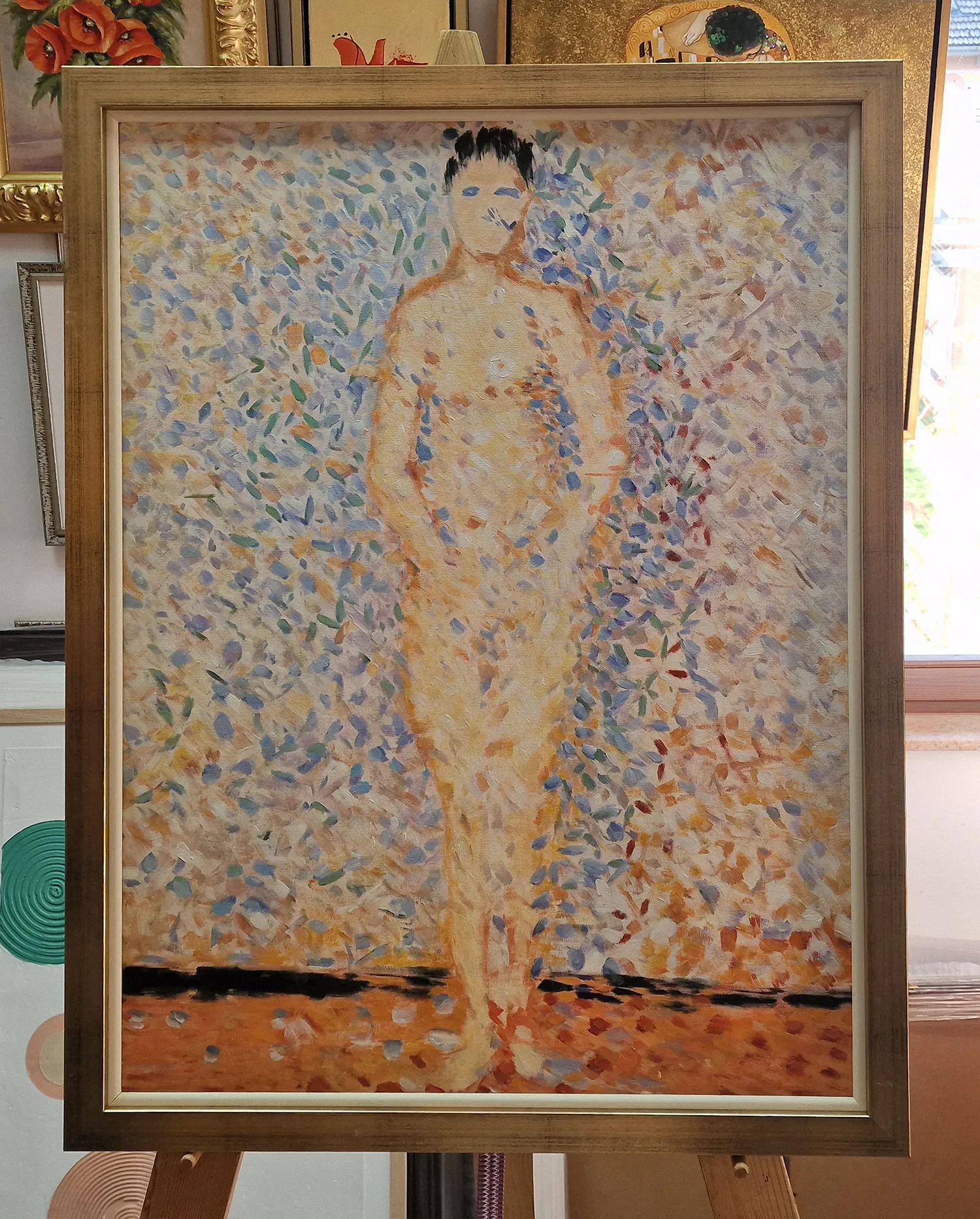
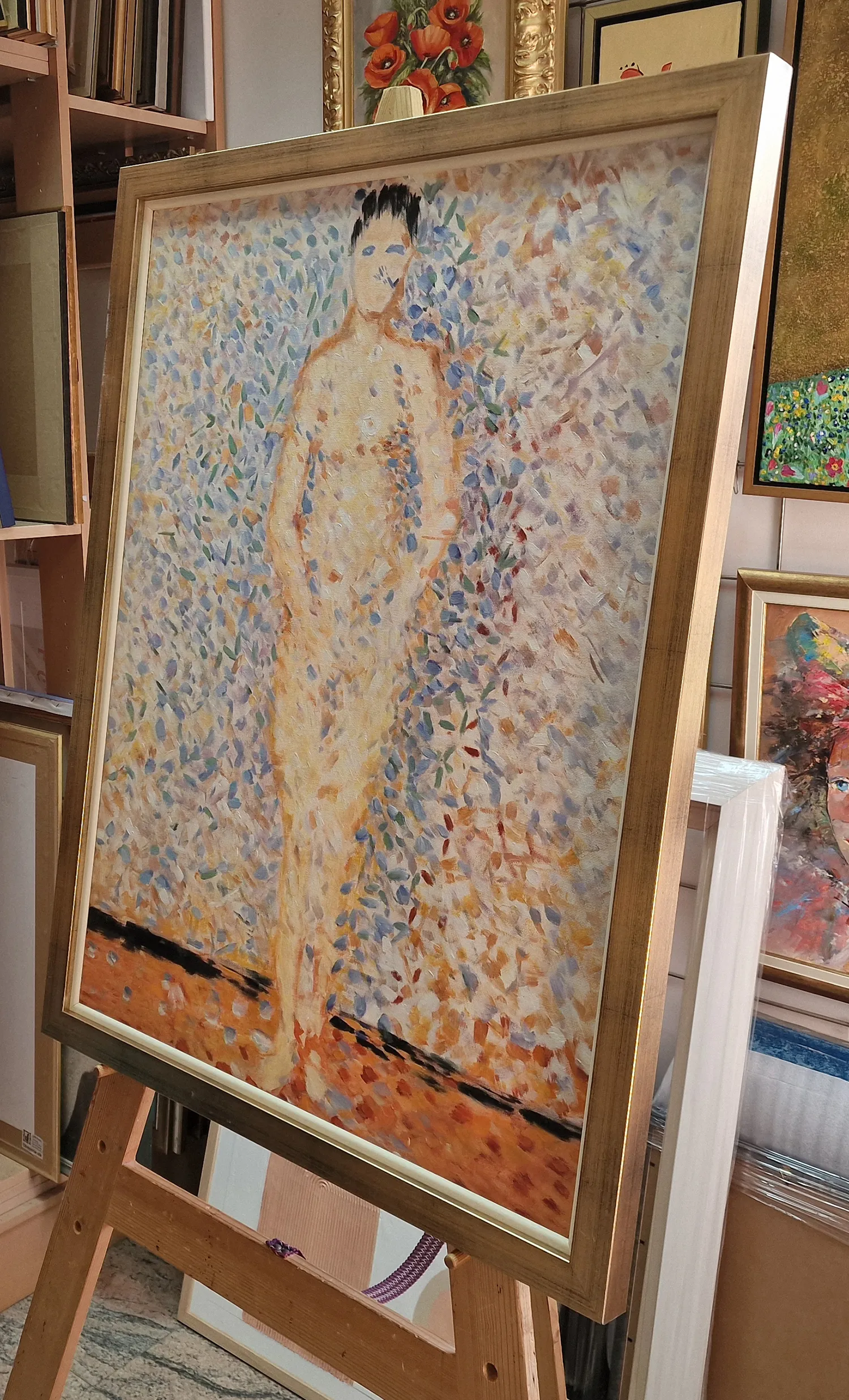
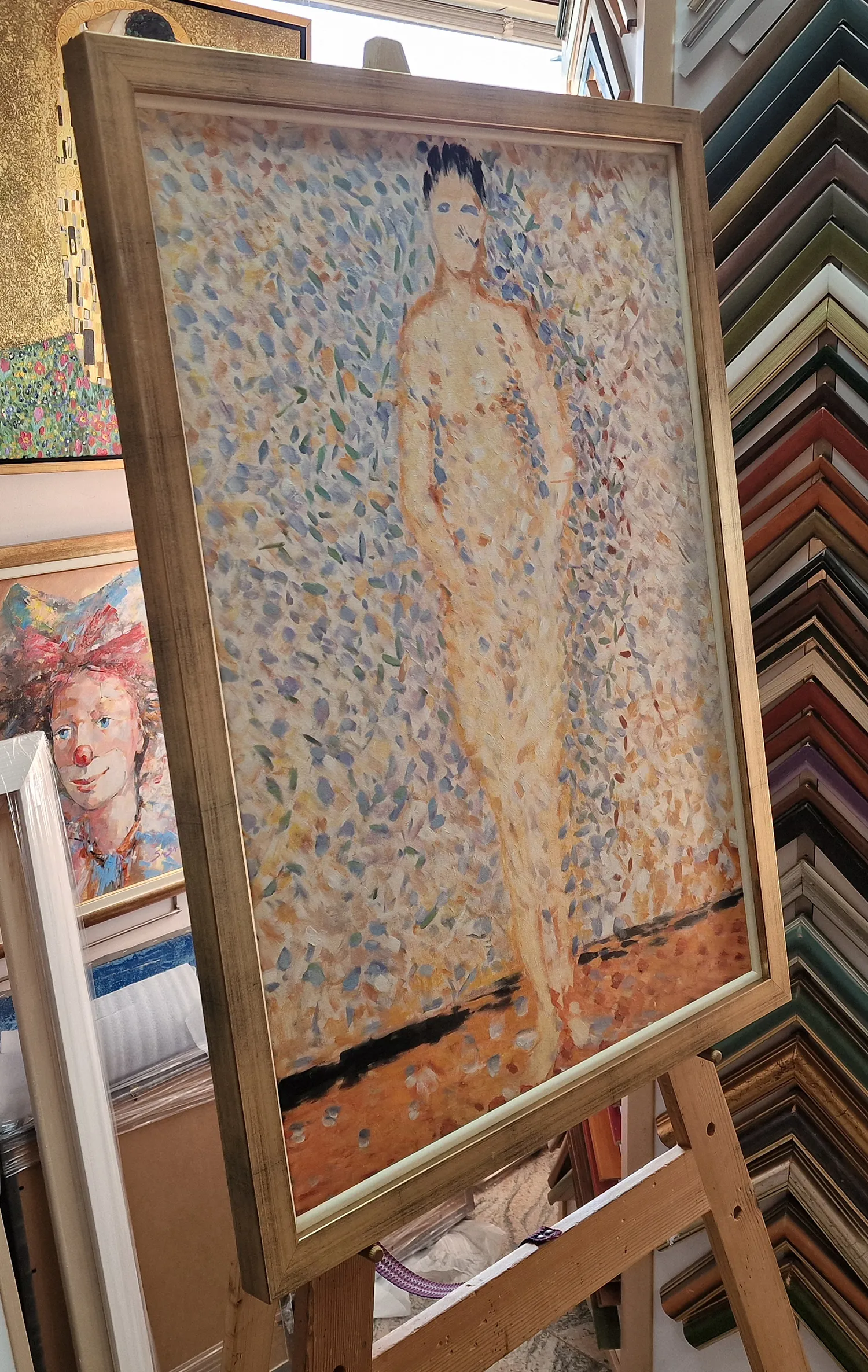
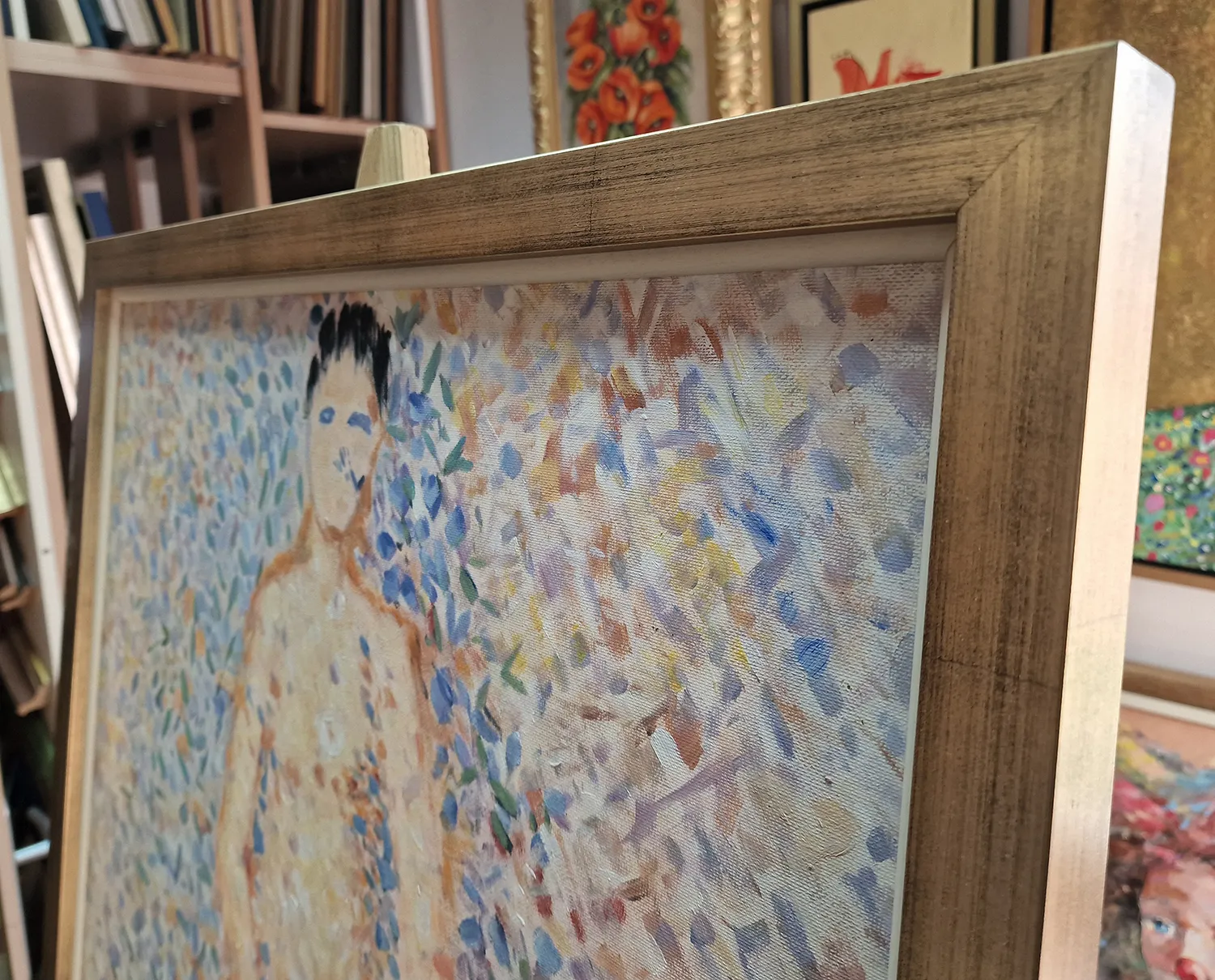
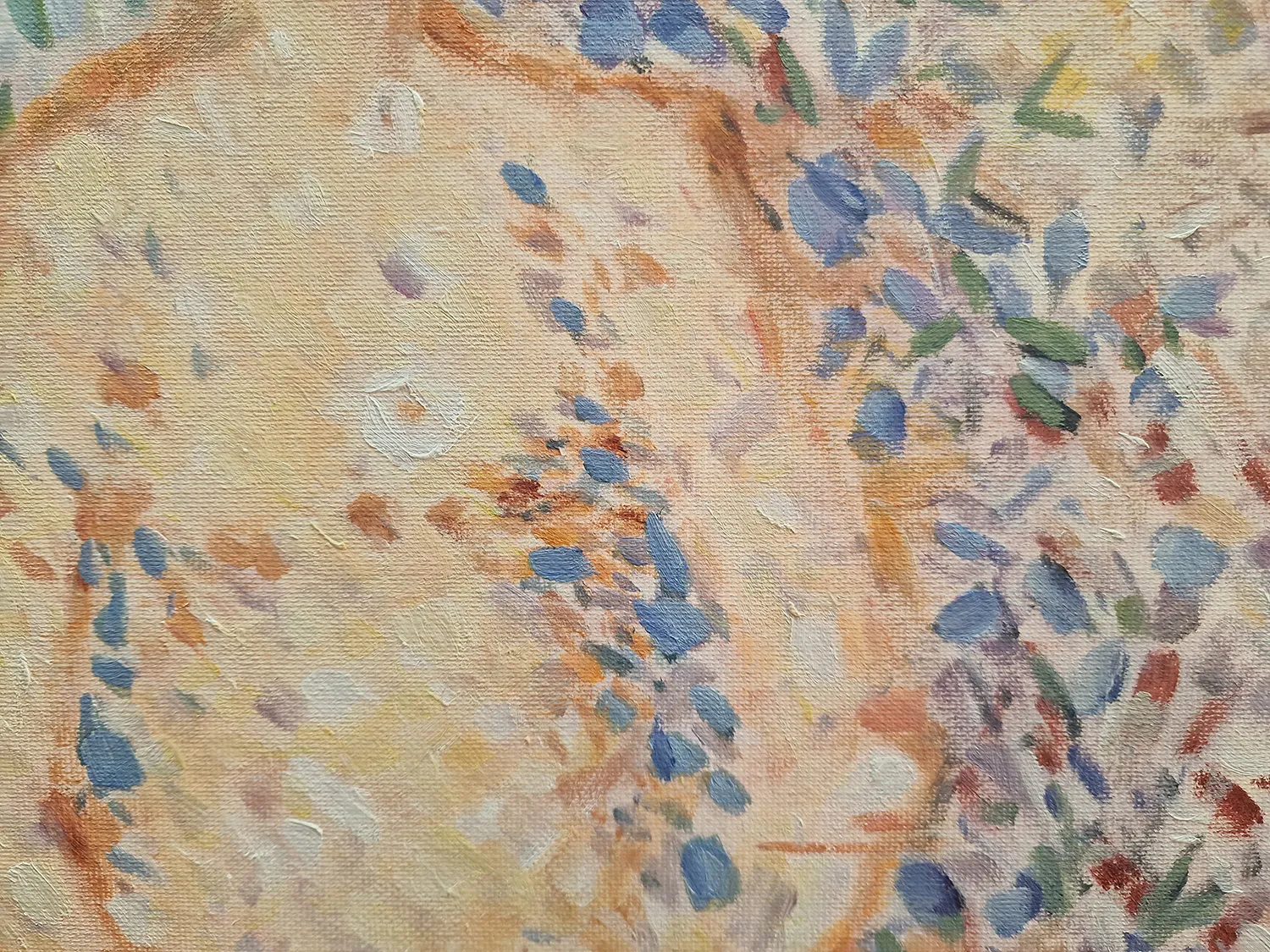
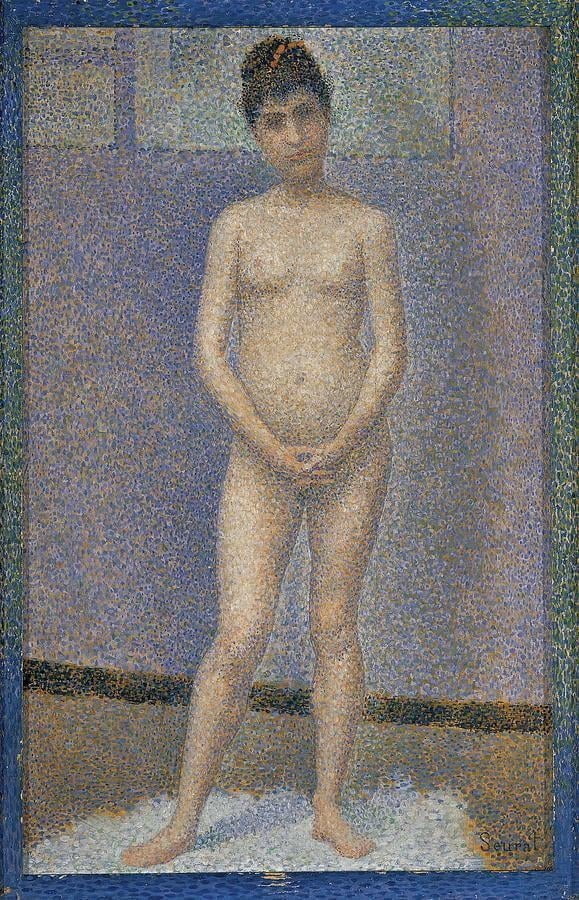
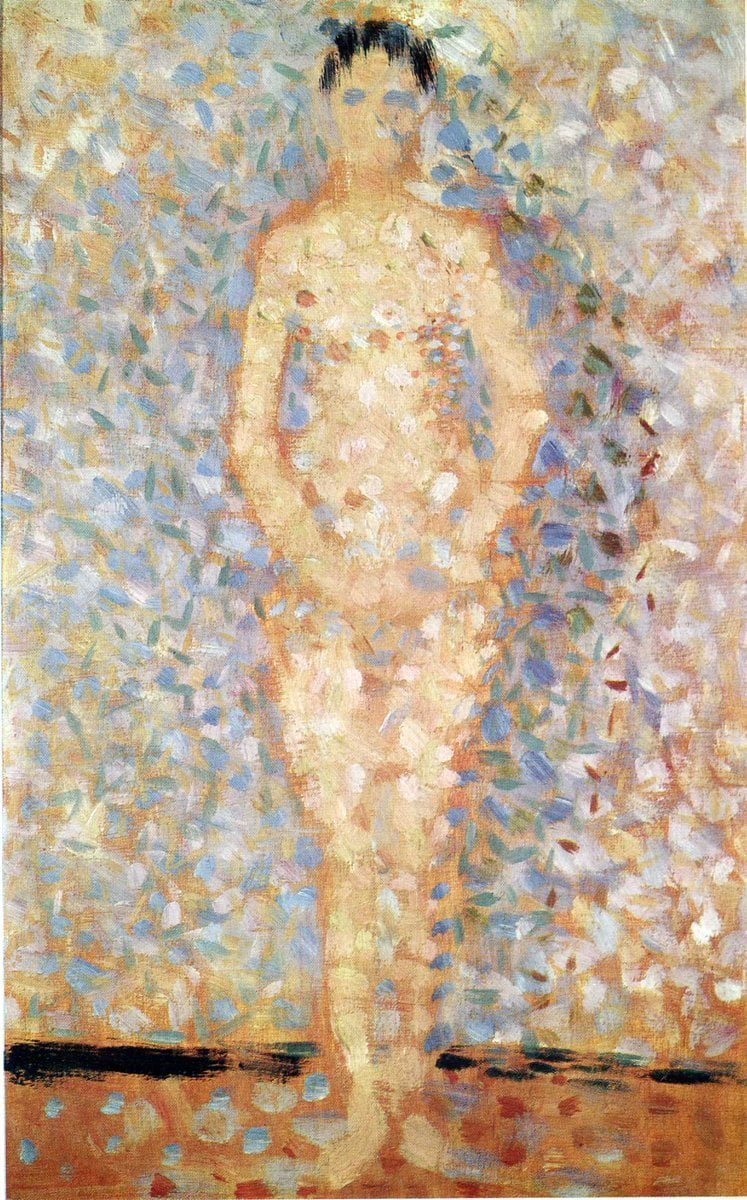
Model Facing Front (Study for Models) is an oil study Seurat made in 1886: a single nude female figure standing turned towards us, against a ground of tiny coloured dots. The original is held by the Musée d’Orsay in Paris under accession number RF 2000 23. We make it as a hand-painted canvas painting, oil on canvas, in eight sizes or to your own measurements. The photographs on this page are our own: they show that very canvas, finished and framed in our studio, before it went to the customer who ordered it.
| Title: | Model Facing Front (Study for Models) |
| Other titles: | Poseuse debout, de face · Modell von vorn |
| Painter: | Georges Seurat (1859–1891) |
| Year painted: | 1886; the museum record notes no signature |
| Original size: | 15.7 cm x 25 cm |
| Original technique: | Oil on wood |
| Painting style: | Pointillism |
| Located at: | Musée d’Orsay, Paris (acc. no. RF 2000 23) |
| Our reproduction: | hand-painted in oil on linen, 8 sizes from 16 x 26 cm to 90 x 150 cm, custom sizes on request |
Model Facing Front (Study for Models) – Georges Seurat
Who is the model?
Someone the museum record does not name. In 1886 and 1887 Seurat painted several small studies of a single standing female figure in preparation for the large canvas Les Poseuses, and this is the first of them: a young woman stands unclothed, turned straight towards us, arms at her sides, her weight even on both legs. Nobody knows who posed; in Seurat’s studio this was a professional job, not a portrait. That is exactly why the figure shows no personality, only a stance — still, frontal, almost a statue in a niche. This French painter treated the pose as a colour problem rather than as a person, which is why the study is an exercise in light more than a nude.
What is on the panel?
An upright wooden panel barely the size of a hand. The figure fills almost the whole height: the body is built from warm ochre, pink and cream dots, the dark hair reduced to a few strokes, the face only suggested. The ground is made of cool blue, grey and violet dots that surround the body like air and push it forward. The lower third is an orange-ochre floor plane, separated from the ground by a dark horizontal line — the only genuinely dark element. There is no room, no furniture, no shadow to explain anything. What holds the scene together is the contrast between a warm body and a cool surround, and that contrast was Seurat’s work.
Why does this study matter?
Because it shows Neo-Impressionism at work rather than on display. The large Poseuses grew out of three such figures, and each was tried out on its own first, on a panel the painter could carry with him. At this size pointillism reads better than it does on a large canvas: the dots are huge in relation to the figure, so you can see how the colour only assembles in the eye. The study also documents how much labour a single body cost in the finished composition. The museum acquired it only in 2000, as a gift from Philippe Meyer with a reserved life interest, which makes it one of the Orsay’s more recent Seurats.
What does the study mean?
Less than it appears to, and that is its strength. In the nineteenth century a nude woman against an empty ground usually signals a mythological or allegorical scene; neither is meant here. She stands simply because the painter asked her to. Seurat took the narrative out of the nude and left only what interested him: how warm skin behaves when cool air made of blue and violet dots surrounds it. That is why the work looks modern — closer to a study of light than to a scene. Hang it at home and you get a quiet, upright figure that tells the room nothing, and for that reason carries daily looking well.
Where does this study sit in Seurat’s work?
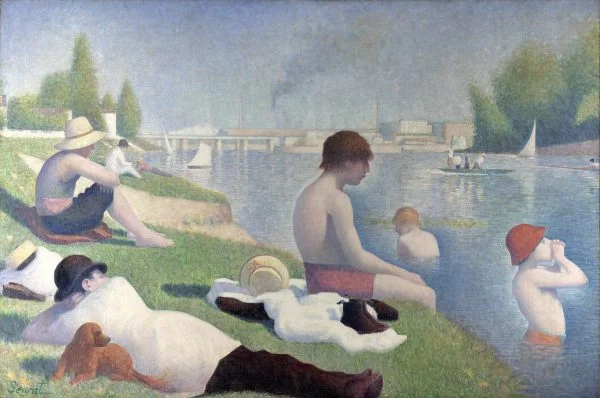
Among the preparations for one of his large figure canvases. The finished work, The Models (Les Poseuses), is held by the Barnes Foundation in Philadelphia; three figures stand in a studio in it, with A Sunday on La Grande Jatte — his most famous painting — hanging on the wall behind them. We also sell Model Facing Front II, a second study of the same standing pose painted a year later — two different panels, not two copies of one work, and the year is what separates them. If you want to see how the same painter handled a crowd instead of one figure, there is Sunday Afternoon on the Island of La Grande Jatte; as a counterpart to the upright figure, Young Woman Powdering Herself.
How is our hand-painted version made?
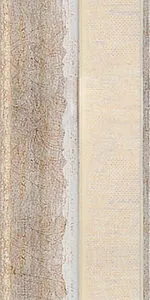
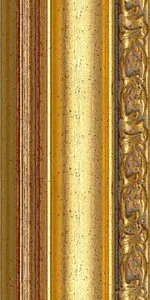
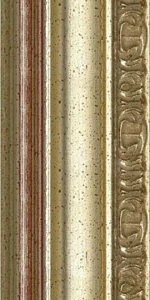
It is made with a brush and oil paint, never a printer, and the photographs on this page record our own work rather than a museum file. In the first photograph the finished canvas stands framed on the easel in our studio, square-on and complete: that is how it looks immediately before packing. In the fifth photograph the surface is shot close up — individual blue, ochre and violet dabs stand visibly above the weave of the linen, which is still readable at the right edge. The second and third photographs show the same framed canvas from the side, so the depth of the moulding and the workshop behind it are visible, and the fourth frames the upper left corner with its fine gold inner lip. That is exactly what you receive: a canvas painted by hand, photographed before dispatch and sent to you for approval. Because everything is done by hand, every hand-painted copy is one of a kind and no two are alike.
Which size for which wall?
If you do not know which: 40 x 65 cm. The original is tiny — 15.7 x 25 cm — and our smallest size, 16 x 26 cm, is close to one to one with it, suited to a shelf, a desk, or a group of small works. The format is upright, close to a 5 : 8 ratio, so it sits well on a narrow wall: between a door and a window, beside a hall mirror, or paired with its sister study. 30 x 50 and 40 x 65 cm are the everyday choices for a bedroom or a hallway; 50 x 85 and 60 x 100 cm work as a standalone piece above a chest of drawers; 70 x 120, 80 x 130 and 90 x 150 cm belong on tall walls, where the figure reaches nearly life size and becomes present like a statue. Every copy of this subject is made to order.
Custom size, stretcher bar and frame
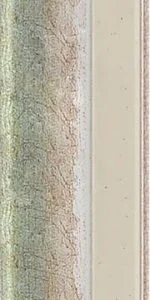
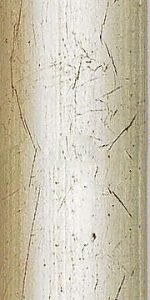
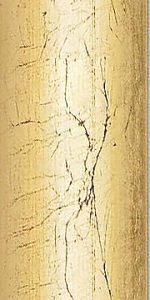
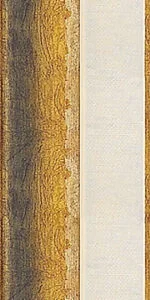
If none of the eight sizes fits your wall, we paint to your measurements and keep the ratio of the original so the figure is never stretched; that is our custom size painting service. You can order the painting in three forms: as a rolled canvas without a stretcher, stretched on a wooden stretcher bar and ready to hang, or framed; you choose the form when you order. You choose the frame in our 3D frame viewer: on this subject it shows every profile we carry — gold, silver, black, white, natural wood — and it is for choosing a frame and nothing else. The second and third photographs show how a warm gold moulding works on this particular scene. To see the work on your own wall, use our separate room-visualisation service, ordered on its own.
Delivery and guarantee
Every copy is made to order in our Slovenian studio, so allow 15 to 45 days depending on the size you choose. We ship it in the form you chose when ordering — rolled, stretched or framed — protected for transport, across the EU, customs-free. Before dispatch you receive a photograph of the finished work for approval — one like those on this page — and our returns policy applies to every order. The full range is in the Georges Seurat gallery, and his life and method are described in our article about Georges Seurat, which also explains what separates a good oil painting reproduction from a poor one.
Frequently asked questions
Where is the original?
In the Musée d’Orsay in Paris, under accession number RF 2000 23. The museum received it in 2000 as a gift from Philippe Meyer with a reserved life interest.
Who is the woman on the panel?
The museum record does not name her. She was a model in Seurat’s studio; the work is not a portrait of a particular person.
Is “Poseuse debout, de face” the same work?
Yes. That is the French title the Musée d’Orsay uses; the English is “Model Facing Front (study for Models)”. One and the same panel.
Is this a print?
No. The work is painted by hand in oil on linen; the brushwork is visible and can be felt, which the fifth photograph shows best.
Which size should I choose?
For a bedroom or hallway, 40 x 65 cm; for the size of the original, 16 x 26 cm. The full guide is above.
Can I have a size that is not listed?
Yes. We paint to measure, keeping the side ratio of the original.
How is it delivered?
In the form you chose (rolled, stretched on a stretcher or framed), 15 to 45 days after you approve the photograph.
What is the painting about, in one sentence?
One body, set squarely in front of us and built out of dots: warm inside cool air, with no story attached.
Is the original for sale and what is it worth?
No. The panel is in the public collection of the Musée d’Orsay and is not for sale; a hand-painted canvas of ours is the only way to have it at home.
How high should I hang it?
Centre at eye level, about 145–150 cm from the floor. At the small sizes hang lower and nearer where you sit, so the dots stay visible.
Is it suitable as a gift?
The smaller sizes make a good gift: they are quiet and fit almost any wall. If you would rather leave the choice to the person receiving it, there is our gift voucher.
- Subject: a single standing female figure facing the viewer, against a ground of cool dots – a study for Les Poseuses, 1886
- Original: 15.7 x 25 cm, oil on wood, Musée d’Orsay, Paris (acc. no. RF 2000 23)
- Ours: a hand-painted fine art reproduction in oils, eight sizes, 16 x 26 to 90 x 150 cm, as a rolled canvas, stretched or framed — your choice
- Worth knowing: the original is smaller than a sheet of A5 – every photograph on this page shows our canvas, not the museum’s