







































Description
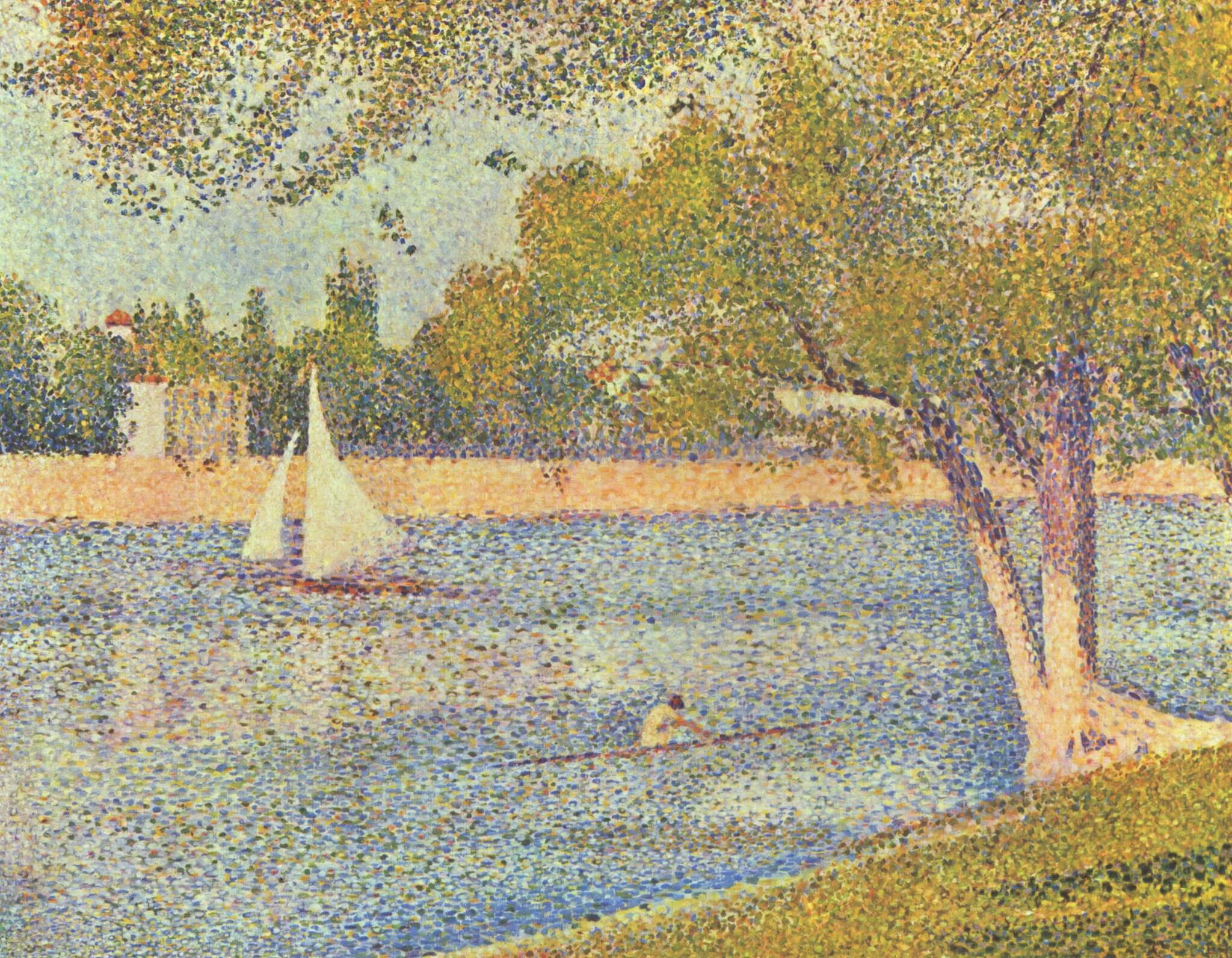
The Seine at La Grande Jatte is Seurat’s painting of 1888: a small yacht with two white sails crosses the blue river, a man rows a narrow skiff in the foreground, and on the right a tree leans out over the water with its crown spread across the top. The original, 82 x 65 cm, is held by the Royal Museums of Fine Arts of Belgium in Brussels under inventory number 5091. We make it as a canvas painting, hand-painted in oils, in eight sizes or to your own measurements, and before dispatch we send you a photograph of the finished work for approval.
| Title: | The Seine at La Grande Jatte |
| Other titles: | La Seine à la Grande-Jatte |
| Painter: | Georges Seurat (1859–1891) |
| Year painted: | 1888; signed lower right: Seurat |
| Original size: | 82 cm x 65 cm |
| Original technique: | Oil on canvas |
| Painting style: | Neo-Impressionism – painted in dots |
| Located at: | Royal Museums of Fine Arts of Belgium, Brussels (inv. no. 5091) |
| Our reproduction: | hand-painted in oil on linen, 8 sizes from 46 x 38 cm to 150 x 120 cm, custom sizes on request |
The Seine at La Grande Jatte – Georges Seurat
What does the painting show?
A summer day on the Seine beside the island of La Grande Jatte, northwest of Paris. In the middle of the river a small yacht carries two white triangular sails, so bright that they become the lightest point on the whole canvas. Closer to us, in the lower part of the picture, a man sits in a long, narrow skiff and rows towards the left; his white shirt answers the white of the sails. On the right a tree with two pale trunks leans out from the bank over the water, and its crown spreads across the upper edge so that the branches frame the sky. On the far bank stands a line of trees, with a pale house and a small turret with a red roof among them. The museum record does not name anyone, so neither do we: these are not sitters but visitors to the river.
What is on the canvas?
A horizontal canvas in which the water takes up almost two thirds of the surface. The river is not painted in a single blue but in countless small dots of blue, violet, pink and green that merge at a distance into a glittering surface; where the tree is reflected, the dots gather into darker, cooler tones. The bank at the lower right is a yellowish green, with warm orange dots where the sun falls and bluish ones in the shade. The sky is pale, almost white, and green and yellow points flicker through the leaves. No mark is longer than a few millimetres, so the whole painting has an even, granular texture that falls apart into coloured dots close up and comes together into light from across the room. The signature, Seurat, sits at the lower right, in the corner by the bank.
Why does this painting matter?
Because it shows Seurat’s famous technique in its mature form, on the simplest possible subject. A few years earlier he had painted his large canvas of a crowd of strollers on this same island; here there is no crowd, only the river, the tree, the yacht and the rower, so all the attention goes to the way the dots build light. This French painter believed that pure colours set side by side would mix more brilliantly in the viewer’s eye than if he blended them on the palette. That method is known today as pointillism, and the wider movement that grew around it as neo-impressionism. The Seine at La Grande Jatte of 1888 is one of its purest examples: every area, from the water to the sky, is made of dots, and nowhere is there a blended transition.
What does the scene mean?
City people’s leisure on the river, caught in a moment of complete stillness. There is no story and no drama here: the yacht is not racing, the rower is in no hurry, the tree leans as it has leaned every summer. That quiet is the real subject. In the 1880s La Grande Jatte was a favourite place for Parisians, who came to the river on Sundays to row and to sail, and Seurat painted it again and again. On this canvas he left out the people on the bank and kept only water and light, which brings it closer to a landscape than to a scene from daily life. On a wall it feels calm and bright, and the diagonal of the tree gives it structure.
Where does this painting sit in Seurat’s work?
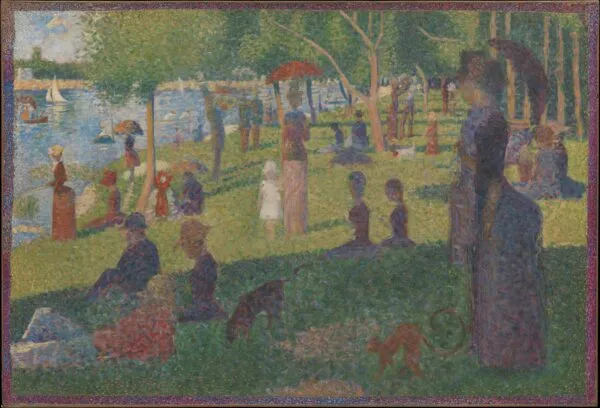
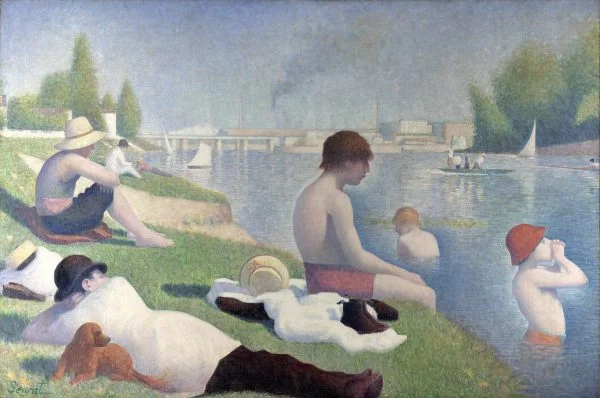
The island of La Grande Jatte runs through his work like a thread. The best known of these paintings is Sunday Afternoon on the Island of La Grande Jatte, the large canvas held by the Art Institute of Chicago; there the bank is full of people, here it is empty. Gray Weather, Grande Jatte, held by the Metropolitan Museum of Art in New York, shows the same place under a different sky, and a little further along the river he painted The Seine at Courbevoie, with a lady and a small dog on the bank. All three are in our gallery as separate products.
How is our hand-painted version made?
With a brush and oil paint, never a printer. Our painter works from a high-resolution image of the original and sets the dots one by one, as Seurat did: first the large colour areas of river, bank and sky, then a dense layer of small points laid over them, changing colour as he goes. The dotted technique needs patience, because the spacing of the dots has to stay even across the whole canvas or the water will not shine. That is why every hand-painted copy takes several days and no two are exactly alike. We do not yet hold our own photographs of a finished canvas of this subject; the first time it is painted we will photograph it, and the photographs will appear here.
Which size for which wall?
If you are not sure which to choose, take 80 x 65 cm. It is 2 cm narrower than the original, which measures 82 x 65 cm, and the same height, so it is the size in our range closest to the original. The format is horizontal, so it sits well above a sofa or a bed. 46 x 38 and 50 x 40 cm suit a hallway, a study or a group of smaller works; 60 x 50 and 70 x 60 cm fill the wall above a desk on their own; 90 x 75 cm is the living-room size, and 120 x 100 and 150 x 120 cm are for large empty walls. Every oil painting reproduction of this subject is made to order.
Custom size, stretcher bar and frame
If none of the eight sizes fits your wall, we paint to your measurements and keep the ratio of the original, so that the yacht and the tree stay in balance; that is our custom size painting service. You can order the painting in three forms: as a rolled canvas without a stretcher, stretched on a wooden stretcher bar and ready to hang, or framed; you choose the form when you order. You choose a frame in our 3D frame viewer, where you can compare gold, silver, black, white and natural wood profiles on this subject; the viewer is for choosing a frame and nothing else. To see it on your own wall first, use our room-visualisation service, ordered separately.
Delivery and guarantee
We paint it to order in our studio in Slovenia, so allow 15 to 45 days depending on the size. It travels in the form you chose when ordering — rolled, stretched or framed — packed for transport, and ships across the EU customs-free. Before we send it you approve a photograph of the finished work, and our returns policy covers every order. All of Seurat’s subjects are in the Georges Seurat gallery, and our article about Georges Seurat tells his story and explains what makes a good fine art reproduction.
Frequently asked questions
Where is the original?
In the Royal Museums of Fine Arts of Belgium in Brussels, under inventory number 5091. The museum received it in 1937 as a bequest from Anna Boch of Brussels.
Who are the people in the painting?
A rower in a narrow skiff and the crew of the yacht. The museum record does not name them; they are anonymous visitors to the river, not known people.
Is La Seine à la Grande-Jatte the same work?
Yes. That is the original French title under which the Brussels museum lists the work; The Seine at La Grande Jatte is the English title of the same canvas.
Is this a print?
No. Every dot is set by hand by our painter, in oil on canvas, so the paint can be seen and felt.
Which size should I choose?
For a living room, 90 x 75 cm; for the size closest to the original, 80 x 65 cm. The full guide is above.
Can I have a size that is not listed?
Yes. We also paint to measure and keep the side ratio of the original.
How is it delivered?
Once you approve the photograph, we pack the painting and send it; delivery within the EU is customs-free.
What is the painting about, in one sentence?
That a perfectly still summer moment on a river can be built out of thousands of small, lively dots of colour.
Is the original for sale?
No. The canvas belongs to the public collection of the Brussels museum and is not for sale; a hand-painted canvas from us lets you have it at home.
How high should I hang it?
Centre at eye level, about 145–150 cm from the floor; above a sofa, keep the lower edge 20–25 cm above the backrest.
Is it suitable as a gift?
Yes. The subject is bright and quiet and suits almost any room. If you would rather leave the choice to the person receiving it, there is our gift voucher.
- Subject: a yacht and a rower on the Seine by the island of La Grande Jatte, a tree leaning over the water – 1888
- Original: 82 x 65 cm, oil paint on canvas, Royal Museums of Fine Arts of Belgium (inv. no. 5091)
- Ours: a famous painting recreated by hand, eight sizes from 46 x 38 to 150 x 120 cm, as a rolled canvas, stretched or framed — your choice
- Worth knowing: the whole surface, from the water to the sky, is built of dots – there is no blended transition anywhere