







































Description
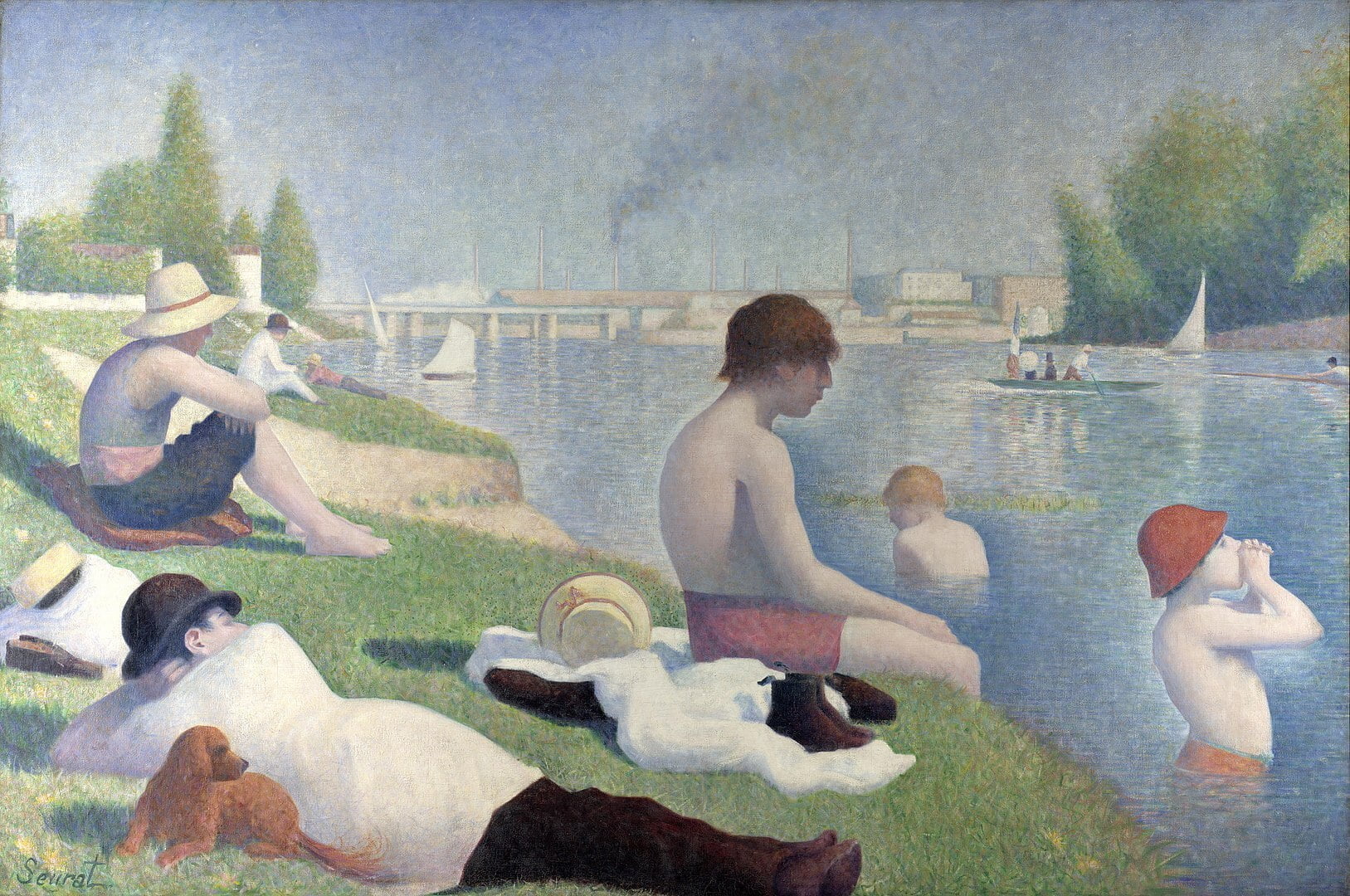
Bathers at Asnières is Seurat’s first large-scale painting, made in 1884: a group of young workers resting by the Seine at Asnières, an industrial suburb west of Paris. The original measures 300 x 201 centimetres and is held in London by The National Gallery under inventory number NG3908. From us it is painted entirely by hand, oil on canvas, in eight sizes or to your own measurements, and before dispatch you receive a photograph of the finished work for approval.
| Title: | Bathers at Asnières |
| Other titles: | Bathers at Asnières · Une Baignade, Asnières |
| Painter: | Georges Seurat (1859–1891) |
| Year painted: | 1884 |
| Original size: | 300 cm x 201 cm |
| Original technique: | Oil on canvas |
| Painting style: | Before pointillism – the museum states it is not painted in his later pointillist style |
| Located at: | The National Gallery, London (inv. no. NG3908) |
| Our reproduction: | hand-painted oil on canvas, 8 sizes from 80 x 55 cm to 300 x 201 cm, custom size on request |
Bathers at Asnières – Georges Seurat
Who is in the painting?
Nobody the museum record names. A group of young men and boys sits and lies along the bank: one sits in the foreground in a hat looking across the water, one lies propped on an elbow, one stands waist-deep in the river with his hands cupped to his mouth as if calling. Hats and clothes lie beside them, and there is a dog in the water. These are not known people but workers from the suburb on a day off. This French painter was twenty-five at the time, and this was, in the gallery’s words, his first large-scale painting.
What is on the canvas?
A very wide horizontal canvas, almost three metres across. At the left the bank slopes to the water; at the right the Seine opens out, and the factory chimneys of the far bank rise in the background. The light is summer light, even and undramatic; the figures are spaced in a calm rhythm, one seated, one lying, one standing in the water. The paint is laid in short, crossed strokes that give the grass and the water a dense, woven surface. The scene is full of people and yet silent: nobody is talking and nobody looks out at us.
Why does this painting matter?
Because with it Seurat stepped into the large format for the first time. The gallery calls it his first large-scale painting, and everything that follows comes out of it: the method of working from studies outdoors and assembling in the studio, the calm geometry of the figures, the interest in the leisure of ordinary people. It was made a year before work began on the Sunday afternoon, and the difference between the two shows how fast the painter’s technique changed: here the stroke is still short and crossed, there the colour will be taken apart into dots. Pointillism comes afterwards; this is the canvas immediately before it.
What does the work mean?
Leisure, shown without idealising and without reproach. The bathers are not townspeople on an outing but workers from the industrial suburb, and the painter presents them as neither poor nor picturesque. They sit in the sun because it is Sunday. The canvas painting that results gives an ordinary afternoon a scale until then reserved for history — and it is exactly that mismatch between subject and format that keeps the work alive. Hang it at home and you get a calm, light surface that asks for no attention and never loses it.
Where does it sit in Seurat’s work?
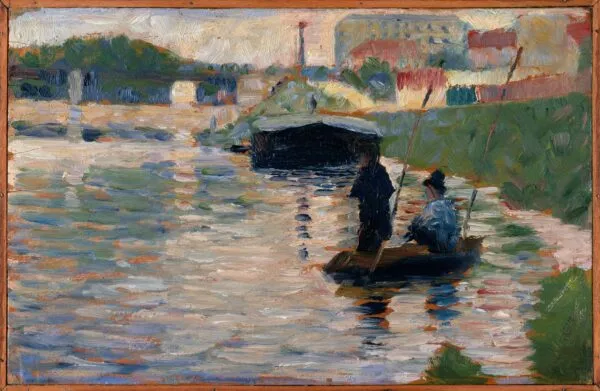
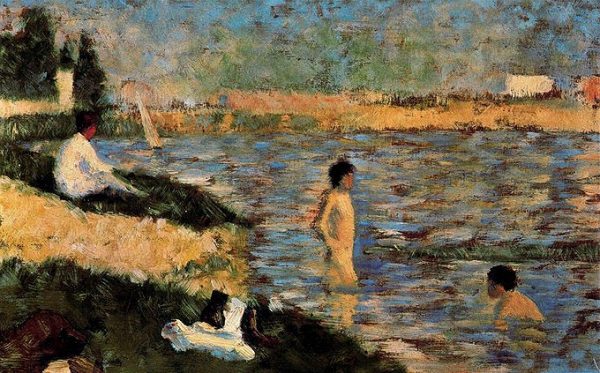
At the start of the large works, and in our Seurat gallery it is surrounded by its own studies. Study for Bathers at Asnières (London) and Study for Bathers at Asnières (Kansas City) are two of the small wooden panels the painter called croquetons and which, in the gallery’s words, he made outdoors to record light and colour before carrying them onto the large canvas; The Rainbow: Study for Bathers at Asnières is the third. The next step is the Art Institute of Chicago and its Sunday Afternoon on the Island of La Grande Jatte: the same day-off subject, the other bank of the same river, and colour already taken apart. Neo-impressionism was born between these two canvases.
How is our hand-painted version made?
By hand and with a brush, never with a printer. Our painter works in oil paint on linen and builds the surface the way it is built on the original: short, crossed strokes, first the large planes of bank, water and sky, then the figures. On this subject the hardest thing is to keep the calm — the scene works only if no figure stands out more than it does on the original. Every hand-painted copy is therefore one of a kind and no two are quite alike; this is not an oil painting reproduction printed onto canvas but a painting made from scratch. Before dispatch we photograph the piece and send you the photograph for approval.
We hold no studio photographs of the finished work for this subject at present. When it is next painted we will photograph it and the shots will appear on this page.
Which size for which wall?
If you do not know which: 140 x 90 cm. The original measures 300 x 201 cm and our largest size is exactly the same — 300 x 201 cm, one to one, which is rare in our Seurat gallery. The format is very wide and horizontal, close to a 3 : 2 ratio, so it needs a long unbroken wall: 80 x 55 and 100 x 70 cm work above a chest of drawers or in a hallway, 120 x 80 and 140 x 90 cm are the everyday choice above a sofa, 180 x 120 and 220 x 150 cm ask for a wall of their own, and 260 x 175 and 300 x 201 cm belong in large rooms, dining rooms and halls where the figures reach life size. Every fine art reproduction of this subject is made to order.
Custom size, stretcher bar and frame
If none of the eight sizes fits your wall, we paint the work to your measurements and keep the ratio of the original so the scene is never squeezed; that is our custom size painting service. You can order the painting in three forms: as a rolled canvas without a stretcher, stretched on a wooden stretcher bar and ready to hang, or framed; you choose the form when you order. You choose the frame in our 3D frame viewer: on this subject it shows every frame profile we carry, so you can compare gold, silver, black, white and natural wood — it is for choosing a frame and nothing else. To see how the work will look on your own wall, use our separate room-visualisation service.
Delivery and guarantee
Every copy is made to order in our studio in Slovenia, so allow 15 to 45 days depending on the size you choose. We ship it in the form you chose when ordering — rolled, stretched or framed — protected for transport, across the EU, customs-free. Before dispatch you receive a photograph of the finished work for approval, and our returns policy applies to every order. The full range by this painter is in the Georges Seurat gallery, and his career is described in our article about Georges Seurat, which also explains what separates a good famous painting copy from a poor one.
Frequently asked questions
Where is the original?
In London, at The National Gallery, under inventory number NG3908; the gallery lists it in Room 44. It was bought in 1924 with the Courtauld Fund.
Who are the bathers?
The record does not name them. They are young workers from Asnières; the work is not a portrait of particular people and we do not give them names either.
Is “Une Baignade, Asnières” the same work?
Yes. That is the French title of the same canvas; in English it appears as “Bathers at Asnières”. It is one and the same work.
Is this a print?
No. The work is painted by hand in oil on linen; the strokes are visible and can be felt, which a print cannot imitate.
Which size should I choose?
Above a sofa, 140 x 90 cm; if you want the size of the original, choose 300 x 201 cm — that is exactly one to one with it. The full size guide is above.
Can I have a size that is not listed?
Yes. We paint to measure, keeping the side ratio of the original.
How is it delivered?
In the form you chose (rolled, stretched on a stretcher or framed), 15 to 45 days after you approve the photograph of the finished work.
What is the work about, in one sentence?
An ordinary free afternoon for working men, painted at a scale until then reserved for history.
Do you have the studies for this painting too?
Yes, three. We also sell the London study, the Kansas City study and The Rainbow — all three small panels made before the large canvas; the links are in the section above.
Is the original for sale and what is it worth?
No. The canvas is in the public collection of The National Gallery and is not for sale; a hand-painted canvas is the only way to have the subject at home.
Is it suitable as a gift?
On this subject the larger sizes work better, because the scene lives on width. If you would rather leave the choice to the person receiving it, there is a gift voucher.
- Subject: young workers resting by the Seine at Asnières, factory chimneys behind – Seurat’s first large-scale painting
- Original: 300 x 201 cm, oil paint on canvas, The National Gallery, London (NG3908), Room 44
- Ours: a hand-painted oil, eight sizes from 80 x 55 to 300 x 201 cm, as a rolled canvas, stretched or framed — your choice
- Worth knowing: our largest size is exactly one to one with the original – 300 x 201 cm