



Description
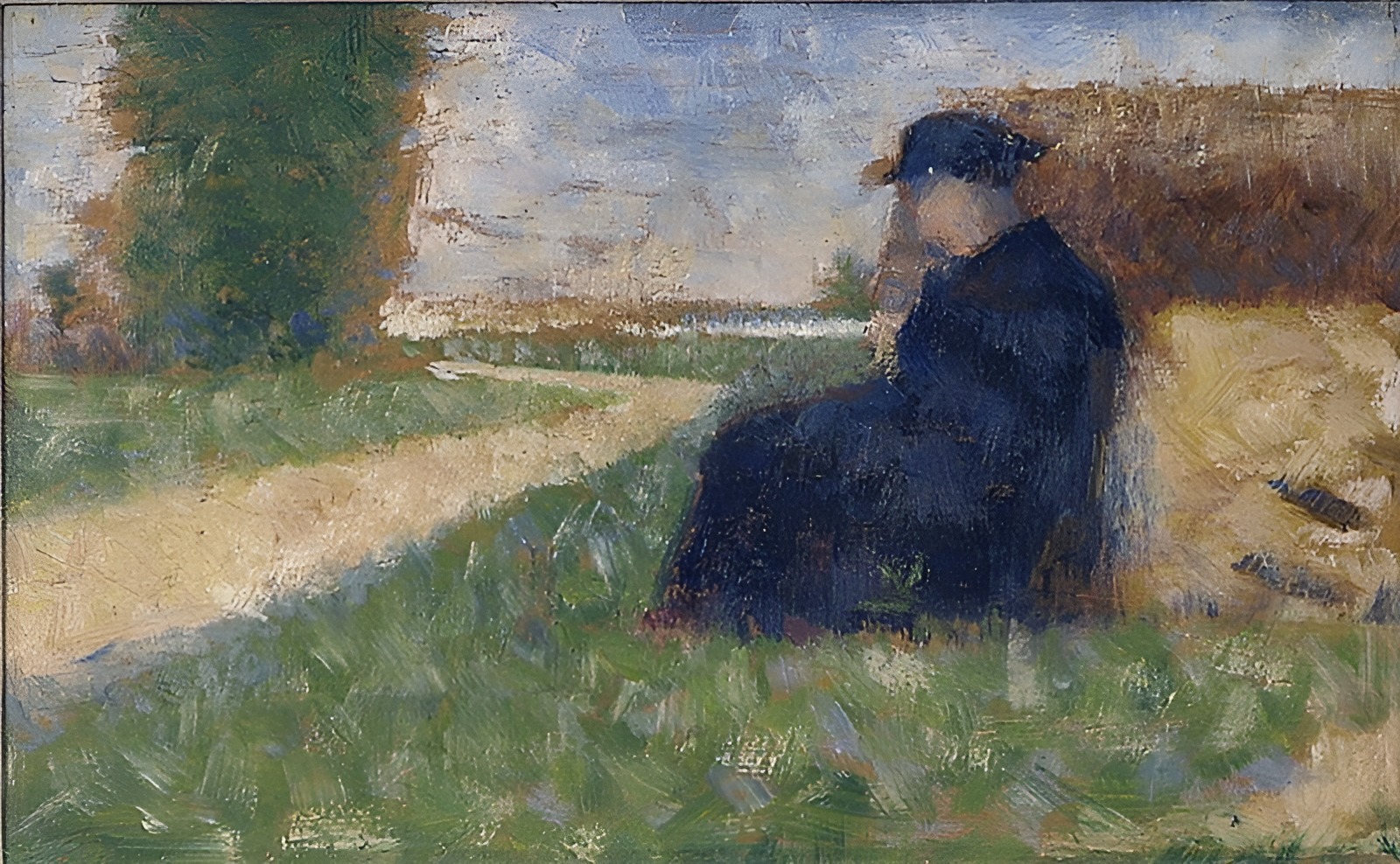
Figure in a Landscape at Barbizon is a tiny oil study on a wooden panel that Georges Seurat painted around 1882 while working outdoors in the forest of Fontainebleau near the village of Barbizon: a single dark, heavy figure bent over its work in the middle of a field. The original measures barely 24.8 x 15.7 centimetres and is kept in Cologne by the Wallraf-Richartz-Museum & Fondation Corboud. From us it is painted entirely by hand, oil on canvas, in eight sizes or to your own measurements, and before dispatch you receive a photograph of the finished work for approval.
| Title: | Figure in a Landscape at Barbizon |
| Other titles: | Figure massive dans un paysage à Barbizon · Massive Figure in a Landscape |
| Painter: | Georges Seurat (1859–1891) |
| Year painted: | circa 1882 |
| Original size: | 24.8 cm x 15.7 cm |
| Original technique: | Oil on wood |
| Painting style: | Early period, before Divisionism |
| Located at: | Wallraf-Richartz-Museum & Fondation Corboud, Cologne (inv. no. Dep. 0705 FC) |
| Our reproduction: | hand-painted oil on canvas, 8 sizes from 25 x 16 cm to 150 x 100 cm, custom size on request |
Figure in a Landscape at Barbizon – Georges Seurat
Who is in the painting?
Nobody the record names. The figure on the panel is a field worker – a farmhand or a farm woman, and neither the stance nor the clothing settles which – bent over the work, back turned to us and without a face. In the summer of 1882 Seurat went out to paint around Barbizon, where Millet had worked a generation earlier, and alongside empty landscapes he made studies of people working in the fields. This French painter was twenty-three at the time and still drew and painted the way he had been taught: he looked for weight and shape before colour. That is why the figure is not a portrait but a mass to be placed in space.
What is on the panel?
The panel is horizontal and barely the size of a hand. The figure stands a little left of centre, built from dark brown, olive and almost black strokes that never resolve into detail: you see a silhouette, not a person. Around it the field is assembled from short, crossed strokes of green, ochre and brown running in different directions, giving the ground the feel of broken earth. A lighter band above suggests the trees at the forest edge; there is no open sky and no sharp horizon. What holds it together is the contrast between the dark mass of the figure and the brighter field around it – and that contrast is what interested Seurat here.
Why does this study matter?
Because it shows the painter before the thing we know him for. Pointillism, the technique of separate dots of pure colour, arrived only two years later; here the stroke is still short and crossed, inherited from the Barbizon school and from Millet, and the colour is earthy rather than broken into primaries. The study is therefore a record of what the later method grew out of: the observation of weight and light on a small panel the painter could carry into the woods with him. Small panels of this kind – Seurat called them croquetons – were his working notebook, and in them you see him move from solid mass to dissolved colour.
What does the work mean?
Less than you would expect from a scene with a person in it, and that is its honesty. The figure tells no story: it does not suffer, does not rest, does not pose. It works – or has paused for a moment – and what interested the painter above all was how much room a dark body takes up in a light field. Peasant labour was a heavy subject in the French painting of the day, full of sympathy and symbol; Seurat took it and removed the narration. As a canvas painting on the wall it therefore reads quiet and a little severe: a small, dense scene that asks nothing and can be looked at daily without wearing out.
Where does this study sit in Seurat’s work?
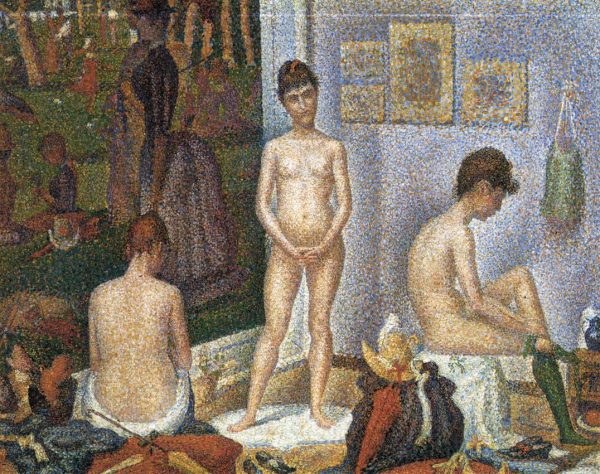
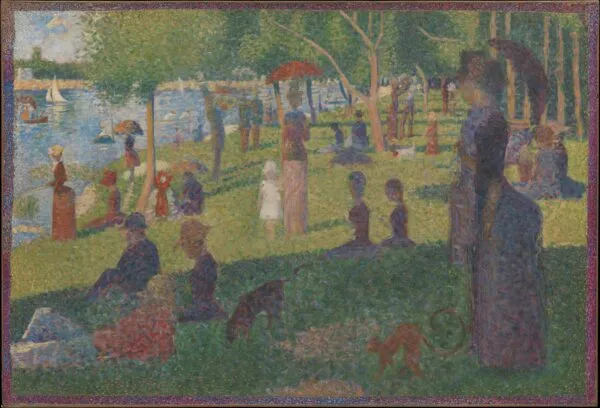
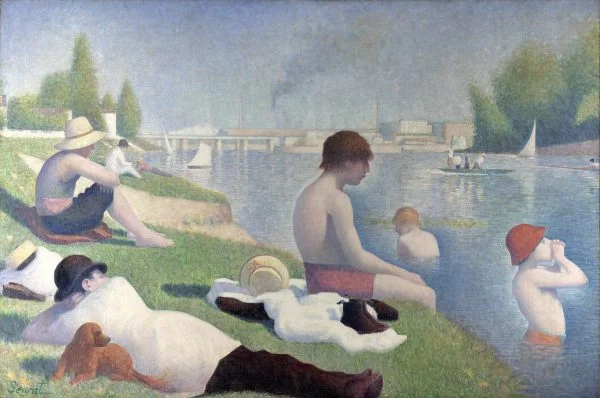
At the beginning, among the preparations. From the same early period we also sell Peasant Woman Seated in the Grass, likewise a study of a person working outdoors, and In the Woods at Pontaubert, where the same short stroke belongs to the forest instead of a figure. A few years later this work grew into Bathers at Asnières, the first large canvas, and then into Sunday Afternoon on the Island of La Grande Jatte, held by the Art Institute of Chicago. Only there did neo-impressionism come into being as a movement; this panel is some years earlier. Hang the two together and you see the difference between a painter looking for mass and a painter who has taken colour apart into dots.
How is our hand-painted version made?
By hand and with a brush, never with a printer. Our painter works in oil paint on linen and builds the surface the way it is built on the original: short, crossed strokes, the dark mass of the figure first and the field around it afterwards. Because the original is very small, at the larger sizes every stroke is correspondingly larger: the work becomes not smoother but more legible, and the relief of the paint can be seen and felt. Every hand-painted copy is therefore one of a kind and no two are quite alike; this is not an oil painting reproduction printed onto canvas but a painting made from scratch. Before dispatch we photograph the piece and send you the photograph for approval.
We hold no studio photographs of the finished work for this subject at present. When it is next painted we will photograph it and the shots will appear on this page.
Which size for which wall?
If you do not know which: 70 x 45 cm. The original is a splinter – 24.8 x 15.7 cm – and our smallest size, 25 x 16 cm, is practically one to one with it: the only size at which you see the work at the scale it was made. The format is horizontal, close to an 8 : 5 ratio, so it sits well above low furniture: a chest of drawers, the head of a bed, a hallway. 50 x 30 and 60 x 40 cm are the everyday choice for a bedroom or a study; 70 x 45 and 80 x 50 cm work as a standalone piece; 90 x 60, 120 x 75 and 150 x 100 cm belong on large walls, where the figure becomes genuinely present and the strokes can be read close up. Every fine art reproduction of this subject is made to order.
Custom size, stretcher bar and frame
If none of the eight sizes fits your wall, we paint the work to your measurements and keep the ratio of the original so that figure and field are never stretched; that is our custom size painting service. You can order the painting in three forms: as a rolled canvas without a stretcher, stretched on a wooden stretcher bar and ready to hang, or framed; you choose the form when you order. You choose the frame in our 3D frame viewer: on this subject it shows every frame profile we carry, so you can compare gold, silver, black, white and natural wood – it is for choosing a frame and nothing else. If you want to see how the work will look on your own wall, use our separate room-visualisation service, ordered on its own.
Delivery and guarantee
Every copy is made to order in our studio in Slovenia, so allow 15 to 45 days depending on the size you choose. We ship it in the form you chose when ordering — rolled, stretched or framed — protected for transport, across the EU, customs-free. Before dispatch you receive a photograph of the finished work for approval, and our returns policy applies to every order. The full range by this painter is in the Georges Seurat gallery, and his path from the Barbizon studies to broken colour is described in our article about Georges Seurat, which also explains what separates a good famous painting copy from a poor one.
Frequently asked questions
Where is the original?
In Cologne, in the collection of the Wallraf-Richartz-Museum & Fondation Corboud, under the inventory mark Dep. 0705 FC. The work belongs to the Fondation Corboud collection, which is held by the museum on permanent loan.
Who is the person on the panel?
The record does not name them. It is an unnamed field worker from the country around Barbizon; the work is not a portrait of a particular person, and we do not give them a name either.
Is “Figure massive dans un paysage à Barbizon” the same work?
Yes. That is the French title of the same panel; in English it also appears as Massive Figure in a Landscape. It is one and the same work.
Is this a print?
No. The work is painted by hand in oil on linen; the brushwork is visible and can be felt, which a print cannot imitate.
Which size should I choose?
For a bedroom or a study, 70 x 45 cm; if you want the size of the original, choose 25 x 16 cm. The full size guide is above.
Can I have a size that is not listed?
Yes. We paint to measure, keeping the side ratio of the original.
How is it delivered?
In the form you chose (rolled, stretched on a stretcher or framed), 15 to 45 days after you approve the photograph of the finished work.
What is the work about, in one sentence?
A single dark figure bent over its work in the middle of a bright field: weight and light, with no story attached.
Is the original for sale and what is it worth?
No. The panel is in a public collection in Cologne and is not for sale; a hand-painted canvas is the only way to have the subject at home.
How high should I hang it?
Centre at eye level, about 145–150 cm from the floor. At the smallest size hang it lower and nearer where you sit, so the strokes stay visible.
Is it suitable as a gift?
The smaller sizes are rewarding as a gift because they are quiet and fit almost any wall. If you would rather leave the choice to the person receiving it, there is a gift voucher.
- Subject: a single dark figure bent over its work in the middle of a field, at the forest edge near Barbizon
- Original: 24.8 x 15.7 cm, oil on wood, Wallraf-Richartz-Museum & Fondation Corboud, Cologne (Dep. 0705 FC)
- Ours: a hand-painted oil, eight sizes from 25 x 16 to 150 x 100 cm, as a rolled canvas, stretched or framed — your choice
- Worth knowing: the original is smaller than a postcard – our smallest size, 25 x 16 cm, is almost one to one with it