


Description
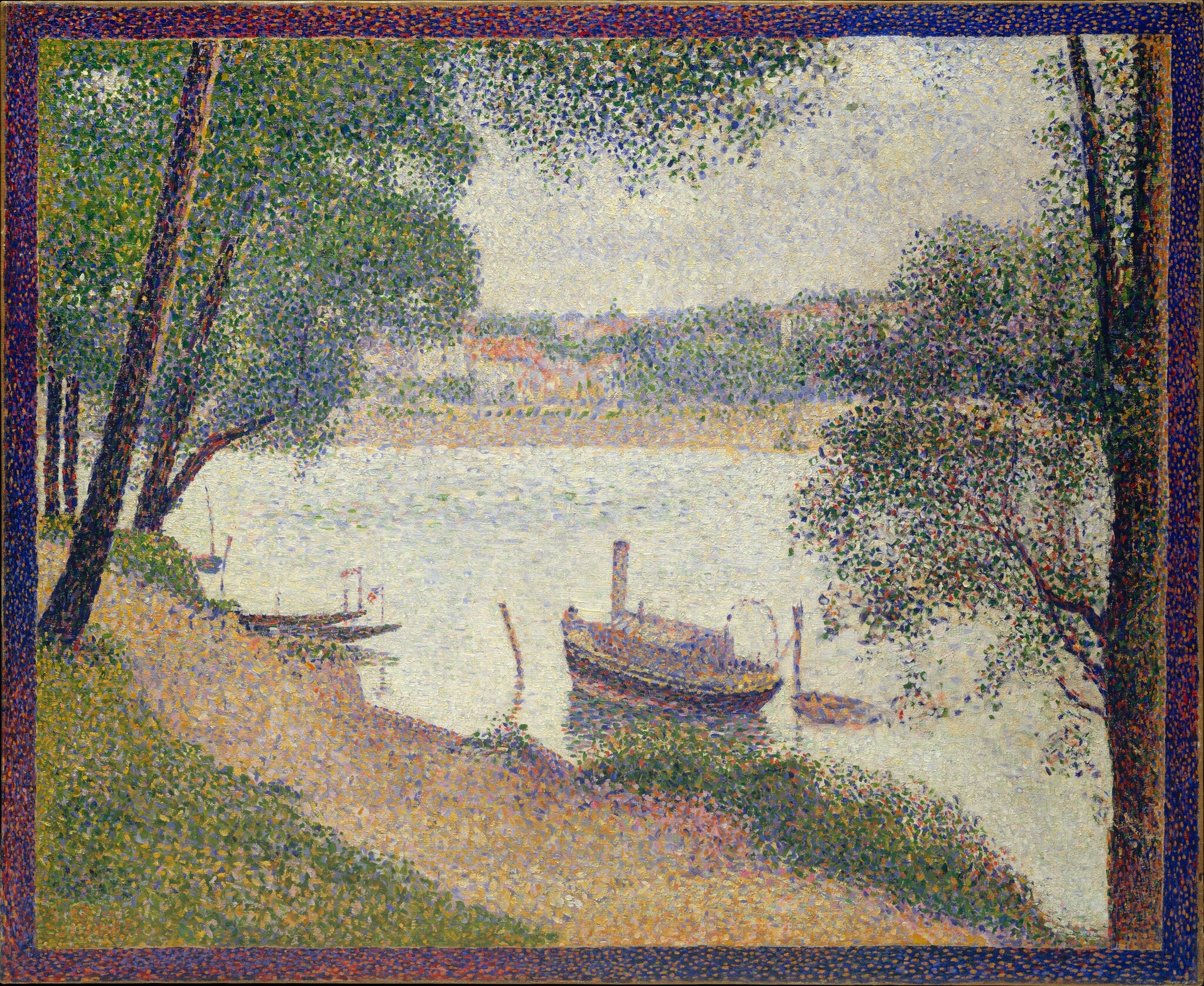
Gray Weather, Grande Jatte is Seurat’s view from the island across the Seine, painted about 1886–88 under an overcast sky. The original measures 86.4 x 70.5 centimetres, is oil on canvas, and hangs in New York at The Metropolitan Museum of Art, in Gallery 823, under object number 2002.62.3. From us it is painted entirely by hand, in eight sizes or to your own measurements, and before dispatch you receive a photograph of the finished work for approval.
| Title: | Gray Weather, Grande Jatte |
| Other titles: | Gray Weather, Grande Jatte – the title the museum itself uses |
| Painter: | Georges Seurat (Paris 1859–1891) |
| Year painted: | about 1886–88 |
| Original size: | 86.4 cm x 70.5 cm |
| Original technique: | Oil on canvas |
| Painting style: | Divisionism, the museum’s own word for it – also called pointillism; neo-impressionism |
| Located at: | The Metropolitan Museum of Art, New York (object no. 2002.62.3, on view in Gallery 823) |
| Our reproduction: | hand-painted oil on canvas, 8 sizes from 70 x 55 cm to 246 x 197 cm, custom size on request |
Gray Weather, Grande Jatte – Georges Seurat
What is on the canvas?
The view begins on the island of La Grande Jatte and crosses the river. The museum describes it like this: the view extends from the island, framed by trees, to the red-roofed houses of a Paris suburb on the far side of the Seine. Which suburb that is, the museum leaves open – Asnières or Courbevoie – and we will not close it either, because we cannot.
The sky is overcast, and that is the whole point. A canvas painting that wants to show the glitter of sunlight has an easy job; this one does not. There is no shadow to pick anything out and no incident to lead the eye. What is left is the light over the water, and that light is made of colour rather than of contrast.
Grey sky is the harder test
Seurat’s colour mixes in the viewer’s eye and not on the palette. The museum calls the technique Divisionism and adds that it is also called pointillism. In sunlight it produces the shimmer everybody remembers. Under cloud it has to work harder still: the grey is not a single colour at all but a close weave of blue, green and rose dots that quieten one another into one even light.
That is why the overcast pictures are the better evidence: if the method holds up when there is no sun, it is not a trick with light but a way of assembling colour. The movement Seurat led is called neo-impressionism, and this work is the quiet end of it.
The museum also quotes the painter himself: he sought, it says, to transcribe most exactly the vivid outdoor clarity of nature in all its nuances. That is a claim about accuracy, not about effect.
The painted border belongs to the original
A painted band runs around the edge of the canvas, and Seurat added it himself. The museum is precise about it: the border was added shortly before the work was first exhibited in 1889. So it is not a frame but part of the painted surface – the painter decided for himself where the scene ends and how the colour meets the wall.
For us that is a practical question and not only a curiosity. Our painter works from the original as the museum shows it. If you would rather have the scene without the painted border, say so with the order; we send you a photograph of the finished work for approval before the canvas leaves the studio in any case.
The island he kept returning to
The same island and the same water carry several works in our Seurat gallery. The largest is Sunday Afternoon on the Island of La Grande Jatte, held by the Art Institute of Chicago and named expressly by the museum; there the same bank is full of people. Three of the studies for it are in our Seurat gallery as well: Study for A Sunday on La Grande Jatte, Study for La Grande Jatte (right) and Study for La Grande Jatte (London).
The other work the museum names alongside this one is Bathers at Asnières from the National Gallery in London: the same reach of the Seine, only from the other side and some years earlier. And because the museum allows that the houses on the far bank may belong to Courbevoie, The Seine at Courbevoie belongs here too – sold in our Seurat gallery with no year and no size, because it is in a private collection and uncatalogued.
Where that road led later is clearest on the coast: The Channel of Gravelines, Grand Fort-Philippe is from the last year of his work, when the dot is fully formed.
Why does the year say about?
Because the museum itself does not give a single year. Its own record reads about 1886–88, a span and not a date, and that is how we give it. Nowhere on this page is one year of making written down as a fact, because the institution that holds the work has not written it that way.
Only one firm year is recorded, and it is not the year of making: 1889, when the work was first exhibited and the border was already on the canvas. The second firm year is 2002, when it came to the museum as a gift from the collection of Walter H. and Leonore Annenberg. The one in between, the real one, is missing – and anyone who finds it written down precisely is reading a source that knows less than the museum does.
How is our hand-painted version made?
By hand and with a brush, never with a printer. Our painter works in oil colours on canvas, and with this subject the hardest part is precisely that the grey must stay assembled and must not turn into one colour. Stir it on the palette and you get a dirty field; leave it standing in dots and you get light. That is why every hand-painted copy is one of a kind and no two are quite alike.
For this subject we have no studio photographs of our own yet. When we next paint it, we will photograph it, and the photographs will appear on this page. What holds meanwhile holds for every oil painting reproduction we make: before dispatch you receive a photograph of the very canvas painted for you, and it leaves only once you have approved it.
Which size for which wall?
The original measures 86.4 x 70.5 centimetres, width first and then height, the way we give measurements everywhere. The format is landscape and nearly square, which matters here: the scene has no single point for the eye to fall on, so it carries width well.
None of our eight sizes matches the original. The closest is 100 x 80 cm, a good fourteen centimetres wider; 70 x 55 cm is a little smaller than the original. We are not going to round that into a claim that we sell the work at its original size, because we do not. For a living room we suggest 120 x 100 or 140 x 110 cm, because the grey gains on a larger surface; 160 x 130, 180 x 140, 200 x 160 and 246 x 197 cm are for walls that have to be filled, and there you see how the colour is put together.
Custom size, stretcher and frame
If none of the eight sizes fits your wall, we paint to your measurements and keep the ratio of the original, so the scene is never stretched; that is our custom size painting. You can order the painting in three forms: as a rolled canvas without a stretcher, stretched on a wooden stretcher and ready to hang, or framed; you choose the form when you order.
You choose the frame in our 3D frame viewer. With this subject it is worth thinking twice, because the original has its own painted border: a narrow dark frame will work with it, a wide ornamented one will argue with it. Our separate room-placement service shows how it will look on your own wall.
Delivery and guarantee
Every copy is made to order in our studio in Slovenia, so allow 15 to 45 days depending on size. We ship it in the form you chose when ordering — rolled, stretched or framed — protected, across the EU, customs-free. You approve a photograph first, and our returns policy applies. The full range by this painter is in the Georges Seurat gallery, and his work is described in our article on Georges Seurat. A fine art reproduction of a famous painting is always made here the same way.
Frequently asked questions
Where is the original?
In New York, at The Metropolitan Museum of Art, object number 2002.62.3. The museum records that it is on view in Gallery 823.
What year is it from?
The museum gives about 1886–88 – a span and not a single year, so that is how we give it.
How big is the original?
The museum gives 70.5 x 86.4 centimetres by height and width, which in our width-by-height notation is 86.4 x 70.5 cm.
What is the painted border?
A band of colour around the edge of the canvas, added by Seurat himself shortly before the first exhibition in 1889. Not a frame, but part of the work.
Is this painted in dots?
Yes. The museum calls the technique Divisionism and says it is also called the dot method; under an overcast sky it shows more plainly than in sunlight.
Which suburb is on the far bank?
The museum leaves it open: Asnières or Courbevoie. Since it does not choose, we do not choose either.
When was it first exhibited?
In 1889, as the museum records; the painted border was already on the canvas by then.
Which size should I choose?
For a living room, 120 x 100 cm. The closest to the original is 100 x 80 cm, though it is a little wider than the original.
Can I have a size that is not on the list?
Yes. We paint to measure and keep the ratio of the sides of the original.
Is this a print?
No. The work is painted by hand in oil colours; the strokes can be seen and felt, which a print cannot imitate.
Is it suitable as a gift?
Yes. The subject is quiet and does not impose itself, so it suits any room. To leave the choice to the recipient, there is a gift voucher.
- Subject: the view from the island of La Grande Jatte across the Seine under an overcast sky, without a single figure
- Original: 86.4 x 70.5 cm, oil, The Metropolitan Museum of Art, New York (2002.62.3)
- Our version: a hand-painted canvas, eight sizes from 70 x 55 to 246 x 197 cm
- Important: this French painter painted the band around the scene himself – not a frame, but part of the work