


Description
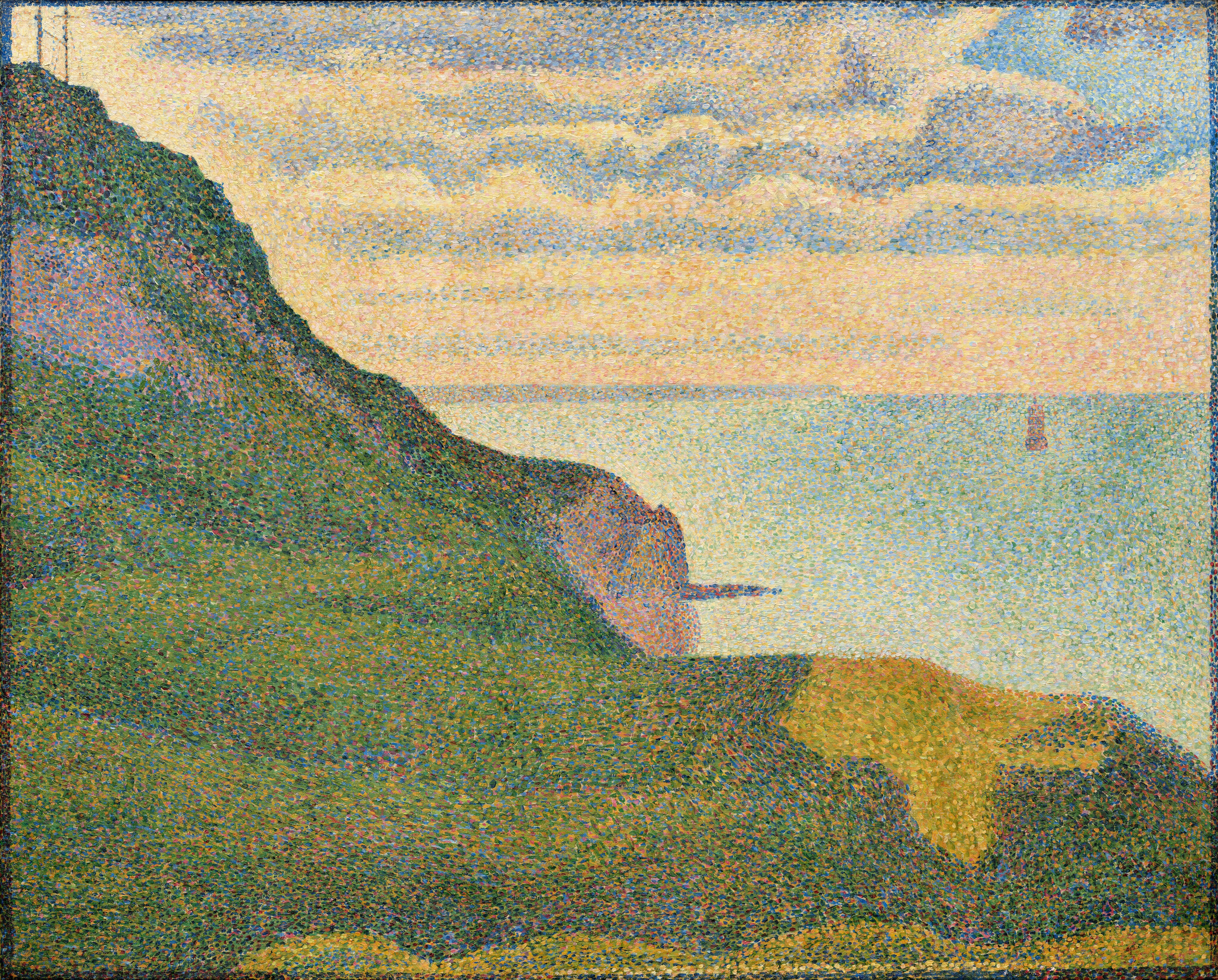
Seascape at Port-en-Bessin is Seurat’s coastal scene of 1888: green hills rolling back towards a turquoise-blue sea. The original measures 80.9 x 65.1 centimetres and is held in Washington by the National Gallery of Art under inventory number 1972.9.21. From us it is painted entirely by hand, oil on canvas, in eight sizes or to your own measurements, and before dispatch you receive a photograph of the finished work for approval.
| Title: | Seascape at Port-en-Bessin, Normandy |
| Other titles: | Seascape at Port-en-Bessin, Normandy · Marine à Port-en-Bessin |
| Painter: | Georges Seurat (1859–1891) |
| Year painted: | 1888 |
| Original size: | 80.9 cm x 65.1 cm |
| Original technique: | Oil on canvas |
| Painting style: | Pointillism |
| Located at: | National Gallery of Art, Washington (inv. no. 1972.9.21, not on view) |
| Our reproduction: | hand-painted oil on canvas, 8 sizes from 70 x 55 cm to 246 x 197 cm, custom size on request |
Seascape at Port-en-Bessin, Normandy – Georges Seurat
What is in the painting?
A coast seen from above. The museum’s own description says what the eye confirms: green hills roll back to a turquoise-blue sea, and the canvas is almost square. The hill angles from nearly the top left corner to the lower right and fills the bottom left half; it is mostly variegated shades of green, with two cliff-like, purple surfaces to the left. No people, no boats – only land, water and sky, arranged so that nothing happens.
Where is Port-en-Bessin, and why did the painter go to the coast?
Port-en-Bessin is a small harbour on the Normandy coast, and Seurat spent the summers of his last years in exactly such places. Each year he left Paris for the sea and came back with a run of coastal canvases; this one is from 1888. For a painter who assembled his large scenes over months in the studio, those coasts were something else: a motif that did not need arranging, because it was already arranged.
How is it made?
Out of layers of small dots. The museum names the colours the scene is built from outright: lavender, lilac, cool blue, warm green, yellow and peach. That is not a description of an impression but of a procedure – the dots stand separately and mix not on the canvas but in the eye. That is why the surface reads like a faintly trembling cloth, and why the work looks different in different light. A canvas painting put together this way falls apart into points of colour up close and reassembles itself at a distance.
Why does it feel so calm?
Because nothing occurs in it. No figure to be read, no narrative, no centre the eye is obliged to go to. Hill, sea and sky are divided into large, clean fields, and the only thing moving is the colour itself. With Seurat that is deliberate: in the same years he was painting circus and theatre scenes full of people, and the coast was their opposite – a place where the method works on its own.
What happened to the original?
The museum publishes the whole route, and it begins, as with several other works by Seurat, in the family. The canvas passed presumably as a gift or by inheritance from the painter to his mother, Mme. Seurat, then to his brother-in-law Léon Appert in Paris and to Appert’s son Léopold, who lived between 1867 and 1931. In 1924 Léopold sold it to the critic Félix Fénéon in Paris – the very man who gave the movement its name. In September 1937 it was acquired by Marie N. Harriman in New York, and on her death by her husband W. Averell Harriman; from him it passed to the W. Averell Harriman Foundation, which gave it to the museum in 1972. That ownership history is the museum’s; we add nothing to it.
Where does it sit in Seurat’s work?
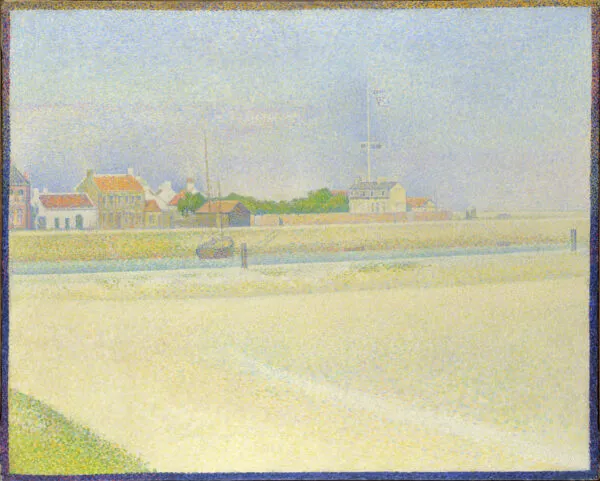
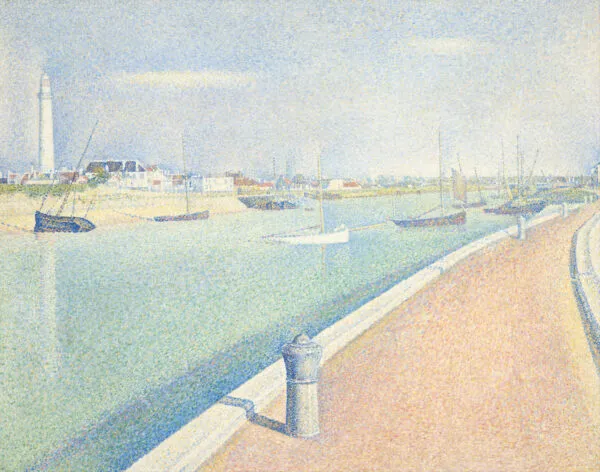
Among the coastal canvases of the late years, of which we also sell several. Evening, Honfleur is from the summer of 1886 and is just as empty; The Channel of Gravelines, Grand Fort-Philippe is from the last such summer. Léon Appert, who opens the history of this canvas, also opens that of the Vase of Flowers in Cambridge and of Angelica Chained to the Rock in Pasadena – three museums name him independently of one another. Pointillism is fully formed here, the high point of that method is held by the Art Institute of Chicago, and neo-impressionism had been named by Fénéon a few years earlier.
How is our hand-painted version made?
By hand and with a brush, never with a printer. Our painter works in oil paint on linen, and on this subject the balance is the hard part: the large, almost empty fields of sea and sky have to stay alive and at the same time must not fall apart into a pattern. The procedure is unforgiving – too few dots and the field stiffens, too many and the scene crumbles. Every hand-painted copy is therefore one of a kind and no two are quite alike; this is not an oil painting reproduction printed onto canvas but a painting made from scratch. Before dispatch we photograph the piece and send you the photograph for approval.
We hold no studio photographs of the finished work for this subject at present. When it is next painted we will photograph it and the shots will appear on this page.
Which size for which wall?
If you do not know which: 120 x 100 cm. The original measures 80.9 x 65.1 cm and sits between our first two rungs: 70 x 55 cm is the nearest below it, and 100 x 80 cm the nearest above and the closest to it in proportion. The format is horizontal and almost square, so it sits well on a quiet wall with no neighbours: 70 x 55 and 100 x 80 cm for an office or a hallway, 120 x 100 and 140 x 110 cm work as a standalone piece, 160 x 130 and 180 x 140 cm want a wall of their own, and 200 x 160 and 246 x 197 cm are for large rooms, where the sea gets its proper measure. Every fine art reproduction of this subject is made to order.
Custom size, stretcher bar and frame
If none of the eight sizes fits your wall, we paint the work to your measurements and keep the ratio of the original so the horizon is never stretched; that is our custom size painting service. You can order the painting in three forms: as a rolled canvas without a stretcher, stretched on a wooden stretcher bar and ready to hang, or framed; you choose the form when you order. You choose the frame in our 3D frame viewer: on this subject it shows every frame profile we carry, so you can compare gold, silver, black, white and natural wood — it is for choosing a frame and nothing else. To see how the work will look on your own wall, use our separate room-visualisation service.
Delivery and guarantee
Every copy is made to order in our studio in Slovenia, so allow 15 to 45 days depending on the size you choose. We ship it in the form you chose when ordering — rolled, stretched or framed — protected for transport, across the EU, customs-free. Before dispatch you receive a photograph of the finished work for approval, and our returns policy applies to every order. The full range by this painter is in the Georges Seurat gallery, and his coastal summers are described in our article about Georges Seurat, which also explains what separates a good famous painting copy from a poor one.
Frequently asked questions
Where is the original?
In Washington, at the National Gallery of Art, under inventory number 1972.9.21. The museum states that it is not on view.
What year is the work from?
The museum dates it to 1888 — a single year, with no “circa” and no span, and that is how we give it.
How large is the original?
The museum gives 65.1 x 80.9 centimetres as the overall measurement, so 80.9 x 65.1 cm in our width-by-height notation. We already gave the same measurement and the museum confirmed it.
Which colours are in it?
The museum lists them itself: lavender, lilac, cool blue, warm green, yellow and peach, applied in layers of small dots.
Who was Félix Fénéon?
The critic the movement owes its name to, and according to the museum’s record the owner of this canvas from 1924. The work hung for some years with the man who named the movement.
How did it reach Washington?
As the gift of the W. Averell Harriman Foundation in memory of Marie N. Harriman, in 1972.
Which size should I choose?
For a living room, 120 x 100 cm; the original sits between 70 x 55 and 100 x 80 cm, and 100 x 80 cm is the closest to it in proportion. The full size guide is above.
Can I have a size that is not listed?
Yes. We paint to measure, keeping the side ratio of the original.
Is this a print?
No. The work is painted by hand in oil on linen; the strokes are visible and can be felt, which a print cannot imitate.
How is it delivered?
In the form you chose (rolled, stretched on a stretcher or framed), 15 to 45 days after you approve the photograph of the finished work.
Is it suitable as a gift?
Very. A coastal subject is quiet and suits almost any room, and the greens and blues agree well with light walls. If you would rather leave the choice to the person receiving it, there is a gift voucher.
- Subject: green hills rolling back towards a turquoise-blue sea – no people and no boats
- Original: 80.9 x 65.1 cm, oil paint on canvas, National Gallery of Art, Washington (1972.9.21)
- Ours: hand-painted in oil on linen, eight sizes from 70 x 55 to 246 x 197 cm, as a rolled canvas, stretched or framed — your choice
- Worth knowing: this French painter left the canvas to his mother; from 1924 it belonged to Félix Fénéon, the critic who named the movement