







































Description
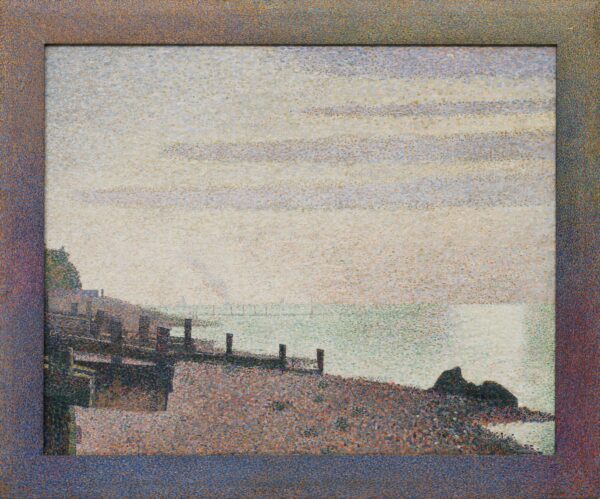
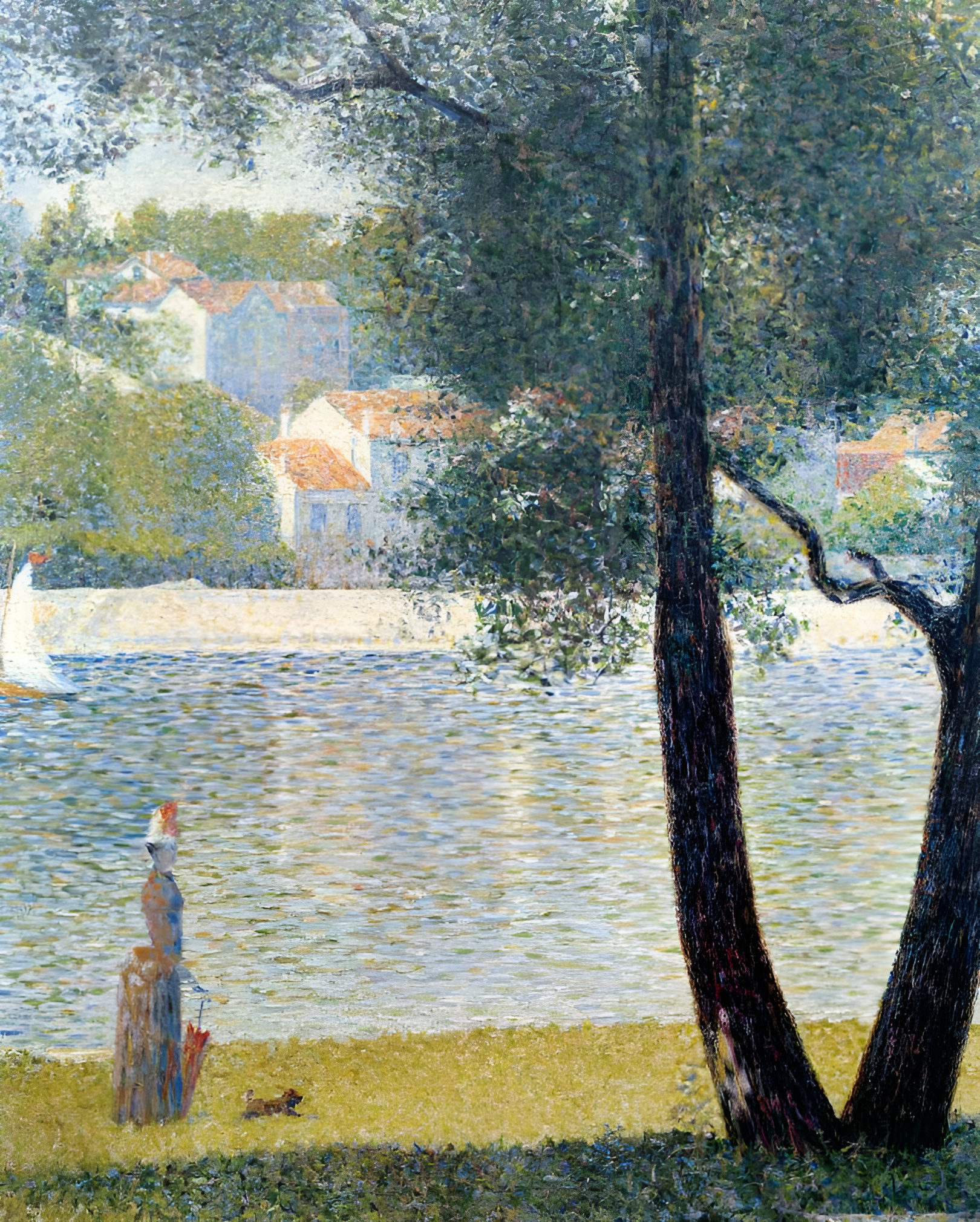
The Seine at Courbevoie is Seurat’s view across the river towards the houses and trees of the suburb of Courbevoie. The original is in a private collection in Paris, so there is no published object record for it: a year, a measured size and an inventory number are deliberately absent from this page, because we cannot check them against any institution. From us it is painted entirely by hand, oil on canvas, in eight sizes or to your own measurements, and before dispatch you receive a photograph of the finished work for approval.
| Title: | The Seine at Courbevoie |
| Painter: | Georges Seurat |
| Original technique: | canvas – the National Gallery’s own word for it |
| Our reproduction: | hand-painted oil on canvas, 8 sizes from 40 x 50 cm to 150 x 190 cm, custom size on request |
The Seine at Courbevoie – Georges Seurat
What is in the painting?
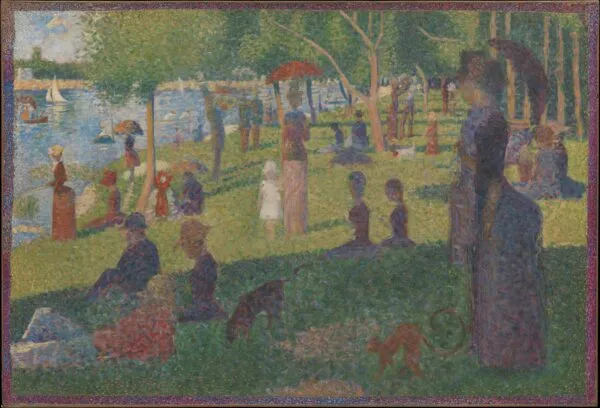
A view across the Seine. What is on this canvas is described by the National Gallery at one remove: it holds a small panel, The Morning Walk, connected to this canvas, and there it says how Seurat built the view. It describes the composition as stacked horizontal bands: the foreground, the river, the far riverbank, and the houses and trees of Courbevoie in the distance. It also states that our canvas is a medium-size work of that view. The description belongs to the panel, and we give it as such – not as a description of the original, which none of us has seen.
Courbevoie is a suburb north-west of Paris, opposite the island of La Grande Jatte, so the scene is what the title promises: river, bank, town.
Why is there no year, no size and no collection here?
What we deliberately do not state here: this canvas is not held by any public collection that has catalogued it, so there is no published object record, no measured dimensions and no inventory number. That is why you will not find a year of execution, a collection name or an accession number on this page. We say what can be checked against an institution, and nothing else.
This page used to look different. It carried a year, a size in centimetres and the name of a collection, and none of the three could be traced to an institution holding and cataloguing the work. So they are gone. Saying “we do not know this” is more honest than copying a number nobody stands behind. If a published record ever appears, we will add the details and say where they came from.
What remains can be checked: the title, the painter’s name, and the National Gallery’s word for the support – canvas. The rest of that table is ours, and therefore reliable.
What does the National Gallery say about this work?
Three things, and no more. First, that the panel in its collection relates to a medium-size canvas called The Seine at Courbevoie. Second, that this canvas is today in a private collection in Paris. Third, that Seurat may have painted the panel before deciding to produce a finished painting of this view at all, or as a study for it. The order is not certain even to the museum, and we do not hide that. The museum’s record is the only source we cite here.
The museum also describes how Seurat worked in these years: more than a hundred identically sized landscape studies on small panels, which look painted on site and continue the long-established tradition of the plein-air oil sketch. After the La Grande Jatte exhibition he went on working in the neighbouring suburbs of Courbevoie and Asnières. A canvas painting such as ours sits in a clearly defined working period, even if we do not know its day.
What does a private collection mean for you?
Two things, both practical. The first: you cannot go and see it. No room, no opening hours, no museum photograph anyone can open. It exists but is out of reach, and a hand-painted copy is the only way to have such a scene on a wall.
The second: with no published measured size, we cannot promise a one-to-one match. Our third size measures 64 x 81 cm and was in the range before, but we do not present it as the size of the original – that would need an institution that had measured the canvas. Each of our sizes is simply one of eight sizes, chosen to suit your wall.
Where does this work stand among Seurat’s paintings?
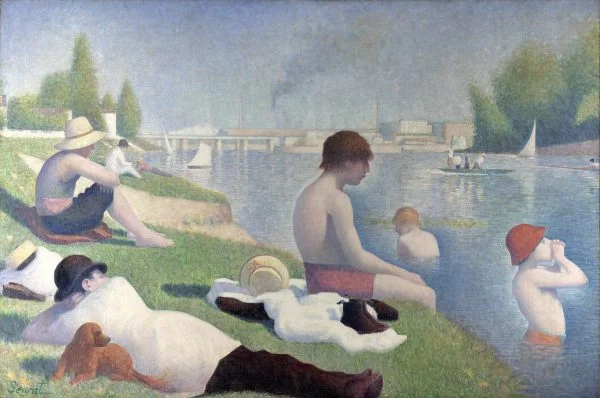
Among the river and coastal scenes, of which we sell several. The view towards Courbevoie is the background of his most famous painting, Sunday Afternoon on the Island of La Grande Jatte; later he carried the method to the sea, as in Seascape at Port-en-Bessin. Boats, Low Tide, Grandcamp also stands here with no institution holding it, built on the same principle as this page.
The wider movement Seurat led is neo-impressionism, and its technique is the one everyone knows by name: pointillism, colour laid down in small separate dots that mix not on the canvas but in the eye. That is why a fine art reproduction from this circle looks different under different light – it breaks into points of colour close up and reassembles from across the room. This French painter did not live to see how far the idea would travel.
How is our hand-painted version made?
By hand and with a brush, never with a printer. Our painter works in oils on a stretched canvas, and here the hardest thing is the balance of the three bands: foreground, water and distant town must stay distinct and yet not fall apart into three surfaces that do not speak to one another. The water is the most demanding part, because it must be quiet and still alive. Every copy is one of a kind; this is not a print but a painting made from scratch. Before dispatch we photograph it and send you the photograph for approval.
For this subject we currently have no studio photographs of our own of the finished work. When we next paint it, we will photograph it, and the photographs will appear on this page.
Which size for which wall?
If you do not know which: 80 x 100 cm. The format is upright, unusual for a river scene – the view is more gathered and goes into depth rather than across. An upright work sits well on a narrow wall or between two doors, where a landscape format would have no room.
We offer eight sizes, and with no measured size for the original we cannot call any of them the original one; choose the one that suits the wall. 40 x 50 and 50 x 60 cm for a smaller wall, a hallway or an office. 64 x 81 and 70 x 90 cm for a living room where the work is not alone. 80 x 100 and 90 x 110 cm stand on their own. 120 x 150 and 150 x 190 cm for large rooms with a high ceiling. Every copy is made to order.
Custom size, stretcher and frame
If none of the eight sizes fits your wall, we paint it to your measurements and keep the ratio of the subject, so the river is never stretched; that is our custom size painting. You can order the painting in three forms: as a rolled canvas without a stretcher, stretched on a wooden stretcher and ready to hang, or framed; you choose the form when you order. You choose the frame in our 3D frame viewer, which shows our profiles side by side – gold, silver, black, white and natural wood. To see the work on your own wall, use our separate room-placement service.
Delivery and guarantee
Every copy is made to order in our studio in Slovenia, so allow 15 to 45 days depending on the size. We ship it in the form you chose when ordering — rolled, stretched or framed — protected, across the EU, customs-free. Before dispatch you receive a photograph of the finished work for approval, and our returns policy applies. The full range by this painter is in the Georges Seurat gallery, and his river and coastal summers are in our article on Georges Seurat.
Frequently asked questions
Where is the original?
In a private collection in Paris, as the National Gallery states beside its own panel. We do not know the address or the owner, and we do not guess.
Why is there no year on the page?
Because no institution publishes one. The year that used to stand here could not be traced to an object record, so we removed it.
Why is the size of the original not given?
Because no public collection has measured the canvas. The dimensions circulating online have no institution behind them, and we would rather give none than a wrong one.
Who was the painter?
Georges Seurat, who developed painting in small separate dots and died very young. His dates are absent because this page writes none without a verifiable object record.
What is the original made of?
The National Gallery calls it a canvas, and says nothing further about the support or the paint. Neither do we.
What does it mean that the work is “related” to the museum’s panel?
The museum says Seurat painted the panel either before deciding on a finished painting of this view, or as a study for it. Which is true it leaves open, and so do we.
Which size should I choose?
For a living room, 80 x 100 cm. The upright format works well on a narrower wall; the full size guide is above.
Does any size match the original?
We cannot claim that. No institution has measured the original, so we mark none of our sizes as its size.
Can I have a size that is not on the list?
Yes. We paint to measure and keep the ratio of the sides.
Is this a print?
No. It is hand-painted in oils on canvas; the strokes can be seen and felt, which a print cannot imitate.
Is it suitable as a gift?
Yes. A river scene is quiet and suits almost any room, and its greens and blues agree with light walls. To leave the choice to the recipient, there is a gift voucher.
- Subject: the view across the Seine towards the houses and trees of Courbevoie, arranged in horizontal bands
- Original: in a private collection in Paris – with no published year, size or accession number
- Our version: a hand-painted oil painting reproduction on canvas, eight sizes from 40 x 50 to 150 x 190 cm
- Source: the National Gallery in London, beside its own panel The Morning Walk, which relates to this canvas