
Description
Portrait of Gustave Geffroy – the canvas its painter gave up on
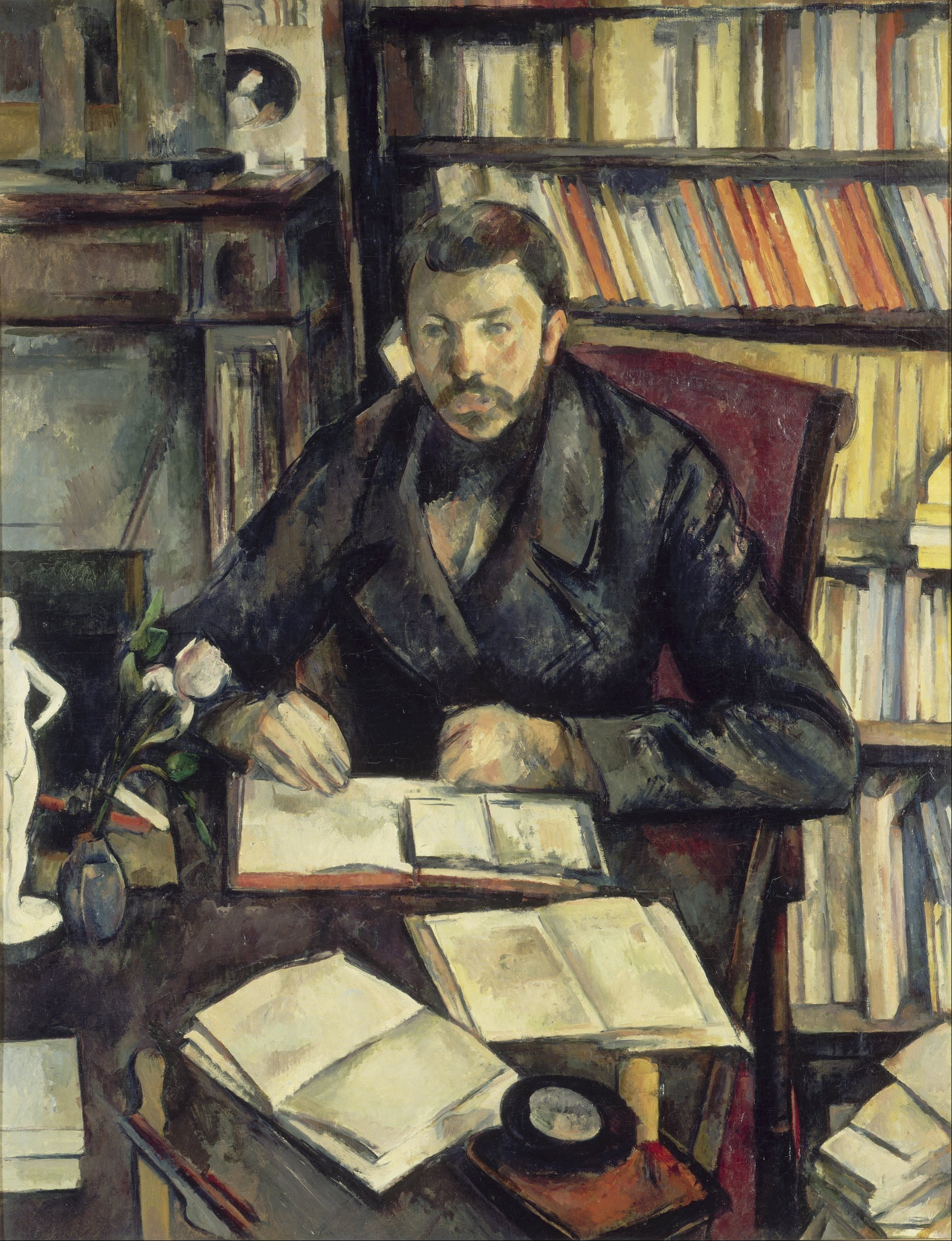
Gustave Geffroy sits at a table in his own study, leaning slightly forward, his hands together above an open book. Behind him a wall of shelves climbs to the top edge of the canvas, the spines painted as blocks of red, orange, blue and yellow. More open volumes and loose papers lie in front of him, a white plaster statuette stands at the left beside a white flower in a blue vase, and a dark inkstand sits at the lower right. This hand-painted painting on canvas reproduces Cézanne’s work of 1895 to 1896, which measures 116 × 89 centimetres in the original and hangs in the Musée d’Orsay in Paris under the inventory number RF 1969 29.
Who Gustave Geffroy actually was
Gustave Geffroy was born in Paris on 1 June 1855 and died there on 4 April 1926. From 15 January 1880 he wrote for La Justice, the newspaper of Georges Clemenceau, and it was through that office that he came to know the politician who would give him a public post decades later. He met Claude Monet in 1886 on the island of Belle-Île-en-Mer, where he had gone to research prisons; out of that chance meeting grew the friendship that eventually brought Cézanne into this study.
Geffroy was no casual onlooker. His Histoire de l’impressionnisme appeared in 1892, and La Vie artistique grew to eight volumes between 1892 and 1903, which makes him one of the earliest historians of a movement he was writing about while it was still going on. In 1900 he became one of the ten founding members of the Académie Goncourt. In 1908 Clemenceau appointed him director of the state tapestry works at the Gobelins, a post he held until his death. He also wrote L’Enfermé (1897) and a book on Claude Monet, published in Paris by Crès in 1922. The shelves at his back are therefore not decoration; they are the working library of a man who lived by writing.
Three months of sittings, and a letter to Monet
In March 1894 Geffroy published a sympathetic article on Cézanne in Le Journal. In November of the same year Monet arranged for the two men to meet, and the meeting ended abruptly. In April 1895 Cézanne wrote to Geffroy asking to paint him, and from April to July of that year Geffroy sat for him every day, for three months, in his own study.
Then Cézanne stopped, left the canvas where it stood and went home to Aix-en-Provence. On 6 July he wrote to Monet: “I am a little upset at the meager result I obtained, especially after so many sittings and successive bursts of enthusiasm and despair.” By Geffroy’s own account the painter said the task was too great for his powers. Why he broke off has been argued over for more than a century – resentment towards the critic, politics, a principle of painting, religion have all been proposed – but none of it is on record, and we will not choose between the explanations here.
What “unfinished” means on this canvas
The least resolved passages are the face and the hands. The hands above the book stand as pale shapes without knuckles; the face is built from broad loadings of paint, and the gaze passes to one side of the viewer. The library behind him, by contrast, is carried much further: every spine is a single charged stroke of the brush, and it is those vertical blocks of colour that give the work the rhythm the figure alone does not have. The catalogue raisonné records a single still-life heading for this canvas – book – although the books here fill an entire wall. The canvas therefore shows two hands at once: quick and certain in the background, slow and hesitant at the centre.
From the man who sat for it to the French state
The work stayed at first with Geffroy himself. On 28 January 1907 it passed to the Galerie Bernheim-Jeune in Paris, and from there to the collector Auguste Pellerin. It was afterwards with the family of René Lecomte in Paris; in 1969 it entered the Musée du Louvre, and in 2000 the Musée d’Orsay. The museum record names the donor explicitly: “Gift of the Pellerin family, 1969”. The canvas thus remained sixty-two years in one family, and in the end it was not sold but given to the nation.
Handed over one day, bought the next
The provenance carries two dates, and a single day separates them. The Galerie Bernheim-Jeune took the work on 28 January 1907, and Auguste Pellerin bought it on 29 January 1907. The portrait its own maker called a meager result, and refused to finish, spent twenty-four hours with the dealer. Later that same year, from 1 to 22 October 1907, it hung as number 16 in the Cézanne retrospective of the Salon d’Automne at the Grand Palais, lent by Pellerin himself.
The exhibitions – and the magazines that ran it when he died
It was first shown in public in April 1903 at Bernheim-Jeune, under the title La bibliothèque, and it was Geffroy himself who lent it. There followed the Musée de l’Orangerie in 1936, the Bibliothèque nationale in Paris in 1957 with Gustave Geffroy et l’art moderne, where the work went on the cover of the catalogue, and in 1977 the MoMA in New York with Cézanne: The Late Work, in which it was number 1, the opening work, before travelling on to Houston and to the Grand Palais. In 2017 it was at the Musée d’Orsay in Cézanne Portraits, a show that afterwards went to the National Portrait Gallery in London and the National Gallery of Art in Washington.
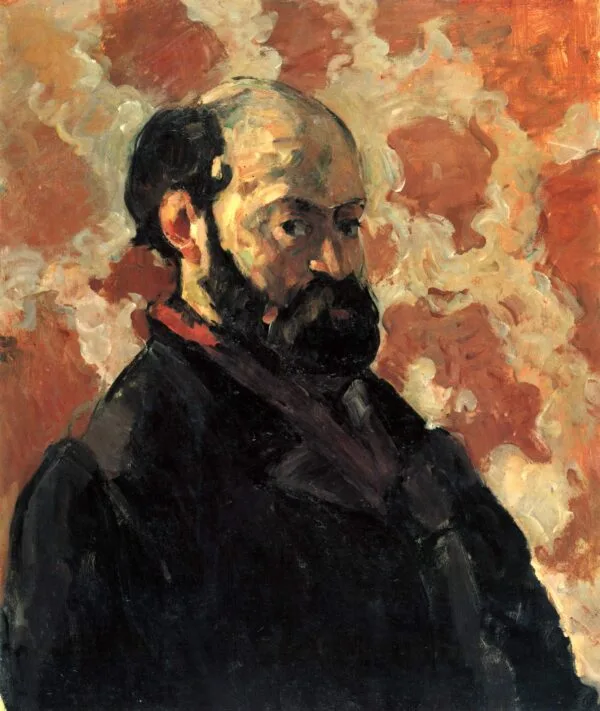
Geffroy died on 4 April 1926. Eleven days later, on 15 April 1926, two Paris art magazines carried this very canvas: L’Art vivant under the heading “Gustave Geffroy aux Gobelins”, and Le Bulletin de la vie artistique in its column “Les disparus”. The work Cézanne had left with an unfinished face became the likeness by which he was remembered. We paint this wall art in fifteen sizes, from 42 × 55 to 138 × 180 centimetres; intermediate measurements we stretch on a made-to-measure stretcher, and how it will look in the chosen frame is shown in advance by our 3D application. From the same Paris collection come Woman with a Coffeepot and Self-Portrait with a Pink Background, and in the same museum hangs Portrait of the Painter Achille Emperaire.
- Subject: Portrait of Gustave Geffroy, Paul Cézanne, 1895-1896, Musée d’Orsay, Paris
- Technique: hand-painted painting, oil on canvas, reproduction
- Sizes: 15 dimensions, custom size on request
- Of note: the painter left the canvas unfinished after three months of daily sittings, and at the dealer it found a buyer the very next day