Description
Oh! These Rumors! is the name Paul Klee gave in 1939 to a painting in which thick, soft, dark lines on a rough, speckled ground of grey-green, rust and dusty pink draw strange creatures leaning towards each other: a big blue face with two round eyes, a pinkish-red mouth, a large curled shape like an ear or a snail shell, and little feet along the bottom. The original, in distemper and oil on canvas, measures 75.5 x 55 cm and belongs to the Fondation Beyeler in Riehen near Basel. We paint it for you by hand, in oil or acrylic on canvas, choosing from 8 upright sizes between 30 x 40 and 151 x 200 cm or a size made to measure. Before it leaves us, you see it in a photograph.
| Title: | Oh! These Rumors! |
| Other titles: | O! diese Gerüchte! (German title) · Oh! Queste voci! (Italian title) |
| Painter: | Paul Klee (1879–1940) |
| Year painted: | 1939 |
| Original size: | 75.5 cm x 55 cm (height x width) |
| Original technique: | Distemper and oil on canvas |
| Painting style: | Modernism |
| Located at: | Fondation Beyeler, Riehen near Basel, Switzerland |
| Our reproduction: | Hand-painted in oil or acrylic on canvas, 8 sizes or made to measure |
Oh! These Rumors! – Paul Klee
What does this painting show?
A coarse, speckled ground of grey-green, rust and dusty pink covers the whole surface, scattered with tiny light and dark grains like an old stone grown over with lichen. Across it Klee drew thick dark lines with soft edges that come together as the outlines of a few odd creatures.
At the upper left a big blue face stares straight out with two round eyes. To its right opens a pinkish-red shape with two dark dots, like a snout whispering something. Lower down in the centre lies a large rounded form with an orange spiral, recalling an ear or a snail shell.
Around these heads are smaller signs: little round eyes peeping in from the edges and leaf-like marks. Along the bottom runs a row of thin little feet, so the creatures seem to shuffle and crowd together.
What does the title tell us about these creatures?
The title sounds like a sigh over news that has already gone round the village, and the figures do lean together, one with an open mouth, another with an enormous ear, like a little crowd that whispers and eavesdrops.
In the sources we rely on, Klee does not say which rumours he meant, so it is best to stay with what is visible. Who is talking and who is listening is for each viewer to decide; the faces look startled and comic rather than spiteful.
Why is this work so typical of late Klee?
In 1939 Klee was living in Bern and produced an extraordinary number of works, often drawn with thick, dark, bar-like lines that conjure a whole figure out of a few strokes. Here every line is at once an outline, a sign and part of a face.
Born in Switzerland to a German music teacher and a Swiss singer, Klee was a German artist shaped by expressionism, cubism and surrealism, and he played the violin from childhood. The poet Rilke wrote that his drawings often struck him as transcriptions of music.
This work has no Wikipedia article of its own; the painter is covered in the English Wikipedia article on Paul Klee.
Where is the original kept, and what is it made of?
The original belongs to the Fondation Beyeler in Riehen near Basel, Switzerland, where it is listed under inventory number 59.6. Klee painted it in 1939 in Bern, where he spent his last years after teaching at the Bauhaus (1921–1931) and at the Düsseldorf Academy (1931–1933).
It is executed in distemper and oil on canvas and measures 75.5 x 55 cm (height x width), a substantial size for an artist who often worked small, on paper, gauze or cardboard.
Two years earlier, in 1937, the Nazis hung seventeen of his works in the exhibition of so-called degenerate art and seized 102 of his works from public collections. Klee died in 1940, a year after this painting was made.
From the same late years comes The Vase, in which bold turquoise, blue and yellow signs surround a dark vase filled with round yellow blossoms.
This work or another Klee?
Oh! These Rumors! is a canvas painting for people who enjoy quiet humour, and its upright format suits a wall beside a door or in a hallway.
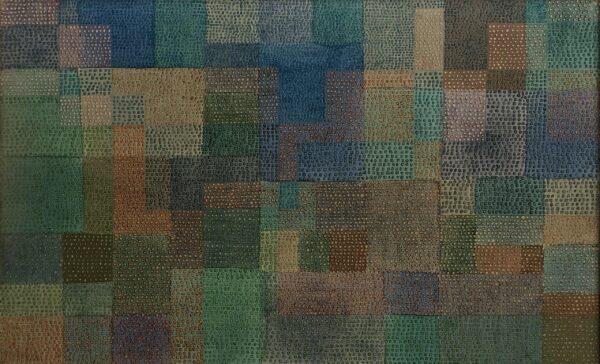
If Klee’s playful side appeals to you, look at Seventeen, Insane, where a face falls apart into its pieces beside the number 17 and two arrows. For a warm, festive wall there is Cliffs by the Sea, built from thousands of tiny squares of colour, and for a mysterious corner Botanical Theater, with invented plants on a dark stage.
All the famous Paul Klee paintings we offer, these four included, are gathered on our Paul Klee page.
How do we hand-paint this work on canvas?
The original is already on canvas. Ours is a hand-painted oil painting reproduction on fresh canvas, worked in oil or acrylic in the size you choose and built up layer by layer.
First the painter lays in the speckled ground in several thin, overlapping tones of grey-green, rust and pink, so the surface comes alive and never turns flat.
Then he pulls the thick dark lines with a broad brush, soft at the edges and equally strong all along, because the eyes, mouth, ear and feet grow out of them; the blue, pink and orange accents come last.
Which size suits which wall?
In short: 30 x 40 or 40 x 55 cm for a shelf or a bedside table, 47 x 62 and 60 x 81 cm for a hallway or the wall beside a door, 74 x 104 cm above a chest of drawers or a bed, 95 x 128 cm above a sofa, and 120 x 160 or 151 x 200 cm for a tall empty wall that the creatures can claim from floor almost to ceiling.
We offer the work in 8 upright sizes (width x height): 30 x 40, 40 x 55, 47 x 62, 60 x 81, 74 x 104, 95 x 128, 120 x 160 and 151 x 200 cm. The original measures 55 x 75.5 cm (width x height), so the smallest sizes are smaller than it, while from 74 x 104 cm upwards they enlarge it; at 151 x 200 cm the creatures are almost three times as wide as they are in Riehen.
As a painting for the living room it works best at 95 x 128 or 120 x 160 cm, where the thick lines read clearly from across the room and the earthy tones sit happily with wood and linen.
Can I get another size, and which frame should I choose?
Of course. For other proportions we keep the faces, ear and feet whole and only widen or shorten the speckled ground. Send us the size you have in mind and we will answer with a price and a date.
You can have it rolled, stretched on a stretcher bar or ready framed; our workshop in Slovenia does the stretching and, if you wish, the framing. You pick the moulding in the 3D app on our website, which serves only for choosing the frame; seeing the painting on your own wall is a separate service.
The rough, earthy ground suits a simple dark wooden frame or a slim moulding in natural oak, though it also hangs well unframed.
How soon will the painting arrive?
As soon as you confirm, the painter starts on the gossiping figures, and within 15 to 45 working days the painting is ready to ship. You get a photograph of it before we pack it, and any change you ask for is made.
No customs duties apply within Slovenia and the EU, and our returns policy covers every order.
This whispering crowd makes a witty present for anyone who enjoys a good joke and modern art; if you are unsure of the size, a wall art voucher leaves the choice to them.
Frequently asked questions
Where can I see the original?
At the Fondation Beyeler in Riehen near Basel, Switzerland, under inventory number 59.6.
Who are the creatures in the painting?
Invented figures with eyes, a mouth, a big ear and little feet, putting their heads together like gossips.
Will I get a print?
No. You get a hand-painted copy, worked by our painter with brushes on canvas in oil or acrylic.
How large is the original?
It measures 75.5 x 55 cm (height x width); our sizes run from 30 x 40 to 151 x 200 cm.
Is a size outside the list possible?
Yes. Tell us the width and height, and we will send you an offer with a price and a date.
How long will I wait for my painting?
From 15 to 45 working days; before dispatch you also receive a photograph of the finished work.
Is it a good choice for a bedroom or a present?
Yes. The calm, earthy colours are easy to live with, and the teasing title makes it a likeable present.
What does the title mean?
It is an exclamation about gossip; the creatures with their heads together can be read as a group swapping whispers.
- Subject: odd creatures drawn in thick dark lines on a speckled grey-green and pink ground, with a blue face and a big curled ear.
- Original: distemper and oil on canvas, 1939, 75.5 x 55 cm, Fondation Beyeler, Riehen.
- Ours: a Paul Klee reproduction hand-painted in oil or acrylic on canvas, in 8 sizes between 30 x 40 and 151 x 200 cm or made to measure.
- Worth knowing: painted in Bern in 1939, in Klee’s last years, when he worked with thick dark lines.