Description
The Vase is a painting by Paul Klee from 1938: on a pale grey ground, where the coarse weave of the jute shows through, stands a dark-outlined, long-necked vase full of round yellow blossoms, with signs in blue, turquoise, black and golden yellow floating around it. The original is oil on hessian, 88 cm high and 54.5 cm wide, and belongs to the Fondation Beyeler in Riehen near Basel. Our painter recreates it for you by hand on canvas, in oil or acrylic, in 8 upright sizes from 29 x 46 to 130 x 200 cm or made to measure. Before dispatch we send you a photograph of your finished vase on canvas.
| Title: | The Vase |
| Other titles: | Die Vase (German title) · Il vaso (Italian title) |
| Painter: | Paul Klee (1879–1940) |
| Year painted: | 1938 |
| Original size: | 88 cm x 54.5 cm (height x width) |
| Original technique: | Oil on hessian |
| Painting style: | Modernism |
| Located at: | Fondation Beyeler, Riehen near Basel, Switzerland |
| Our reproduction: | Hand-painted in oil or acrylic on canvas, 8 sizes or made to measure |
The Vase – Paul Klee
What does The Vase show?
The lower half belongs to a vase that Klee draws with one thick dark line. A horizontal bar closes it at the top like a rim; the line then runs down the long neck, swells into a round belly on the right and ends in a flat base. Inside, the vase is full of round yellow patches, flowers or fruit.
Lively signs are spread around the vase. Near the top floats a blue oval, with a turquoise hook beside it holding a yellow diamond. Lower down a blue wave winds across, on the left stands a turquoise curve shaped like a 3, and on the right a blue curl like a question mark. Black dots are scattered between them, and just above the vase rests a large yellow oval.
A small coral-red sprig grows in the top left corner, and a red leaf lies in the bottom right. A dark green painted border runs round everything like a frame.
What do the signs around the vase mean?
Our sources record no explanation from Klee for this work, so we do not give it a story we cannot confirm. The title only names what stands in the middle: a vase filled with yellow shapes.
English Wikipedia notes that from 1938 Klee worked more intensively with hieroglyph-like elements. Here too the forms are half letter, half object: one resembles a number, one a question mark, one a hook, while the sprig and the leaf are scraps of nature. Read it as a still life or as a page of signs: both stay open.
Why does this painting feel so cheerful?
The colours are few and clean: blue, turquoise, golden yellow and black on a calm grey. Because they never blend, the eye catches them from across the room, so the work looks fresh although it is more than eighty years old.
English Wikipedia describes Klee’s final designs as simpler and larger, with heavier lines and fewer but bigger blocks of colour. Here every sign is set down in one decisive stroke, with no shading and no fussy detail.
The work has no Wikipedia article of its own; for more on the painter, read the English Wikipedia article about Paul Klee.
Where is the original, and how was it made?
The original belongs to the Fondation Beyeler in Riehen near Basel, under inventory number 94.6. It measures 88 x 54.5 cm (height x width), fairly large for Klee, since many of his works are small and on paper.
He painted it in 1938 in Bern, where he had returned from Germany at the end of 1933, after teaching at the Bauhaus and the Düsseldorf Academy. According to English Wikipedia, he made 489 works in 1938 alone.
The support is hessian, the coarse jute cloth known from sacks, and its rough weave gives the surface warmth and life. Klee died in 1940.
The Vase or another Klee?
The Vase is a canvas painting for anyone who wants a bright, clear composition in an upright format. Tall and narrow, it fills the pier between two windows.
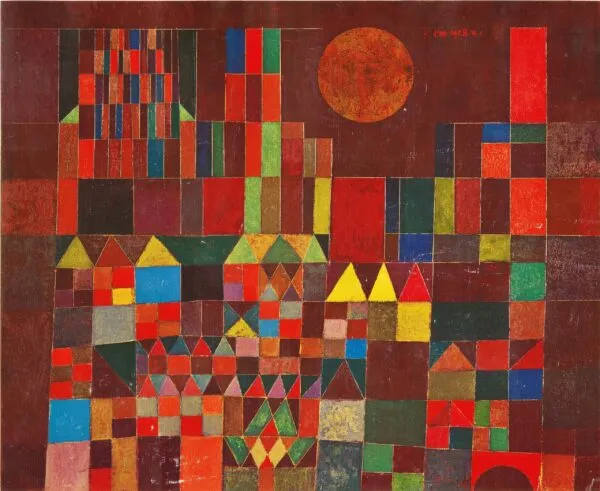
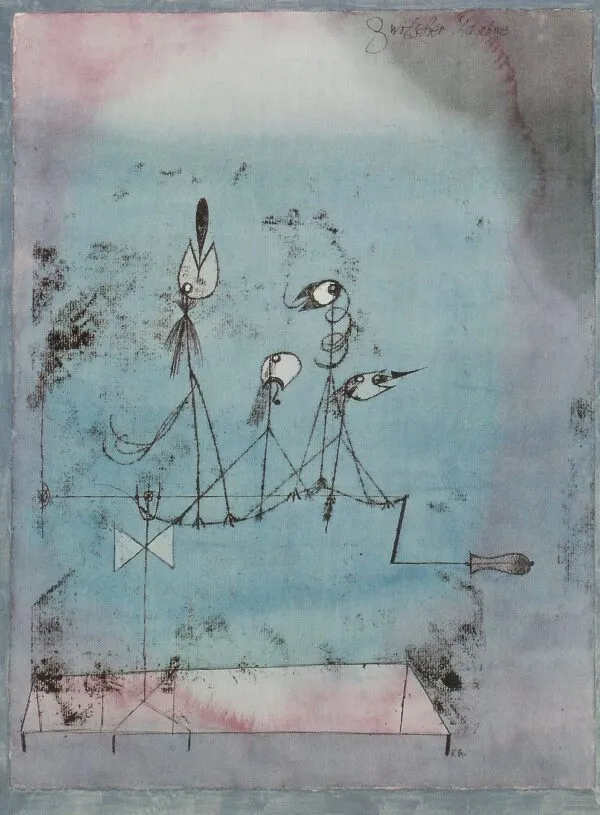
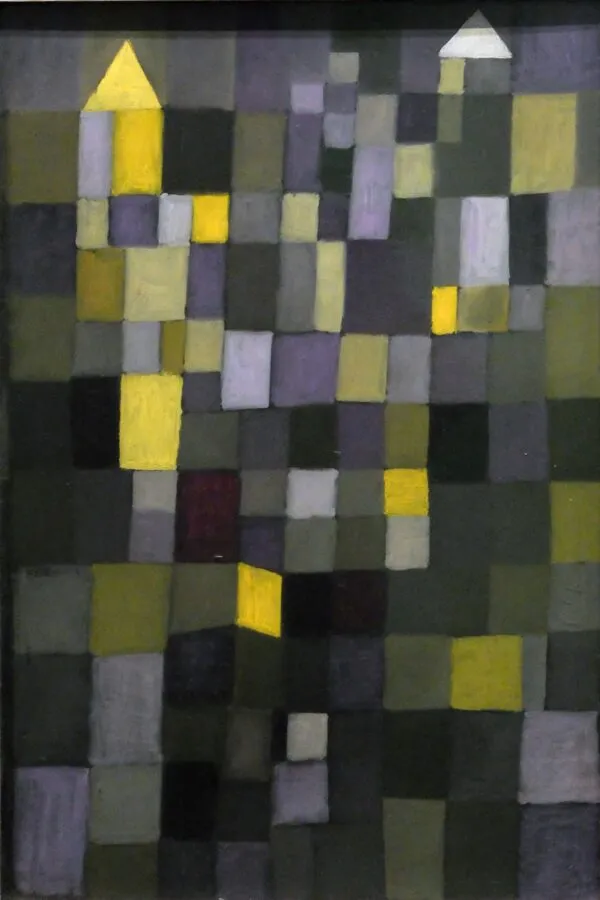
If you love fine, precise drawing, look at Botanical Theater, full of invented plants. For a warm, shimmering wall there is Cliffs by the Sea, built from thousands of tiny squares of colour, much like Ad Parnassum.
If Klee’s humour appeals to you, choose Seventeen, Insane, where a number and letters drift among the pieces of a face. The oldest in this group is Town with the Three Domes from 1914, a town of transparent patches that glow like stained glass.
Beside the vase, the famous Paul Klee paintings we offer are gathered on our Paul Klee page.
How do we hand-paint The Vase on canvas?
Klee’s original is painted in oil on jute, not on ordinary canvas. Ours is an oil painting reproduction on canvas: the painter works in oil or acrylic, in the size you choose, and builds it up layer by layer so that it hangs like any painted work.
First he marks on the grey ground where the vase and every sign belong, because the work only balances when the spacing is right. Then he pulls the thick dark lines of the vase, lays in the blue, turquoise and yellow shapes, and adds the dots, the leaf, the sprig and the green border last.
He brushes the grey on lightly and not quite evenly, with soft shifts towards pink and pale blue, so that it recalls the jute weave of the original.
Which size suits which wall?
In short: the two smallest for a narrow wall or the kitchen, the middle sizes beside a door or between windows, and 100 x 159 or 130 x 200 cm for a tall wall or a stairwell.
We paint The Vase in 8 upright sizes (width x height): 29 x 46, 40 x 62, 48 x 75, 55 x 85, 70 x 110, 77 x 129, 100 x 159 and 130 x 200 cm. The original measures 54.5 x 88 cm (width x height), so the smaller sizes are a little smaller than it and the larger ones enlarge it; at 130 x 200 cm the painting is more than twice as tall as in the museum.
As a painting for the living room it looks best at 77 x 129 or 100 x 159 cm, beside the sofa or between two windows.
Can I order another size or a frame?
Yes. If you need different proportions, say a less tall format, we widen or shorten the grey ground, while the vase and the signs stay whole and in place. Write to us with your own measurements and we will quote a price and a date for the vase.
The Vase reaches you rolled, stretched on a stretcher bar or framed; our workshop in Slovenia handles the stretching and framing and readies every painting for its journey. You pick the moulding for The Vase in our 3D app, which is only for choosing the frame, while seeing the painting on your own wall is a separate service.
As the work already has a painted dark green border, a plain frame suits it, such as a slim moulding in natural oak or a black one.
When will your painting arrive?
After you confirm, the painter starts on the vase and its signs, and the painting is ready to ship in 15 to 45 working days. Before packing you receive a photograph of the finished Vase; if you would like a change, we make it.
The Vase travels to you without customs duties within Slovenia and the rest of the EU, and your purchase is covered by our returns policy.
The vase of yellow blossoms makes a happy present for a housewarming, a wedding or a birthday. Unsure of the size? Give a wall art voucher and the recipient decides.
Frequently asked questions
Where is the original kept?
At the Fondation Beyeler in Riehen near Basel, Switzerland, under inventory number 94.6.
What is in the picture?
A dark long-necked vase full of yellow blossoms, surrounded by blue, turquoise and black signs on a grey jute ground.
Will I receive a print?
No. The Vase comes to you as a hand-painted copy, worked with brushes on canvas in oil or acrylic.
How big is the original?
It measures 88 x 54.5 cm (height x width); our sizes run from 29 x 46 to 130 x 200 cm.
Can I have The Vase in a size missing from the list?
Yes. Send us the width and height, and we will reply with a price and a date for your vase.
How long will I wait for my painting?
We paint The Vase in 15 to 45 working days and send you a photograph of it before dispatch.
Would it suit a dining room, or make a good gift?
Yes. The vase of flowers and the bright colours suit a dining room or kitchen, and as a present it pleases anyone who likes modern art.
What do the 3 and the question mark mean?
Klee did not explain them; the shapes only recall a number and a question mark, so everyone reads them in their own way.
- Subject: a dark-outlined vase of yellow blossoms among blue, turquoise and black signs on a pale grey ground.
- Original: oil on hessian, 1938, 88 x 54.5 cm, Fondation Beyeler, Riehen near Basel.
- Ours: a Paul Klee reproduction painted by hand in oil or acrylic on canvas, 8 upright sizes from 29 x 46 to 130 x 200 cm, or made to measure.
- Worth knowing: the work comes from Klee’s late years in Bern, when he painted with bold signs that look like writing.