







































Description
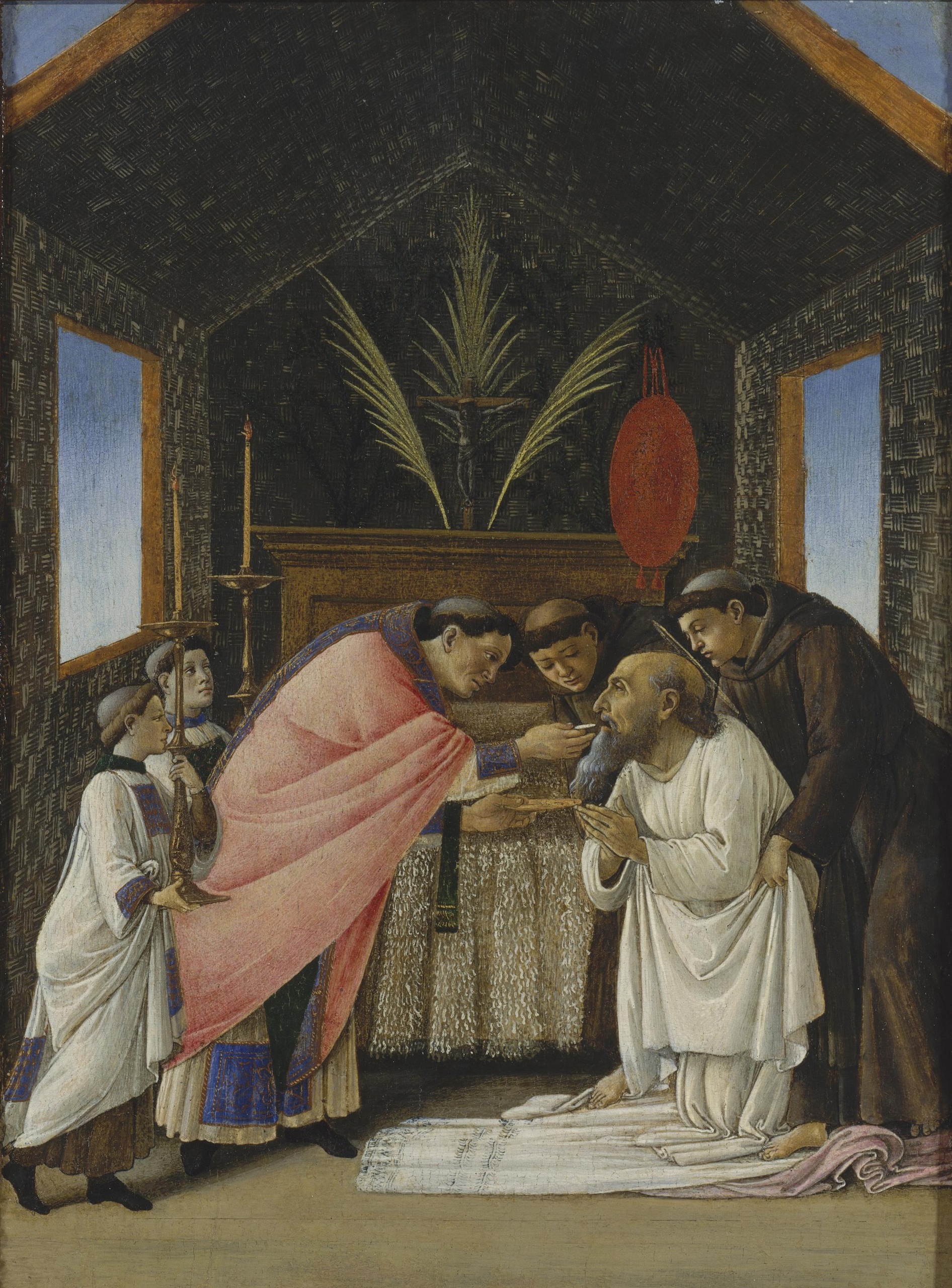
The Last Communion of Saint Jerome is a painting by Sandro Botticelli from about 1494–1495: inside a wooden hut, two monks hold up the old, bald saint in his white robe while a priest in a pink cope gives him the host. The original, tempera and gold on a wooden panel, measures just 34.3 x 25.4 cm and belongs to the Metropolitan Museum of Art in New York. Our painter paints it for you by hand in oil on canvas, in 6 portrait sizes from 45 x 60 to 136 x 180 cm or made to measure, every one of them larger than the original. Before your Saint Jerome is dispatched, we send you a photograph of it.
| Title: | The Last Communion of Saint Jerome |
| Other titles: | Comunione di san Girolamo (Italian title) · Zadnje obhajilo svetega Hieronima (Slovene title) |
| Painter: | Sandro Botticelli (c. 1445–1510) |
| Year painted: | c. 1494–1495 |
| Original size: | 34.3 cm x 25.4 cm (height x width) |
| Original technique: | Tempera and gold on panel |
| Painting style: | Early Renaissance |
| Located at: | Metropolitan Museum of Art, New York, USA |
| Our reproduction: | Hand-painted in oil on canvas, 6 sizes or made to measure |
The Last Communion of Saint Jerome – Sandro Botticelli
What does The Last Communion of Saint Jerome show?
We look into a plain wooden hut, as if its front wall had been lifted away. The roof beams meet in a point, the walls and ceiling are lined with woven reed mats, and through two windows, left and right, a pale blue sky shines in.
At the back stands an altar with a crucifix set between palm fronds. To its right a scarlet cardinal’s hat with tassels hangs on the wall.
On the right kneels the grey-bearded Jerome in white, a faint halo above his bald head. Two barefoot monks in dark brown habits support him: one leans over him, the other holds his robe.
From the left a priest bends towards him, his pink cope edged with blue and gold embroidery. In his right hand he holds the host, in his left a golden paten. Behind him stand altar boys in white, one with a tall candlestick, and under the saint’s knees a white linen cloth lies spread on the floor.
What story lies behind the scene?
Botticelli drew on a medieval letter attributed to Eusebius and addressed to Damasus, also known by its Latin title De morte Hieronymi. It is pseudepigraphical, written under Eusebius’s name but not by him, and no ancient author describes this scene.
According to the letter, the aged Jerome gathered the brothers of his monastery around him, lay on a linen sheet and asked one of them to bring him the body of Christ. When he saw the priest approach, he asked his companions to help him to his knees and professed his faith in Christ, present in the wafer.
The panel catches exactly that moment: the saint is already kneeling, the monks hold him, and the sheet he lay on is still spread across the floor.
The historian Rita Lizzi Testa links the picture with Girolamo Savonarola’s preaching in Florence and suggests the patron may have seen a parallel between Jerome and the friar; that is her reading, not a settled fact.
Why is this small panel so special?
Painters usually showed Jerome in his study, bent over his books. His last communion is a rare subject, which sets this panel apart among Botticelli’s works.
Its small format rewards a close look: every mat, palm leaf and stitch on the cope is painted in tiny strokes. The same quiet devotion fills Saint Augustine in His Cell, also a small late panel of a saint in his room.
For the source and the patron, see the English-language Wikipedia article.
Where is the original today, and how did it get there?
The original belongs to the Metropolitan Museum of Art in New York. It is painted in tempera and gold on a wooden panel of 34.3 x 25.4 cm, only a little larger than a sheet of A4 paper.
It was commissioned by the Florentine Francesco del Pugliese, a noted follower of Savonarola. It stayed with his heirs until about 1553, when it passed to the Capponi family.
In 1912 the daughter of Gino Capponi, the Marchesa di Farinola and last of that Florentine branch, decided to sell it. The following year the collector Benjamin Altman bought it, and he later gave it to the museum.
At the museum the panel sits in a carved and gilded frame from the workshop of Giuliano da Maiano, crowned by a lunette with the Trinity among angels painted by Botticelli’s assistant Bartolomeo di Giovanni. Our painting shows the panel alone, without the frame or the lunette.
The Last Communion of Saint Jerome or another Botticelli?
This canvas painting suits anyone who prefers a still, inward scene of faith to a lavish mythology. Its upright format fits a narrow wall, a prayer corner, a study or a hallway.
If Botticelli’s late years appeal to you, look at The Mystical Nativity, with angels circling above the stable, and at Lamentation over the Dead Christ (Milan), the mourning over Christ’s body. For a single standing saint there is Saint Sebastian.
All our other famous Botticelli paintings are gathered on the Sandro Botticelli page, each with its own choice of sizes.
How do we hand-paint The Last Communion of Saint Jerome?
The original is not an oil painting: Botticelli worked in tempera and gold on a wooden panel of 34.3 x 25.4 cm. Ours is a Sandro Botticelli reproduction hand-painted in oil on canvas, layer by layer, so we can send it rolled in a tube, stretched on a stretcher bar or ready framed.
Because all our sizes are larger than the original, the painter has more room for details that measure only millimetres on the panel: the weave of the mats, the palm leaves, the embroidery and the halo above Jerome’s head.
Which size for which wall?
In short: 45 x 60 or 58 x 75 cm for a bedroom or hallway, the middle sizes above a chest of drawers, the largest for a tall living-room wall.
We paint The Last Communion of Saint Jerome in 6 portrait sizes (width x height): 45 x 60, 58 x 75, 73 x 100, 91 x 127, 105 x 145 and 136 x 180 cm. The original measures only 25.4 x 34.3 cm (width x height), so every one of our sizes is larger: even 45 x 60 cm is nearly twice as tall, and 136 x 180 cm more than five times.
As a painting for the living room it comes into its own from 91 x 127 cm, when the monks’ faces and the embroidery on the cope can be read from the sofa.
Can I order another size, and which frame should I choose?
Yes. The scene is almost exactly 3 : 4, so most portrait sizes fit without cropping; for other proportions we adjust a strip of floor or wall, and the oil painting reproduction still shows the whole hut. Send us your custom size and we will quote a price and a date for this scene.
Our workshop in Slovenia stretches the canvas on a stretcher bar, frames it and packs it with care. The moulding for Saint Jerome is chosen in our 3D app, which handles frame choice only, while seeing the painting on your own wall is a separate service. A gold moulding echoes the panel’s gilded museum frame.
When will your painting of Saint Jerome arrive?
Your Last Communion is ready to ship 15 to 45 working days after you confirm the order. Once it is finished we send you a photograph, and if you would like a change, we make it before packing.
There are no customs within Slovenia and the EU, and our returns policy applies to every order.
This quiet scene makes a fitting gift for a confirmation or a retirement; if the size is uncertain, give a gift voucher instead.
Frequently asked questions
Where can I see the original?
At the Metropolitan Museum of Art in New York, which owns the panel.
What is the red hat on the wall?
It is Jerome’s cardinal’s hat, marked by its scarlet tassels.
Is it a print?
No. Every one is a hand-painted copy, brushed by our painter in oil colours on canvas.
How large is the original?
34.3 x 25.4 cm (height x width), so even our smallest size, 45 x 60 cm, is clearly larger.
Can you paint Saint Jerome in a size that is not listed?
Yes: give us the width and height, and we quote for this scene.
How long does the Jerome take, and how does it travel?
Dispatch after 15 to 45 working days, rolled, stretched on a stretcher bar or framed.
Does it suit a bedroom or a study?
Yes. Its calm browns and whites suit a quiet room.
Who commissioned the painting?
The Florentine Francesco del Pugliese, a follower of the preacher Girolamo Savonarola.
- Subject: the aged Jerome kneels in a wooden hut to receive his last communion from a priest, held up by two monks.
- Original: tempera and gold on panel, c. 1494–1495, 34.3 x 25.4 cm, Metropolitan Museum of Art, New York.
- Ours: hand-painted in oil on canvas, 6 sizes from 45 x 60 to 136 x 180 cm, all larger than the original, or made to measure.
- Worth knowing: the scene comes from a medieval letter on Jerome’s death and was rarely painted.