







































Description
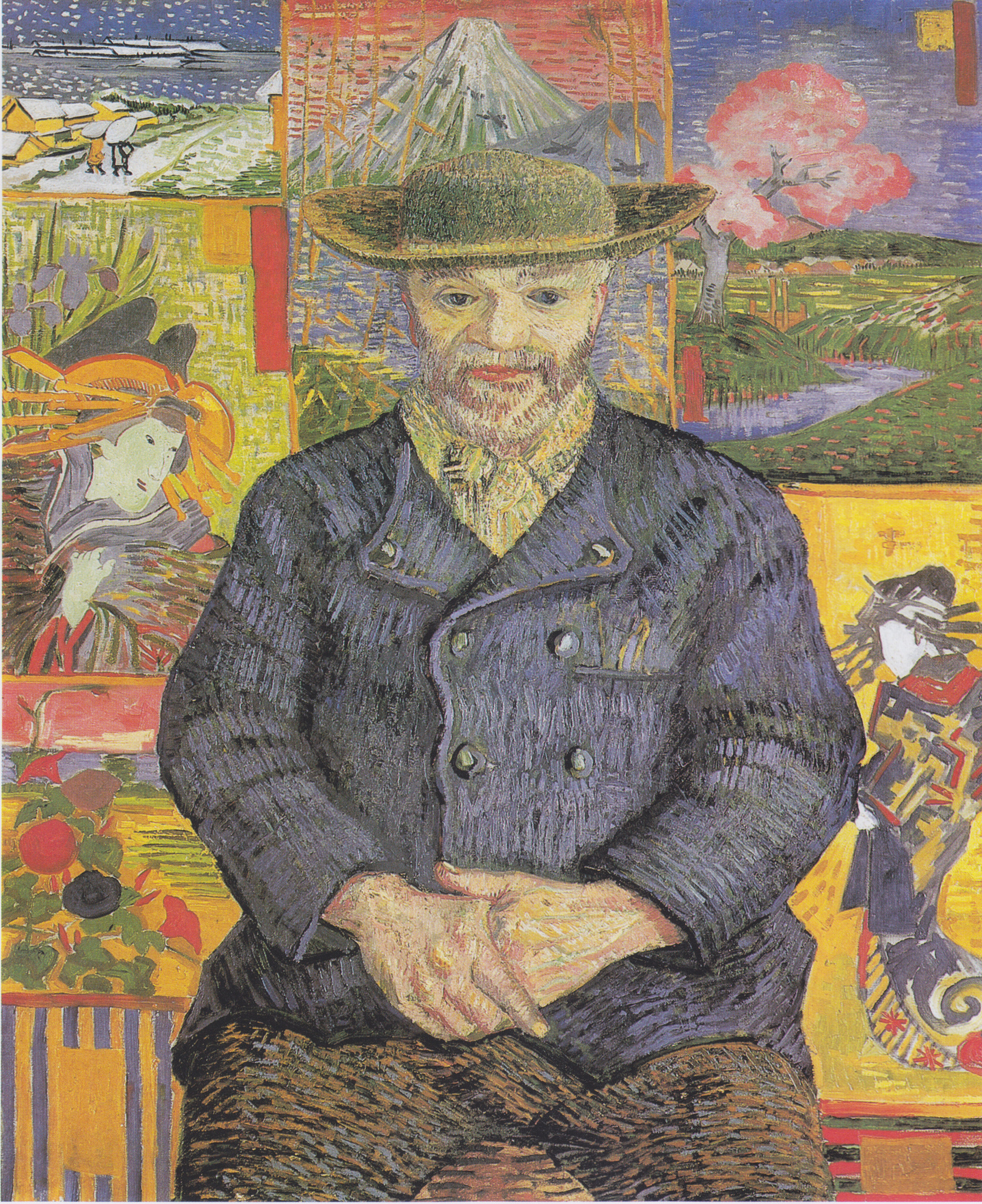
Portrait of Père Tanguy is the portrait Vincent van Gogh painted in Paris in 1887 of Julien-François Tanguy, the paint dealer known as Père Tanguy: a grey-bearded man in a brimmed hat and a blue jacket, sitting face-on with his hands clasped, in front of a wall of Japanese prints with Mount Fuji rising above his hat. The original, oil on canvas, measures 92 x 75 cm and is in the Musée Rodin in Paris. We paint it by hand in oil on canvas, in 17 sizes from 30 x 40 to 120 x 150 cm or to your own measurement, and send you a photograph of the finished work for approval before dispatch.
| Title: | Portrait of Père Tanguy |
| Other titles: | Père Tanguy · Le Père Tanguy |
| Painter: | Vincent van Gogh (1853–1890) |
| Year painted: | 1887, Paris |
| Original size: | 92 cm x 75 cm |
| Original technique: | Oil on canvas |
| Painting style: | Post-Impressionism |
| Located at: | Musée Rodin, Paris (acc. no. P.07302) |
| Our reproduction: | Hand-painted oil on canvas, 17 sizes or made to measure |
Portrait of Père Tanguy – Vincent van Gogh
What does Portrait of Père Tanguy show?
An older man sits facing us in the middle of the canvas, seen from his hat down to his lap. He has a short grey beard and a broad, weathered face, and wears a straw-coloured hat with a wide brim. His jacket is a deep blue, buttoned high, with two rows of buttons, and his brown trousers show at the bottom edge. His hands are folded in his lap, one over the other.
Behind him the whole wall is covered with Japanese prints, pinned edge to edge. At the top, in the middle, the white cone of Mount Fuji stands against a blue sky, so that the mountain seems to sit on the crown of his hat. To the left of it is a village under snow, to the right a tree in pink blossom above a river. Further down, a figure in Japanese dress looks out on each side, the one on the right standing in a patterned kimono against bright yellow, and in the lower left corner there are red flowers.
Why is Père Tanguy sitting in front of Japanese prints?
According to the Musée Rodin, the wall is filled with Japanese prints that Vincent and his brother Theo collected. The English Wikipedia article on the portraits of Père Tanguy adds that they were prints sold at Tanguy’s shop, and it singles out Mount Fuji on top of his hat and kabuki actors sharing the wall with cherry trees in bloom.
The prints also give the painting its colour. The museum describes pure colours, complementary colours set against each other, visible brushwork and a flat space, the marks of Neo-Impressionism. Wikipedia notes that in 1887 Van Gogh began to set red against green and orange against blue: here the blue jacket stands in front of yellow and orange.
What does Portrait of Père Tanguy mean?
It is a portrait of a friend. Julien-François Tanguy ran a small paint shop in Paris and, the museum writes, often accepted paintings in exchange for what he sold; Van Gogh, who had come to Paris in 1886 to join Theo, valued him as a friend. Wikipedia explains that his nickname, Père, simply means Father.
The museum reads the pose closely: Tanguy is shown frontally, hands clasped over his stomach, immobile and lost in thought, and the prints around him make him look like a Japanese sage. Wikipedia quotes the historian Naomi Maurer, who speaks of the iconic tranquillity of a Buddha, and sees in the calm of the sitter a serenity that Van Gogh was looking for himself.
Where is the original today?
The original is in the Musée Rodin in Paris, which lists it as Père Tanguy by Vincent van Gogh, 1887, oil on canvas, 92 cm high and 75 cm wide, under the inventory number P.07302.
How it got there is told in two ways. The museum writes that Tanguy never parted with the painting, and asks, without answering, whether Auguste Rodin bought it in 1894; Rodin had his own collection of Japanese prints, and the museum quotes him calling Van Gogh an admirable demolisher of academic formulae. Wikipedia states that after Tanguy’s death his daughter sold the portrait to Rodin.
Portrait of Père Tanguy or another Van Gogh – which should you choose?
First, which Tanguy this is. The museum and Wikipedia both say that Van Gogh painted three portraits of Tanguy. According to Wikipedia, the first, from the winter of 1886/87, is mostly brown; the one we paint is the canvas in the Musée Rodin, with Tanguy seated face-on in front of a wall of Japanese prints.
If you like the Japanese side of the painting, four works from our range go with it. Courtesan is Van Gogh’s painting after a Japanese woodcut by Keisai Eisen, made in Paris in 1887, and Bridge in the Rain is his 1887 copy after Hiroshige. Pink Peach Tree in Blossom shows a tree in flower, like the blossoming tree pinned behind Tanguy. Self-Portrait as an Artist, from his Paris years, shows the painter himself at the easel. Choose Tanguy for a calm face surrounded by colour, Courtesan for a single Japanese figure, and Bridge in the Rain for a landscape.
How is our hand-painted Portrait of Père Tanguy made?
The painter first draws the figure, the hat, the hands and the edges of the prints behind him, and checks the proportions against the original. Then come the prints, one by one, from Mount Fuji down to the flowers, after them the blue jacket and the hands, and last the face, the beard and the hat. Our oil painting reproduction is painted by hand in oil on canvas with real impasto: the paint goes on thickly, so the brushstrokes stand up from the canvas as they do in the original and catch the light.
On this painting the relief shows most in the short strokes of the jacket, in the beard and in the dense, patterned touches of the prints. A print shows only a flat surface; on our painting the strokes are real.
Every painting is a hand-painted copy made for your order, so no two are quite the same.
Which size for which wall?
Short answer: 40 x 50 or 50 x 62 cm for a narrow wall in a hallway or a study, 73 x 95 or 80 x 100 cm above a chest of drawers or a desk, and 100 x 120 or 120 x 150 cm above a sofa or on a large wall.
There are 17 sizes: 30 x 40, 40 x 47, 40 x 50, 41 x 51, 50 x 61, 50 x 62, 54 x 65, 60 x 70, 63 x 80, 70 x 85, 73 x 95, 80 x 100, 90 x 108, 93 x 115, 100 x 120, 105 x 125 and 120 x 150 cm (width x height). The original is 75 cm wide and 92 cm high, so our 73 x 95 cm size is close to the size of the original, and 80 x 100 cm is a little larger with almost the same proportions. A painting for the living room should cover about two thirds of the width of the furniture below it.
Hang it with the centre of the canvas about 150 cm above the floor, so that Tanguy’s face is close to your own eye level. Above a sofa, a bed or a sideboard, leave 20 to 30 cm between the furniture and the bottom edge.
What if I need a custom size or a frame?
If none of the 17 sizes fits your wall, we paint it to measure in any width and height you need. Send us the width and height you want and we will quote a price and a lead time. Every painting we make is stretched over a wooden stretcher and ready to hang.
For the moulding, use our 3D application: it shows each of our frame profiles on this subject, so you can compare gold, silver, black, white and natural wood – the application is for choosing the frame only. Seeing the painting on your own wall is our separate room placement service. A gold moulding picks up the yellow and orange of the prints, while a dark wood or black one repeats the deep blue of the jacket and keeps the colours calm.
How does delivery work, and what is the guarantee?
Every painting is made to order in our studio in Slovenia, so allow 15 to 45 days depending on the size you choose. We ship it stretched and protected, framed if you chose a frame, across the EU with no customs. Before dispatch you receive a photograph of the finished work to approve, and we correct anything that is not right. Our returns policy applies to every order.
You will find more famous Van Gogh paintings among all our Vincent van Gogh paintings, and more about the painter in our article on Vincent van Gogh. If it is a present and you are not sure of the size, a wall art voucher lets the recipient choose.
Frequently asked questions
Where is the original Portrait of Père Tanguy today?
In the Musée Rodin in Paris. The museum lists it as Père Tanguy, 1887, oil on canvas, 92 x 75 cm, under the inventory number P.07302. It belonged to Auguste Rodin before it belonged to his museum: according to Wikipedia, Tanguy’s daughter sold it to Rodin after her father’s death, while the museum leaves open whether Rodin bought it in 1894.
Who was Père Tanguy?
Julien-François Tanguy, a Paris shopkeeper who sold paint and artists’ materials. The Musée Rodin writes that he often took paintings in exchange for his goods, and Wikipedia that he took paintings as payment for paints. His nickname, Père, means Father. Van Gogh met him after coming to Paris in 1886, valued him as a friend and painted his portrait three times.
When and where did Van Gogh paint the Portrait of Père Tanguy?
In Paris, in 1887. The Musée Rodin dates the painting to 1887. Van Gogh was living in the city, where he had moved in 1886 to join his brother Theo. Wikipedia places it in the year when he began to set red against green and orange against blue, and the painting shows exactly those contrasts.
What are the Japanese prints behind Père Tanguy?
Woodblock prints from Japan of the kind Van Gogh and his brother collected. The Musée Rodin says the prints in the background were collected by Vincent and Theo, and Wikipedia that they were sold at Tanguy’s shop. Wikipedia names Mount Fuji above his hat and kabuki actors beside cherry trees in bloom.
How many portraits of Père Tanguy did Van Gogh paint?
Three, according to both the Musée Rodin and Wikipedia. Wikipedia describes the first, from the winter of 1886/87, as mostly brown, with a touch of red on the lips and green on the apron. The version we paint is the one in the Musée Rodin, from 1887, with Tanguy seated face-on in front of a wall of Japanese prints.
Why does Père Tanguy sit so still in the portrait?
Because the calm is the subject. The Musée Rodin describes him as immobile and lost in thought, hands clasped over his stomach, and says that the prints make him look like a Japanese sage. Wikipedia quotes a historian who sees the tranquillity of a Buddha in him and links it to the serenity Van Gogh wanted for himself.
How big is the original Portrait of Père Tanguy?
92 cm high and 75 cm wide, according to the Musée Rodin: a large upright format for a portrait. Our 73 x 95 cm size comes close to the original, and 80 x 100 cm is slightly larger. If you want Tanguy smaller or larger, there are 17 sizes from 30 x 40 to 120 x 150 cm, and custom sizes in any proportions.
Which size of the Portrait of Père Tanguy suits a living room?
Above a sofa, choose 100 x 120 or 120 x 150 cm, so that the canvas painting holds its own on a large wall and the prints behind Tanguy can be read from across the room. On a narrower wall, beside a bookcase or above a sideboard, 63 x 80 or 80 x 100 cm is enough. For a small room, 50 x 62 cm keeps the face clear.
Does your Portrait of Père Tanguy have the raised brushstrokes of the original?
Yes. We paint our Tanguy in impasto: the paint goes on thickly, so the brushstrokes stand up from the canvas as on Van Gogh’s original. You see it best in the short strokes of the blue jacket, in the grey beard and in the small coloured touches of the prints behind him, where the relief catches the light from the side.
- Subject: the Paris paint dealer Julien Tanguy, seated face-on in a brimmed hat and a blue jacket, in front of a wall of Japanese prints with Mount Fuji.
- Original: 1887, Paris, oil on canvas, 92 x 75 cm, Musée Rodin, Paris.
- Ours: a Van Gogh reproduction painted by hand in oil on canvas, in 17 sizes from 30 x 40 to 120 x 150 cm or made to measure.
- Worth knowing: our 3D application shows every frame profile on this portrait, so you can choose the frame before you order.