







































Description
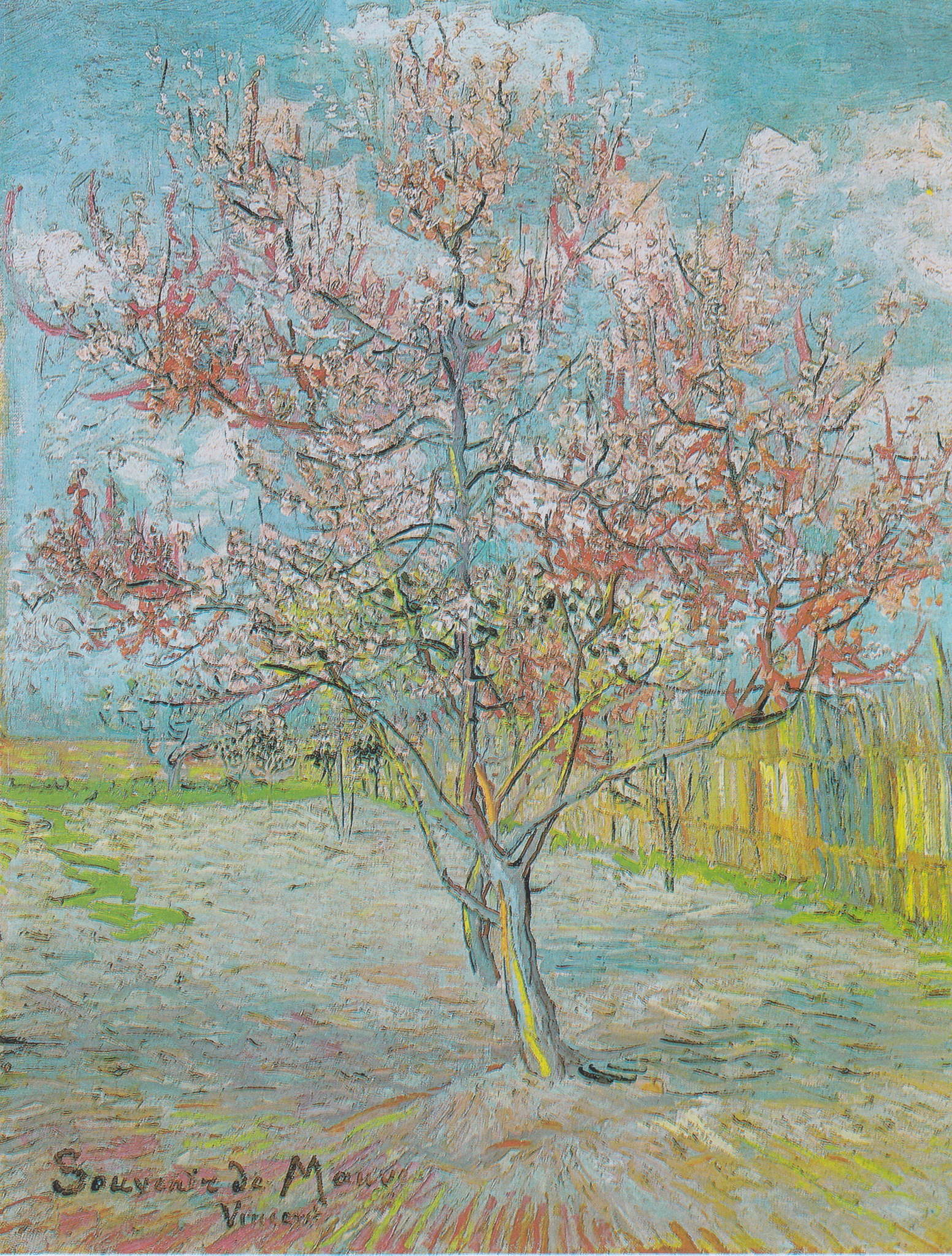
Pink Peach Tree in Blossom (Reminiscence of Mauve) is the spring painting Vincent van Gogh made in Arles around 30 March 1888: a young peach tree in full pink blossom on a patch of freshly dug ground, with a wicker fence behind it and a blue sky with white clouds. In the lower left corner he wrote “Souvenir de Mauve”, in memory of the painter Anton Mauve, his cousin by marriage and teacher. The original, oil on canvas, measures 73 x 59.5 cm and hangs in the Kröller-Müller Museum in Otterlo. We paint it by hand in oil on canvas, in 17 sizes from 30 x 40 to 120 x 150 cm or to your own measurement, and send you a photograph of the finished work for approval before dispatch.
| Title: | Pink Peach Tree in Blossom (Reminiscence of Mauve) |
| Other titles: | Pink Peach Trees (Souvenir de Mauve) · Roze perzikbomen (Souvenir de Mauve) · Souvenir de Mauve |
| Painter: | Vincent van Gogh (1853–1890) |
| Year painted: | c. 30 March 1888, Arles |
| Original size: | 73 cm x 59.5 cm |
| Original technique: | Oil on canvas |
| Painting style: | Post-Impressionism |
| Located at: | Kröller-Müller Museum, Otterlo (inv. KM 108.317) |
| Our reproduction: | Hand-painted oil on canvas, 17 sizes or made to measure |
Pink Peach Tree in Blossom (Reminiscence of Mauve) – Vincent van Gogh
What does the painting show?
A young peach tree stands in the middle of the canvas, covered in pale pink blossom. Its slim trunk divides low down into thin, crooked branches that reach out to both edges, and close behind it a second trunk rises from the same spot. The ground around it has been dug over and shines in pale lilac, cream and pink, with strips of fresh green grass along the left side.
On the right a yellow wicker fence runs into the distance, and above everything there is a light blue sky with white clouds. In the lower left corner Van Gogh painted the words “Souvenir de Mauve” and, beneath them, his signature “Vincent”.
Why does the painting say “Souvenir de Mauve”?
Because it is a painting in memory of Anton Mauve. According to the Kröller-Müller Museum, on the evening of the day Van Gogh made it he found a letter from his sister telling him that Mauve had died. Mauve was not only his cousin by marriage; he had also taught him to paint in oils and watercolour. Van Gogh decided to dedicate the work to him.
He wrote to Theo that he had inscribed it “Souvenir de Mauve Vincent & Theo” and that, if Theo agreed, they would send it to Mrs Mauve in both their names. He told his sister the same in a letter of about 30 March 1888, letter 590 in the online edition of his letters. The editors note that the words “& Theo” can no longer be seen on the canvas; Vincent probably removed them at Theo’s insistence.
What does the painting mean?
It is a memorial without any mourning in it. Van Gogh wrote to Theo that in memory of Mauve “we needed something that was both tender and very cheerful and not a study in a more serious key than that”.
The colour says something too. In the same letter to his sister he wrote that the countryside of the south could not be painted with the palette of Mauve, whom he called the master of grey, and that the palette of his own day was colourful: sky blue, pink, orange, vermilion, brilliant yellow, bright green. The pink blossom and blue sky can be read as his answer to his old teacher. The museum adds that Van Gogh considered this one of the most successful paintings of his whole blossom series.
Where does the original hang?
The original hangs in the Kröller-Müller Museum in Otterlo, in the Netherlands, which lists it as Roze perzikbomen (‘Souvenir de Mauve’), c. 30 March 1888, oil on canvas, object number KM 108.317. The online edition of the letters gives its size as 73 x 59.5 cm and its catalogue numbers as F 394 and JH 1379.
Van Gogh meant it for Mauve’s widow, Jet Mauve. According to the editors of the letters, he sent it to Theo in May 1888 with his first batch of paintings from Arles, and a later letter shows that Jet Mauve did receive it.
Pink Peach Tree or Almond Blossom – which one is which?
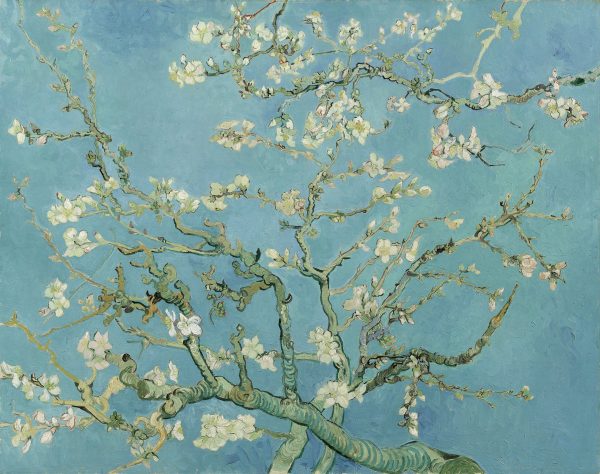
Both are blossom paintings, built very differently. This one shows a whole small tree standing in an orchard, with ground, fence and sky around it. Almond Blossom comes much closer: flowering branches seen against a flat blue sky, with no ground at all. The peach tree is part of the series Van Gogh painted in the orchards of Arles in the spring of 1888.
For more Arles in our range, The Yellow House shows the house where he lived and worked, Sunflowers I builds a whole painting on yellow, and Café Terrace at Night turns to the town at night. Choose the peach tree for soft pink and blue in a calm room, Almond Blossom for a quiet bedroom, and Café Terrace at Night if you want strong colour and contrast.
How is our hand-painted version made?
The painter first draws the trunks, the main branches and the line of the fence and checks the proportions against the original, so the tree stands exactly where Van Gogh placed it. Then come the sky and clouds, the dug-over ground in its pale lilac and cream strokes, the green grass and the yellow fence, and last the branches and the pink blossom, dabbed on in small touches, with the inscription in the corner. Our oil painting reproduction is painted by hand in oil on canvas with real impasto: the paint goes on thickly, so the brushstrokes stand up from the canvas as they do in the original and catch the light.
On this painting the relief shows most in the blossom, where every flower is a small raised dab of pink and white, in the short, crossing strokes of the ground and in the upright strokes of the fence. A print shows only a flat surface; on our painting the strokes are real.
Every painting is a hand-painted copy made for your order, so no two are quite the same. Before dispatch we photograph it, sending you the photograph to approve.
Which size for which wall?
Short answer: 30 x 40 or 40 x 50 cm for a small wall in a hallway, a study or beside a bed, 60 x 70 or 63 x 80 cm above a chest of drawers or a sideboard, 100 x 120 or 120 x 150 cm above a sofa or a bed.
There are 17 sizes: 30 x 40, 40 x 47, 40 x 50, 41 x 51, 50 x 61, 50 x 62, 54 x 65, 60 x 70, 63 x 80, 70 x 85, 73 x 95, 80 x 100, 90 x 108, 93 x 115, 100 x 120, 105 x 125 and 120 x 150 cm (width x height). The original is 59.5 cm wide and 73 cm high, so our 60 x 70 cm size comes closest to the size of the painting in the museum. The 40 x 50, 80 x 100 and 120 x 150 cm sizes keep almost exactly its upright proportions of about four to five. The pale pink and light blue make this a soft, bright painting: it looks good on a white, cream, light grey or sage green wall. A painting for the living room should cover about two thirds of the width of the furniture below it.
Hang it with the centre of the canvas about 150 cm above the floor. Above a sofa, a bed or a sideboard, leave 20 to 30 cm between the furniture and the bottom edge.
What if I need a custom size or a frame?
If none of the 17 sizes fits your wall, we paint it to measure. Send us the measurements you want and we will quote a price and a lead time. Every painting we make is stretched over a wooden stretcher and ready to hang.
For the moulding, use our 3D application: it shows each of our frame profiles on this subject, so you can compare gold, silver, black, white and natural wood – the application is for choosing the frame only. Seeing the painting on your own wall is our separate room placement service. A light natural wood or a white frame suits the pale spring colours; a narrow gold frame picks up the yellow of the fence.
How does delivery work, and what is the guarantee?
Every painting is made to order in our studio in Slovenia, so allow 15 to 45 days depending on the size you choose. We ship it stretched and protected, framed if you chose a frame, across the EU with no customs. Before dispatch you receive a photograph of the finished work to approve, and we correct anything that is not right. Our returns policy applies to every order.
More famous Van Gogh paintings are in the Vincent van Gogh gallery, and there is more about the painter in our article on Vincent van Gogh. If you are giving it as a present and are not sure of the size, a wall art voucher lets the recipient choose.
Frequently asked questions
Where is the original Pink Peach Tree in Blossom today?
In the Kröller-Müller Museum in Otterlo, in the Netherlands. The museum lists it as Roze perzikbomen (‘Souvenir de Mauve’), oil on canvas, object number KM 108.317. Van Gogh intended it for Anton Mauve’s widow, sent it to Theo in May 1888, and according to the editors of his letters she did receive it.
When and where did Van Gogh paint the pink peach tree?
In Arles, in the south of France, around 30 March 1888, the date of his 35th birthday. It was early spring, and he was painting the blossoming fruit trees of Arles nearly every day. In a letter to his sister of about that date, he described it as the one he had brought home that day.
Why is the peach tree painting called Souvenir de Mauve?
Because Van Gogh dedicated it to Anton Mauve, who had just died. That evening a letter from his sister brought the news, and he wrote “Souvenir de Mauve” in the lower left corner, which means “in memory of Mauve”. He also wrote “Vincent & Theo”, planning to send it to Mauve’s widow in his and his brother’s names.
Who was Anton Mauve, remembered in the peach tree painting?
A painter and Van Gogh’s cousin by marriage. According to the Kröller-Müller Museum, Mauve taught him to paint in oils and watercolour. Van Gogh called him the master of grey and wrote that the south could not be painted with Mauve’s palette, and this memorial is painted in pink and blue rather than grey.
Why is a memorial painting of a peach tree so cheerful?
Because Van Gogh wanted it that way. He wrote to Theo that in memory of Mauve they needed something both tender and very cheerful, not a study in a more serious key. A peach tree in full blossom on a sunny spring day, painted in light pinks and blues, was his way of remembering his teacher.
Is the pink peach tree part of a series?
Yes. In the spring of 1888 Van Gogh painted the fruit trees of Arles in bloom nearly every day, and the Kröller-Müller Museum counts fourteen paintings and several drawings of blossoming trees made in a short period. According to the museum, he considered this pink peach tree one of the most successful in the series.
How big is the original Pink Peach Tree in Blossom?
The original is 73 cm high and 59.5 cm wide, an upright format of medium size. Our 60 x 70 cm size comes closest to it, and there are smaller and larger sizes from 30 x 40 up to 120 x 150 cm, as well as a canvas painting made to any custom size you need.
Which size of the peach tree painting suits a living room or a gift?
Above a sofa, 100 x 120 or 120 x 150 cm usually works best, since a painting above furniture should cover about two thirds of its width. As a gift, 40 x 50 or 60 x 70 cm fits almost any wall. If you are not sure of the recipient’s wall, a voucher lets them choose the size themselves.
Does your Pink Peach Tree in Blossom have the raised brushstrokes of the original?
Yes. We paint our peach tree in impasto: the paint goes on thickly, so the brushstrokes stand up from the canvas as on Van Gogh’s original. You see it best in the small raised dabs of pink blossom, in the crossing strokes of the dug-over ground and along the fence, where the relief catches the light. A print cannot have this relief, because its surface is flat.
- Subject: a young peach tree in pink blossom on dug-over ground, with a yellow wicker fence and a blue sky with white clouds.
- Original: c. 30 March 1888, Arles, oil on canvas, 73 x 59.5 cm, Kröller-Müller Museum, Otterlo.
- Ours: a Van Gogh reproduction painted by hand in oil on canvas, in 17 sizes from 30 x 40 to 120 x 150 cm or made to measure.
- Worth knowing: you receive a photograph of the finished work for approval before dispatch.