







































Description
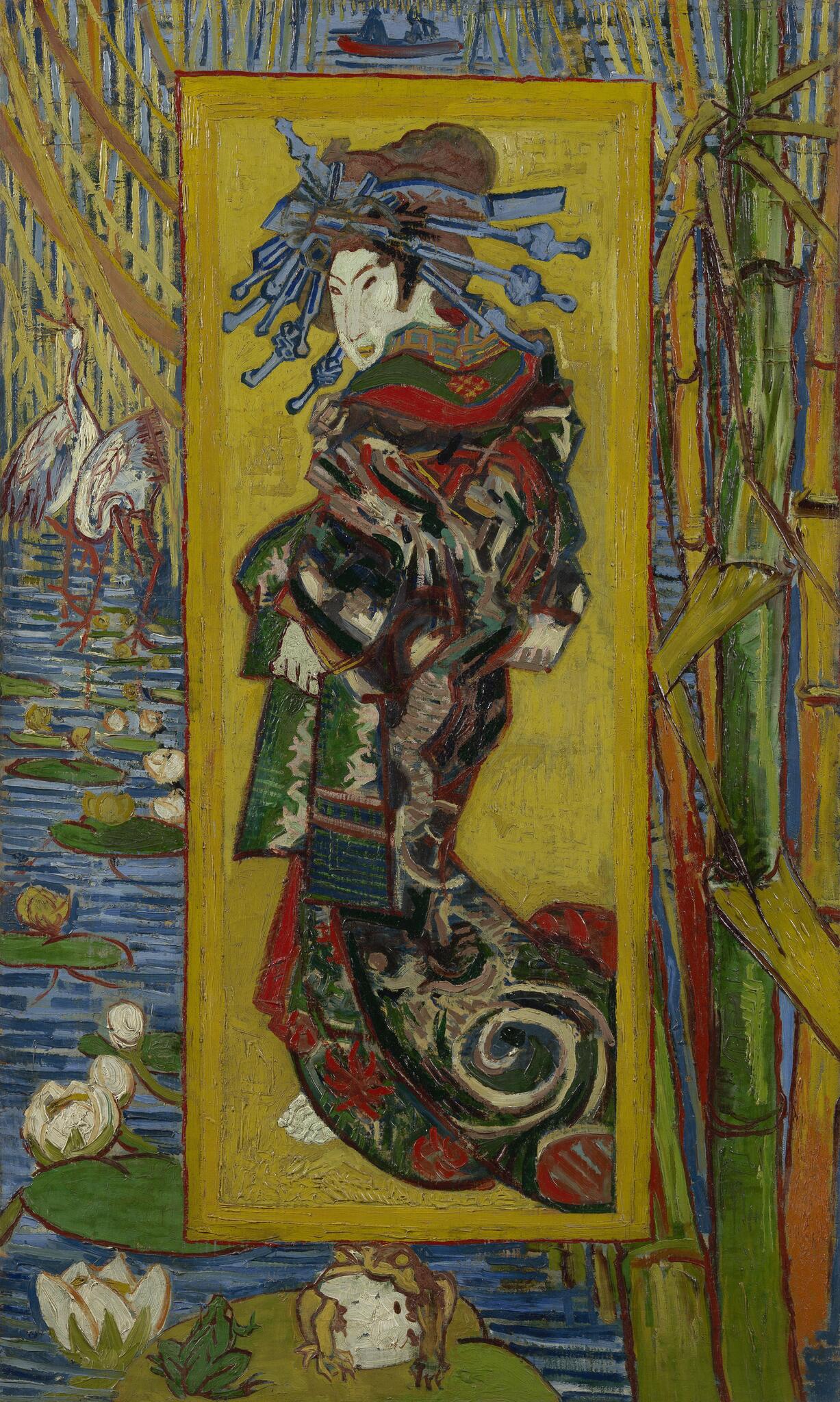
Courtesan (after Eisen) is the painting Vincent van Gogh made in Paris in October and November 1887 after a Japanese woodcut by Keisai Eisen: a courtesan in a richly patterned kimono, with long hairpins in her hair, stands on a yellow panel surrounded by a pond with water lilies, cranes, frogs and bamboo. The original, oil on cotton, measures 100.7 x 60.7 cm and hangs in the Van Gogh Museum in Amsterdam. We paint it by hand in oil on canvas, in 17 sizes from 32 x 46 to 120 x 170 cm or to your own measurement, and send you a photograph of the finished work for approval before dispatch.
| Title: | Courtesan (after Eisen) |
| Other titles: | Courtisane (naar Eisen) · The Courtesan (after Eisen) |
| Painter: | Vincent van Gogh (1853–1890) |
| Year painted: | October–November 1887, Paris |
| Original size: | 100.7 cm x 60.7 cm |
| Original technique: | Oil on cotton |
| Painting style: | Post-Impressionism, Japonisme |
| Located at: | Van Gogh Museum, Amsterdam (inv. s0116V1962) |
| Our reproduction: | Hand-painted oil on canvas, 17 sizes or made to measure |
Courtesan (after Eisen) – Vincent van Gogh
What does Courtesan (after Eisen) show?
In the centre stands a Japanese courtesan, her body turned to the left and her head looking back over her shoulder. Her hair is piled high and pierced with long blue hairpins, and her kimono is a mass of red, green and black patterns, with a large coiled motif across the train at her feet. She stands on a bright yellow panel set into the painting like a print pinned to a wall.
Around the panel Van Gogh painted a pond. Water lilies float at the bottom left, two cranes stand in the water, bamboo stems rise on the right, two frogs sit at the lower edge and a small boat crosses the water at the top. The Van Gogh Museum notes that he used bright colours and bold outlines, as if the painting were itself a woodcut.
Why did Van Gogh copy a Japanese print?
In May 1886 the Paris magazine Paris Illustré devoted an issue to Japan, and its cover carried a colour woodcut of a courtesan by Keisai Eisen. The cover printed the woodcut in reverse, so Van Gogh’s courtesan is a mirror image of Eisen’s; he traced the figure and enlarged it. The Van Gogh Museum adds that he used a grid to copy and enlarge her.
He and his brother Theo dealt in ukiyo-e woodcuts and owned hundreds of them, now in the Van Gogh Museum, and in 1887 he organised an exhibition of Japanese prints in Paris. As the English Wikipedia article on his Japonaiserie records, he made three paintings that copy a Japanese print directly: this courtesan and two studies after Hiroshige. Later he wrote: “All my work is based to some extent on Japanese art.”
What does Courtesan (after Eisen) mean?
The Van Gogh Museum gives the key to the scene: it has a hidden meaning, because grue (crane) and grenouille (frog) were French slang words for a prostitute. The animals around the panel describe the woman in the middle with a Parisian play on words.
We can tell she is a courtesan, the museum explains, by her hairstyle and by her obi, the broad belt tied at the front of her kimono rather than at the back. The figure belongs to Eisen; the strong colours, the heavy outlines and the joke belong to Van Gogh. That mix of a borrowed figure and his own colour is Japonisme as Van Gogh practised it in Paris.
Where does the original hang?
The original hangs in the Van Gogh Museum in Amsterdam, which lists it as Courtesan (after Eisen), Paris, October–November 1887, oil on cotton, 100.7 x 60.7 cm, under the object number s0116V1962. Note the support: the museum records cotton. The painting belongs to the Vincent van Gogh Foundation.
Van Gogh left it at Theo’s apartment in Paris in the autumn of 1887. After Theo’s death in January 1891 it passed to his widow, Jo van Gogh-Bonger, and their son, Vincent Willem. It was on loan to the Stedelijk Museum from 1931 and has been in the Van Gogh Museum since the museum opened in 1973. In 2017 and 2018 it travelled to Japan for the exhibition Van Gogh & Japan.
Courtesan (after Eisen) or another Van Gogh – which should you choose?
Courtesan (after Eisen) is a Japanese print turned into an oil painting, with a single figure and a strong yellow centre. From the same Paris years comes Self-Portrait as an Artist, in which he shows himself at the easel with his palette.
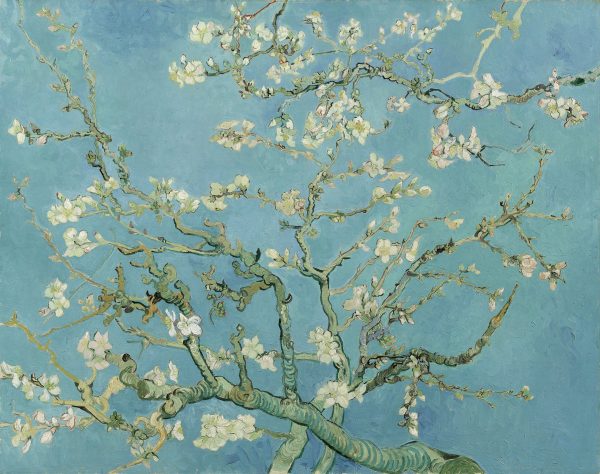
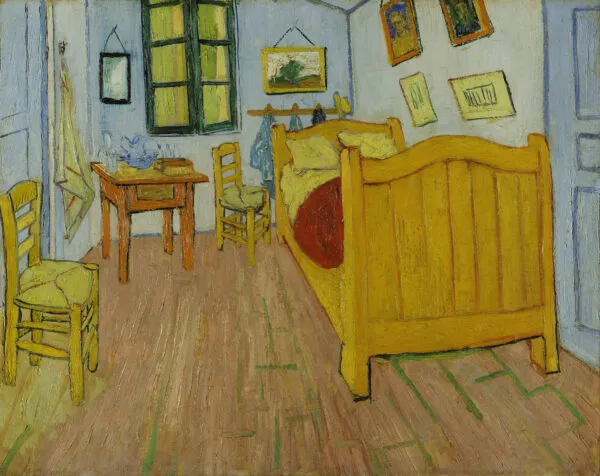
Almond Blossom sets flowering branches against a flat blue sky, Irises gives every flower a firm outline, and Sunflowers I builds a whole painting on yellow. Choose the courtesan for a figure with a story on a narrow wall, Almond Blossom for a calm bedroom, and Irises or Sunflowers I for colour above a sofa.
How is our hand-painted Courtesan (after Eisen) made?
The painter first draws the yellow panel and the figure and checks the proportions against the original, so that the turn of the head and the fall of the kimono sit where Van Gogh placed them. Then come the blue water, the green bamboo and the yellow panel, after them the kimono patterns and the animals, and last the dark outlines that hold every shape together, as in a woodcut. Our oil painting reproduction is painted by hand in oil on canvas with real impasto: the paint goes on thickly, so the brushstrokes stand up from the canvas as they do in the original and catch the light.
On this painting the relief shows most in the short strokes of the yellow panel, in the horizontal strokes of the water and along the bamboo stems. A print shows only a flat surface; on our painting the strokes are real.
Every painting is a hand-painted copy made for your order, so no two are quite the same. Before dispatch we photograph it, sending you the photograph to approve.
Which size for which wall?
Short answer: 40 x 60 or 50 x 70 cm for a narrow wall in a hallway or beside a door, 60 x 90 or 70 x 100 cm above a chest of drawers or a bed, and 100 x 140 or 120 x 170 cm for a high wall in a stairwell or a room with a tall ceiling. The portrait format fits between two windows or next to a wardrobe.
There are 17 sizes: 32 x 46, 40 x 60, 45 x 65, 50 x 69, 50 x 70, 54 x 75, 57 x 82, 60 x 90, 65 x 95, 70 x 100, 77 x 107, 80 x 120, 85 x 125, 89 x 130, 93 x 135, 100 x 140 and 120 x 170 cm (width x height). The original is 60.7 cm wide and 100.7 cm high; our 65 x 95 and 70 x 100 cm sizes are the closest to it, so the courtesan on your wall is about as large as she is in the museum. The 32 x 46 cm size suits a study. The yellow panel is the brightest part of the painting, so it looks best on a white or warm grey wall and under warm light. A painting for the living room should cover about two thirds of the width of the furniture below it.
Hang it with the centre of the canvas about 150 cm above the floor. Above a sofa, a bed or a sideboard, leave 20 to 30 cm between the furniture and the bottom edge.
What if I need a custom size or a frame?
If none of the 17 sizes fits your wall, we paint it to measure. The original is slimmer than any of our standard sizes, close to three parts wide to five high; if you want exactly those proportions, ask for a custom size such as 60 x 100 cm. Send us the width and height you want and we will quote a price and a lead time. Every painting we make is stretched over a wooden stretcher and ready to hang.
For the moulding, use our 3D application: it shows each of our frame profiles on this subject, so you can compare gold, silver, black, white and natural wood – the application is for choosing the frame only. Seeing the painting on your own wall is our separate room placement service. A gold frame picks up the yellow panel; a narrow black frame repeats the dark outlines.
How does delivery work, and what is the guarantee?
Every painting is made to order in our studio in Slovenia, so allow 15 to 45 days depending on the size you choose. We ship it stretched and protected, framed if you chose a frame, across the EU with no customs. Before dispatch you receive a photograph of the finished work to approve, and we correct anything that is not right. Our returns policy applies to every order.
More famous Van Gogh paintings are in the Vincent van Gogh gallery, and there is more about the painter in our article on Vincent van Gogh. If you are giving it as a present and are not sure of the size, a wall art voucher lets the recipient choose.
Frequently asked questions
Where is the original Courtesan (after Eisen) today?
In the Van Gogh Museum in Amsterdam. The museum lists it as Courtesan (after Eisen), oil on cotton, 100.7 x 60.7 cm, under the object number s0116V1962, in the collection of the Vincent van Gogh Foundation. Van Gogh left it with his brother Theo in Paris in 1887, and it stayed in the family until it came to the museum.
When and where did Van Gogh paint Courtesan (after Eisen)?
In Paris, in October and November 1887, according to the Van Gogh Museum, which also records that he left the finished painting at his brother Theo’s apartment there. In the same year he organised an exhibition of Japanese prints in the city. The magazine cover he worked from, the Japan issue of Paris Illustré, had appeared in May 1886.
Who is the woman in Courtesan (after Eisen)?
She is a Japanese courtesan, an oiran, taken from a woodcut by Keisai Eisen. The Van Gogh Museum explains that her hairstyle gives her away, and so does her obi, the broad belt tied at the front of her kimono rather than at the back. She is a figure from a print, not a portrait.
Which Japanese print is Courtesan (after Eisen) based on?
On a colour woodcut of a courtesan by Keisai Eisen, which Van Gogh knew from the cover of the Japan issue of the magazine Paris Illustré, published in May 1886. The cover printed the woodcut in reverse, so his figure is a mirror image of Eisen’s. He traced it and enlarged it with a grid to a height of about one metre.
What do the frogs and cranes in Courtesan (after Eisen) mean?
They are a joke about the woman in the middle. According to the Van Gogh Museum, grue (crane) and grenouille (frog) were French slang words for a prostitute, so the animals Van Gogh painted around the panel describe her profession. The water lilies and bamboo complete the Japanese setting.
How big is the original Courtesan (after Eisen)?
The original is 100.7 cm high and 60.7 cm wide, a tall portrait format a little over a metre high. Our 65 x 95 and 70 x 100 cm sizes come closest to it, and there are smaller and larger sizes from 32 x 46 up to 120 x 170 cm, as well as custom sizes.
Did Van Gogh copy other Japanese prints besides Courtesan (after Eisen)?
Yes, two. In 1887 he also painted Flowering Plum Tree and The Bridge in the Rain, both after prints by Hiroshige, in which he changed the colours and added borders with Japanese characters taken from other prints. Together with the courtesan they are the three paintings in which he copied a Japanese print directly.
Is Courtesan (after Eisen) a good painting to give as a gift?
Yes, for anyone with a feeling for Japan, Japanese prints or fashion and pattern. The tall format makes it an easy canvas painting to place in a hallway, a bedroom or between two windows, and the story of the frogs and cranes makes it a conversation piece. If you are unsure of the size, a voucher lets the recipient choose.
Does your Courtesan (after Eisen) have the raised brushstrokes of the original?
Yes. We paint our courtesan in impasto: the paint goes on thickly, so the brushstrokes stand up from the canvas as on Van Gogh’s original. You see it best on the yellow panel, in the strokes of the blue water and along the bamboo stems, where the relief catches the light. A print cannot have this relief, because its surface is flat.
- Subject: a Japanese courtesan in a patterned kimono on a yellow panel, framed by a pond with water lilies, cranes, frogs and bamboo.
- Original: October–November 1887, Paris, oil on cotton, 100.7 x 60.7 cm, Van Gogh Museum, Amsterdam.
- Ours: a Van Gogh reproduction painted by hand in oil on canvas, in 17 sizes from 32 x 46 to 120 x 170 cm or made to measure.
- Worth knowing: you receive a photograph of the finished work for approval before dispatch.