







































Description
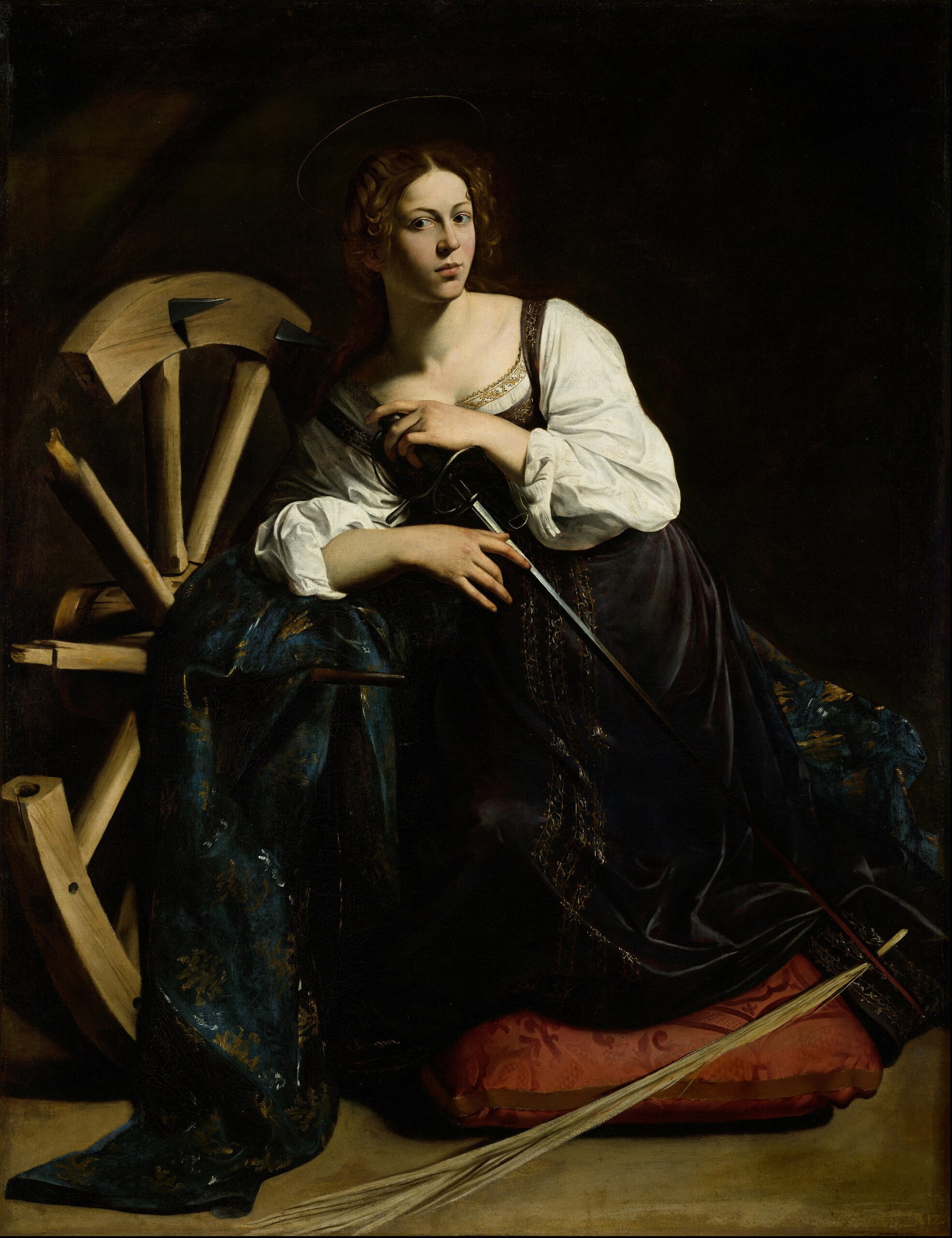
Saint Catherine of Alexandria is an early work by Caravaggio, dated by Wikipedia to about 1593: the young saint, in dark velvet with white sleeves, kneels on a red cushion beside the broken spiked wheel, holds a slender sword and looks straight back at us. The original, oil on canvas, measures 173 cm high by 133 cm wide and belongs to the Museo Nacional Thyssen-Bornemisza in Madrid. One of our painters paints it for you by hand in oils on canvas, in 8 portrait sizes from 40 x 50 to 142 x 190 cm or to a size of your choosing, and we send you a photograph of your finished Catherine before she leaves us.
| Title: | Saint Catherine of Alexandria |
| Other titles: | Santa Caterina d’Alessandria · Die heilige Katharina von Alexandrien |
| Painter: | Michelangelo Merisi da Caravaggio (1571–1610) |
| Year painted: | c. 1593 |
| Original size: | 173 cm x 133 cm (height x width) |
| Original technique: | Oil on canvas |
| Painting style: | Baroque, tenebrism |
| Located at: | Museo Nacional Thyssen-Bornemisza, Madrid, Spain |
| Our reproduction: | Hand-painted oil on canvas, 8 sizes or made to measure |
Saint Catherine of Alexandria – Caravaggio
What does Saint Catherine of Alexandria show?
The tall canvas holds a single figure. A young woman kneels on a red cushion, dressed in a rich gown of dark velvet from which wide white sleeves shine out. Against an almost black ground, the light gathers on her face and hands.
Beside her lies the broken wheel, studded with sharp spikes: the device on which she was meant to die. In her hands she holds a long, slender sword, and on the floor lies a palm frond, the sign of a martyr.
The saint neither looks up to heaven nor prays. She turns her head a little and regards us calmly, as if we had broken in on her thoughts.
Who was Saint Catherine of Alexandria?
According to tradition Catherine was of noble birth and gave herself to the Christian faith after a vision. At eighteen she confronted the Roman emperor Maximus, presumably Galerius Maximianus, debated his pagan philosophers and won many of them over.
The emperor had her imprisoned, yet in prison she converted his empress, Valeria Maximilla, and the leader of his armies. Maximus executed her converts, the empress among them, and ordered Catherine put to death on a spiked wheel. The wheel is said to have shattered the moment she touched it, and she was then beheaded.
Hence the objects in the scene: the broken wheel for the miracle, the sword for the beheading, the palm for martyrdom. Catherine is the patron saint of libraries and librarians, of teachers, archivists and everyone whose work is wisdom and teaching. Her feast falls on 25 November, and tradition places her martyrdom in 305.
In 1969 the Church removed her from the calendar of saints, since most historians doubted she had ever lived; by 2002 she was reinstated.
Why is this painting so well known?
Because the young Caravaggio, working in Rome, paints the saint of legend as a real woman. Instead of a heavenly vision we see a kneeling figure in a real space, with cushion, wheel and sword, caught by hard light in the dark. It is his tenebrism, gathered into one still figure.
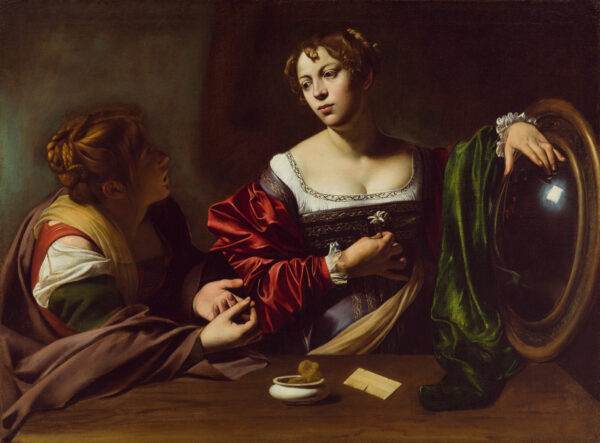
For his model Caravaggio chose Fillide Melandroni, a well-known Roman courtesan, a choice Wikipedia calls controversial. Fillide sat for him again in Martha and Mary Magdalene, in Judith Beheading Holofernes and in a portrait that burned in Berlin during the Second World War.
From the same early Roman years, about 1596, comes The Lute Player, a young musician in a white shirt playing behind a table of flowers and fruit. The story of the painting and of the saint is told at more length in the English Wikipedia article.
Where is the original, and where did it come from?
The original belongs to the Museo Nacional Thyssen-Bornemisza in Madrid.
It was part of the collection of Cardinal Francesco Maria del Monte, where it was catalogued in 1627. Wikipedia notes that Catherine, together with Mary Magdalene, was among the cardinal’s favourites.
According to the art historian Alessandro Zuccari, Caravaggio painted it at the cardinal’s suggestion while he was living with him in the Palazzo Madama in Rome.
Saint Catherine of Alexandria or another Caravaggio?
Saint Catherine of Alexandria is a canvas painting for anyone who likes a single figure, a calm pose and costly fabric in half-light. Its upright format fills even a narrow wall.
If you would like another saint lost in her own thoughts, look at Penitent Magdalene, where a young woman sits with her head bowed. Its male counterpart is Saint Francis in Meditation: the saint in his brown habit kneels in the dark and gazes at the skull in his hands.
To compare it with the late Caravaggio, there is The Annunciation of about 1608, in which an angel in white descends on a cloud towards the kneeling Virgin with her head bowed. Catherine and the other famous Caravaggio paintings we offer are gathered on the Caravaggio page.
How does our painter paint Saint Catherine?
Every Catherine is painted only once you order it, in oils on canvas and in several layers. The painter first lays a dark ground, then sketches the kneeling figure, the wheel and the sword with a fine brush.
Then he builds from shadow to light. The velvet gets a deep, almost black tone with soft reflections, the white sleeves bright folds that never turn hard. He spends longest on the face and hands, which carry the gaze.
This Caravaggio reproduction has a surface you can feel under your fingers and colour that opens into depth in the dark passages. An oil painting reproduction like this stays reserved by day; under an evening lamp the red cushion and white sleeves glow.
Which size suits which wall?
In short: 40 x 50 or 45 x 60 cm above a bedside table, a shelf or between two windows, 58 x 75 or 66 x 83 cm for a hallway or study, 80 x 108 or 100 x 135 cm above a sofa or sideboard, and 117 x 145 or 142 x 190 cm for a large wall or a stairwell.
We paint Saint Catherine of Alexandria in 8 portrait sizes (width x height): 40 x 50, 45 x 60, 58 x 75, 66 x 83, 80 x 108, 100 x 135, 117 x 145 and 142 x 190 cm. The closest to the original is the largest, 142 x 190 cm, which is 9 cm wider and 17 cm taller.
The figure fills nearly the whole canvas, so the saint reads well even small. As a painting for the living room it is most convincing at 80 x 108 or 100 x 135 cm above the sofa. Hang her face at about eye level.
Can I order another size or a frame?
Of course. For a size of your own we adapt the composition so that wheel, sword and palm stay whole and the saint keeps room around her head. Tell us the width and height you would like, and we will reply with a price and a lead time.
Catherine leaves us rolled, stretched on a stretcher bar or framed. Our workshop in Slovenia does the stretching and framing and packs each painting for its journey. Catherine’s frame is chosen in our 3D app, which does nothing but help you pick the moulding; showing the painting on your own wall is a service of its own.
Dark velvet and a red cushion go well with a dark wooden frame or a slim antique-gold moulding.
When does the painting arrive, and how is it sent?
We start painting once you confirm your order, and Saint Catherine sets off within 15 to 45 working days. Before that we send you a photograph of the finished painting, and if you would like a change, we make it before dispatch. Within Slovenia and across the EU there are no customs charges, and our returns policy covers every order.
Catherine makes a fine gift for a librarian, a teacher or a student, as patron of wisdom and learning, and for anyone called Catherine. If you are unsure of the size, give a wall art voucher instead.
Frequently asked questions
Where is the original on display?
In the Museo Nacional Thyssen-Bornemisza in Madrid, which holds this work by Caravaggio.
What does the spiked wheel mean?
It is the wheel on which Catherine was to die; legend says it broke when she touched it.
Is this a print?
No. You receive a hand-painted copy, made by the painter with brush and oil paints on canvas.
What are the dimensions of the original?
It is 173 cm high and 133 cm wide; our nearest size is 142 x 190 cm.
When did Caravaggio paint it?
Wikipedia dates it to about 1593, in his early Roman years.
Is it suitable for a bedroom?
Yes, the calm upright figure sits well in a bedroom, a library or a study.
Will you paint Catherine in a size not on your list?
Yes. Send us the width and height, and we will reply with a price and a date.
How long will I wait for my Catherine?
15 to 45 working days; before dispatch you get a photograph of the completed painting.
- Subject: Saint Catherine in dark velvet kneels on a red cushion beside the broken spiked wheel, a sword in her hands and a palm on the floor.
- Original: c. 1593, oil on canvas, 173 x 133 cm, Museo Nacional Thyssen-Bornemisza, Madrid.
- Ours: painted by hand in oils on canvas, in 8 portrait sizes from 40 x 50 to 142 x 190 cm or made to measure.
- Worth knowing: the model for the saint was Fillide Melandroni, whom Caravaggio painted several more times.