







































Description
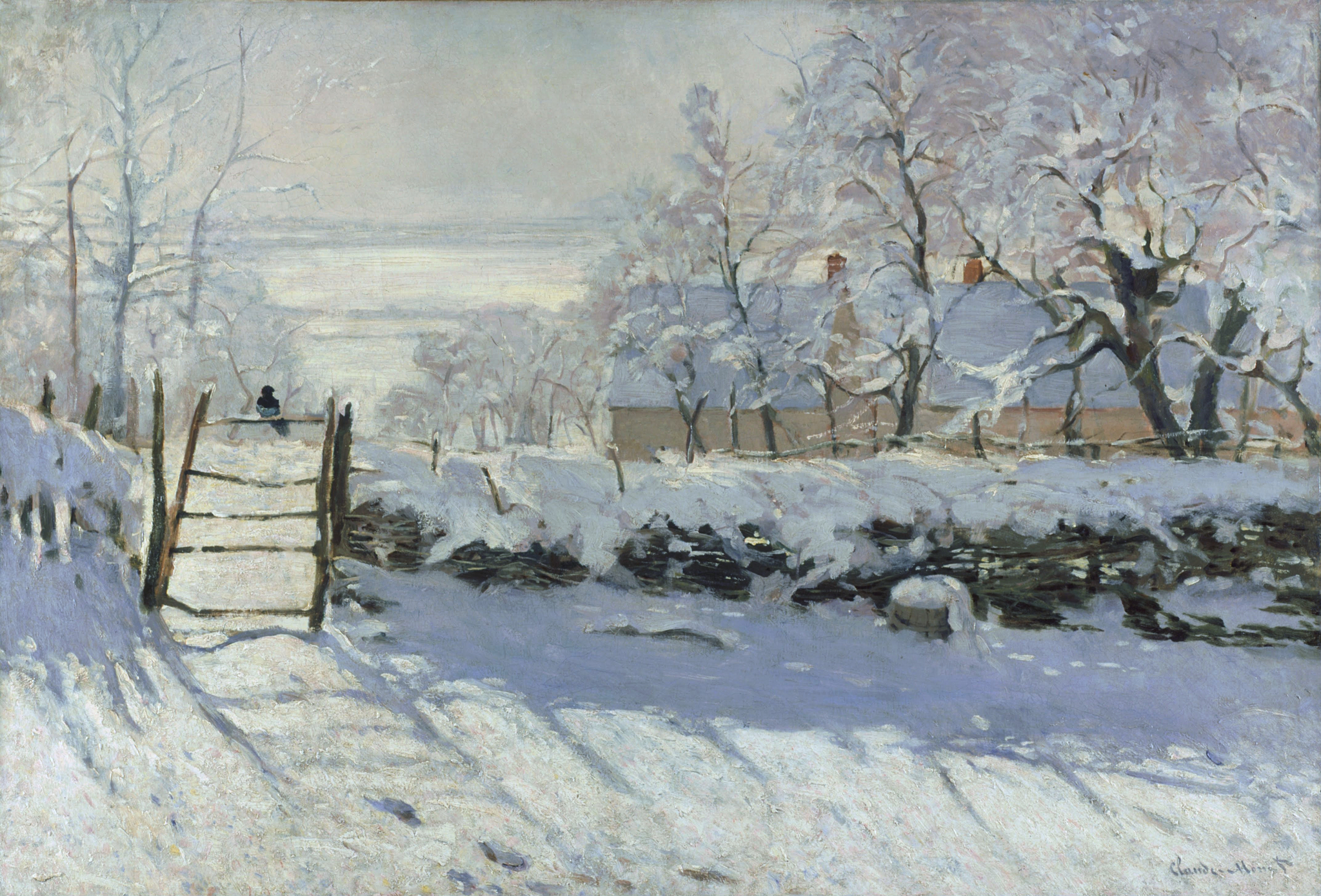
The Magpie is Monet’s canvas of 1868–1869: a snowy field near Étretat, a wattle fence with a small gate, a single black magpie perched on the gate, and blue-violet shadows across the sunlit snow. The original hangs in the Musée d’Orsay in Paris. We make it as a hand-painted reproduction in oil on canvas, in seven sizes or to your own measurement, with a photograph of the finished work sent for approval before dispatch.
| Title: | The Magpie |
| Other titles: | La Pie · Die Elster · La gazza |
| Painter: | Claude Monet (1840–1926) |
| Year painted: | 1868–1869 |
| Original size: | 130 cm x 89 cm |
| Original technique: | Oil on canvas |
| Painting style: | Impressionism |
| Located at: | Musée d’Orsay, Paris (inv. RF 1984-164) |
| Our reproduction: | Hand-painted oil on canvas, seven sizes or made to measure |
The Magpie – Claude Monet
What is shown?
A winter day in the Normandy countryside near Étretat. A wattle fence runs across the canvas from the left, broken by a small wooden gate, and on the top bar of the gate sits a single magpie, the only black in the whole scene. Behind the fence stand snow-laden trees and the roofs of a farmhouse; in front, a wide field of snow fills the lower half. The sun is low, and every post of the fence throws a long shadow across the snow.
Why is the snow blue?
Because Monet painted what he saw, not what he knew. Snow in shadow reflects the blue of the sky, and in the low winter sun the shadows of the fence turn blue and violet, while the lit snow is warm, almost cream. Most of the canvas reads as white, yet hardly any of it is pure white: it is built from pale yellows, blues, pinks and greys laid next to one another.
Why does this painting matter?
It is one of the largest snow scenes of its time, and one of the first in which coloured shadows carry a whole painting. The Paris Salon turned it down in 1869. Today it hangs in the Musée d’Orsay, which acquired it in 1984.
Winter at Étretat
Monet spent the winter of 1868–69 at Étretat on the Normandy coast with Camille and their young son Jean, and painted several snow scenes there. He worked outdoors, in front of the motif, which was still unusual at the time: the light in this canvas is the light of one particular hour, and the long shadows say so.
Other snow scenes by Monet
Snow came back again and again in Monet’s work. The village under snow is Snow Effect in Vétheuil; a single stack in a white field is Stack of Wheat (Snow Effect); and a cart on a white road near the coast is A Cart on the Snowy Road at Honfleur.
How is our hand-painted version made?
The painter starts with the snow, and the snow is not white: first the cream of the lit areas and the blue-violet of the shadows, laid side by side in broad strokes. Then the fence and the gate in greys and browns, and only at the very end the magpie, a few dark touches that must sit exactly on the gate. If the shadows come out grey instead of blue, the whole canvas goes cold and flat, so that is what we check first.
Every piece is a hand-painted copy in oil on canvas, made for your order. An impressionist painting lives on its visible brushwork, so we do not smooth it away: the strokes stand slightly above the surface and catch the light, which a printed oil painting reproduction cannot do.
Which size for which wall?
Short answer: 100 x 70 cm above a sofa or sideboard, 70 x 50 cm for a hallway or a smaller wall, and 150 x 100 cm for a large empty wall. A painting for the living room should take up about two thirds of the width of the furniture below it. All seven sizes, from 70 x 50 to 150 x 100 cm, follow the format of the original.
How high to hang the painting: put the centre of the canvas about 150 cm above the floor; above a sofa, leave 20 to 30 cm between the back and the lower edge.
Made to measure, stretcher and frame
If none of the sizes suits, we paint to measure — send the width and the height and we will quote a price and a lead time. The original measures 130 x 89 cm, a ratio of about 1.46 : 1. Every canvas painting we make is stretched over a wooden stretcher with painted edges, so it does not look unfinished without a frame. A pale wood or a narrow white or silver moulding suits the cool palette; a heavy gilt frame would push the snow towards yellow.
Delivery and guarantee
We ship to the United Kingdom, Ireland and across the EU, wrapped in protective film and packed in a rigid box. Before dispatch we send you a photograph of the finished work; if something on it is not right, we correct it while the canvas is still in our workshop. Every other Monet reproduction we paint is in the Claude Monet gallery, and we write about the painter and about choosing a subject on our blog.
If the painting is a gift and you are unsure of the size, there is a wall art voucher: the recipient chooses the size and the subject.
Frequently asked questions
Where is the original?
In the Musée d’Orsay in Paris, under inventory number RF 1984-164. The work is recorded in Wikidata, and the photograph we paint from is on Wikimedia Commons.
What year is it from?
Monet painted it in the winter of 1868–69, so it is dated 1868–1869. He sent it to the Paris Salon of 1869, which turned it down.
What does The Magpie mean?
It tells no story. The subject is light on snow: the magpie is the one dark accent that makes the white around it read as light. Many viewers also feel a quiet note of solitude in the single bird on the gate.
Where did Monet paint it?
Near Étretat on the Normandy coast, where he spent the winter of 1868–69. He painted it outdoors, in front of the snowy field.
Is the original for sale, and what is it worth?
No. It belongs to the Musée d’Orsay and is not for sale, so it has no market price. What we can state is the price of our hand-painted version: it is shown on this page for the size you choose.
- Painted by hand. Oil on canvas, no print and no machine application.
- Seven sizes or made to measure. From 70 x 50 to 150 x 100 cm, all in the format of the original.
- A photograph before dispatch. You see the finished work before it leaves the workshop.
- About the original. Year, size and inventory number as the Musée d’Orsay records them.