


Description
| Title: | Woman with a Parasol (Facing Left) |
| Other titles: | Essai de figure en plein-air : Femme à l’ombrelle tournée vers la gauche · Ženska s senčnikom, obrnjena v levo |
| Painter: | Claude Monet (1840–1926) |
| Year painted: | 1886 |
| Original size: | 88.7 cm x 131 cm |
| Original technique: | Oil on canvas |
| Painting style: | Impressionism |
| Located at: | Musée d’Orsay, Paris (inv. no. RF 2621) |
| Our reproduction: | Hand-painted oil on canvas, eight sizes from 40 x 60 to 120 x 180 cm or made to measure |
Woman with a Parasol (Facing Left) is Monet’s study of a figure in the open air, painted in 1886: the figure with the green parasol stands on a flowering slope, behind her there is only sky, and the painter left the face without features. The original is held by the Musée d’Orsay in Paris under accession number RF 2621 and listed as oil on canvas, 88.7 x 131 cm. We make it as a hand-painted reproduction in oil on canvas, in eight sizes or to your own measurements, with a photograph of the finished work sent to approve before dispatch.
Woman with a Parasol (Facing Left), 1886 – Claude Monet
What is the painting of?
A figure with an open parasol, in a meadow under open sky. The museum record names nobody: it lists the work as an essai de figure en plein-air, a study of a figure in the open air — not a portrait of anyone, but the question of how a human figure looks in diffused daylight. Painted in 1886, when Monet was already at Giverny, it reached the museum in 1927 as a gift from Michel Monet, the painter’s son.
What is on the canvas?
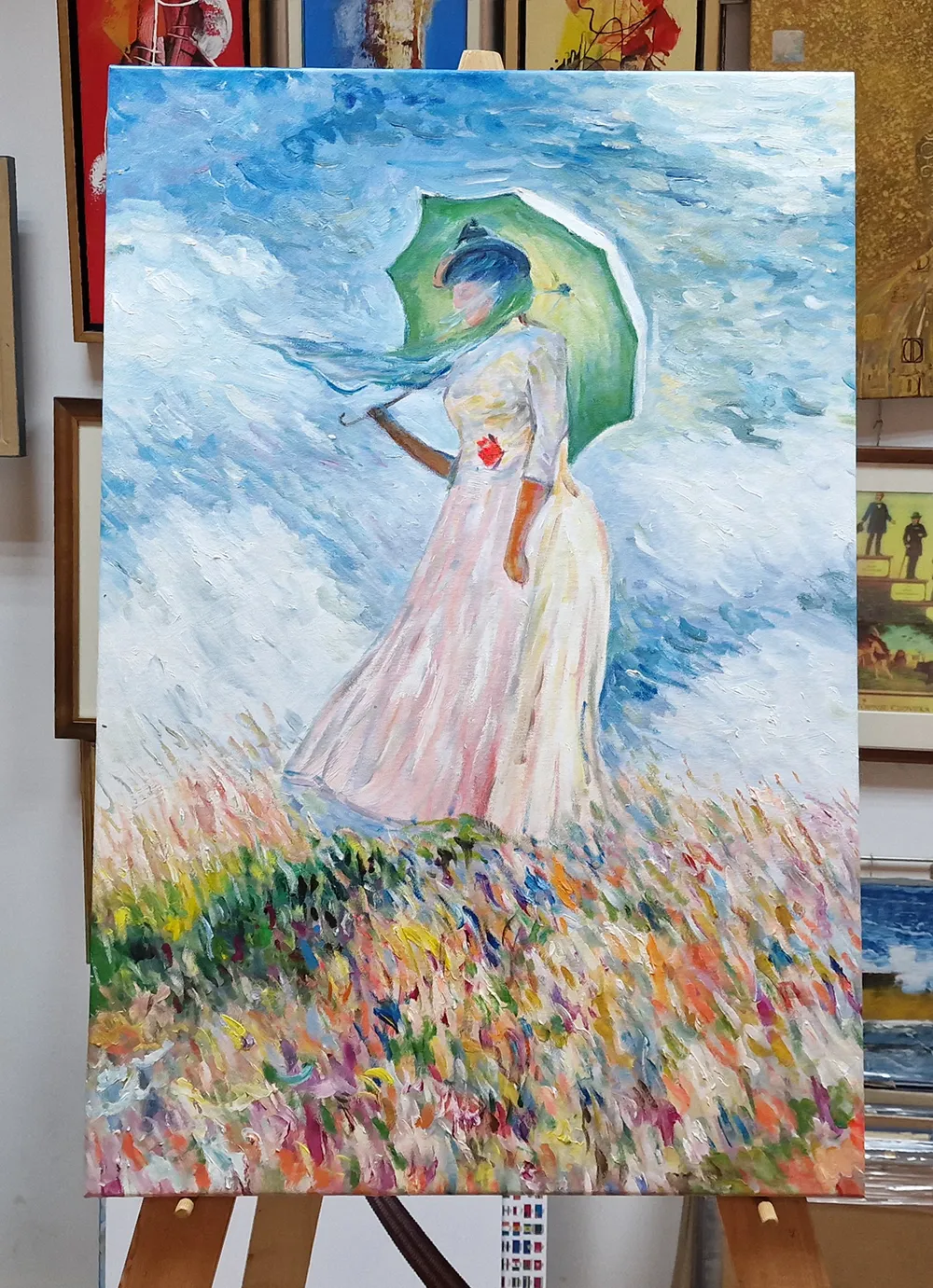
The canvas is upright and tall. The figure is painted from below, so that almost nothing but sky remains behind her — no horizon, no distance. She faces left, the body slightly in profile, the parasol held above the head and a little back; it is green, its ribs visible and its edge pale. She wears a white-cream bodice with three-quarter sleeves and a long skirt that passes from pale pink into white; at the breast sits a small red flower, the only pure red in the work. On her head a dark blue-grey hat, from behind which a veil streams to the left — which is how you see that the wind is blowing. The face was left without features: under the parasol there is only a pale plane, no eyes, nose or mouth. In the lower third the meadow rises, painted in short separate dashes of yellow, orange, pink, violet, green and blue.
Why does this painting matter?
Because it is a figure painted with the method Monet had worked out on landscape. Sky and meadow are laid in with the same quick broken stroke as water or snow in his landscapes, and the figure is woven into them rather than set on top. As an impressionist painting that is rare: after the 1870s Monet almost stopped painting people, and these two canvases of 1886 are among the last where a human figure is the subject. The title is not a name but a task — a study of a figure in the open air.
Why is the face left blank?
Because the work is not a portrait. With no face the eye slides on to the skirt, the parasol and the grass — the figure becomes a shape in light rather than a person, and that was the object of the exercise. The emptiness above has its opposite below: the meadow is laid on in dense short strokes that almost nowhere close into a surface, so the colours mix only in the viewer’s eye. This hand-painted oil painting carries two ways of painting on one canvas — soft above, broken up below.
Which of Monet’s two parasols is this?
In 1886 Monet painted two almost identical studies, hanging in the same room at the Orsay and from the same gift: this is the one facing left, RF 2621, 88.7 x 131 cm. Its twin is mirrored — Femme à l’ombrelle tournée vers la droite, RF 2620, and it is not the same size: it measures 89.3 x 130.5 cm. Eleven years earlier the same motif appeared as a family scene with Camille and their son Jean: The Walk, Woman with a Parasol. The group version of the garden subject is Women in the Garden, Camille Monet on Her Deathbed is a rare case of a figure indoors, and how far Monet took the broken stroke in landscape is shown by Impression, Sunrise.
How is our hand-painted version made?
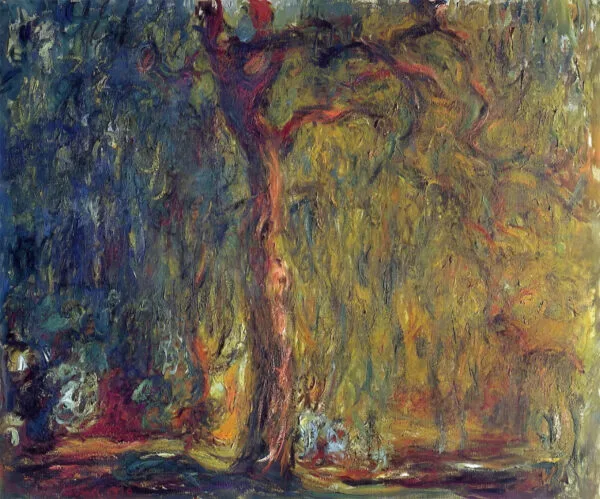
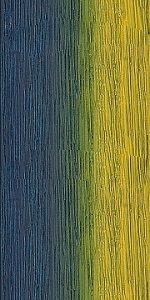
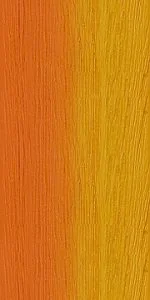
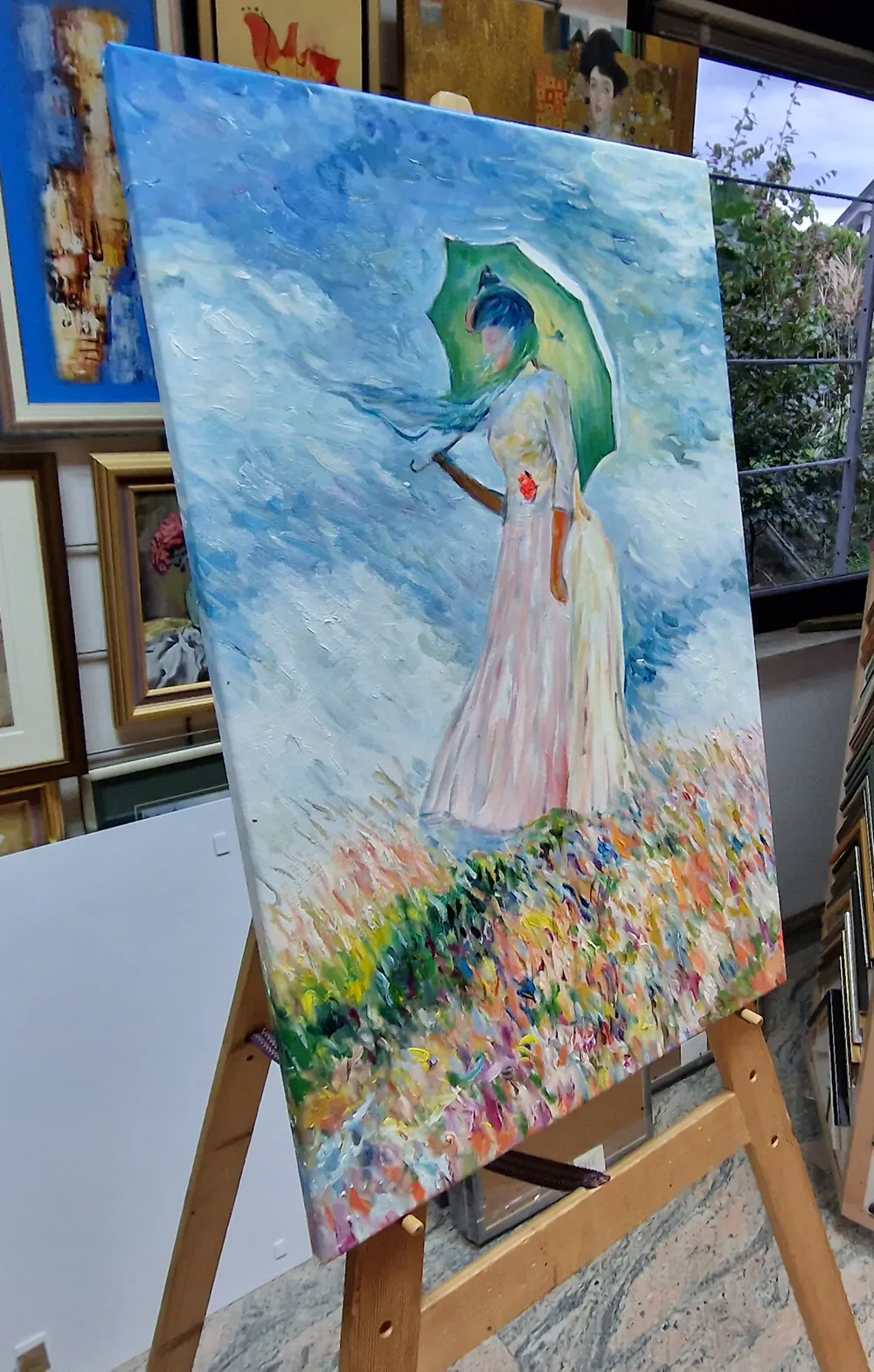
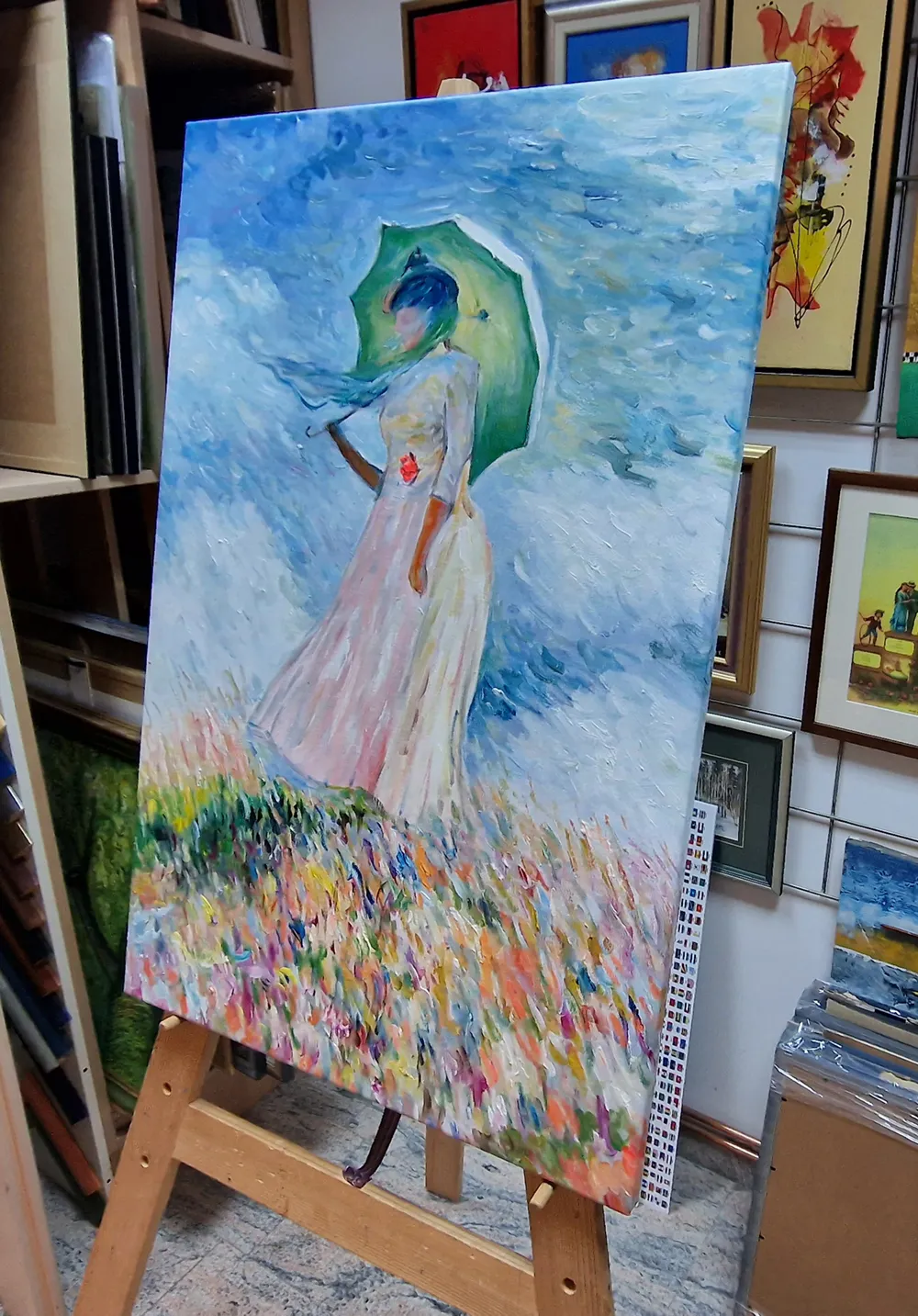
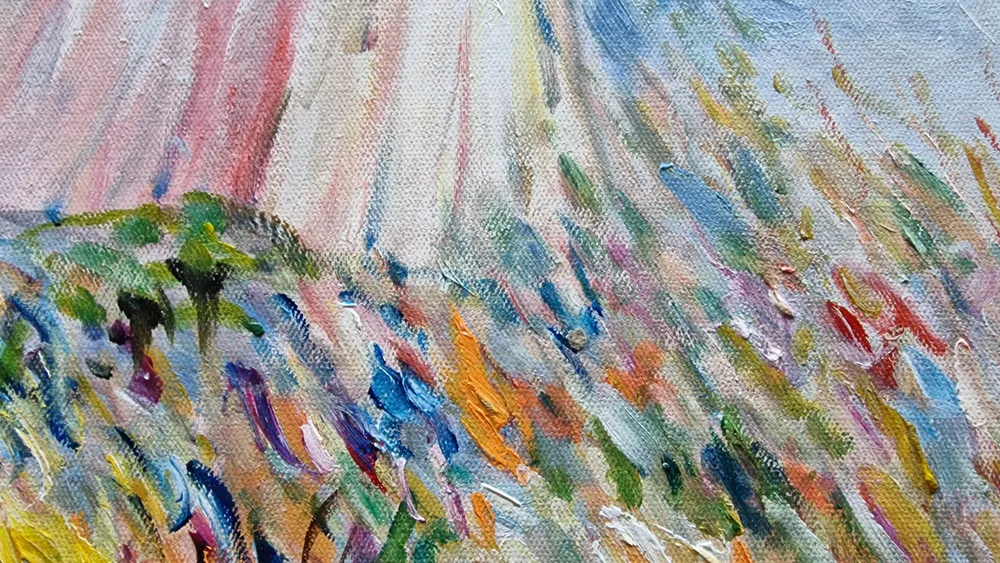
The painter works with a brush and oil colour, not a printer, and builds the canvas at two speeds: first the sky and the dress in broad soft passages, then the meadow in hundreds of short separate strokes. In the first photograph the finished canvas stands on the easel in our workshop, shot head on and unframed, as we ship it if you choose no frame. The second and third are taken from the side, from the left and from the right, and in them the edge of the stretched canvas is visible. The fourth shows the meadow close up: every dash stands on its own, and between them the weave shows. That relief is what a print cannot give, because there is nothing on an impression to cast a shadow. Each copy is made separately, so a hand-painted copy is always a work of its own, and every oil painting reproduction is photographed in daylight before dispatch.
In the 49-second video under the description a brush first draws the outline of the figure on white canvas, then paints the pink-and-white dress close up; after that the finished painting stands among frames in our workshop, and a close-up shows the raised strokes of the meadow. That is where this Monet reproduction shows what a photograph taken head on cannot catch.
It is hand-painted oil on canvas; the strokes are visible and can be felt, as the fourth photograph and the video under the description record close up.
Which size for which wall?
If you are unsure: 88 x 131 cm. That size is the closest to the original, which measures 88.7 x 131 cm, and is therefore the most faithful choice. The format is markedly upright, roughly 2 : 3, so it fills a narrow wall between a door and a window. 40 x 60 cm and 50 x 75 cm belong in a hallway; 60 x 90 cm and 70 x 100 cm are the usual choice above a chest of drawers; 80 x 120 cm, 100 x 150 cm and 120 x 180 cm are meant for tall walls. Because the upper half is pale and quiet and the lower half busy, this kind of canvas painting hangs better a little higher, so the meadow does not fall to furniture height. As impressionist wall art it brings light into a room without strong contrast, and that is why as a painting for living room walls it warms a room instead of dividing it.
How high to hang the painting: centre at eye level, roughly 145–150 cm from the floor — with this upright format rather a little higher, so the meadow clears the furniture.
Made to measure, stretcher and frame
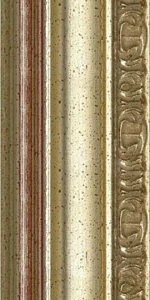
If none of the eight sizes fits your wall, we paint the work to your measurements; that is our painting made to order. We keep the ratio of the sides, so the figure is not squeezed. Every copy arrives stretched on a wooden bar frame and ready to hang. For the frame, use our 3D application: on this subject it shows all our mouldings, so you can compare gold, silver, black, white and natural wood before deciding — it is for choosing the frame only and does not show the work in your room. If you want to see how it will look on your wall, that is our separate room-placement service.
Delivery and guarantee
Every copy is made to order in our studio in Slovenia, so allow 15 to 45 days, depending on the size; the largest are usually at the top of that range. We ship it stretched and protected for transport, framed if you chose a frame, within Slovenia and the EU with no customs. Before dispatch you receive a photograph of the finished work to approve, and every order is covered by our returns policy. The full range is in the Claude Monet gallery, the painter’s path in the article on Claude Monet.
If the painting is a gift and you are unsure of the size, there is a wall art voucher: the recipient chooses the size and the subject.
Frequently asked questions
Where is the original?
At the Musée d’Orsay in Paris, accession RF 2621: oil on canvas, 88.7 x 131 cm, a gift from Michel Monet in 1927.
What year is it from?
1886. The museum gives that year without qualification, so we give it without qualification too.
What does the painting mean?
It is a study of light and air: Monet was less interested in the model’s face than in how sun, wind and shadow play over the dress, the veil and the grass.
Why did Monet paint Woman with a Parasol?
In 1886 he returned to a subject he had painted with Camille in 1875. This time Suzanne Hoschedé posed, and he painted her twice, facing left and facing right, as studies of a figure out of doors.
Where did Monet paint it?
On the Île aux Orties, a small island in the Seine near Giverny where the family went walking.
How big is the original?
131 x 88 cm, oil on canvas: an almost life-size figure.
- Subject: a figure with a green parasol on a flowering slope, facing left, the face blank, 1886.
- Original: 88.7 x 131 cm, oil on canvas, Musée d’Orsay, Paris (inv. RF 2621), gift of Michel Monet 1927.
- Our version: hand-painted oil on canvas, eight sizes from 40 x 60 to 120 x 180 cm; 88 x 131 cm is the closest to the original.
- Worth knowing: there are two — this one faces left, its twin faces right, and they are not the same size.