


Description
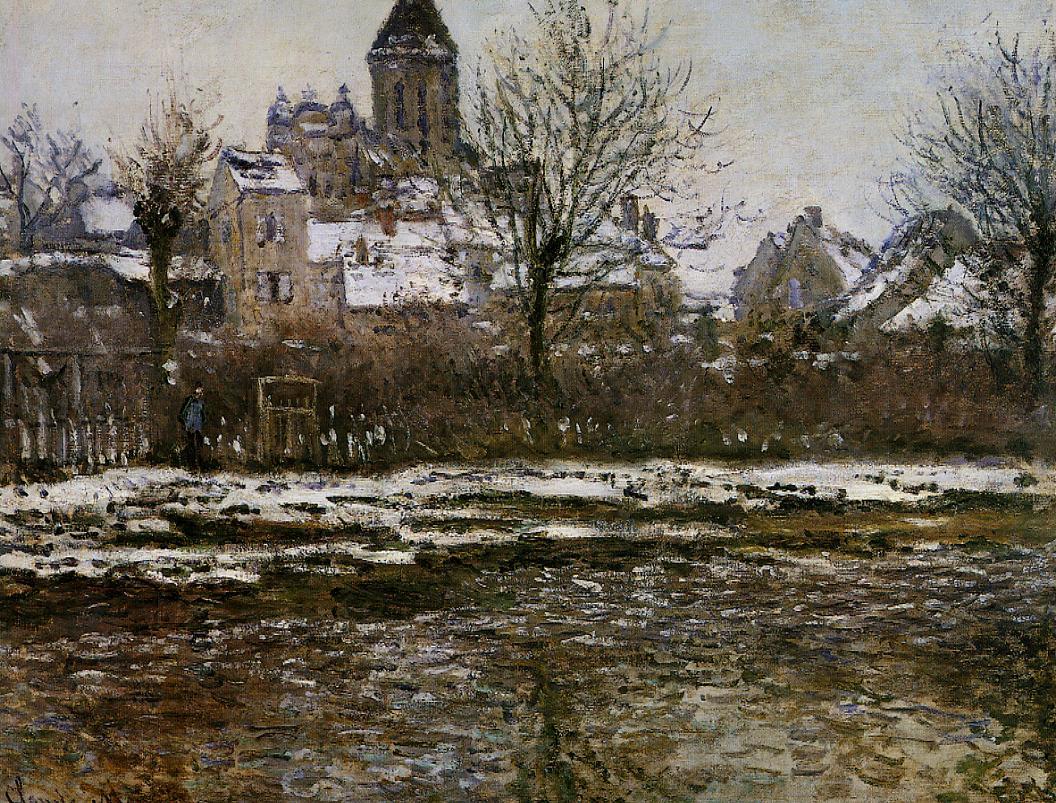
Snow Effect in Vétheuil is a hand-painted Monet reproduction of a winter scene: the steeple of the village church rises above snow-covered roofs, a band of snow lies below them, and the lower third is a dark, thawing expanse. The original measures 71 x 52.5 cm, is oil on canvas, and belongs to the Musée d’Orsay in Paris under accession number RF 3755. The museum dates it between 1878 and 1879. We paint it in eight sizes or to your own measurements, with a photograph of the finished work sent for approval before despatch.
| Title: | Snow Effect in Vétheuil |
| Other titles: | L’Église de Vétheuil, neige (the second name in the museum’s own record) |
| Painter: | Claude Monet (1840–1926) |
| Year painted: | between 1878 and 1879, as the museum dates it; nobody states a single year |
| Original size: | 71 cm x 52.5 cm |
| Original technique: | Oil on canvas |
| Painting style: | Impressionism |
| Located at: | Musée d’Orsay, Paris (acc. no. RF 3755) |
| Our reproduction: | Hand-painted oil on canvas, eight sizes or to your measure |
Snow Effect in Vétheuil – Claude Monet
What is on the canvas?
The upper half belongs to the village. The church steeple rises left of centre, dark and pointed, with snow-covered roofs crowding around it. Bare trees stand among them and in front of them, several pollarded into thick stumps so that the branches are short and hard. Lower down runs a fence with a gate, and beside it a small dark figure in blue — the only person in the picture and the only thing that gives it scale. Below the fence lies a band of snow, broken into pieces. The lower third is a wide dark plane, mottled and restless, where the snow has already gone. The sky is an even grey, with no sun and no blue in it.
Where is Vétheuil, and why was Monet there?
Vétheuil is a village on the Seine between Paris and Rouen, pressed between the river and a steep hillside. Monet moved there in 1878 and stayed until 1881; they were hard years, without money and with illness in the house. Yet those years produced a run of paintings now held by major museums, and this is one of them. He painted the village in summer and winter, from the river and from the road, so often that Vétheuil alone names dozens of his canvases. Closest in place is Banks of the Seine, Vétheuil, which shows the same village in a warmer season.
Why does the museum give two names?
The Musée d’Orsay’s record carries a designation in two parts, separated by its own semicolon: “Effet de neige à Vétheuil ; L’Église de Vétheuil, neige”. The first names the effect — snow as a condition of light, which is Monet’s way of titling. The second says what is actually painted: the church at Vétheuil, in snow. Both are the museum’s names, not ours and not exhibition names, and both mean this one canvas. Our table carries the second in its Other titles row precisely because the church is the first thing you see.
Why is the year not a single one?
Because the museum does not give one. Under Datation its record reads “entre 1878 et 1879” — between 1878 and 1879 — and it does not narrow that. So we do not write one either, tidier though it would look. Where a museum and a database disagree, we follow the museum. There is no date on the canvas either: the record notes no inscription at all, so the year cannot be read off the painting as on some other works by Monet.
What does the museum’s record say?
The work is held by the Musée d’Orsay under accession number RF 3755. The technique is oil on canvas.
The road to the Orsay: the Caillebotte bequest
The museum gives a single acquisition line, and it is a famous one: “Legs Gustave Caillebotte, 1896” — the bequest of Gustave Caillebotte, 1896. Caillebotte was a painter himself, one of the few who bought his colleagues’ work when nobody else wanted it. His collection is for that reason one of the founding routes by which impressionism entered French public collections. The museum publishes no chain of owners before that, so we do not invent one.
The other Vétheuil church in the same museum
Confusion is a real possibility here, inside a single collection. The Musée d’Orsay holds a second Monet of the church at Vétheuil, accession RF 1973 18, which it lists as “Église de Vétheuil”. Since our own work’s second name is L’Église de Vétheuil, neige, anyone searching that museum for the church of Vétheuil meets both. They part at once, on two measures. Ours is horizontal, 71 cm wide and 52.5 high; that one is upright, 50.5 wide and 65.5 high. And where the museum dates ours to a range, it dates that one to a single year, 1879. It entered the collection as the gift of Mr and Mrs Kaganovitch in 1973. Monet’s best-known snow scene, a single black bird perched on a gate above blue shadows, is The Magpie.
How is our hand-painted version made?
Every order is painted individually by an artist, in oils, on cotton or linen. A canvas painting is made here without printing, without transfer and without any machine step in between. A winter scene is demanding because of the snow: on this canvas it is not white but grey, blue and pale pink, and painting it white loses the light the original has. The work begins with the greys of the sky and only then builds the lighter pieces. Every hand-painted oil painting leaving our workshop is a little its own; two orders of the same motif never match down to the last detail.
Stretched on a wooden frame in a rigid box, or rolled in a tube, with tracking. Before that you receive a photograph of the finished work.
Which size for which wall?
Eight sizes are available, from 50 x 40 to 150 x 110 cm. The original is 71 cm wide and 52.5 high, so the nearest in size is 70 x 50 cm and the nearest in proportion is 150 x 110 cm. The scene is low and wide, which suits a wall above a sofa, a sideboard or a bed — anywhere broader than it is tall. As a painting for living room use, 100 x 80 cm reads quietly, because the colour range here is narrow and subdued. For more from the same period see the Claude Monet gallery; close in season are Frost, A Cart on the Snowy Road at Honfleur and Stack of Wheat (Snow Effect).
How high to hang the painting: centre about 145 cm above the floor; above furniture leave the lower edge 20 to 30 cm clear. More on placing work is on our blog.
Custom sizes, stretcher and frame
None of the eight repeats the original’s proportion exactly. If it is that proportion you want, a custom size is the only way: send us the width and height in centimetres. The canvas can arrive stretched and ready to hang, or rolled in a tube for framing yourself; a frame is not included in the price. A pale or greyish wooden frame suits this scene, carrying the winter light on; a dark frame shuts it in. The museum keeps its original framed, at 89 x 72.5 cm overall.
Delivery and guarantee
Painting normally takes two to three weeks, longer at the largest sizes, since the oil has to dry between layers. Stretched canvases travel in a rigid box with protected corners, rolled ones in a tube. If the work arrives damaged, or differs noticeably from the photograph you approved, we replace it or refund the price. A hand-painted copy is not a factory product and small differences in the brushwork are expected; damage or a wrong subject are not, and those are ours to put right.
If the painting is a gift and you are unsure of the size, there is a gift voucher: the recipient chooses the size and the subject.
Frequently asked questions
Where is the original?
In Paris, at the Musée d’Orsay, accession number RF 3755. It arrived there with the bequest of Gustave Caillebotte in 1896.
Where is Vétheuil?
On the Seine, between Paris and Rouen. Monet lived there from 1878 to 1881 and painted the village a dozen times and more.
Why is there no exact year?
Because the museum gives none: its record reads between 1878 and 1879. There is no date on the canvas, so there is nothing to read a year off, and we do not invent one.
What does the painting say in one sentence?
That snow is not white but grey and blue, and that a village under it does not disappear but goes quiet.
- Subject. The steeple of the Vétheuil church above snow-covered roofs, bare pollarded trees, a small figure by a gate, and a dark thawing plane across the lower third.
- Original. Oil on canvas, 71 x 52.5 cm, between 1878 and 1879 by the museum’s dating; Musée d’Orsay, acc. no. RF 3755, the bequest of Gustave Caillebotte, 1896.
- Ours. Eight sizes from 50 x 40 to 150 x 110 cm, or made to your own measurements, the only way to keep the original’s proportion.
- Worth knowing. The same museum holds another Monet of the church at Vétheuil, RF 1973 18; that one is upright and dated to a single year, ours horizontal and dated to a range.