




Description
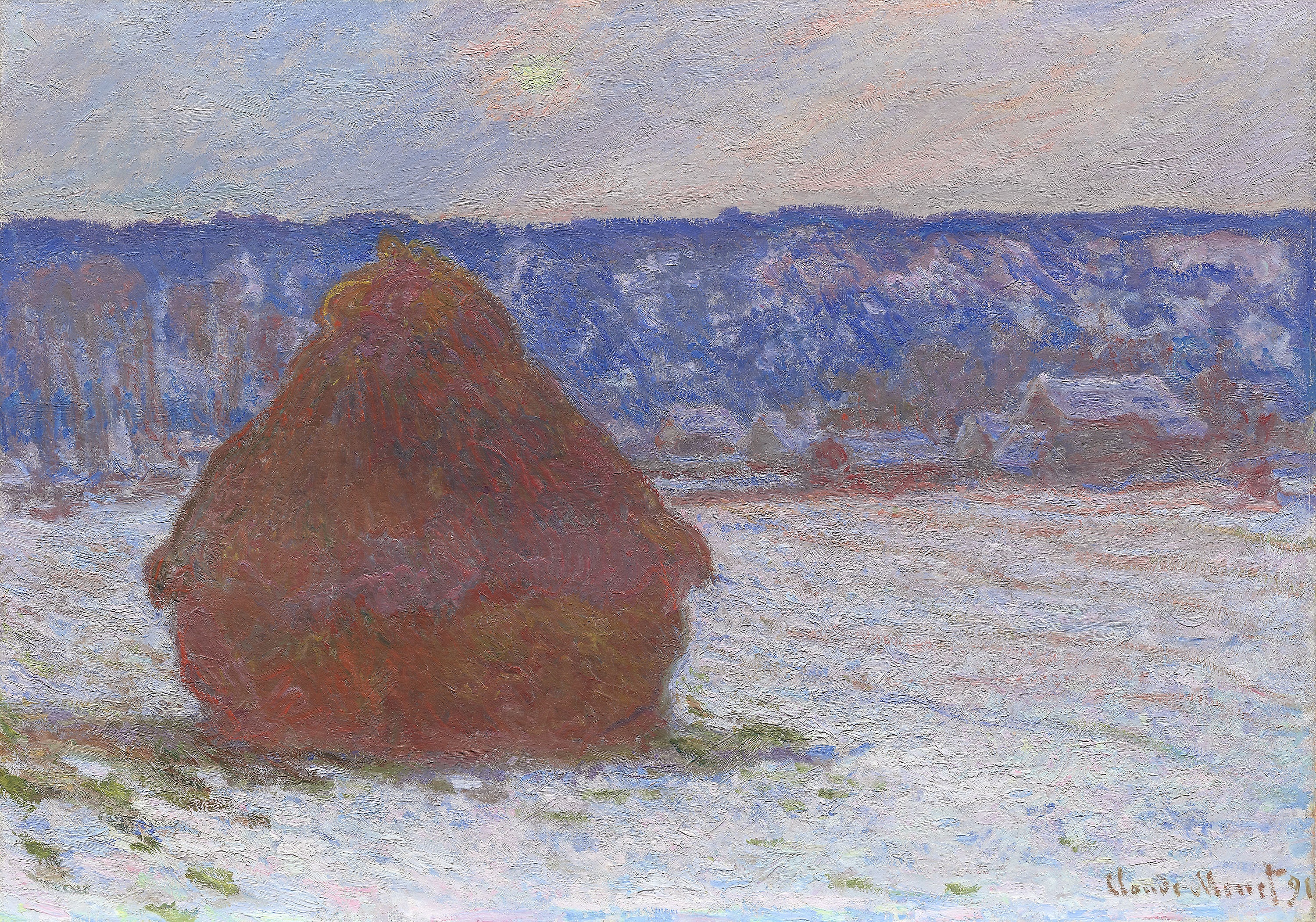
Stack of Wheat (Snow Effect) is a hand-painted reproduction of Monet’s winter scene at Giverny: a single brown stack stands left of centre in a snowy field, a blue band of wooded hill runs behind it, the roofs of the village crowd the right edge, and above it all a blurred sun sits in a pale sky. The original measures 93 x 66 cm, is oil on canvas and belongs to the Art Institute of Chicago under accession number 1933.1155. The museum dates it to the span 1890–91 and records the signature at lower right, “Claude Monet 91”. We paint it in eight sizes or to your own measurements, with a photograph of the finished work sent for approval before dispatch.
| Title: | Stack of Wheat (Snow Effect) |
| Other titles: | Stack of Wheat (Snow Effect, Overcast Day) (the museum’s own name) |
| Painter: | Claude Monet (1840–1926) |
| Year painted: | 1890–91, as the museum dates it; the canvas is signed “Claude Monet 91” |
| Original size: | 93 cm x 66 cm |
| Original technique: | Oil on canvas |
| Painting style: | Impressionism |
| Located at: | Art Institute of Chicago (acc. no. 1933.1155) |
| Our reproduction: | Hand-painted oil on canvas, eight sizes or made to measure |
Stack of Wheat (Snow Effect) – Claude Monet
What is on the canvas?
One stack, and everything else arranges itself around it. It stands left of centre, brown and reddish, a darker thatched cap over a lighter top, and takes up about a third of the width. Behind it a band of wooded slope runs the full width, blue and violet, flecked with snow between the trees. At the right edge, low roofs and a red wall emerge from under it. The lower half is snow: not white but pale blue, pink and grey, with dark grass showing through in places. The sky is evenly pale, and a dull sun without a hard edge sits in it a little left of centre.
Where did the stack stand?
Just behind Monet’s house at Giverny. The Art Institute of Chicago records that these stacks rose fifteen to twenty feet, some four to six metres, and stood in the field beside the artist’s farmhouse — not an excursion, then, but the view from a window. The museum adds that through 1890 and 1891 Monet worked two ways at once: in the field, at several easels, moving to the next as the light shifted, and in the studio, refining the colour relationships afterwards.
Why is there no single year?
Because the museum gives none. Its date field carries the span 1890–91, two years, and it does not narrow that. Yet the canvas carries one year: the museum itself transcribes the inscription at lower right, “Claude Monet 91”. Both come from the museum and do not contradict each other: the series runs across two winters and the signature belongs to the finishing. Since the institution that owns the work states a span, we state no single year. Where museum and database disagree, we follow the museum.
What does the museum record say about size?
The work belongs to the Art Institute of Chicago under accession number 1933.1155. It gives its measurements height by width, 66 x 93 cm; our table puts width first, so here you read 93 x 66 cm. Framed, the whole measures 114.7 x 87.4 x 11.5 cm, and the work hangs in Gallery 243.
The exhibition that changed Monet’s standing
In May 1891 Monet hung fifteen canvases from this series side by side in a single small room at the Galerie Durand-Ruel in Paris. The museum describes that show as an unprecedented critical and financial success and a breakthrough in the painter’s career and in French art. This very canvas was there: in the catalogue it carried the number 9 and the name “Meule. (Effet de neige; temps couvert)”. The poplars followed, then Rouen Cathedral, and later his own garden — each time the same motif at different hours.
The road to Chicago: from Durand-Ruel to Ryerson
The museum publishes the chain of owners with the prices, and every station is theirs. The work stayed with the painter until 9 May 1891, when Durand-Ruel of Paris bought it for 2,500 francs. Late in 1892 it passed to the firm’s New York branch, and on 31 March 1893 Martin A. Ryerson of Chicago bought it for $1,500. It came to the museum with his collection in 1933, hence the name it is entered under. The museum reports these figures from the Durand-Ruel stock books, confirmed by the family’s archive.
Six stacks in one museum — which is ours?
Confusion here is real: the same museum holds six canvases from the series, by its own account the largest group of Monet’s stacks anywhere. Ours is the only one it names with the qualifier “Snow Effect, Overcast Day”, under accession number 1933.1155. The most misleading neighbour is Stack of Wheat, acc. no. 1983.29, at 92.3 x 65.8 cm — less than a centimetre of difference in each dimension. The simplest test is counting: ours has one stack, while Stacks of Wheat (Sunset, Snow Effect) and Stacks of Wheat (End of Day, Autumn), which we also sell, show two. Monet’s best-known snow scene, a single black bird perched on a gate above blue shadows, is The Magpie.
How is our hand-painted version made?
Every order is painted individually, in oils on cotton or linen. A canvas painting is made here without printing, transfer or machine steps; a Monet reproduction from our collection is a new object, not a copy of a photograph. The winter scene is demanding because of the snow: on the canvas it is not white but pale blue, pink and grey, and painted white it loses the light the original has. So it starts from the cold greys, with the lighter passages last. The stack is the opposite task: a dense, warm mass of dozens of red, brown and orange strokes that must not merge into one colour. Every hand-painted oil painting that leaves our workshop is a little its own. Before dispatch you receive a photograph of the finished work.
Stretched in a rigid box or rolled in a tube, with tracking. Before that you receive a photograph of the finished work.
Which size for which wall?
Eight sizes are available, from 50 x 35 to 150 x 110 cm. The original is 93 cm wide and 66 cm high, so the closest by size is 90 x 65 cm, and the closest in proportion are 70 x 50 and 105 x 75 cm, both at 1.40 against the original’s 1.41. The scene is low and wide, so it sits well over a sofa, a sideboard or a bed. As a painting for living room walls, 105 x 75 cm reads calmly: the range is cold and quiet, and the brown stack, the only warm thing here, only really glows at a larger size. Related subjects from the same place and years are in the Claude Monet gallery: Poppy Field (Giverny) and, by season, Frost.
How high to hang the painting: centre it about 145 cm above the floor; over furniture, keep the lower edge 20 to 30 cm clear. We write more about hanging on our blog.
Made to measure, stretcher and frame
None of the eight sizes repeats the original’s proportion exactly. If that proportion is what you want, made to measure is the only route: send us the width and height in centimetres. The canvas can arrive stretched and ready to hang, or rolled in a tube if you will have it framed yourself. A frame is not included. This scene suits a pale or greyish wooden frame that continues the winter light; a dark one closes it in. The museum keeps its original in a frame that brings the whole to 114.7 x 87.4 cm.
Delivery and guarantee
Painting usually takes two to three weeks, longer at the largest sizes, because the oil has to dry between layers. Stretched canvases travel in a rigid box, rolled ones in a tube. If the work arrives damaged, or differs noticeably from the photograph you approved, we replace or refund it. A hand-painted copy is not a factory product and small differences in the brushwork are expected; damage or the wrong subject are not. We deliver within the European Union.
If the painting is a gift and you are unsure of the size, there is a gift voucher: the recipient chooses the size and the subject.
Frequently asked questions
Is the original for sale, and what is it worth?
It is not. It has been in a public collection since 1933. The last price the museum records is $1,500 in 1893, which says nothing about its value now.
How many haystack paintings did Monet make?
About thirty. Between 1890 and 1891 he painted the stacks in a field near his house at Giverny again and again, and fifteen of them were shown together at the Galerie Durand-Ruel in Paris in 1891.
Why did Monet paint haystacks?
The stacks stood in a field next to his house at Giverny. He wanted to show how the same simple motif changes with the light, the season and the weather, so he worked on several canvases at once.
Where did the stacks stand?
In a field just outside Monet’s house at Giverny, fifteen to twenty feet high. He painted them from the summer of 1890 into the winter of 1891, at several easels at once, and in May 1891 hung fifteen of them together at the Galerie Durand-Ruel in Paris.
- Subject. A single brown stack left of centre on bluish snow, a band of wooded hill and the roofs of Giverny behind it, a dull sun in a pale sky.
- Original. Oil on canvas, 93 x 66 cm, 1890–91 by the museum’s dating, signed lower right “Claude Monet 91”; Art Institute of Chicago, acc. no. 1933.1155, Ryerson Collection, Gallery 243.
- Ours. Eight sizes from 50 x 35 to 150 x 110 cm, or made to your own measurements, the only option that keeps the original’s proportion.
- Worth knowing. This very canvas hung in the May 1891 exhibition where Monet first showed fifteen stacks side by side; in the catalogue it was number 9.