


Description
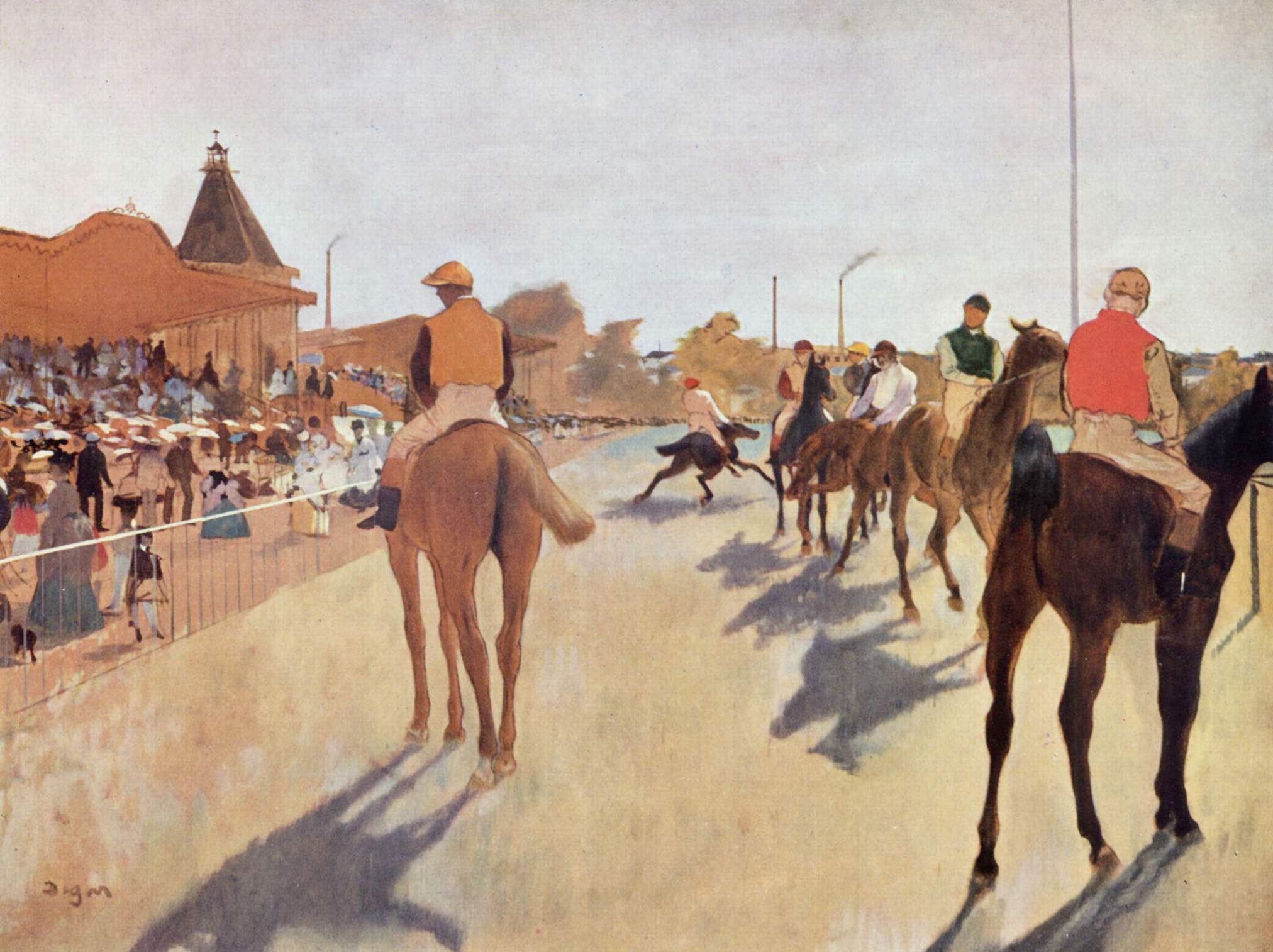
Race Horses before the Stands shows the minutes before a race, as the jockeys walk their horses past the stands. In the foreground a chestnut seen from behind carries a rider in an orange cap and orange-and-white silks; to the right a file of four or five more, among them one in a green cap and one in a red jacket. In the middle a single horse has bolted and is galloping back towards the left. On the left the crowd presses behind a rail under white parasols, and along the horizon four factory chimneys are smoking. The original is painted in oil on paper later laid down on canvas, and is held by the Musée d’Orsay in Paris under inventory number RF 1981. Ours is made by hand in eight sizes from 40 x 30 to 120 x 90 cm, or to your own measurement, and you receive a photograph of the finished work for approval before it ships.
| Title: | Race Horses before the Stands |
| Other titles: | Le défilé, Chevaux de courses devant les tribunes |
| Painter: | Edgar Degas (1834–1917) |
| Year: | circa 1866 |
| Size of the original: | 46 cm x 61 cm |
| Technique of the original: | oil, paper laid down on canvas |
| Style: | impressionism |
| Where it hangs: | Musée d’Orsay, Paris (inv. RF 1981) |
| Our version: | hand-painted in oil on linen, 8 sizes from 40 x 30 cm to 120 x 90 cm, custom size on request |
Race Horses before the Stands – Edgar Degas
Who is in the scene?
Jockeys with their horses, and the spectators along the track; none of them is named. In the foreground, left of centre, a chestnut walks quietly away from us so that we see its back and tail; the rider wears an orange cap, orange-and-white silks, white breeches and black boots. To the right runs a file of four or five more: one in a green cap and green jacket, in front of him one in pink and white with a yellow cap, at the right edge one in a red jacket on a dark horse, and at the very margin another dark animal that the edge cuts through. In the middle of the scene a single horse gallops towards the left, and it has plainly bolted.
What is on the canvas?
The scene lies wide and low. The left third is taken by the stand: an ochre pavilion with a dark pointed roof and a small turret, a densely packed gallery above, and below it a crowd of white parasols behind a rail with a pink bar. The remaining two thirds are open, pale sandy ground, across which long violet-grey shadows fall forward and to the left, which means a low sun. A line of trees stands on the horizon, and between them rise four thin factory chimneys with grey smoke. A tall mast stands at the right edge. The upper third is filled by an empty pale sky. Lower left, the signature in a dark colour.
Why does this scene matter?
For three reasons. First: the French title means a parade, and the parade is already coming apart. While the others walk quietly, one horse has bolted and is running the wrong way, its rider holding on as well as he still can. Second: behind the elegant crowd, factory chimneys are smoking. The racecourse is not out in the country but on the edge of a working city, and Degas did not hide that — he put it on the horizon. Third there is an absence: the race is missing. These are the minutes before it, while the whole thing is still a walk.
What does the scene mean?
Waiting, and an order that barely holds. Impressionism in Degas was never open-air painting for the sake of light, but a cut taken from the instant as the eye catches it from one particular place, and that place here is beside the rail. An impressionist painting of this kind therefore shows not the climax but the preparation for it. As wall art it reads calm and wide, because most of the surface is sandy and light; it does not want a loud wall but one it can spread across. Anyone after a large painting that opens a room rather than filling it will find one here. The shadows give the scene a beat the eye reads as a run of slanting lines.
The subject among Degas’s works
The racecourse runs through Degas’s whole career. Before the Race shows the same waiting from closer in, At the Races in the Countryside puts a carriage and a family in the foreground, and Scene from the Steeplechase shows what happens when it goes wrong. The work is held by the Musée d’Orsay in Paris, it is described in the Degas catalogue raisonné as MS 56, and a jockey study of the same years is at the Art Institute of Chicago.
How is our hand-painted version made?
With a brush and oil paint, not a printer. There is a difference here worth stating plainly: the original is not painted on canvas but on paper, laid down on canvas afterwards, which is why the colour sits thin, matt and a little chalky. Our version is oil on canvas, and we reach that lightness with thinner passes and by letting the sandy areas breathe instead of flooding them with paint. The hardest passage is the shadows: cool enough to separate from the sand, and transparent enough that the ground still shows through. The crowd on the left we paint as a run of small strokes, not as faces. Every reproduction is painted afresh, and no two are quite alike, because a hand does not repeat the same stroke twice; each hand-painted copy is therefore its own. For this work we have no photographs of our finished canvases, so none are shown here and none are described. You receive the photograph of your own canvas before it ships.
Which size for which wall?
If you do not know which: 80 x 60 cm. The original is 46 x 61 cm; our 59 x 50 cm is closest to it in size, while in proportion three of our sizes are closest — 40 x 30, 80 x 60 and 120 x 90 cm all share the same ratio, so we name them together. The 40 x 30 and 50 x 40 cm belong in a tight space, though at those sizes the crowd on the left melts into a smudge. The 59 x 50 and 70 x 55 cm are the usual choice above a sideboard. The 80 x 60 cm makes the most sense here, because it joins the right proportion to enough size for the chimneys still to read. The 90 x 70 and 100 x 80 cm want a broader wall, and 120 x 90 cm is already among the sizes in which the scene truly breathes and the long shadows get their full run. Measure the size you choose on the wall first with a paper cut-out. No size is kept in stock as a finished piece: every copy is painted to order and stays a single piece.
Custom size, stretcher and frame
If none of the eight sizes fits, or if you want the proportion of the original, we paint to your measurement and keep the proportions of the scene as we do, so that the stand on the left stays as wide as it is in Degas and the file of riders on the right does not lose its last horse; this is our work painted to order. Every canvas painting ships stretched on a wooden stretcher, ready to hang. For the frame, use our 3D app: it shows every moulding we carry on this subject, so you can compare gold, silver, black, white and natural wood — it is for choosing a frame and nothing else. If you want to see how the work looks on your own wall, we have a separate service for that, placement in the room.
Delivery and guarantee
Every piece is painted to order in our workshop in Slovenia, so allow 15-45 days depending on the size chosen; at the largest sizes the time is usually at the upper end. It travels stretched and protected for transport, framed if you chose a frame, to sixteen countries in the European Union, with no customs. Before it ships you receive a photograph of the finished work for approval, and our returns policy applies to every order. The painter’s full offer is in the Edgar Degas gallery, and his life is described in our article about Edgar Degas.
Frequently asked questions
What is happening in the scene?
Jockeys are walking their horses past the stands before the race. The race itself is not shown.
Why is one horse running the other way?
Because it has bolted. In the middle of the scene it gallops towards the left while the others walk on quietly.
What are the chimneys in the background?
Factory chimneys with grey smoke. The racecourse sits on the edge of the city, and Degas did not leave it out.
How many riders can be seen?
Six, counting the one on the bolted horse and the one at the very right edge.
Where is the original?
In the Musée d’Orsay in Paris, under inventory number RF 1981.
How big is the original?
46 x 61 cm. Our 59 x 50 cm is the closest to it in size.
What is the original painted on?
On paper, laid down on canvas afterwards. Our version is painted directly onto canvas.
Do your sizes follow the proportion of the original?
Three of the eight very closely: 40 x 30, 80 x 60 and 120 x 90 cm. The rest are a little squarer.
Is this a print?
No. The work is made by hand in oil; the brushstrokes are visible and can be felt.
Can I have a size that is not on the list?
Yes, we paint to measurement and keep the proportions of the scene as we do.
Is it suitable as a gift?
Yes, especially for someone who likes horses or racing. Because every piece is painted to order, allow for the making time; if you would rather leave the choice to the recipient, there is our voucher.
- Subject: jockeys with their horses before the stands in the minutes before a race, one horse bolted
- Original: Edgar Degas, oil on paper laid down on canvas, 46 x 61 cm, Musée d’Orsay, Paris (RF 1981)
- Ours: painted by hand in oil, eight sizes from 40 x 30 to 120 x 90 cm, stretched and framed on request
- Note: behind the elegant crowd, four factory chimneys smoke on the horizon