



Description
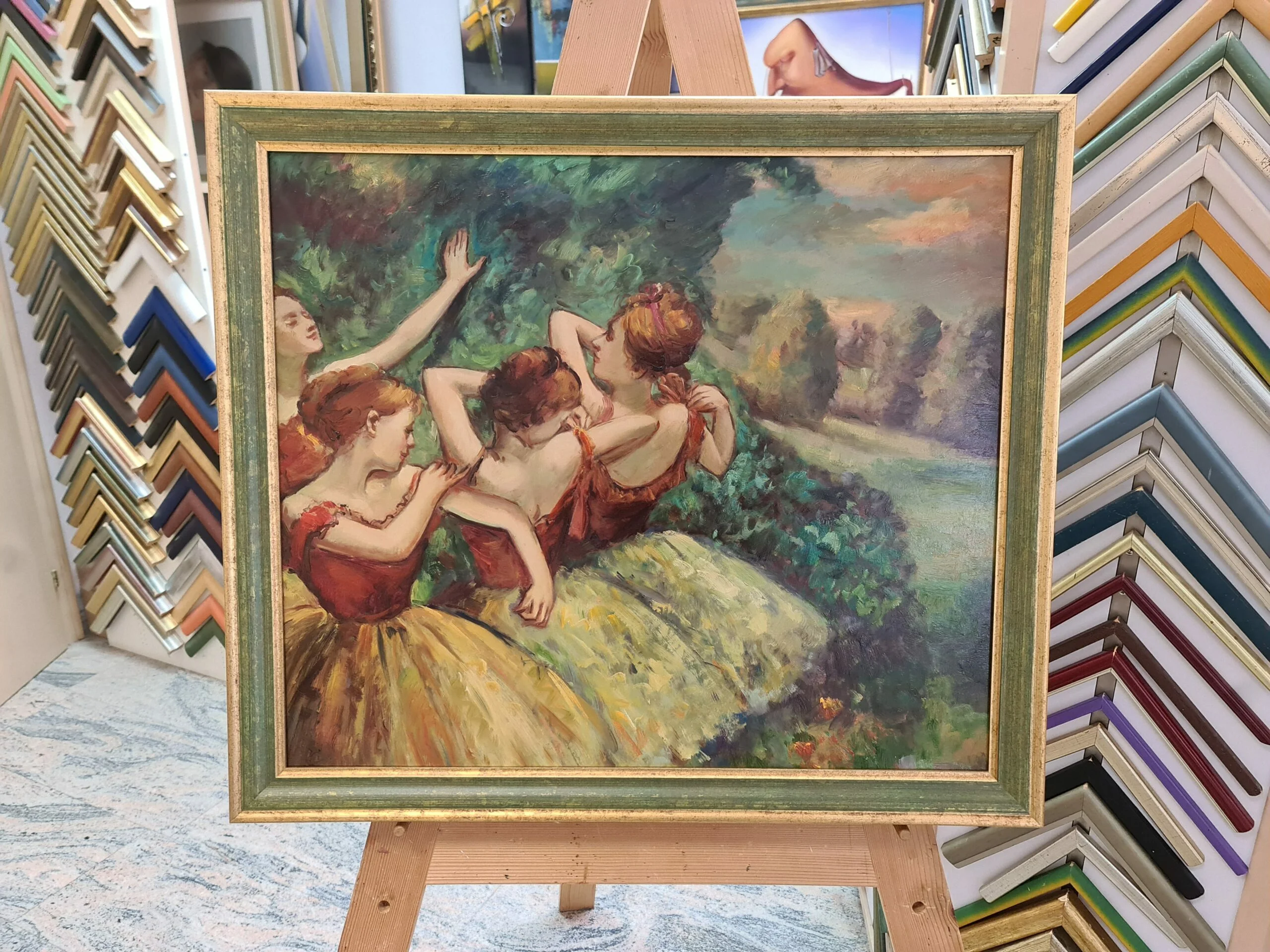
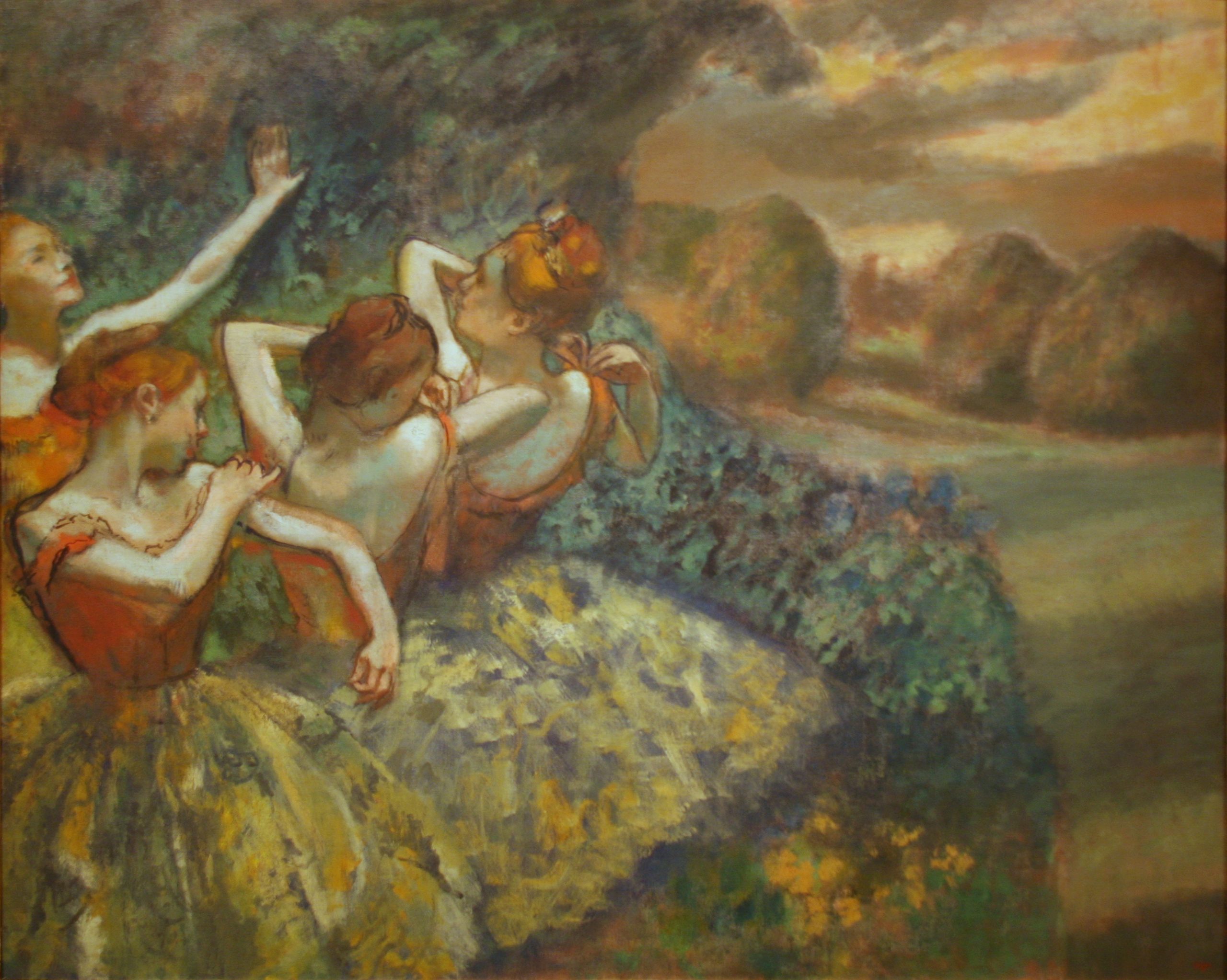
Four Dancers stand close together in the left half of the canvas, adjusting straps and hair, one of them raising an arm high above her head; behind them is a painted flat of dark green, and to the right a landscape opens out with trees and an orange evening sky. As a canvas painting this is the moment before the performance, not the performance. The original is held by the National Gallery of Art in Washington under the accession number 1963.10.122. We make it as a hand-painted oil on linen canvas, in sizes from 50 x 40 to 180 x 150 cm or to your own measurements, and you receive a photograph of the finished work for approval before dispatch.
| Title: | Four Dancers |
| Subject: | four dancers before the performance, a green stage flat, an open landscape at the right |
| Painter: | Edgar Degas (1834–1917) |
| Year painted: | about 1899 |
| Original size: | 151.1 cm x 180.2 cm |
| Original technique: | Oil on canvas |
| Painting style: | Impressionism |
| Located at: | National Gallery of Art, Washington (acc. no. 1963.10.122) |
| Our reproduction: | hand-painted oil on linen canvas, 7 sizes from 50 x 40 cm to 180 x 150 cm, custom sizes on request |
Four Dancers – Edgar Degas
Who is shown?
Four dancers just before going on. There are no names: Degas drew for decades at rehearsals and in the wings and almost never named his models. What they are doing is clear enough – they adjust each other’s straps and their own, pull a skirt straight and put their hair in order. This is the work of the last few seconds, which nobody in the auditorium ever sees.
What is on the canvas?
The format is landscape, the figures are pressed into the left half and cut by the left edge, so that it feels as though we are seeing them from the wings. All four wear brick-orange bodices and yellow-green skirts that merge below into one large mass of cloth. The dancer at the far left is visible only by her head and shoulder; the next looks down and adjusts a strap; the third stands with her back to us, hands in her hair; the fourth, furthest right, raises her right arm high above her head, and that is the only vertical in the whole scene. Behind them stands a painted flat of dense dark green. The right third opens into a landscape: round trees in green and brown, a meadow, and a sky in orange, pink and grey. The light comes from the right, out of that sky, and colours the shoulders and neck of every figure.
Why does this particular scene matter?
Because it is late, and because colour becomes independent in it. The work was made around 1899, when Degas was old and his eyesight was failing; the scene is no longer a drawing filled in with colour but a plane of colour in which the bodies barely separate from the ground. The orange bodices are repeated in the sky, the green skirts in the flat, so that the whole canvas is assembled out of two colours. This is a very different Degas from the one of the 1870s, where every face still had its own expression.
What does the scene mean?
Readiness. Nobody dances, nobody looks out at us, and no pose is meant for an audience; all four are turned in on themselves and on their clothes. As an impressionist painting it is unusual in that the space is not real – the green behind them is a stage flat, and the landscape at the right may be a painted backdrop or a true view, and the work deliberately does not resolve which. Impressionism for Degas always meant the stage and artificial light more than nature, and it is precisely that ambiguity which does the work here. It is wall art that keeps one question permanently open.
The motif among Degas’s works
Dancers are Degas’s largest subject and our range holds several. Closest to this scene are The Dancing Class, where the same errand is set inside a full room, Dancers in Pink, where a single colour carries the group, and Seated Dancer Adjusting Her Shoes, where the same moment is reduced to one figure. If you want to see how Degas solved the same material in pastel rather than oil, look at Ballet at the Paris Opéra at the Art Institute of Chicago, while Yellow Dancers in the same collection is likewise painted in oil on linen and likewise a scene from the wings.
How is our hand-painted version made?
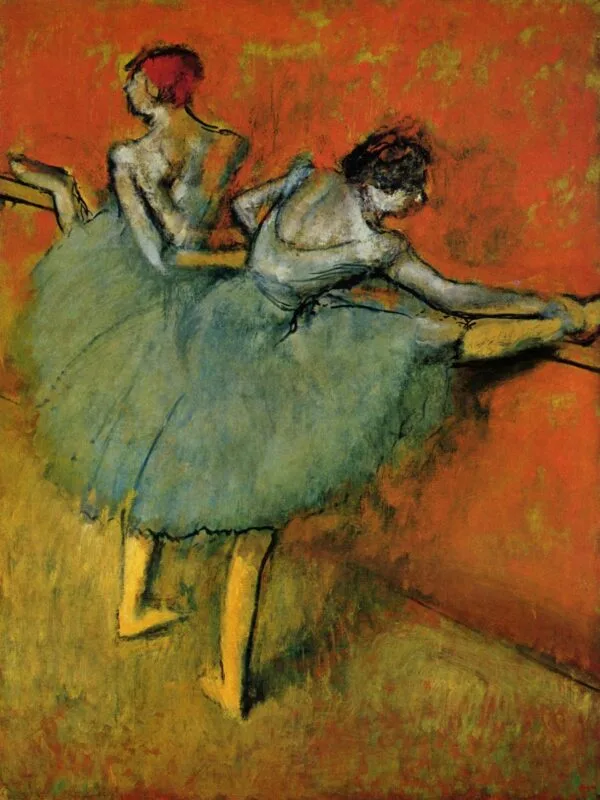
It is made with a brush and oil colours, not a printer. The hardest thing in this motif is keeping the boundary between bodies and ground as undecided as it is in the original: sharpen the outlines and the four figures fall apart into four separate characters, and the scene loses its mass. The same goes for the skirts – the lower third has to stay one moving surface rather than four recognisable dresses. In the first photograph our finished canvas stands on an easel in the workshop, framed in a green and gold moulding, with the racks of profile samples behind it that you choose from. Every reproduction is made afresh and no two copies are quite the same, because a hand does not repeat the same stroke twice; every hand-painted copy is therefore its own. The photograph of your canvas reaches you before dispatch.
Which size for which wall?
If you do not know which: 90 x 70 cm. The format is landscape and the scene is dense, so it loses air at small sizes; below 60 x 50 cm the four figures begin to read as a single patterned surface. The 50 x 40 and 60 x 50 cm sizes are for a shelf, a hallway or a group of smaller works; 70 x 60 and 80 x 65 cm go above a chest of drawers; 90 x 70 and 100 x 80 cm are the sizes above a sofa, where the work finally opens out and where it most often ends up. The 180 x 150 cm size is a special one: it is effectively the size of the original, and at it the dancers are close to life size – for that you need a long, empty wall. Measure your chosen size on the wall with a paper cut-out first; at the largest size that goes double, because a large painting also demands the distance you view it from.
Custom size, stretcher bar and frame
If none of the seven sizes suits your wall, we paint to your measurements and keep the proportions of the scene, so that the group on the left and the open landscape on the right keep their relation; that is our painting made to order. Every copy is delivered stretched on a wooden bar, ready to hang. For the frame, use our 3D application: on this motif it shows every moulding profile we carry, so you can compare gold, silver, black, white and natural wood – it is for choosing a frame and nothing else. If you want to see how the work looks on your own wall, that is our separate room-placement service.
Delivery and guarantee
Every copy is made to order in our studio in Slovenia, so allow 15 to 45 days depending on the size you choose; at the largest size the time is usually at the upper end. We send it stretched and protected for transport, framed if you chose a frame, to sixteen countries in the European Union, without customs duties. You receive a photograph of the finished work for approval before dispatch, and our returns policy applies to every order. The whole range is in the Edgar Degas gallery, and the painter’s life is described in our article about Edgar Degas.
Frequently asked questions
How many dancers are there?
Four. The one at the far left is visible only by her head and shoulder, because the left edge cuts her off.
What are they doing?
Adjusting straps, skirts and hair just before going on stage. None of them is dancing.
Is the landscape on the right real?
The work does not say. It may be a painted backdrop or a true view, and part of the effect lies in exactly that openness.
When was it painted?
About 1899. The museum record carries the year with the qualifier “about”, so we give it the same way rather than as a fixed year.
Where is the original?
In the National Gallery of Art in Washington, under accession number 1963.10.122. It measures 151.1 by 180.2 cm.
Is this a print?
No. It is painted by hand in oil on canvas; the brushstrokes are visible and can be felt.
Does any size match the original?
Yes, 180 x 150 cm is effectively the size of the original. It is the only size at which the figures are close to life size.
Which size should I choose?
For a living room usually 90 x 70 cm, for a smaller wall 70 x 60 cm. The size guide is above.
Can I have a size that is not listed?
Yes, we paint to measure and keep the proportions of the scene while doing it.
How is it delivered?
Stretched on the bar, and framed if you chose that, in 15 to 45 days after you approve the photograph.
Is it suitable as a gift?
Yes, especially for someone who dances or used to. Because every copy is made to order, allow for the making time; if you would rather leave the choice to them, there is our gift voucher.
- Subject: four dancers just before going on, orange bodices and yellow-green skirts, an open landscape at the right
- Original: Edgar Degas, about 1899, oil applied to canvas, 151.1 x 180.2 cm, National Gallery of Art in Washington (1963.10.122)
- Ours: hand-painted in oil, seven sizes from 50 x 40 to 180 x 150 cm, stretched and framed on request
- Worth knowing: all four figures wear the same two colours, and those colours return in the sky and the stage flat – the whole canvas is assembled from orange and green