


Description
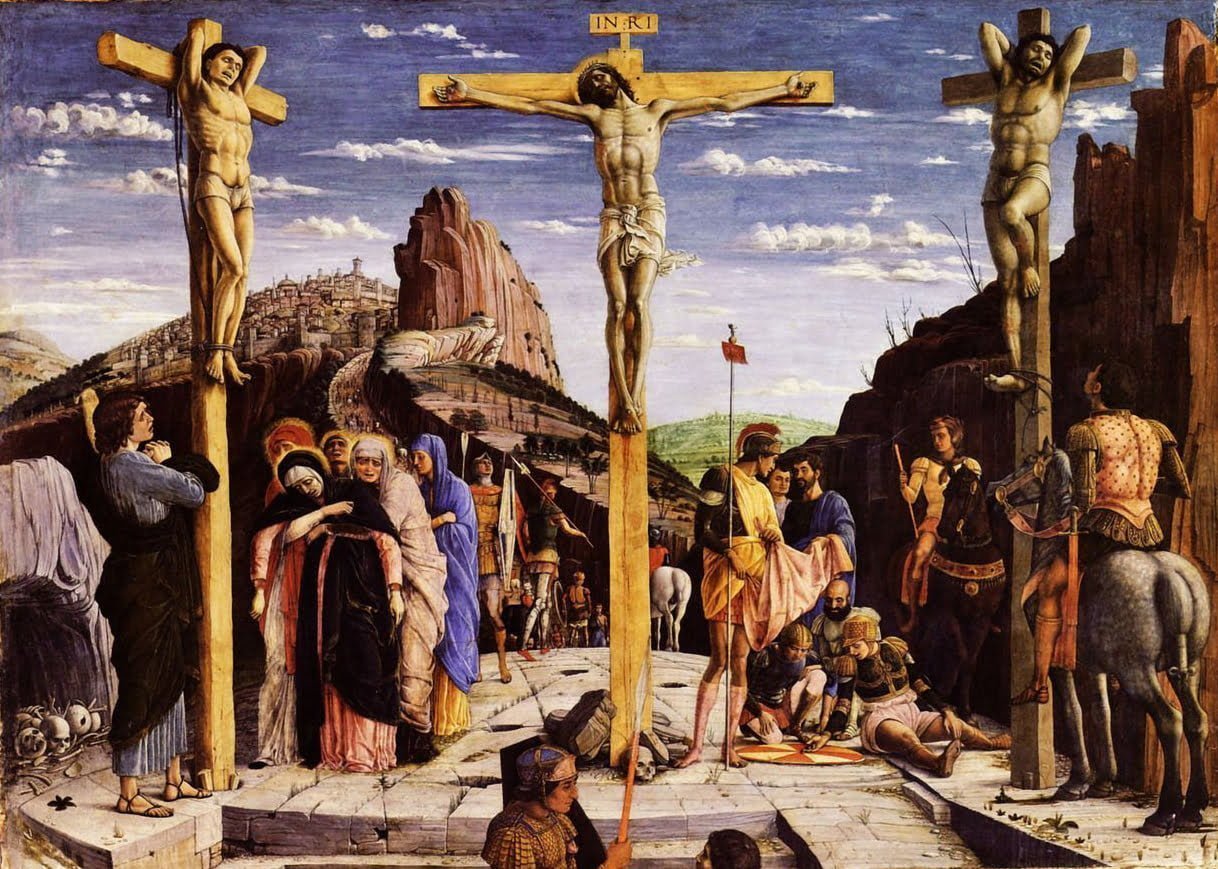
Calvary, after a painting by Andrea Mantegna is Degas’s copy, made in 1861 from a panel that hangs in the Louvre. Three crosses stand on a rocky rise: Christ in the middle, a thief on either side. Lower left the Virgin faints and is caught by the women around her, with Saint John the Evangelist beside them. To the right soldiers in Roman armour throw dice for the robe, horsemen wait, and a winding road carries the eye back towards the city. Degas painted the canvas at almost the size of the original but left it in the state of a sketch: the museum itself records that the painting does not give back the smoothness and finish of the original panel. The original measures 92,5 x 69 cm, is oil paint on canvas, signed lower right, and is in the Musée des Beaux-Arts in Tours under inventory number 1934-6-1. Ours is made by hand, in eight sizes from 50 x 40 to 150 x 110 cm or to your own measurement, and before dispatch you receive a photograph of the finished work for approval.
| Title: | Calvary, after a painting by Andrea Mantegna |
| Other titles: | Le Calvaire d’après Mantegna (the museum’s title) |
| Painter: | Edgar Degas (1834–1917), after Andrea Mantegna (1431–1506) |
| Year: | 1861 (signed lower right: Degas) |
| Size of the original: | 92,5 cm x 69 cm |
| Technique of the original: | oil paint on canvas |
| Painting style: | a copy after an old master, from Degas’s student years |
| Where the original is: | Musée des Beaux-Arts, Tours (inv. 1934-6-1); Joconde record 02650010032 |
| Our version: | hand-painted oil on linen, 8 sizes from 50 x 40 cm to 150 x 110 cm, made to measure on request |
Calvary, after a painting by Andrea Mantegna – Edgar Degas
What is in the scene?
A crucifixion, set into a wide, almost horizontal field. Christ on the cross in the centre, the two thieves to left and right — the good one and the bad — all three on a rocky, paved rise that looks more like a stone platform than a hill. Lower left the Virgin faints and is caught by the women surrounding her; Saint John the Evangelist stands close by. Lower right soldiers crouch and throw dice for Christ’s robe, behind them horses and riders in Roman armour, Longinus with his lance. In the distance the road climbs past cliffs towards the walled city that stands for Jerusalem. The light comes from the left and divides the scene into lit and shadowed bands; that effect of light is precisely what interested Degas most in the panel.
Which painting is in the photograph?
This is worth saying plainly: the photograph on this page is not the Degas but the Mantegna. It shows the original panel Le Calvaire, in the Louvre since 1798 under INV 368, measuring 96 x 76 cm and painted in tempera on wood as the central element of the predella of an altarpiece from the church of San Zeno in Verona. What we paint is the Degas version in Tours, not this panel. The reason for the photograph is simple and measured: the only published photograph of Degas’s canvas, issued by the French state database Joconde, is 798 x 600 pixels. That is too small to show on this page and too small for our sizes — at 150 cm it would give about 5 pixels per centimetre, a third of what we require. So the panel by Mantegna stands here, which is exactly what Degas had in front of him, while what we paint is his copy. The product title states that difference already.
Why did Degas paint it, and why does it look like a sketch?
Because copying was how he learned. In the spring of 1853, barely out of school, Degas applied for a copyist’s card at the Louvre, and between 1853 and 1861 he copied the old masters regularly. This copy is the last of that run. It is dated to 1861 because it was from Mantegna that Degas took the group of women around the fainting Virgin and used it in his own Daughter of Jephthah. About its appearance the museum records something worth repeating honestly: it is treated as a sketch and does not give back the smoothness and finish of the original panel. Mantegna’s surface is hard and enamel-like, with no trace of the brush; Degas’s is open, quicker, and in places the ground shows through. This was not an exact imitation but an attempt to understand how the scene is built.
What does the scene mean?
Two things at once: an old religious subject, and a document of how a painter learns. As a canvas painting it is an unusual choice, being neither decorative nor pleasant; it is serious, and carries a story most people know, told here at a distance. The colours are earthy — stone, armour, brown road, pale sky — so it sits more quietly on a living-room wall than a crucifixion might suggest, and agrees with wood and warm paint. Among wall art it belongs where you want content rather than pattern. In Degas’s work it stands right at the beginning: before the dancers came the old masters. Our reproduction follows the Degas version, with the paved rock and the arrangement of figures as he set them.
From Degas’s studio to Tours
The path of this canvas is short and well recorded. It stayed with the painter until his death and was sold in 1918 at the sale of his studio at the Galerie Georges Petit in Paris. In 1934 it belonged to Jeanne Fevre in Nice — Degas’s niece, who cared for him in his last years — and in the same year it was bought by the Compagnie générale du gaz pour la France in Paris and given, still that year, to the city of Tours. It has belonged to the city ever since and hangs in the Musée des Beaux-Arts under inventory number 1934-6-1. A pleasing coincidence: that same museum also holds two further panels of the same San Zeno predella — The Agony in the Garden and The Resurrection — while the central panel, the one Degas copied, stayed in the Louvre. In Tours the copy therefore hangs beside two sisters of the original.
The subject among Degas’s works
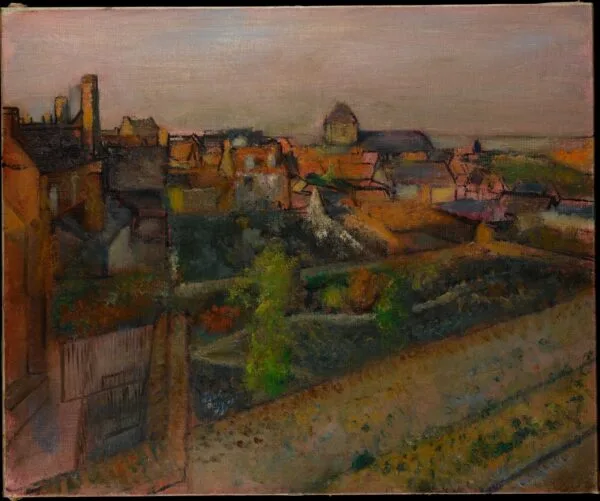
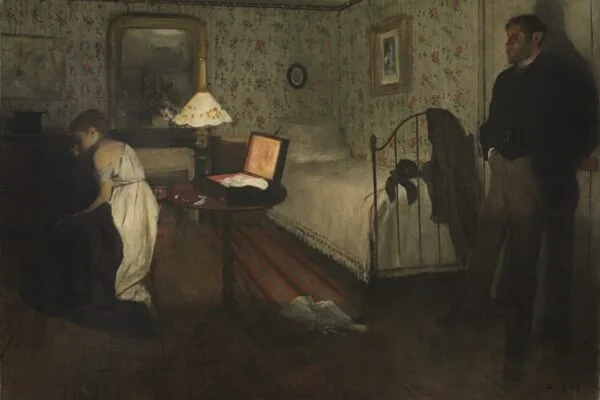
From these years we carry two more works, both historical and both before the ballet. Young Spartans Exercising, of 1860, shows the same Degas still thinking in scenes from antiquity and scripture. David and Goliath is a second biblical subject of the same period. A little later comes The Rape, where the storytelling moves into a contemporary room. The museum record for this canvas is Joconde 02650010032: Le Calvaire d’après Mantegna, 1861, oil paint on canvas, 92,5 x 69 cm, signature lower right, inv. 1934-6-1, and it is held by the Musée des Beaux-Arts de Tours, which received the work as a gift in 1934.
How is our hand-painted version made?
With brush and paint, as oil on canvas of linen. The hardest part is the arrangement. The scene holds many figures in a small space, and if one group grows by a few centimetres the balance between the three crosses and the crowd below collapses; so the grid of three verticals goes down first and the people only afterwards. The second difficulty is the rock: a paved, sharply articulated surface that must stay solid and never become a pattern. The third is the finish. Because the original is deliberately unsmoothed, we do not smooth it either — a copy of Degas’s copy that was more handsomely finished than his would no longer be the same work. Every hand-painted version is therefore a little its own. For this subject we have no photographs of our finished canvases yet, because we have not painted it before, so there are none here and we describe none. You receive a photograph of your own canvas before dispatch.
Which size for which wall?
The original has a ratio of 1,34, a decidedly horizontal format, and the ladder hits it almost exactly in two places. 80 x 60 cm and 120 x 90 cm are both 1,33, within one per cent of the original; the first is 12,5 cm narrower than Degas’s canvas and the closest in size among those that also keep the shape. 150 x 110 cm at 1,36 is still close, and is the size at which a large painting of this kind really tells: the figures along the bottom become readable. Take care with two of them: 60 x 40 and 90 x 60 cm are 1,50 and sit furthest from the original — 90 x 60 cm is nearest the original’s width, yet it is at the same time the weakest choice on the ladder, because it squeezes the scene in height and cuts away the sky above the crosses. 50 x 40 and 100 x 80 cm, at 1,25, are too square for this composition. Measure the chosen size out with a paper cut-out first. None is held in stock: every piece is made to order.
Custom size, frame and stretcher
If none of the eight suits, we paint to your measurement and keep the ratio of 1,34 and the space above the crosses, since it is that empty band that lets the scene breathe; this is our work made to order. Every piece ships stretched on a wooden stretcher, ready to hang. For the frame use our 3D application: it shows every moulding we carry — gold, silver, black, white and natural wood — and serves the choice of frame and nothing else. How the work sits on your own wall is shown by our separate service, placement in the room.
Delivery and guarantee
Every piece is made to order in our workshop in Slovenia; allow 15-45 days depending on size, at the upper end for the largest. It travels stretched and protected for transport, framed if you choose a frame, to Slovenia and fifteen other European Union countries, with no customs duty. Before dispatch you receive a photograph of the finished work for approval, and our returns arrangement applies to every order. The whole range is in the Edgar Degas gallery, and his life is described in our article on Edgar Degas.
Frequently asked questions
Which painting is this?
Degas’s copy after Mantegna’s Calvary, painted in 1861. It measures 92,5 x 69 cm and is in the Musée des Beaux-Arts in Tours under inventory number 1934-6-1.
Does the photograph show the Degas or the Mantegna?
The Mantegna — the original panel in the Louvre. The only published photograph of Degas’s copy is 798 x 600 pixels, too small to show and too small for our sizes. We paint the Degas version even where the photograph shows the original he copied.
Is the work signed?
Yes, lower right. That is worth saying because most of Degas’s works carry only the studio-sale stamp, applied after his death; this canvas he signed himself.
When was it painted?
In 1861. The museum argues the year from the fact that Degas took the group of women around the Virgin for his own Daughter of Jephthah.
Why did Degas copy another painter?
Because that is how he learned. In the spring of 1853 he applied for a copyist’s card at the Louvre and copied the old masters regularly until 1861. Mantegna interested him particularly.
Why does it look less finished than Mantegna’s?
Because it is meant to. The museum itself records that it is treated as a sketch and does not give back the smoothness of the original panel. The point was to understand how the scene is built, not to imitate its surface.
How large is the original?
92,5 cm wide and 69 cm high. Mantegna’s panel measures 96 x 76 cm, so Degas copied at very nearly full size.
Where is the original today?
In the Musée des Beaux-Arts in Tours, where it arrived in 1934 as a gift. Mantegna’s panel, from which it was made, is in the Louvre.
Which of your sizes matches the original?
By shape, 80 x 60 and 120 x 90 cm, both at 1,33 against the original’s 1,34. By width the nearest is 90 x 60 cm, but that is precisely the weakest of the eight in shape.
Is this a print?
No. The work is made by hand, in oil paint on linen; the brushstrokes are visible and can be felt.
Is it suitable as a gift?
For someone curious about how painters learn it is a good gift: a classical subject and a look into the young Degas’s workshop. Since every piece is made to order, allow for the making time; if you would rather leave the choice to them, there is our gift voucher.
- Subject: a crucifixion with three crosses on paved rock, the fainting Virgin to the left, soldiers throwing dice to the right, Jerusalem behind
- Original: Edgar Degas, 1861, oil paint on canvas, 92,5 x 69 cm, Musée des Beaux-Arts, Tours (inv. 1934-6-1), signed lower right
- Our version: hand-painted oil, eight sizes from 50 x 40 to 150 x 110 cm; 80 x 60 and 120 x 90 cm are closest in shape
- Worth knowing: the photograph on this page shows Mantegna’s original panel in the Louvre, because Degas’s copy is published nowhere at a usable resolution; what we paint is the Degas version