


Description
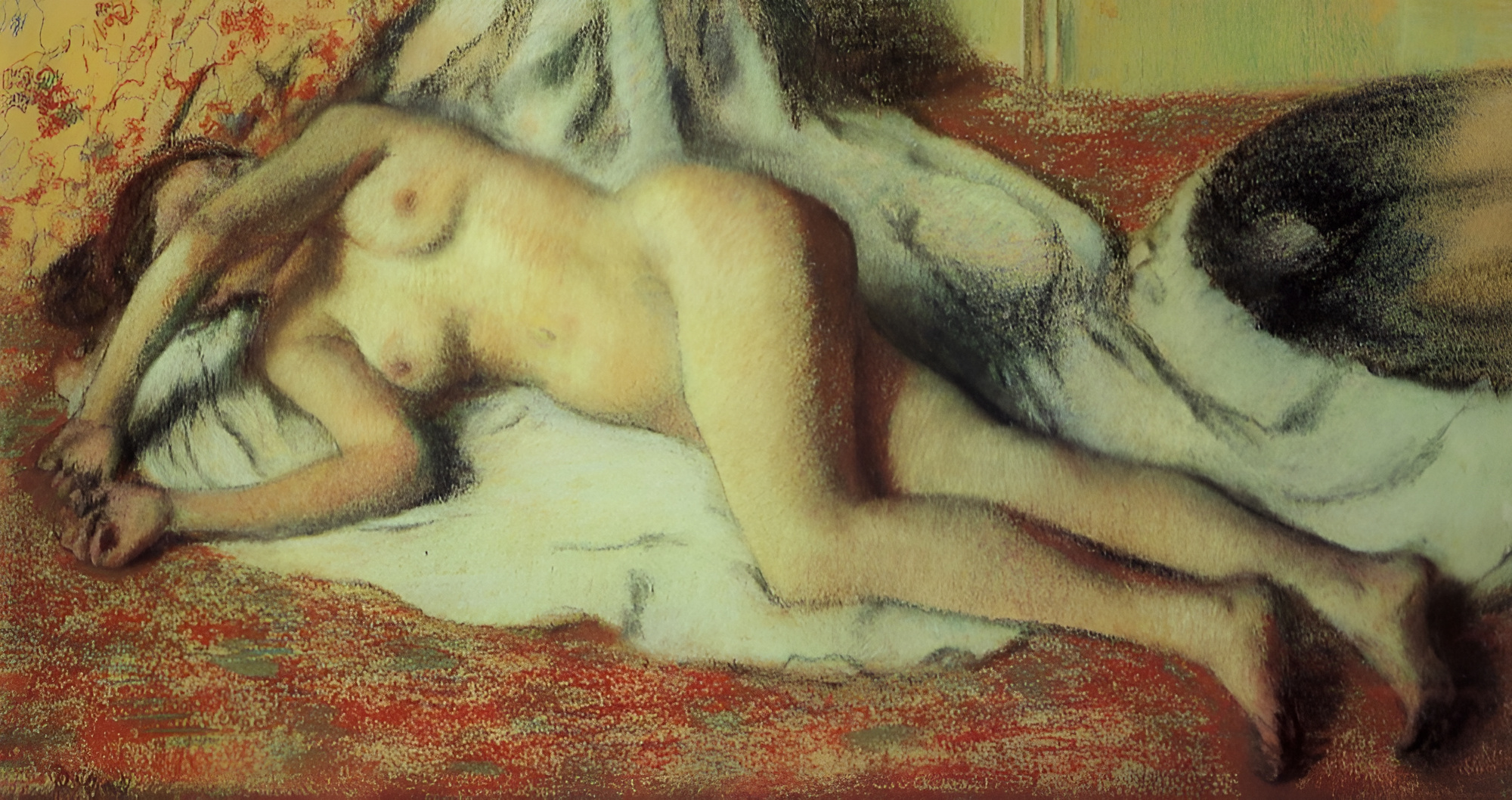
Bather Stretched out on Floor shows a nude woman lying stretched out on white towels after her bath, her head at the left and one arm bent above it; the face is turned away and almost hidden, the legs reach far to the right, and the ground beneath her is a red and green pattern. As a canvas painting this is a very wide, low scene of rest, with no look towards the viewer. The original is a pastel on paper and is located in the Musée d’Orsay in Paris under the inventory number REC 50. We make it as a hand-painted oil on linen canvas, in sizes from 70 x 40 to 180 x 100 cm or to your own measurements, and you receive a photograph of the finished work for approval before dispatch.
| Title: | Bather Stretched out on Floor |
| Other titles: | Baigneuse allongée sur le sol |
| Painter: | Edgar Degas (1834–1917) |
| Subject: | a nude figure stretched out on white towels, a patterned red and green ground |
| Original size: | 48 cm x 87 cm |
| Original technique: | Pastel on paper |
| Painting style: | Impressionism |
| Located at: | Musée d’Orsay, Paris (inv. no. REC 50) |
| Our reproduction: | hand-painted oil on linen canvas, 8 sizes from 70 x 40 cm to 180 x 100 cm, custom sizes on request |
Bather Stretched out on Floor – Edgar Degas
Who is shown?
A single figure, unnamed. In his late years Degas made a series of works in which women wash, dry themselves or rest after bathing, and he almost never named his models. Here the woman is not posing: she lies stretched out with one arm bent above her head, her face turned away and almost hidden in her hair and the cushion. That is the heart of the scene – the viewer is an observer, not the person being addressed.
What is on the canvas?
The format is exceptionally wide and low, nearly twice as long as it is high, and the figure fills it along its whole length. The body lies at an angle, the head at the left edge and the legs reaching to the right; beneath it are white towels gathering into heavy, soft folds. The ground is densely patterned in red, brick and green, and reads as a carpet or a covered divan. At the upper left is a wall with a floral pattern in ochre and red, at the upper right a dark mass – a curtain or a piece of furniture – and beside it pale cloth. The colours are warm and dry; nowhere is there a sharp edge. At the lower left stands the signature.
Why does this particular scene matter?
Because it shows Degas in a technique that suited him better than oil in his late years. Pastel is laid down dry, in short hatched strokes that do not merge, and that is exactly why the skin on this sheet is not smooth but assembled from countless small marks. In places the grain of the paper shows through the colour. A work like this was not meant as a large exhibition piece but as a sheet to be looked at closely – and that is what makes it interesting for a wall today, because the motif is quiet while the surface is alive.
What does the scene mean?
Rest without a story. There is no event, no second person, no look towards us. As an impressionist painting you recognise it by the fact that the subject is entirely ordinary and the light comes from the side, soft and even. Impressionism for Degas always meant a body in a position nobody would choose for a portrait; here that position is completely relaxed. The work therefore reads as calm rather than insistent, although the figure is nude – the tone is one of observation, not display. It is wall art for a quiet room.
The motif among Degas’s works
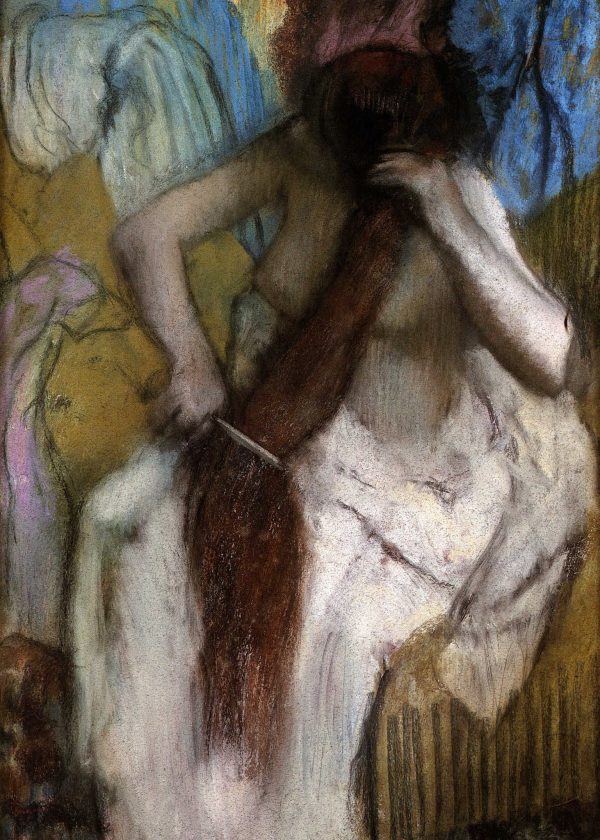
The bath and the bathers are among Degas’s great late subjects. Closest to this sheet in our range are After the Bath, bending figure and After the Bath, where the same moment is shown upright and in a narrower format, and Peasant Girls Bathing in the Sea at Dusk, where the bathing is moved out of doors. If you want to see how Degas used pastel for stage scenes rather than for the nude, look at Ballet at the Paris Opéra at the Art Institute of Chicago, while Combing the Hair at the National Gallery in London shows the same material carried out in oil.
How is our hand-painted version made?
It is made with a brush and oil colours, not a printer, and there is a difference here that has to be said plainly: the original is not painted in oil but in pastel on paper. Pastel is dry and granular, oil is denser and more continuous, so the painter lays the colour in short separated strokes and leaves the ground visible between them to come close to the effect of dry chalk. The hardest part is keeping the softness of the transitions on the body without the skin turning smooth as porcelain. Every reproduction is made afresh and no two copies are quite the same; every hand-painted copy is therefore its own. This family has no photographs of our finished canvases, because the work has not been painted since we began photographing every piece – so we show and describe none here. The photograph of your canvas reaches you before dispatch.
Which size for which wall?
If you do not know which: 110 x 60 cm. The format is very wide, so the work needs wall length; above a bed, a sofa or a chest of drawers it does better than on a narrow wall. The 70 x 40 and 80 x 45 cm sizes are for a smaller room or a hallway; the 87 x 47 cm size is effectively the size of the original and is meant for someone who wants exactly that; 100 x 55 and 110 x 60 cm are the sizes above a chest or a bed and are the ones most people choose; 120 x 65 cm goes above a sofa, where the work may take over the wall. The 150 x 80 and 180 x 100 cm sizes are for a long, empty wall where a large painting really gets air and the figure is close to life size. Measure your chosen size on the wall with a paper cut-out first; with a format this wide the mistake is usually made in the width. None of the sizes is held in stock as a finished item: every copy is made to order and stays a single piece.
Custom size, stretcher bar and frame
If none of the eight sizes suits your wall, we paint to your measurements and keep the proportions of the scene, so that the figure does not lose her length and the towels beneath her keep their space; that is our painting made to order. Every copy is delivered stretched on a wooden bar, ready to hang. For the frame, use our 3D application: on this motif it shows every moulding profile we carry, so you can compare gold, silver, black, white and natural wood – it is for choosing a frame and nothing else. If you want to see how the work looks on your own wall, that is our separate room-placement service.
Delivery and guarantee
Every copy is made to order in our studio in Slovenia, so allow 15 to 45 days depending on the size you choose; for the two largest sizes the time is usually at the upper end. We send it stretched and protected for transport, framed if you chose a frame, to sixteen countries in the European Union, without customs duties. You receive a photograph of the finished work for approval before dispatch, and our returns policy applies to every order. The whole range is in the Edgar Degas gallery, and the painter’s life is described in our article about Edgar Degas.
Frequently asked questions
What is happening in the scene?
A woman is resting after her bath, stretched out on white towels. There is no event and no second person.
Why is the face barely visible?
Because it is turned away and partly hidden in her hair and the cushion. In the late bathers Degas often chose exactly this position.
Is the original a painting or a pastel?
A pastel on paper. That is why the surface is dry and granular, and why the grain of the paper shows through in places.
Is our version a pastel?
No. Ours is painted in oil on linen; the composition, the colours and the proportions follow the original, while the surface is by nature more continuous.
Where is the original located?
In the Musée d’Orsay in Paris, under the inventory number REC 50.
Why is no year given?
Because the record available to us gives it only to the decade and with a range of uncertainty. We would rather not state it than round it into an exact year.
How large is the original?
48 by 87 cm. Our 87 x 47 cm size is effectively the same.
Is this a print?
No. It is painted by hand in oil on canvas; the brushstrokes are visible and can be felt.
Which size should I choose?
Above a bed or sofa usually 110 x 60 cm, for a smaller room 87 x 47 cm. The size guide is above.
Can I have a size that is not listed?
Yes, we paint to measure and keep the proportions of the scene while doing it.
Is it suitable as a gift?
Yes, especially for someone who likes quiet, warm scenes and the classical nude. Because every copy is made to order, allow for the making time; if you would rather leave the choice to them, there is our gift voucher.
- Subject: a nude figure stretched out on white towels over a red and green patterned ground, the face turned away
- Original: Edgar Degas, pastel on paper, 48 x 87 cm, Musée d’Orsay in Paris (REC 50)
- Ours: hand-painted in oil, eight sizes from 70 x 40 to 180 x 100 cm, stretched and framed on request
- Worth knowing: the 87 x 47 cm size is effectively the original’s – the only one at which the figure is as long as she is on the sheet