







































Description
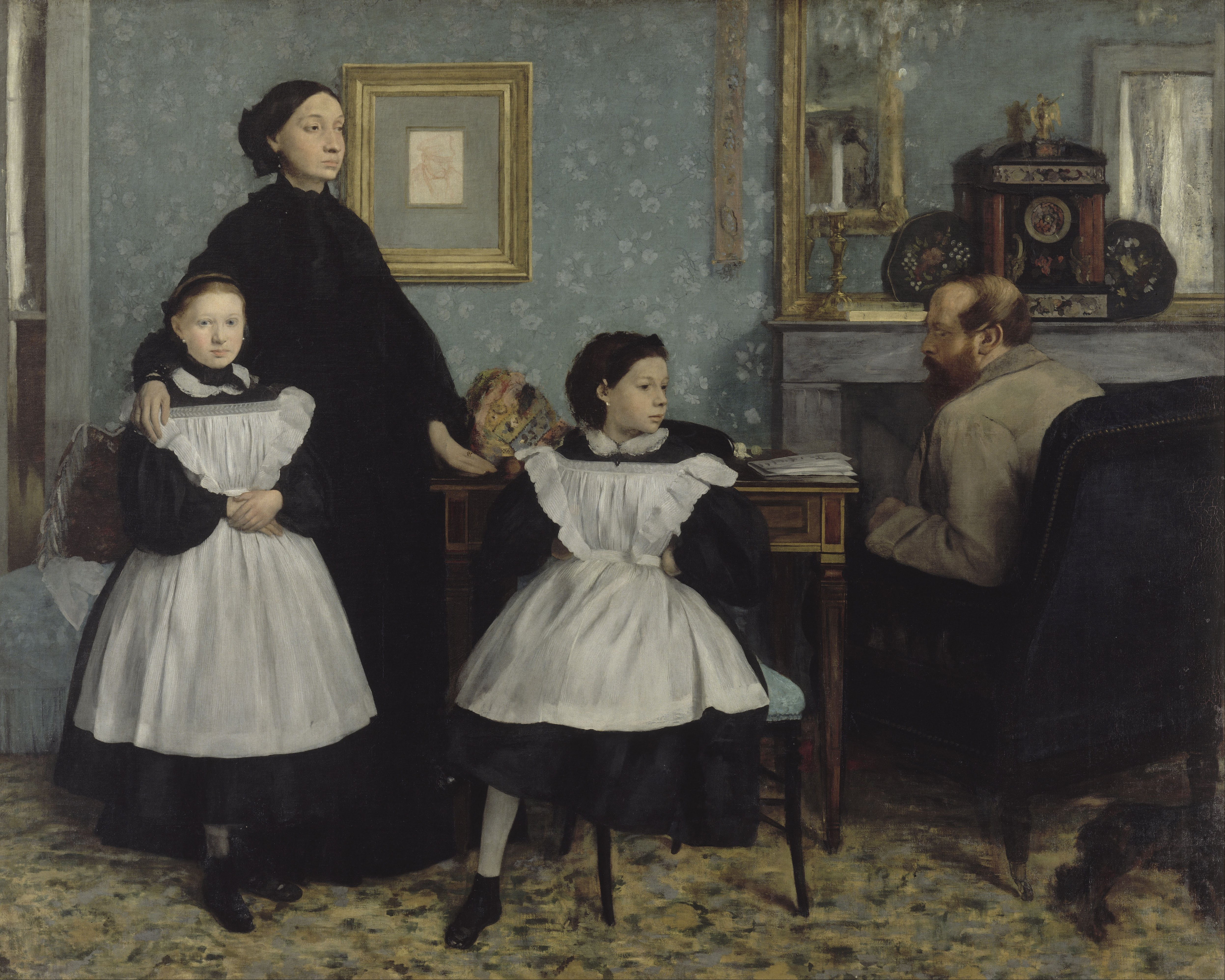
The Bellelli Family shows four people in a drawing room with pale blue floral wallpaper. At the left a woman in a black dress stands with her hand resting on the table; beside her the elder daughter stands in a black dress with a white pinafore and is the only one who looks straight out at us. In the middle the younger daughter sits on a chair, one leg tucked under her, turned towards her father. At the right the father sits in an armchair by the writing table, seen from behind and in three-quarter view, in a grey-brown jacket. Above the table hangs a framed red-chalk drawing, above the fireplace a gilt mirror and a clock with an inlaid case, and at the lower right a small dog is leaving the scene. Four people look in four directions and no gaze meets another. The original is two and a half metres wide and is held by the Musée d’Orsay in Paris under inventory number RF 2210. Ours is made by hand in seven sizes from 50 x 40 to 150 x 110 cm, or to your own measurement, and you receive a photograph of the finished work for approval before it ships.
| Title: | The Bellelli Family |
| Other titles: | Portrait de famille ou La famille Bellelli |
| Painter: | Edgar Degas (1834–1917) |
| Year: | about 1860 |
| Size of the original: | 201 cm x 249.5 cm |
| Technique of the original: | oil on canvas |
| Style: | impressionism |
| Where it hangs: | Musée d’Orsay, Paris (inv. RF 2210; Schulman catalogue MS 1260, Lemoisne I-79) |
| Our version: | hand-painted in oil on linen, 7 sizes from 50 x 40 cm to 150 x 110 cm, custom size on request |
The Bellelli Family – Edgar Degas
Who is in the scene?
Four people and a dog. At the left a woman stands in a long black dress with a white collar; her right hand rests on the table and her gaze goes past us to the left. Beside her, close under her arm, the elder girl stands in a black dress with a large white pinafore, her hands folded in front of her, and she is the only one who looks straight out at us. In the middle the younger girl sits on a chair in the same black and white clothes, one leg tucked under her, her body turned to the right and her head turned further still towards her father. At the right a man sits in an armchair by the writing table, turned away from us, in a grey-brown jacket; we see his profile and the back of his neck. At the lower right a small curly dog is walking out of the picture, and only its hindquarters and tail remain.
What is on the canvas?
A drawing room with pale blue-grey wallpaper in a small floral pattern. Behind the woman hangs a red-chalk drawing in a wide gilt frame. At the right is the fireplace: a gilt mirror above it, on the mantel a clock with an inlaid red-brown case and two dark screens with flowers, a candlestick at the side. The table beside the woman is covered with a black cloth, and on it lie an open patterned fan and some papers. The floor is covered by a patterned carpet in olive, ochre and blue. At the left, the edge of a window frame and the back of a blue chair. All three women are in black; the only pale areas in the scene are the white pinafores and collars.
Why does this scene matter?
Because the four gazes do not meet. The mother looks past us to the left, the elder daughter straight out at us, the younger towards her father, and the father away from all of them, towards the fire. In a family portrait that is unusual: work of this kind usually tries to bind people together, and this one pulls each of them in a separate direction. The second reason is the arrangement: mother and elder daughter run together into a single black mass, while the father is pushed against the right edge with his back to us. The third is the format. The canvas measures 201 x 249.5 cm — the scale the painter kept then for history subjects, used here on his own relatives in a sitting room.
What does the scene mean?
A family portrait that does not flatter. Impressionism in the young Degas is still close to the old masters: the drawing is exact, the colours held back, the stroke hidden. As an impressionist painting it is therefore unusual — no light effects, but an arrangement that is hard to forget. As wall art it works where you want a scene with people in it and not an ornament; being mostly black, grey and white, it stays quiet even in a small room. Hung as a large painting the faces become readable from across the room, which is where this canvas painting starts to work as it was meant to.
The subject among Degas’s works
The early portraits are a group of their own in Degas. Edmondo and Thérèse Morbilli is a double portrait in which the gazes likewise do not meet, Hilaire de Gas is the portrait of an old man in an armchair, and Woman Seated beside a Vase of Flowers is a scene in which the person is pushed to the edge. This canvas is described in the Schulman catalogue of Degas’s works as MS 1260 and is held by the Musée d’Orsay under RF 2210. A related family portrait by the same painter, Henri Degas and His Niece Lucie Degas, is at the Art Institute of Chicago as 1933.429.
How is our hand-painted version made?
With a brush and oil paint, not a printer. The original is painted in oil on a canvas support, so ours is oil on canvas in the same technique. The hard part is the black: the dresses of the mother and the two girls have to stay a single dark area and still show where one figure ends and the next begins. So they are built from several dark colours — brown, blue and green — and never from black alone. The white pinafores are the second problem: they are painted with three or four different whites, or they lose their folds. The faces are left until last, because they are small and because everything depends on where each one is looking; if one gaze shifts, the scene falls apart. The patterned carpet goes on last so that it does not take over the lower third. Every reproduction is painted afresh, and no two are quite alike, because a hand does not repeat the same stroke twice; each hand-painted copy is therefore its own. For this work we have no photographs of our finished canvases, so none are shown here and none are described. You receive the photograph of your own canvas before it ships.
Which size for which wall?
If you do not know which: 100 x 80 cm. The original is far larger than anything we make — 201 x 249.5 cm, two and a half metres wide — so there is no rung here that comes near it in size, and we do not hide that. In proportion the closest are 100 x 80 and 50 x 40 cm: 1.25 against 1.241. The 50 x 40 cm is small and the clock on the mantel is lost at that size. The 70 x 50, 80 x 60 and 90 x 60 cm are longer than the original; on those the scene is a little compressed in height. The 100 x 80 cm is the right choice above a sofa or a chest of drawers. The 120 x 90 and 150 x 110 cm want a broader wall and some distance; at 150 x 110 cm the faces are readable from across the room. Measure the size you choose on the wall first with a paper cut-out. No size is kept in stock as a finished piece: every copy is painted to order and stays a single piece.
Custom size, stretcher and frame
If none of the seven sizes fits, or if you want the exact proportion of the original, we paint to your measurement and keep the arrangement as we do, so that the father at the right is not cropped away and the dog at the lower right stays in the picture; this is our work painted to order. Every piece ships stretched on a wooden stretcher, ready to hang. For the frame, use our 3D app: it shows every moulding we carry on this subject, so you can compare gold, silver, black, white and natural wood — it is for choosing a frame and nothing else. If you want to see how the work looks on your own wall, we have a separate service for that, placement in the room.
Delivery and guarantee
Every piece is painted to order in our workshop in Slovenia, so allow 15-45 days depending on the size chosen; at the largest sizes the time is usually at the upper end. It travels stretched and protected for transport, framed if you chose a frame, to sixteen countries in the European Union, with no customs. Before it ships you receive a photograph of the finished work for approval, and our returns policy applies to every order. The painter’s full offer is in the Edgar Degas gallery, and his life is described in our article about Edgar Degas.
Frequently asked questions
What painting is this?
It is Degas’s oil The Bellelli Family, about 1860, 201 x 249.5 cm, held by the Musée d’Orsay in Paris under inventory number RF 2210.
How big is the original?
201 x 249.5 cm, that is two and a half metres wide. Our largest size is 150 x 110 cm; none of our sizes comes near the original in size, while in proportion the closest are 100 x 80 and 50 x 40 cm.
Did Degas sign this canvas?
No. In the lower right corner is the stamp of the sale of his studio, Vente Degas — a mark made after the painter’s death.
How did it reach the Orsay?
The catalogue gives the route: Degas’s studio, Durand-Ruel & Cie in Paris in 1913, the Vente Degas sale of 1918 as lot 4, then the Musée du Luxembourg from 1918 to 1929, the Musée du Louvre from 1929 to 1947, the Jeu de Paume from 1947 to 1986, and the Musée d’Orsay since 1986.
Where can it be seen?
At the Musée d’Orsay in Paris. It was last shown there in 2023, in the exhibition Manet Degas, as number 39.
What hangs on the wall behind the woman?
A red-chalk drawing in a wide gilt frame. The record says nothing further about it, so neither do we claim who it shows.
Who is the dog at the lower right?
A small curly dog walking out of the picture; only its hindquarters and tail are painted. It is the one figure in the scene that is moving.
Why is the year given as an approximation?
Because the catalogue records it that way: circa 1860. Where a record gives an approximation, we keep it.
Is the original oil or pastel?
Oil, painted on canvas. On this work our technique is the same as the original’s.
Is this a print?
No. The work is made by hand in oil; the brushstrokes are visible and can be felt.
Is it suitable as a gift?
Yes, for someone who likes portraits and quiet colour. Because every piece is painted to order, allow for the making time; if you would rather leave the choice to the recipient, there is our voucher.
- Subject: four members of a family in a drawing room, each looking a different way; at the lower right a dog walks out of the picture
- Original: Edgar Degas, oil on linen canvas, 201 x 249.5 cm, Musée d’Orsay, Paris (RF 2210)
- Ours: painted by hand in oil, seven sizes from 50 x 40 to 150 x 110 cm
- Note: the original is two and a half metres wide — the scale then reserved for history painting