













Description
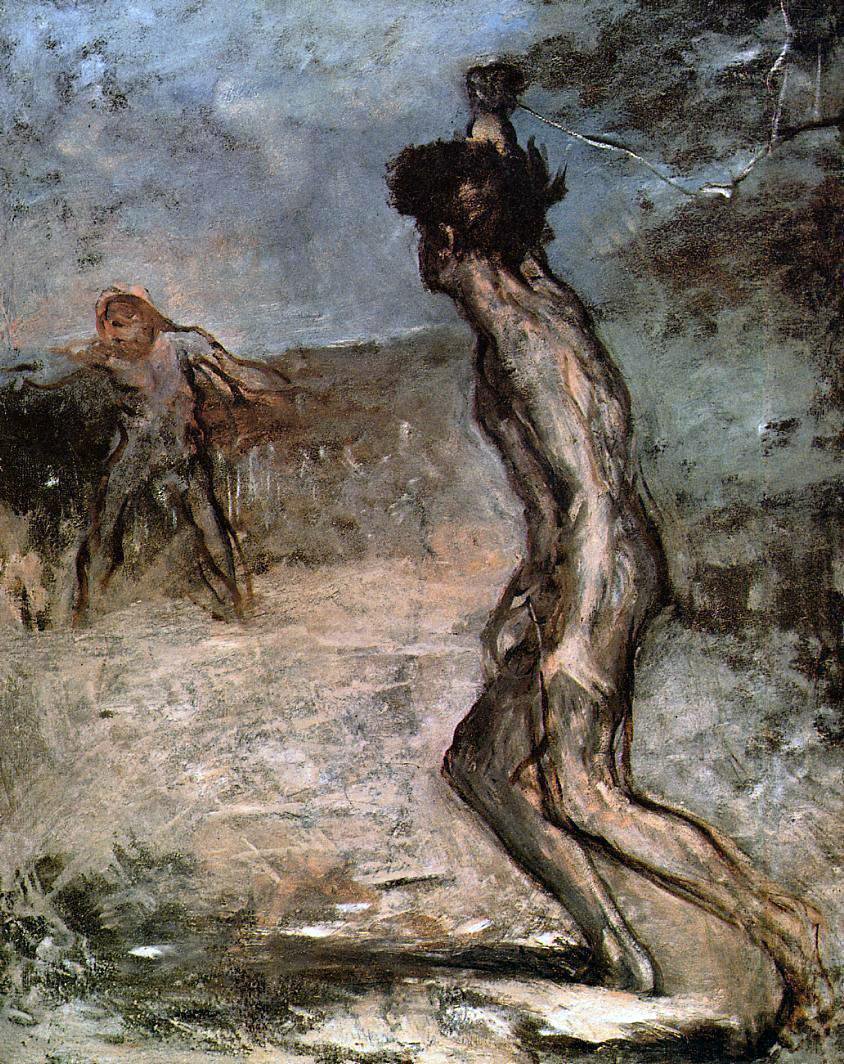
David and Goliath is an early and deliberately unfinished work by Edgar Degas: a nude youth in the foreground swings a sling above his head, a thin pale cord rises towards the upper right corner, and on the left, in the distance, a second clothed figure leans forward. As a canvas painting this is the swing before the blow, not the triumph after it. The original is held by the Fitzwilliam Museum in Cambridge under the accession number PD.7-1966. We make it as a hand-painted oil on linen canvas, in six sizes or to your own measurements, and you receive a photograph of the finished work for approval before dispatch.
| Title: | David and Goliath |
| Other titles: | David et Goliath |
| Painter: | Edgar Degas (1834–1917) |
| Year painted: | about 1864, after the label on the frame that the museum records |
| Original size: | 80 cm x 63.8 cm |
| Original technique: | Oil on canvas |
| Painting style: | French school, history scene |
| Located at: | The Fitzwilliam Museum, Cambridge (acc. no. PD.7-1966) |
| Our reproduction: | hand-painted oil on linen canvas, 6 sizes from 40 x 50 cm to 150 x 200 cm, custom sizes on request |
David and Goliath – Edgar Degas
Who is shown?
Among the things this scene depicts, the entry of the Fitzwilliam Museum for PD.7-1966 lists David, Goliath, nudity and a slingshot. Which of the two is which the entry does not say, but the work does: the sling is swung by the nude youth in the foreground, so David, while the second, clothed figure approaches from the left. The moment chosen is before the outcome — the stone has not yet been released. Neither figure has a finished face, so no names appear on the canvas; only the act remains.
What is on the canvas?
The format is upright and the scene is cut by a diagonal. Right of centre stands a nude male figure, bent forward, the body turned so that back and hip are seen at once; both arms are raised above the head and swing the sling with them. From the hands a thin pale cord rises to the upper right corner — the only sharp mark on the whole canvas. The head is small, dark and lowered, and there is no face. The legs are apart in a stride and the feet barely separate from the ground. On the left, in the middle distance, stands a smaller figure in pink-red and pale cloth, leaning forward, arms held before the body. The ground is a broad, pale ochre slope scratched with white and black; the sky is grey-blue and darker towards the right, as before a storm. The colour is thin and scrubbed, in places the weave of the linen shows through it, and this unfinished state is the character of the work.
Why does this particular scene matter?
Because it shows Degas inside an attempt that did not go to plan. In the first half of the 1860s he meant to become a history painter and took on large biblical and ancient subjects; this scene is one of those beginnings that stopped at the first swing. That is exactly what makes it interesting: large finished works show the result, this one shows the procedure. You can see how the painter set the movement of the body first and only afterwards thought about the surroundings, which here are almost absent. Anyone wanting to understand how Degas builds a figure gets more here than from many a finished work.
What does the scene mean?
The story of David is a story of unequal combat, and Degas tells it without weapons, armour or crowd. What remains is a body taking its swing and a cord pulling taut. The museum places the work in the French school and names nudity alongside David and Goliath among its subjects — and indeed the nude counts here as much as the narrative. Impressionism is nowhere in this work and did not yet exist: the first Impressionist exhibition was held only ten years later. It is therefore not an impressionist painting but an early history attempt by an artist who would only later become what we know him for. From this follows its present fate too: by the museum’s entry the work is kept in storage and is not on permanent display.
The motif among Degas’s works
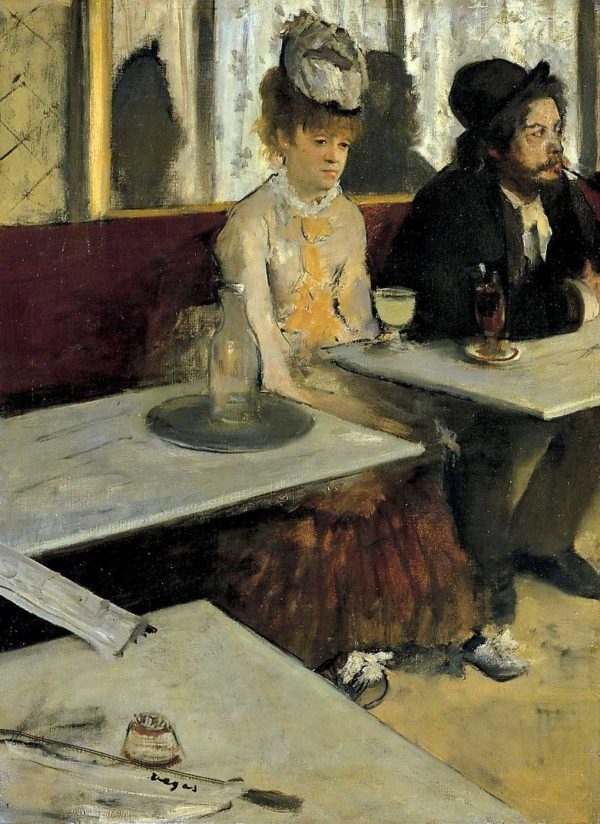
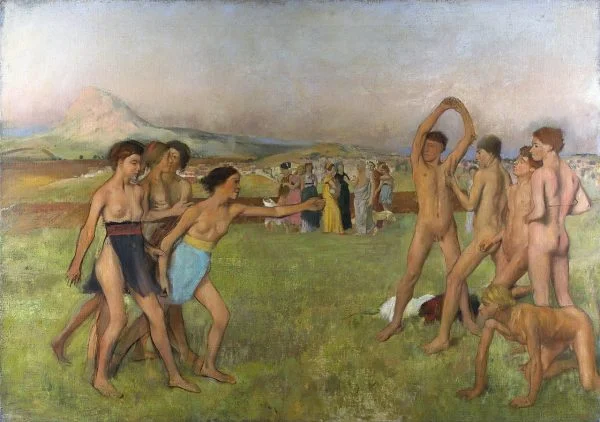
This is not an isolated attempt. From the same years comes Young Spartans Exercising, the second large history composition, held by the National Gallery in London as NG3860 and, unlike this one, carried to completion. Soon afterwards Degas turned from history to the Paris of his own day, as The Absinthe Drinker shows most clearly. The nude body, by contrast, never left him: the museum’s entry cites among the literature for this work the very book on Degas’s nudes, and the late nudes are represented in our range by Bather Stretched out on Floor.
How is our hand-painted version made?
It is made with a brush and oil colours, not a printer. This motif asks more of the painter than a finished scene, because what has to be painted is a sketch and not a completed work: the strokes must stay open, the ground visible in places, and what the original leaves unsaid must remain unsaid. The easiest way to go wrong is to finish the face or to pull the cord of the sling too hard — either would turn the work into something it is not. Every reproduction is made afresh and no two copies are quite the same, because a hand does not repeat the same stroke twice; every hand-painted copy is therefore its own. This family has no photographs of our finished canvases, because the work has not been painted since we began photographing every piece — so we show and describe none here. The photograph of your canvas reaches you before dispatch.
Which size for which wall?
If you do not know which: 70 x 90 cm. The format is upright and the proportion of our sizes is almost exactly that of the original, so the scene loses none of its swing at any size. The 40 x 50 and 50 x 70 cm sizes are for a narrow wall, a hallway or a group of smaller works; 70 x 90 cm comes closest to the size of the original and is also the size most people choose; 80 x 100 cm goes above a chest of drawers or into a study, where wall art of this kind is not required but is welcome. The 120 x 160 and 150 x 200 cm sizes belong in a high room with a staircase, or on a wall where the work should hang alone — at those two a large painting really has air around it, and the grey sky becomes a surface in its own right. Measure your chosen size on the wall with a paper cut-out first. None of the sizes is held in stock as a finished item: every copy is made to order and stays a single piece.
Custom size, stretcher bar and frame
If none of the six sizes suits your wall, we paint to your measurements and keep the proportions of the scene, so that the figure does not lose the space above his head where the cord of the sling rises; that is our painting made to order. Every copy is delivered stretched on a wooden bar, ready to hang. For the frame, use our 3D application: on this motif it shows every moulding profile we carry, so you can compare gold, silver, black, white and natural wood — it is for choosing a frame and nothing else. If you want to see how the work looks on your own wall, that is our separate room-placement service.
Delivery and guarantee
Every copy is made to order in our studio in Slovenia, so allow 15 to 45 days depending on the size you choose; for the two largest sizes the time is usually at the upper end. We send it stretched and protected for transport, framed if you chose a frame, to sixteen countries in the European Union, without customs duties. You receive a photograph of the finished work for approval before dispatch, and our returns policy applies to every order. The whole range is in the Edgar Degas gallery, and the painter’s life is described in our article about Edgar Degas.
Frequently asked questions
What is happening in the scene?
David is taking his swing with the sling before releasing the stone. Goliath approaches from the left, and the outcome is not shown on the canvas.
Why does the work look unfinished?
Because it is. It is an early start that Degas did not carry through, and that is precisely where its value lies.
What is the pale line at the upper right?
The cord of the sling. It is the only sharp mark on the canvas and pulls the eye upward into the empty sky.
Why is the figure nude?
The museum lists nudity among the subjects of this work, alongside David and Goliath. Degas used the subject as an occasion to study the body in motion.
When was it painted?
About 1864. The year comes from a label on the frame that the museum records, not from a signature by the painter.
Where is the original?
In the Fitzwilliam Museum in Cambridge, under accession number PD.7-1966. By the museum’s entry it is kept in storage.
How did it reach the museum?
It was bequeathed in 1966 by Captain Stanley William Sykes. Before that it was in the Paris–Londres exhibition of 1956 at the dealer Arthur Tooth & Sons in London.
Is this a print?
No. It is painted by hand in oil on canvas; the brushstrokes are visible and can be felt.
Which size should I choose?
For a living room usually 70 x 90 cm, for a narrow wall 50 x 70 cm. The size guide is above.
Can I have a size that is not listed?
Yes, we paint to measure and keep the proportions of the scene while doing it.
Is it suitable as a gift?
Yes, especially for someone drawn to drawing and to how a work comes into being rather than to a smooth finish. Because every copy is made to order, allow for the making time; if you would rather leave the choice to them, there is our gift voucher.
- Subject: David swings the sling in the foreground, Goliath approaches from the left, an empty slope and a storm sky between them
- Original: Edgar Degas, about 1864, oil applied to canvas, 80 x 63.8 cm, Fitzwilliam Museum in Cambridge (PD.7-1966)
- Ours: hand-painted in oil, six sizes from 40 x 50 to 150 x 200 cm, stretched and framed on request
- Worth knowing: the cord of the sling is the only sharp mark — everything else, including both faces, stayed at the first lay-in