





Description
Ballet Dancers in the Wings shows four dancers waiting at the side of the stage: one is fixing her hair with both hands, one stands with her hands behind her back, one leans back with her palm to her head, and at lower right one bends forward. The scene takes place in the wings, not on stage; as a canvas painting it lives on postures rather than on an event. We make it as a hand-painted oil on linen, in seven sizes or to your own measurements, and you receive a photograph of the finished work for approval before dispatch.
| Title: | Ballet Dancers in the Wings |
| Other titles: | Dancers in the Wings · Danseuses dans les coulisses |
| Painter: | Edgar Degas |
| Our reproduction: | hand-painted oil on linen canvas, 7 sizes from 50 x 60 cm to 150 x 170 cm, custom sizes on request |
Ballet Dancers in the Wings – Edgar Degas
Who is shown?
Four dancers at the side of the stage, just before going on or just after. Who they are is not recorded: Degas painted rehearsal and the backstage of the opera house for decades and almost never named his models, so we give no names either. What is certain is the relation between them – each is alone with her own task, though they stand within arm’s reach.
What is shown?
Four dancers arranged along a diagonal that falls from upper left to lower right. At upper left one stands with both arms raised: she is fixing her reddish hair, elbows wide, her face hidden. Beside her a second turns to the right, hands behind her back, her gaze upward; her bodice is blue with a yellow edge. Right of centre a third leans back and lays her palm against her head, the elbow raised like a roof. At lower right the fourth bends forward, so that what we mostly see is her back and the spread of her skirt. The skirts are yellow-green, threaded with blue lines that are not outlines but short strokes across the cloth. Behind them stands a painted flat in green and ochre that could be trees; a dark horizontal band runs across the middle, separating the dancers from the background. The floor is grey and violet, without shadow and without an edge. The feet are bare or in pale shoes, and of the stage itself nothing is visible.
Why are the dancers in the wings and not on stage?
Because the performance did not interest Degas. What interested him was the time just before it and just after: fixing hair, stretching, waiting, being bored. In the wings the body holds itself differently than on stage – the weight drops onto one leg, a hand goes to the head, a back bends. That posture is what the painter catches here. So there is no audience in the scene, no footlights, and no face turned towards us; all four are turned in on themselves. This is not ballet as a performance but ballet as work.
The colour is laid in open, dry strokes that do not blend. Yellow and green alternate across the skirts, and blue runs over them in thin lines, so the cloth reads as a mesh rather than a plane. The ground shows through in places, and it is exactly those gaps that give the scene air. The background is deliberately unfocused: the flat is drawn as a flat, not as a landscape, and tells the viewer at once that we are behind the stage. Look closely and you see corrected outlines – arms and shoulders were moved, and the old line stays visible under the new. Degas left the drawing open instead of smoothing it away.
What does the scene mean?
It means tiredness and readiness at the same time. Four bodies in four different occupations, none of them a pose for the viewer. As a group portrait the scene does not work, because no dancer takes any notice of another; as a snapshot it works immediately. As an impressionist painting this is an unusual case too, since impressionism usually means daylight out of doors, whereas here we are indoors with no single source of light. The work hangs well where you want movement without noise: wall art that does not demand attention but slowly earns it.
What we deliberately do not state here: the year, the technique of the original, the name of the collection and the accession number. The scene is identified, but the holding institution’s record is not reachable from here, and we do not copy such details second-hand. We say what is visible on the canvas.
The motif among Degas’s works
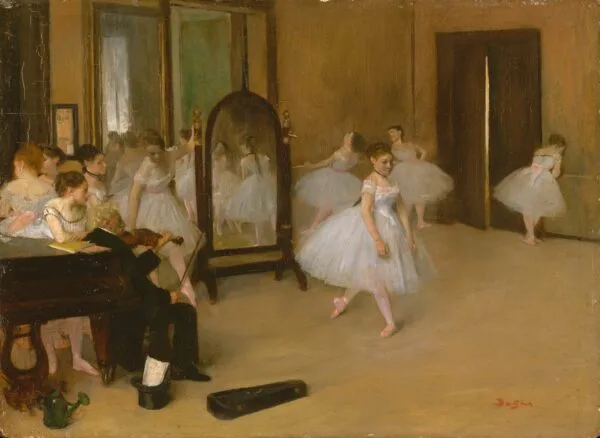
Dancers in the wings and in the rehearsal room are a recurring world in Degas, not a single scene. Closest to this one are Dancers in Pink, where the same group arrangement is translated into a warmer colour, The Dancing Class, where the same moment happens under the teacher’s eye, and The Rehearsal, where the room is wider and the figures more numerous. If you are looking for a scene with a single dancer, look elsewhere; this is a group sharing a cramped space at the side of the stage.
How is our hand-painted version made?
It is made with a brush and oil colours, not a printer. The painter works from a high-resolution reference and builds the surface the way the original builds it: yellow and green denser in the skirts, the blue lines over them thinner and quicker, so the strokes stay visible. Every reproduction is made afresh and no two copies are ever quite the same, because a hand does not repeat the same stroke twice; every hand-painted copy is therefore its own. This family has no photographs of our finished canvases – the work has not been painted since we began photographing every piece – so we deliberately show none here and describe none. The photograph of your canvas reaches you before dispatch.
Which size for which wall?
If you do not know which: 80 x 90 cm. The format is close to square and so behaves differently from an upright single dancer: it needs a wall with room on both sides. The 50 x 60 and 60 x 70 cm sizes belong in a hallway, an entrance or above a narrow chest; 70 x 80, 80 x 90 and 90 x 100 cm go above a sofa, a bed or a desk and are the size most people choose; 120 x 130 cm fills a large wall on its own; and 150 x 170 cm is for a stairwell or a high room, where a large painting finally has air around it. Measure your chosen size on the wall with a paper cut-out before ordering. None of the sizes is held in stock as a finished item – every copy is made to order.
Custom size, stretcher bar and frame
If none of the seven sizes suits your wall, we paint to your measurements and keep the proportions of the scene so the group stays whole; that is our painting made to order. Every copy is delivered stretched on a wooden bar, ready to hang. For the frame, use our 3D application: on this motif it shows every moulding profile we carry, so you can compare gold, silver, black, white and natural wood – it is for choosing a frame and nothing else. If you want to see how the work looks on your own wall, that is our separate room-placement service.
Delivery and guarantee
Every copy is made to order in our studio in Slovenia, so allow 15 to 45 days depending on the size you choose. We send it stretched and protected for transport, framed if you chose a frame, to sixteen countries in the European Union, without customs duties; for destinations outside the EU, write to us before you order. You receive a photograph of the finished work for approval before dispatch, and our returns policy applies to every order. The whole range is in the Edgar Degas gallery, and the painter’s life is described in our article about Edgar Degas.
Frequently asked questions
How many dancers are there?
Four. They stand along a diagonal from upper left to lower right, each in an occupation of her own.
Why is there no year or museum?
Because we could not read the institution’s record at source. The scene is identified, but we do not copy the details second-hand.
Is this a print?
No. It is painted by hand in oil on canvas; the brushstrokes are visible and can be felt.
Which size should I choose?
For a living room usually 80 x 90 cm, for a hallway 50 x 60 cm. The size guide is above.
Can I have a size that is not listed?
Yes, we paint to measure and keep the proportions of the scene while doing it.
How is it delivered?
Stretched on the bar, and framed if you chose that, in 15 to 45 days after you approve the photograph.
Is it suitable as a gift?
Yes, especially for someone who dances or used to. Because every copy is made to order, allow for the making time; if you would rather leave the choice to them, there is our gift voucher.
- Subject: four dancers in the wings, a diagonal from upper left to lower right, a painted flat behind them
- Original: Edgar Degas; year, technique, collection and accession are not given, because we could not read them at source
- Ours: hand-painted in oil on linen, seven sizes from 50 x 60 to 150 x 170 cm, stretched and framed on request
- Worth knowing: not one of the four dancers looks towards the viewer – the scene is four people each entirely on her own