





Description
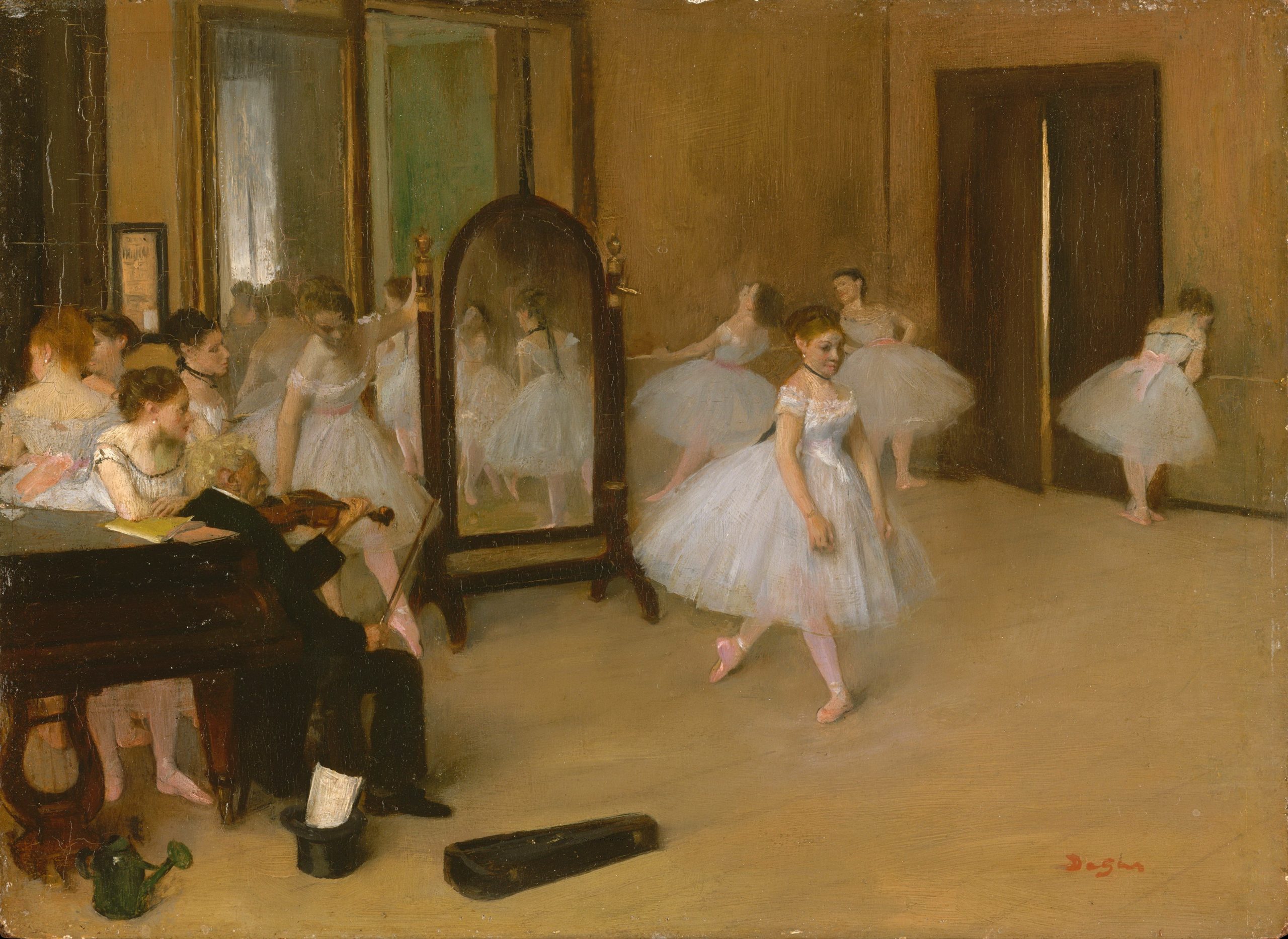
The Dancing Class shows a rehearsal room in which a fiddler sits beside the piano, and in front of him a dancer in pale blue steps forward, a black ribbon at her throat and pink shoes on her feet; others practise at the barre on the right, and on the left a tall arch-topped cheval mirror reflects a second group and a window. As a canvas painting this is a lesson, not a performance. The original is held by the Metropolitan Museum of Art in New York under the accession number 29.100.184, and it is small – smaller than a sheet of paper. We make it in sizes from 27 x 20 to 150 x 110 cm or to your own measurements, and you receive a photograph of the finished work for approval before dispatch.
| Title: | The Dancing Class |
| Painter: | Edgar Degas (1834–1917) |
| Year painted: | about 1870 |
| Original size: | 19.7 cm x 27 cm |
| Original technique: | Oil on wood |
| Painting style: | Impressionism |
| Located at: | The Metropolitan Museum of Art, New York (acc. no. 29.100.184) |
| In the collection since: | 1929, H. O. Havemeyer Collection, Bequest of Mrs. H. O. Havemeyer |
| Our reproduction: | hand-painted oil on linen canvas, 8 sizes from 27 x 20 cm to 150 x 110 cm, custom sizes on request |
The Dancing Class – Edgar Degas
Who is shown?
Dancers at a rehearsal and a fiddler playing for them. There are no names; Degas almost never named his models. The roles are clear enough all the same: the man in black sits beside the piano with the violin under his chin, a top hat and an open violin case lie at his feet, and on the left, by the piano, two women sit and wait. The centre is held by a dancer in pale blue stepping forward, a black ribbon at her throat and pink shoes on her feet. Three more practise at the barre on the right.
What is on the canvas?
The scene is horizontal and comparatively empty: a large part of the surface is bare wooden floor in a warm ochre. On the left stands a tall upright mirror with a rounded top, in which another group of dancers and a bright window are reflected – so the viewer sees a part of the room that would otherwise lie outside the work altogether. A small framed sheet hangs on the wall at the left edge. On the right there is a closed brown door, and beside it a dancer bends towards the barre. At the lower left stands a green watering can, of the kind used in rehearsal rooms to damp the dust on the floor. The colours are pale: white and light blue skirts, an ochre wall, brown wood. At the lower right the signature is written in red.
Why does this particular scene matter?
Because it is one of the first. It was made around 1870, at the very beginning of the ballet series Degas would go on developing for nearly thirty years. Everything he would repeat later is already here: the rehearsal instead of the performance, the musician at the edge, the mirror as a way of doubling the room, and the empty floor taking up more space than the figures. What surprises most is how small the work is – it measures barely 19.7 by 27 cm, less than a sheet of writing paper, and yet it carries a whole room.
What does the scene mean?
The work before the work. Nobody is performing; one dancer practises a step, the others wait, the fiddler keeps time. It is precisely that restrained note which makes this one of the works that do not tire on a wall. As an impressionist painting you recognise it by the light falling from the left through the window and bouncing off the floor, yet nothing in it is hurried: impressionism shows here in colour and light, while the drawing is still entirely firm and exact, as you would expect of a work this early.
The motif among Degas’s works
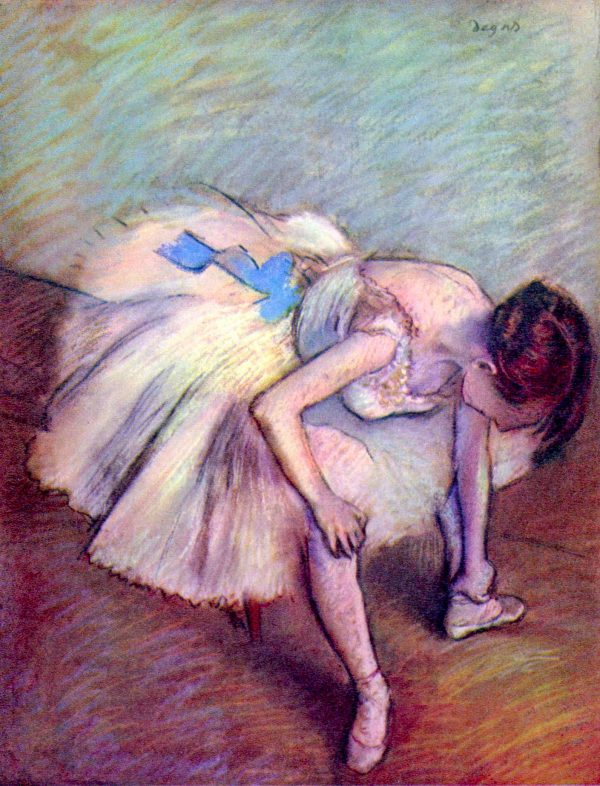
This is the beginning of a series our range represents several times over. Closest to it are Four Dancers, which show the same world thirty years later and almost without drawing, Dancers in Pink, where a single colour carries the group, and Seated Dancer Adjusting Her Shoes, where the same practice is reduced to one figure. If you want to see where the series led, look at Ballet Dancers at the National Gallery in London, a late oil of the 1890s, and Ballet at the Paris Opéra at the Art Institute of Chicago, where he solved the same material in pastel.
How is our hand-painted version made?
It is made with a brush and oil colours, not a printer, and there is one difference here worth saying plainly. The original is not painted on canvas but on a wooden panel – the museum’s entry gives oil on wood – and that is exactly why its surface is smooth, with no weave beneath the colour. Ours is oil on canvas, so the painter lays the colour thin and smooth, keeping the texture of the cloth from asserting itself. The second thing that needs care is the mirror: what stands inside it has to stay softer and paler than what stands in front of it, or the room collapses. Every reproduction is made afresh and no two copies are quite the same; every hand-painted copy is therefore its own. This family has no photographs of our finished canvases, because the work has not been painted since we began photographing every piece – so we show and describe none here. The photograph of your canvas reaches you before dispatch.
Which size for which wall?
If you do not know which: 80 x 60 cm. The format is horizontal and the scene is full of small incident, so at the smallest sizes you lose exactly what makes it interesting – the watering can, the case, the reflection. The 27 x 20 cm size is precisely the size of the original, and it is meant for someone who wants just that: the work at true size, on a shelf or in a group of small pieces. The 50 x 40 and 60 x 45 cm sizes are for a hallway or a narrower wall; 70 x 50 and 80 x 60 cm go above a chest of drawers and are the ones most people choose; 100 x 75 and 120 x 90 cm are the sizes above a sofa. The 150 x 110 cm size is for a large wall, where a large painting gets air – there the dancers are close to life size, so considerably larger than in the original. Because wall art looks smaller on a screen, measure your chosen size on the wall with a paper cut-out first. None of the sizes is held in stock as a finished item: every copy is made to order and stays a single piece.
Custom size, stretcher bar and frame
If none of the eight sizes suits your wall, we paint to your measurements and keep the proportions of the scene, so that the empty floor keeps its share and the room does not become cramped; that is our painting made to order. Every copy is delivered stretched on a wooden bar, ready to hang. For the frame, use our 3D application: on this motif it shows every moulding profile we carry, so you can compare gold, silver, black, white and natural wood – it is for choosing a frame and nothing else. If you want to see how the work looks on your own wall, that is our separate room-placement service.
Delivery and guarantee
Every copy is made to order in our studio in Slovenia, so allow 15 to 45 days depending on the size you choose; at the largest size the time is usually at the upper end. We send it stretched and protected for transport, framed if you chose a frame, to sixteen countries in the European Union, without customs duties. You receive a photograph of the finished work for approval before dispatch, and our returns policy applies to every order. The whole range is in the Edgar Degas gallery, and the painter’s life is described in our article about Edgar Degas.
Frequently asked questions
What is happening in the room?
A rehearsal. One dancer steps forward in a movement, others practise at the barre or wait, and the fiddler keeps time.
What is the object at the lower left?
A green watering can. In rehearsal rooms water was used to damp the dust on the wooden floor so it would not rise.
Why is the mirror so large?
Because it doubles the room for Degas: another group of dancers and a window appear in it, that is, a part of the room we would not otherwise see.
How large is the original?
Very small: 19.7 by 27 cm, less than a sheet of writing paper. Our smallest size, 27 x 20 cm, is effectively the same.
Why is the original on wood rather than canvas?
Because Degas painted it on a wooden panel; the museum’s entry gives oil on wood. At a format this small a panel was the usual support.
Is our version on wood?
No. Ours is painted in oil on linen, stretched on a bar; the composition, the colours and the proportions follow the original.
Where is the original, and is it on view?
In the Metropolitan Museum of Art in New York, under accession number 29.100.184. By the museum’s entry it hangs in gallery 815; whether it still hangs there can change.
When was it painted?
About 1870. The museum’s entry carries the year with the qualifier “about”, so we give it the same way.
Is this a print?
No. It is painted by hand in oil colours; the brushstrokes are visible and can be felt.
Which size should I choose?
For a living room usually 80 x 60 cm, for a smaller wall 60 x 45 cm. The size guide is above.
Is it suitable as a gift?
Yes, especially for someone who dances or used to. Because every copy is made to order, allow for the making time; if you would rather leave the choice to them, there is our gift voucher.
- Subject: a rehearsal room with a fiddler at the piano, a dancer in pale blue, and a tall mirror that doubles the space
- Original: Edgar Degas, about 1870, oil on wood, 19.7 x 27 cm, Metropolitan Museum of Art in New York (29.100.184)
- Ours: hand-painted in oil on linen, eight sizes from 27 x 20 to 150 x 110 cm, stretched and framed on request
- Worth knowing: our smallest size, 27 x 20 cm, is effectively the size of the original – the only work on this shelf where the smallest size is also the most faithful