







































Description
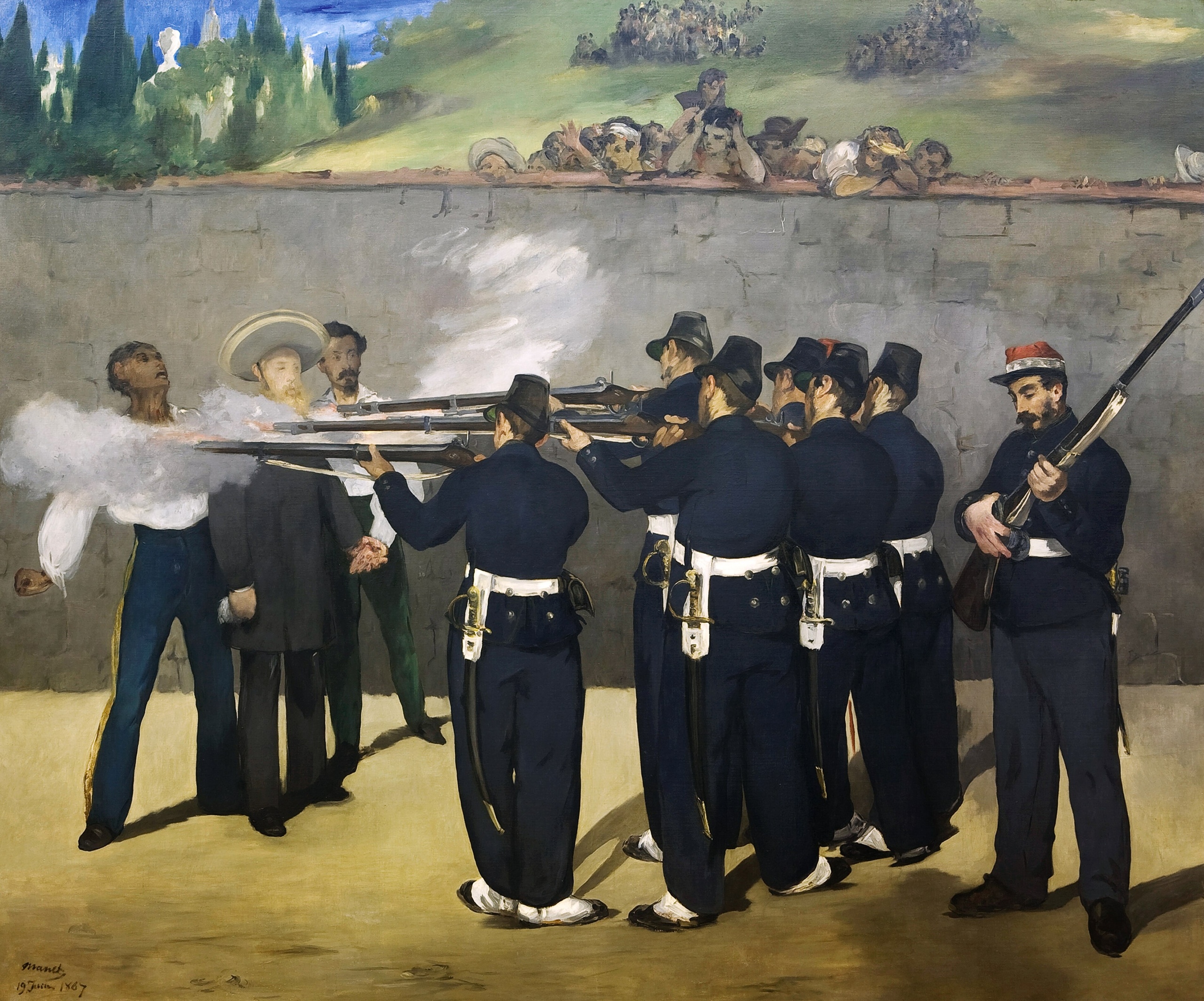
The Execution of Emperor Maximilian is the final version of Manet’s series on the death of Mexico’s emperor, painted in 1868–1869: before a high grey wall, a firing squad in dark uniforms and white belts fires at close range on three condemned men, half hidden at the left by rifle smoke. The original is oil on canvas, 252 x 302 cm, one of Manet’s largest works, and it belongs to the Kunsthalle Mannheim. Our painter hand-paints it for you in oil on canvas, in 8 landscape sizes from 40 x 32 to 190 x 151 cm or made to measure, and before dispatch we send you a photograph of the finished painting.
| Title: | The Execution of Emperor Maximilian |
| Other titles: | L’Exécution de Maximilien (French title) |
| Painter: | Édouard Manet (1832–1883) |
| Year painted: | 1868–1869 |
| Original size: | 252 cm x 302 cm (height x width) |
| Original technique: | Oil on canvas |
| Painting style: | Realism and Impressionism |
| Located at: | Kunsthalle Mannheim, Mannheim, Germany |
| Our reproduction: | Hand-painted in oil on canvas, 8 sizes or made to measure |
The Execution of Emperor Maximilian – Édouard Manet
What does The Execution of Emperor Maximilian show?
The scene plays out on sandy ground before a tall wall of grey stone. On the right, soldiers in dark blue uniforms with white belts, white gaiters and sabres hold their rifles level and fire from almost no distance; white smoke pours from the barrels.
On the left stand the three condemned men: the one in the middle wears a wide pale sombrero, his neighbour has dark hair and a moustache, and the third, in a white shirt, looks upward. The smoke partly covers them, and two of them hold hands.
At the far right a sergeant in a red cap readies his rifle with lowered eyes. Onlookers lean over the wall; behind them rise green hills, dark cypresses and a strip of blue sky. Manet’s signature and the date 19 June 1867 sit at the lower left.
Who was Maximilian, and what happened in Mexico?
Born in 1832 as the second son of Archduke Franz Karl, a Habsburg, Maximilian served in the Austrian Navy before Napoleon III, after the French intervention in Mexico, urged him to take the Mexican throne. He arrived in May 1864.
Forces loyal to the deposed president Benito Juárez opposed him throughout, and once Napoleon withdrew his troops in 1866 the empire fell apart. Captured in May 1867 and sentenced by a court martial, Maximilian was shot on 19 June 1867 with Generals Miguel Miramón and Tomás Mejía.
Manet backed the Republican cause, Léon Gambetta in particular, and the news led him to begin a large canvas, taking Goya’s The Third of May 1808 as his model.
In the final version the soldiers wear uniforms almost identical to French ones, and the man preparing the coup de grâce has the features of Napoleon III. This was read as an accusation, and under his reign the painting was barred from public display in Paris.
Why does this work matter so much?
Manet (1832–1883), among the first nineteenth-century artists to paint modern life and a pivotal figure between Realism and Impressionism, here took an event only months old and set it on a canvas more than three metres wide.
Between 1867 and 1869 he produced three large oils, a smaller oil sketch and a lithograph of the subject; the Mannheim canvas is the final version.
All five works were first shown together in London and Mannheim in 1992–1993, and again at the Museum of Modern Art in New York in 2006. For the full story, read the Wikipedia article on the series, which is in English.
Where is the original, and how did it reach Mannheim?
The original, oil on canvas measuring 252 x 302 cm (height x width), belongs to the Kunsthalle Mannheim under accession number M281. Manet signed it at the lower left with the date of the execution, 19 June 1867, although he finished it only in 1868–1869.
Since it could not be shown in Paris, Manet’s friend, the opera singer Émilie Ambre, took it to New York and Boston in 1879–1880. In 1905 it hung beside the Boston version at the Salon d’Automne, and in 1910, after an exhibition at the Berlin Secession, the Kunsthalle Mannheim acquired it.
Fragments of an earlier, even larger version, reassembled by Edgar Degas, are now combined on one canvas at the National Gallery in London; a third, unfinished version is at the Museum of Fine Arts in Boston.
The Execution of Emperor Maximilian or another Manet?
This is a serious canvas painting for anyone drawn to nineteenth-century history and politics.
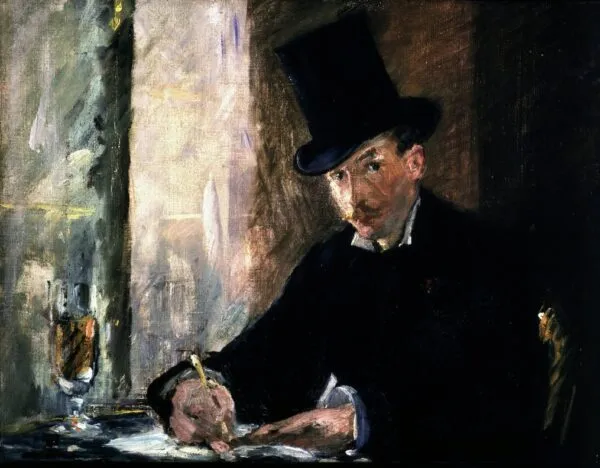
The same political world opens up in Portrait of Henri Rochefort, the journalist and politician who opposed Napoleon III, arms crossed in a black suit. A bright, different Manet appears in The Grand Canal, Venice (Blue Venice), a black gondola among blue-and-white poles, and in Banks of the Seine at Argenteuil, where a woman and a small child watch sailing boats. An unfinished oil sketch of a writer at a café table is George Moore at the Café.
Our Édouard Manet page brings together famous Manet paintings and quieter ones, each painted to order.
How do we hand-paint The Execution of Emperor Maximilian?
Manet’s original is a large oil on canvas, 302 cm wide. What you receive is an oil painting reproduction on new canvas, painted by hand in oil on canvas at the size you pick and built up in layers.
The painter first fixes the line of the wall and the placing of the two groups, since the short gap between them carries the tension. Then come the grey wall, the dark blue uniforms and the yellowish ground, and last the white belts, the smoke and the faces above the wall.
As Manet did, he keeps the smoke loose and the uniforms almost flat, so the painting stays clear even at a small size.
Which size suits which wall?
In short: 40 x 32 or 50 x 42 cm for a bookshelf, 65 x 52 and 74 x 59 cm above a desk, 90 x 78 and 115 x 96 cm for a home office or library, 150 x 120 or 190 x 151 cm for a large wall.
We paint it in 8 landscape sizes (width x height): 40 x 32, 50 x 42, 65 x 52, 74 x 59, 90 x 78, 115 x 96, 150 x 120 and 190 x 151 cm. The original measures 302 x 252 cm (width x height), so every one of our sizes is much smaller, and even the largest, 190 x 151 cm, reaches only about two thirds of its width.
As a painting for the living room it is a deliberate choice: the grave scene belongs above a sofa at 150 x 120 cm rather than in a bedroom.
Is another size or a frame possible?
Yes. For other proportions we keep both groups and the wall whole and adjust only the strip of ground or sky at the edge. Tell us the size you need for your wall and we will quote a price and a date.
It leaves us rolled, stretched on a stretcher bar or framed, with stretching and framing done by our workshop in Slovenia. Our 3D app lets you pick the frame and nothing more; seeing the painting on your own wall is a different, separate service.
A plain dark moulding suits the sober tone; a narrow gold frame lifts the pale sky.
How soon will the painting arrive?
Work on the wall and the firing squad starts as soon as you confirm, and the painting is ready to leave within 15 to 45 working days. Before the canvas is packed, you get a photograph of it and we make any corrections you request.
Your history painting travels within Slovenia and across the EU without customs duties, under our returns policy.
This is not a cheerful present; it is a considered gift for a history lover, a collector of history painting, or a library wall. Unsure of the wall? Give a wall art voucher so the history lover picks the size.
Frequently asked questions
Where can I see the original?
At the Kunsthalle Mannheim in Germany, under accession number M281.
Who are the three men at the wall?
Emperor Maximilian and Generals Miguel Miramón and Tomás Mejía, shot on 19 June 1867.
Is this a print?
No. It is a hand-painted copy, made with brushes in oil on canvas.
How big is the original?
It measures 252 x 302 cm (height x width), so each of our sizes is much smaller.
Can I order a size that is not listed?
Yes. Send us the width and height you want, and we will send an offer with a price and a delivery time.
How long does it take to make?
Between 15 and 45 working days, and before dispatch you see the finished painting in a photograph.
Is it right for a bedroom, or as a gift?
We would not choose it for a bedroom, as the scene is serious; as a gift it suits people who love history and history painting.
What does the sergeant’s likeness to Napoleon III mean?
The French uniforms and his features were read as a charge that the French emperor shared the blame for Maximilian’s death.
- Subject: a firing squad before a high grey wall, three condemned men in smoke at the left, onlookers above the wall.
- Original: oil on canvas, 1868–1869, 252 x 302 cm, Kunsthalle Mannheim.
- Ours: an Édouard Manet reproduction hand-painted in oil on canvas, 8 sizes from 40 x 32 to 190 x 151 cm, or made to measure.
- Worth knowing: the final version of the series, kept from public view in Paris under Napoleon III.