


Description
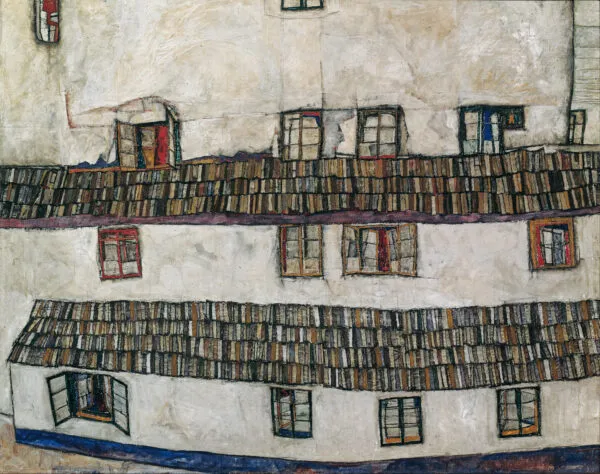
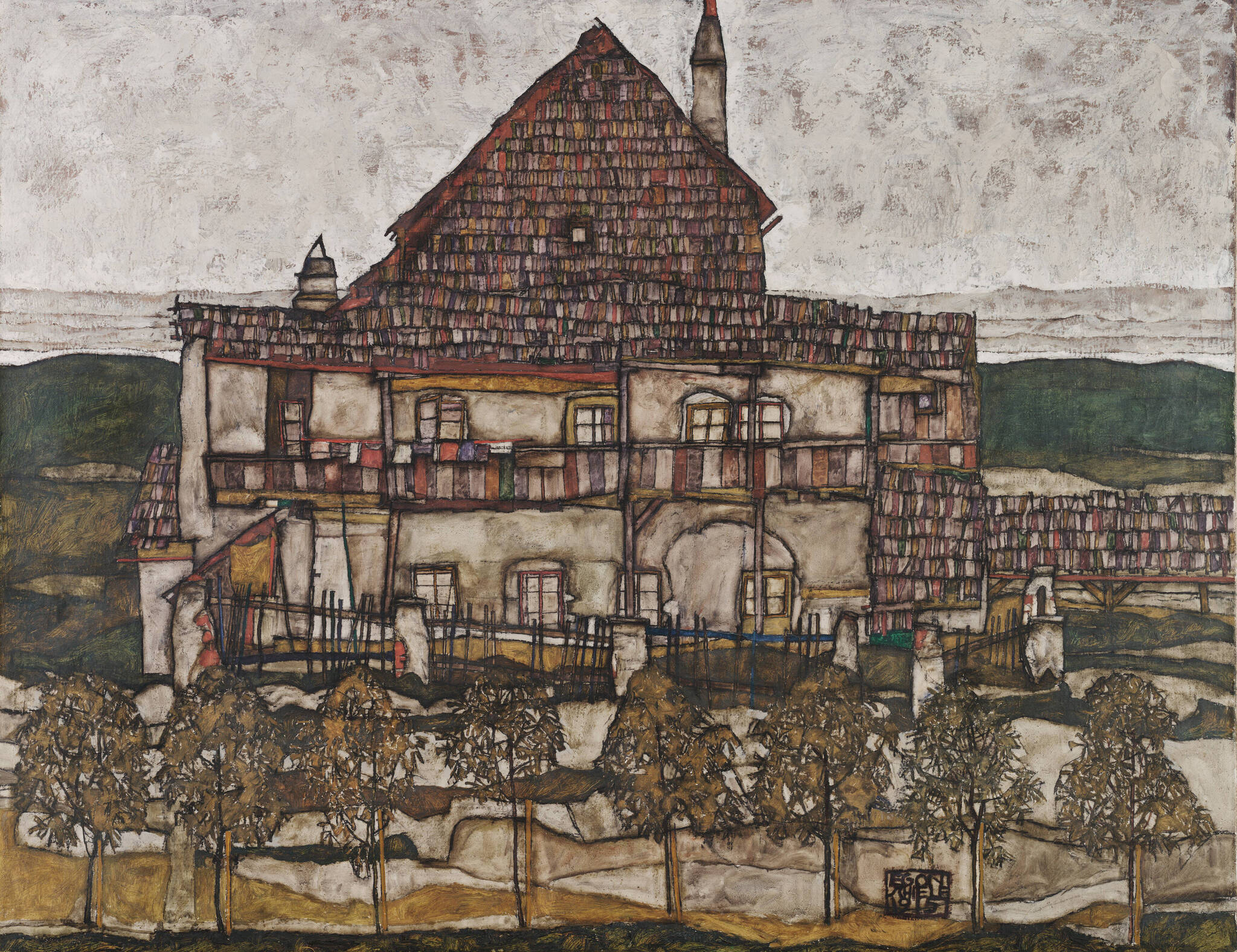
House with Shingle Roof is a 1915 painting by Egon Schiele: a single old house under a huge roof of reddish shingles, with strips of washing on its balcony, standing behind a fence and a row of young trees. The original, 110 x 140 cm, is in the Leopold Museum in Vienna. We paint it by hand in oils on canvas at the size you choose, and before dispatch we send you a photograph of the finished work for approval.
| Title: | House with Shingle Roof |
| Other titles: | Old House II · Haus mit Schindeldach · Altes Haus II |
| Painter: | Egon Schiele (1890–1918) |
| Year: | 1915, signed and dated lower right “EGON SCHIELE 1915” |
| Original size: | 110 cm x 140 cm |
| Original technique: | Oil on canvas |
| Style: | Expressionism |
| Location: | Leopold Museum, Vienna (inv. 469) |
| Our reproduction: | hand-painted oil on canvas, 6 sizes from 45 x 35 cm to 160 x 126 cm, or a made-to-measure size |
House with Shingle Roof – Egon Schiele
What does the painting show?
One house fills the middle of the canvas. Its steep gable and long roof are covered with small shingles, set down one by one in red, brown, violet and grey, with a slim chimney rising beside the gable and a small round one further left. Below the roof run two storeys of pale, weathered wall with small windows, a wooden balcony hung with strips of washing in red, blue, green and yellow, and a broad arch in the wall. A low fence with white posts runs in front of the house, and along the bottom stands a row of slender trees with brownish-gold leaves. The background is kept almost empty: a pale grey sky, a dark green band of hills and flat, light ground. The Austrian painter placed his signature and the year in a small block at the lower right.
Why do people love it?
Because an ordinary, rather run-down house is painted with the attention usually given to a person. Every shingle and every piece of washing is painted with care, while the land around it is reduced to a few quiet bands of colour, so the building seems to stand before you almost like a person. The muted reds and greys are calm to live with, and the detail of the roof keeps rewarding a closer look.
Where does it sit among Schiele’s works?
Among his views of houses and walls, where windows, roofs and façades often matter more than the people living behind them. Fronts that fill almost the whole canvas also appear in House Wall (Windows) and House Wall on the River, and a group of houses seen in winter in Houses in Winter (View from the Studio). The full selection is in the Egon Schiele gallery, and there is more on his life in our article about Egon Schiele.
How is our hand-painted version made?
Each copy is a hand-painted painting made for your order, not a print: a painter builds it up in oils, stroke by stroke. Like the original, our copy is oil on canvas. The hard part here is the roof: hundreds of small shingles in slightly different reds and violets have to be laid down one by one without turning into a mechanical pattern, and the little strips of washing have to keep their bright colours against the pale wall. The empty sky and the flat hills, by contrast, must stay calm and even. When the work is finished we photograph it and send you the photograph for approval, and only then does it ship. We have not yet photographed this work in our workshop; photographs will be added to this page once we have them.
Which size for which wall?
The original measures 110 x 140 cm, and of our sizes 140 x 110 cm comes closest to it. In a living room above a sofa, 90 x 70 cm or 120 x 95 cm shows the shingles and the washing clearly; 140 x 110 cm or 160 x 126 cm gives the house its full weight on a large wall or in a dining room. In a hallway, a bedroom or a study, 45 x 35 cm or 70 x 55 cm works as a quiet accent. A canvas painting in these muted reds and greys sits well on a white or warm light wall. Hang it with the centre at eye level, about 145–150 cm from the floor.
Custom size, stretcher bar and frame
If none of the six sizes suits your wall, we paint the work to your own measurement. If you choose YES under the Podokvir (stretcher bar) option, the canvas comes stretched on a wooden stretcher bar, ready to hang. Our 3D application is for choosing a frame only. The frame is chosen separately and need not be part of the order.
Delivery and guarantee
We paint to order and deliver to sixteen countries in the European Union, among them Slovenia, Croatia, Austria, Italy, Hungary, Germany and France; the United Kingdom and Ireland are not currently among them. The work arrives protectively packed and, if you chose YES under Podokvir, stretched on a stretcher bar. Before dispatch we send you a photograph of the finished work to approve. Production time depends on the size and on the studio’s workload. Every order is covered by our Returns and Refund Policy.
Frequently asked questions
Which house does it show?
The museum does not identify a particular building. Its record lists Krumau (Český Krumlov), the town where Schiele’s mother was born, among the keywords, but it describes the setting as imaginary surroundings built from a few single-coloured planes.
Does it have other titles?
Yes. The Leopold Museum also uses Old House II, and its German titles are given in the table above. In the 1952 purchase contract, when Rudolf Leopold acquired it, the work was called “Arbeiterhaus in Landschaft”, a worker’s house in a landscape.
Why does the house seem almost alive?
Schiele often gave houses and trees something of a human presence, and the Leopold Museum sees that idea reach a memorable high point here. The shabby house is shown with a care far beyond its humble status: the shingles and the brightly coloured washing are painted in detail and partly exaggerated, while the surroundings stay plain.
Is there a study for it?
Yes. The Leopold Museum also holds a preparatory study for this work. In the painting the single house is isolated and made monumental, set in surroundings reduced to a few flat areas of colour.
When did Schiele paint it?
In 1915, the same year as Crescent of Houses II (Island Town), which had the same first owner. He signed and dated it at the lower right: EGON SCHIELE 1915.
Who owned it before the Leopold Museum?
Heinrich Böhler owned it from 1915 to 1940, followed by Mabel Böhler until 1952. Rudolf Leopold then acquired it, and in 1994 it passed to the Leopold Museum Private Foundation.
Does it work as a gift?
Yes; if you are unsure which size to choose, there is a gift voucher.