


Description
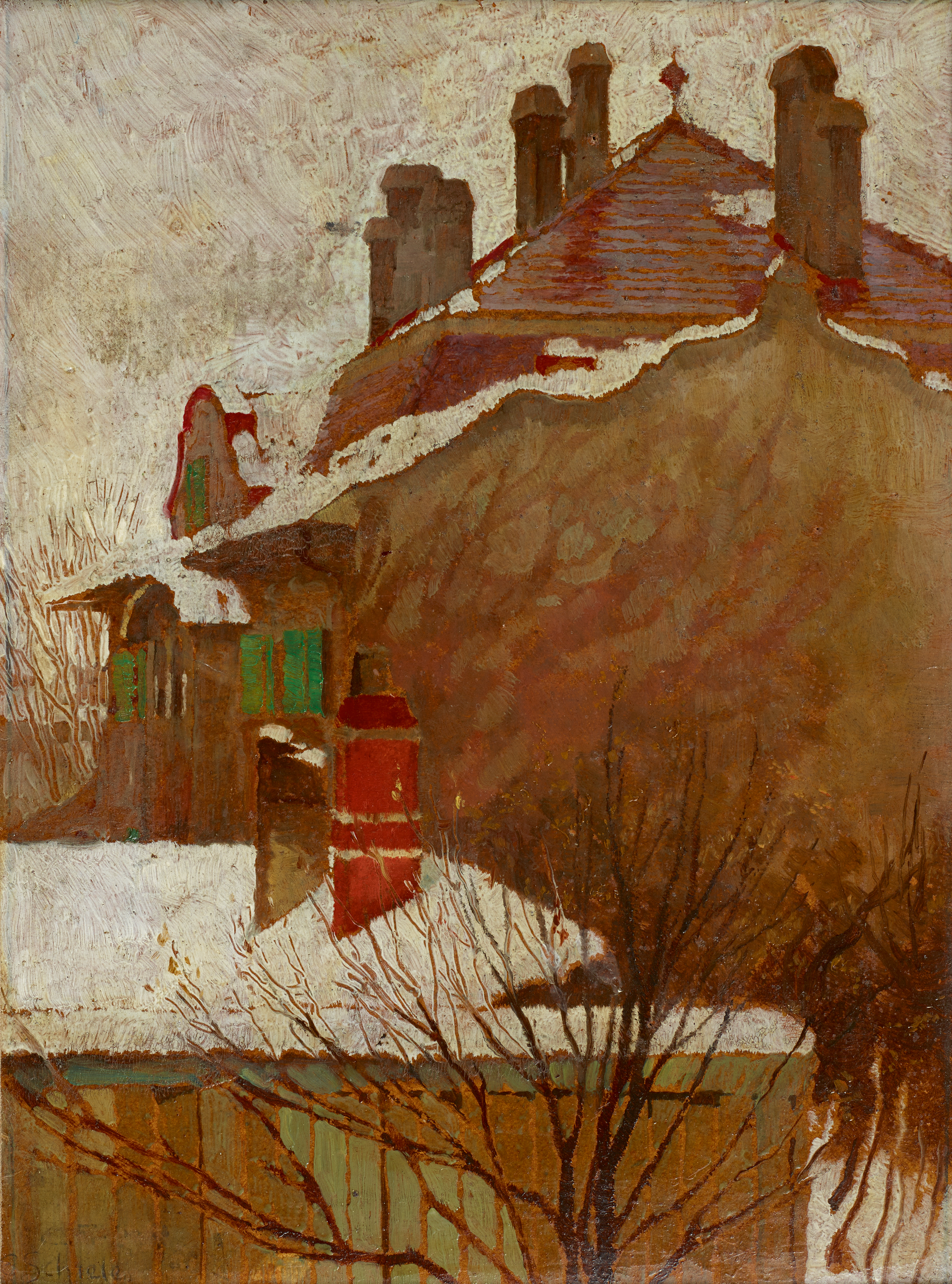
Houses in Winter (View from the Studio) is a painting by Egon Schiele from 1907/1908: a view over snow-covered roofs with tall chimneys, green shutters and bare branches in the foreground. We paint it by hand in oils at the size you choose, and before dispatch we send you a photograph of the finished work for approval.
| Title: | Houses in Winter (View from the Studio) |
| Other titles: | Häuser im Winter |
| Painter: | Egon Schiele (1890–1918) |
| Year: | 1907/1908, signed lower left “E. Schiele”, without a date |
| Original size (width × height): | 17.8 cm x 24 cm |
| Original technique: | Oil on cardboard |
| Style: | Early Schiele, before Expressionism |
| Location: | Belvedere, Vienna |
| Our reproduction: | hand-painted oil on canvas, 13 sizes from 50 x 65 cm to 160 x 205 cm, or a made-to-measure size |
Houses in Winter (View from the Studio) – Egon Schiele
What does the painting show?
The Austrian painter looks out over the roofs. On the right, a large house wall in ochre and warm brown fills much of the picture; its reddish tiled roof is edged with snow, and tall brown chimneys rise from it into a pale, cream-coloured sky. A small pointed ornament sits on the ridge. On the left stands a lower building with green shutters, and above it a small gable with a red edge. In the middle an upright red shape with white bands, rather like a chimney, catches the eye. Below, a broad band of snow runs across the scene, and beneath it a greenish fence. In the foreground thin, bare, reddish-brown branches climb up through the picture. The signature is at the lower left.
Why do people love it?
Because it is winter without the cold. The snow is not white but cream and pale grey, the walls glow in ochre and red-brown, and the green shutters and the red shape in the middle give the eye small bright points to find. Nothing happens, and that is the charm: a quiet view from a window, the kind you look at every morning. The bare branches in front lead you into the depth, from the fence up to the chimneys. It suits a hallway, a study, a bedroom or a reading corner, and in winter it feels right in a living room too.
Where does it sit among Schiele’s works?
Among the other Schiele works in our shop, you can compare it with Trude Engel, Portrait of Wally Neuzil and Mother with Two Children III; if you are choosing between them, open them side by side. The full selection is in the Egon Schiele gallery, with more on his life in our article about Egon Schiele.
How is our hand-painted version made?
One of our artists paints it by hand in oils, stroke by stroke, for your order – it is not a print. A hand-painted painting keeps its brushstrokes, and you can see and feel them on the surface. Two places decide the result. The first is the snow: it is cream and greyish rather than white, and painted pure white it would flatten the roofs beneath it. The second is the branches in the foreground – they must stay thin and loose and still be there, or the view loses its depth. The original is painted on cardboard and ours is oil on canvas, so the surface will not be identical. When it is finished we photograph it and send you the photograph for approval, and only then does it ship. This work has not yet been photographed in our workshop.
Which size for which wall?
Short answer: this is a calm winter view with plenty of detail, so give it a wall you can step back from. We offer it in thirteen sizes, from 50 x 65 cm to 160 x 205 cm. In a hallway or a study, 50 x 65 cm or 60 x 75 cm; above a chest of drawers or a bed, 70 x 90 cm or 80 x 100 cm; above the sofa in a living room, 100 x 130 cm or 120 x 150 cm; on a large wall or in a stairwell, 140 x 180 cm or 160 x 205 cm. A canvas painting of this size needs some distance: close up you see the single strokes in the snow and the sky, and the roofs and branches come together from a distance of a few steps.
Custom size, stretcher bar and frame
If none of the thirteen sizes suits your wall, we paint the work to your own measurement. If you choose “YES” under the Stretcher option, the canvas comes stretched on a wooden stretcher bar, ready to hang. Our 3D application is for choosing a frame only, not for showing the work on your wall. The frame is chosen separately and need not be part of the order.
Delivery and guarantee
We paint to order and deliver to sixteen countries in the European Union, among them Slovenia, Croatia, Austria, Italy, Hungary, Germany and France; the United Kingdom and Ireland are not currently among them. The work travels protectively packed. Before dispatch we send you a photograph of the finished work to approve. Production time depends on the size and on the studio’s workload. Every order is covered by our Returns and Refund Policy.
Frequently asked questions
What does Schiele’s Houses in Winter show?
A view over snow-covered roofs: an ochre house wall with a snow-edged tiled roof and tall chimneys, a lower building with green shutters on the left, and thin, bare branches climbing up through the foreground. The snow is cream and pale grey rather than white. Nobody appears in it; it is a quiet view from a window.
Which studio was Houses in Winter painted from?
The subtitle View from the Studio has often linked the work to Schiele’s first studio of his own, at Kurzbauergasse 6 near the Vienna Prater, which he had from 1907 to 1909. A Vienna local-history site on the Pratercottage quarter considers that link rather doubtful, and the Belvedere’s record names no building. Which view it shows therefore remains open.
When did Schiele paint Houses in Winter?
The Belvedere dates it 1907/1908; it is signed lower left “E. Schiele” but carries no date. The young painter was then a student at the Vienna Academy of Fine Arts, which had admitted him in 1906, at 16, as the youngest in his class. It is a small work in oils on cardboard, only 17.8 x 24 cm.
Where is Houses in Winter today?
In the Belvedere in Vienna, under inventory number 5493. The museum’s record names the Viennese owner Franz Zelezny and a purchase from a private collection in Wolkersdorf in 1962.
Is Houses in Winter typical of Schiele?
It belongs to his beginnings: according to the Belvedere, Gustav Klimt’s work had a decisive influence on Schiele at the start of his career, and he found his own visual language only after co-founding the Neukunstgruppe in 1909. Houses and roofs stayed with him, though: from 1910 he painted many views of Krumau (today Český Krumlov), his mother’s hometown in Bohemia.
Does it work as a gift?
Yes; if you are unsure which size to choose, there is a gift voucher.