


Description
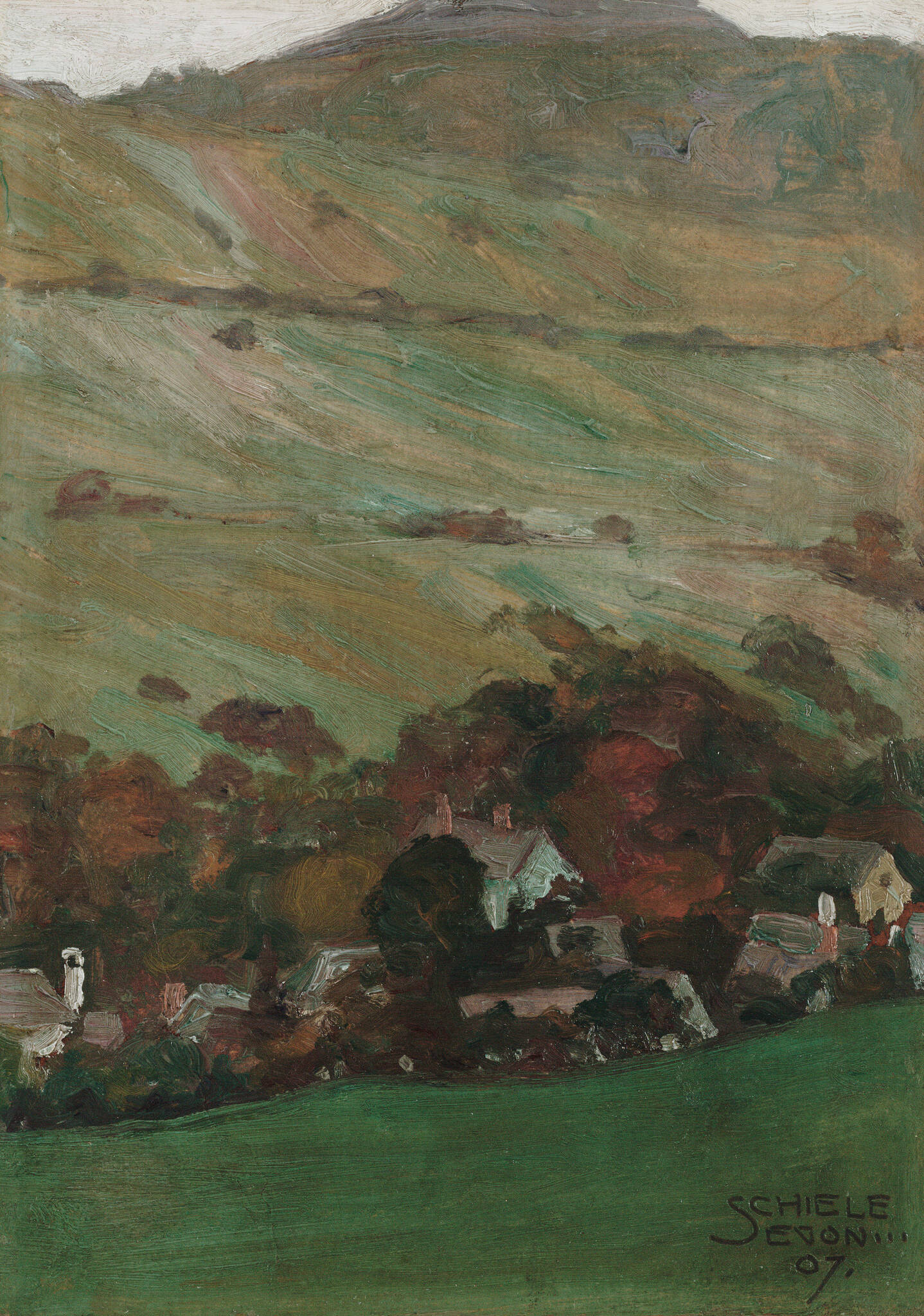
Village at the Foot of a Hill is an early work by Egon Schiele from 1907: an upright view of a group of houses below a mountain slope, painted in oils on cardboard mounted on wood. It is signed and dated at the lower right. The original is held by the Leopold Museum in Vienna under inventory number LM 471 and measures 17.9 x 25 cm. We paint it by hand in oils on canvas, in one of six sizes or to your own measurement, and before dispatch we send you a photograph of the finished work for approval.
| Title: | Village at the Foot of a Hill |
| Other titles: | the museum’s German title is Häuser vor Bergabhang; older catalogues list Dorf am Hang |
| Painter: | Egon Schiele (1890–1918) |
| Year: | 1907 |
| Original size (width × height): | 17.9 cm x 25 cm |
| Original technique: | Oil on cardboard, mounted on wood |
| Style: | Expressionism |
| Location: | Leopold Museum, Vienna (inv. LM 471) |
| Our reproduction: | hand-painted oil on canvas, 6 sizes from 50 x 70 cm to 120 x 170 cm, or a made-to-measure size |
Village at the Foot of a Hill – Egon Schiele
What does the painting show?
The title says what is there: a group of houses below a mountain slope, in an upright format, so that the hillside rises above the roofs. The museum record carries no description of the scene for this work, so we keep to what is on file: a small oil on cardboard mounted on wood, from 1907, and a motif the seventeen-year-old Schiele found close to home. At the lower right the work is signed and dated, with the lettering SCHIELE EGON and the year 07. Older catalogues listed it as Dorf am Hang, village on the slope, which is where the English title comes from.
Why do people love it?
Because this is Schiele before Schiele: the subject is completely calm – houses, a slope, no drama at all – but it comes from the hand of the painter who a few years later made the most charged portraits of his time. An upright landscape is rare and unusually useful: it fills a narrow wall between a door and a window, a hallway wall, or a tall slim strip beside a staircase, where a wide picture will not go. And because the original is small, our enlarged version shows the brushwork as a texture you can genuinely see up close.
Where does it sit among Schiele’s works?
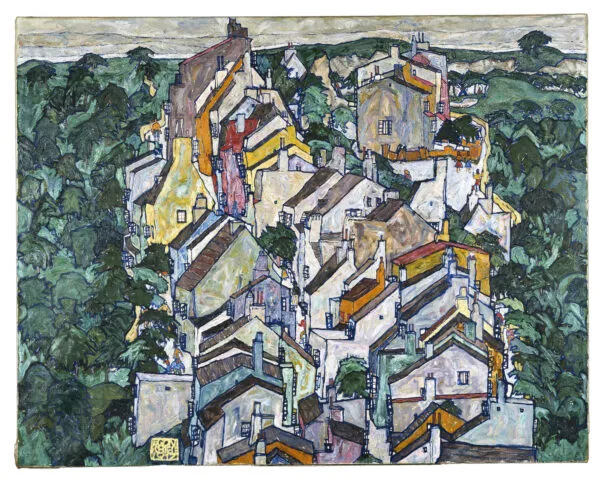
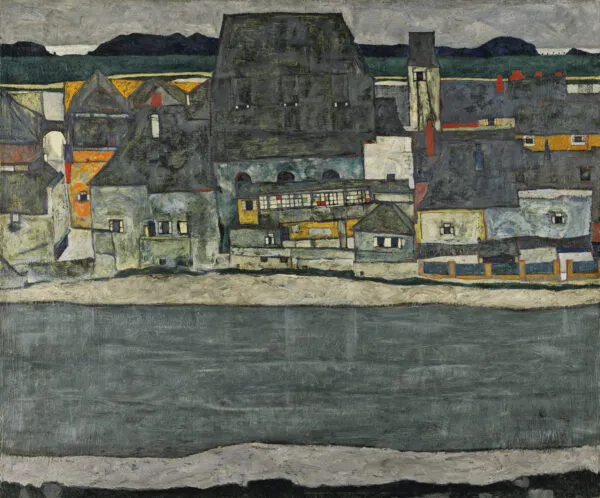
Among Schiele’s early landscapes and house pictures of 1907, from the Vienna Academy years when he was still moving towards his later hand. Houses crowded together stayed a subject for life; later examples in our selection are Krumau on the Vltava (The Small Town IV), Houses on the River (The Old Town) and House Wall on the River. The picture stayed in Schiele’s estate after his death in 1918, later entered Rudolf Leopold’s collection, and came to the Leopold Museum in 1994. The full selection is in the Egon Schiele gallery, with more on his life in our article about Egon Schiele.
How is our hand-painted version made?
A painter works every canvas in oils, stroke by stroke: a hand-painted painting made for your order, not a machine print. The hard part here is the change of scale. The original is postcard-sized and our smallest size is three times as tall, and strokes cannot simply be enlarged: the painter has to set them again on the bigger canvas so that they stay as loose as in the original and the houses do not turn into an architectural drawing. The original is oil on cardboard mounted on wood; our copy is oil on canvas, because canvas is what gets stretched and hung. When it is finished we photograph it and send you the photograph for approval, and only then does it ship. This work has not yet been photographed in our workshop, so there are no workshop photographs of it on this page yet.
Which size for which wall?
The original is very small, 17.9 cm wide and 25 cm high, so every size we offer is considerably larger – deliberately, because a postcard-sized painting disappears on a wall. For a hallway, a narrow wall between a door and a window, or above a low cabinet, 50 x 70 cm; in a bedroom above a nightstand or beside a staircase, 65 x 90 cm; in a living room next to a window or on a narrow strip of wall, 85 x 120 cm; on a larger wall in an entrance hall or dining room, 100 x 140 cm; in a tall room, 110 x 155 cm or 120 x 170 cm. Prices run from 207 EUR for 50 x 70 cm to 1207 EUR for 120 x 170 cm. An upright picture takes a narrower wall than a wide one; hang it with the centre at eye level, about 145-150 cm from the floor.
Custom size, stretcher bar and frame
If none of our sizes suits your wall, we paint the work to your own measurement. If you choose “YES” under the Stretcher option, the canvas comes stretched on a wooden stretcher bar, ready to hang. Our 3D application is for choosing a frame only, not for showing the work on your wall. The frame is chosen separately and need not be part of the order.
Delivery and guarantee
We paint to order and deliver to sixteen countries in the European Union, among them Slovenia, Croatia, Austria, Italy, Hungary, Germany and France; the United Kingdom and Ireland are not currently among them. The painting arrives protectively packed and, if you chose “YES” under Stretcher, stretched on the stretcher bar; before dispatch we send you a photograph of the finished work to approve. Production time depends on the size and on the studio’s workload. Every order is covered by our Returns and Refund Policy.
Frequently asked questions
What does the German title mean?
Literally, houses in front of a mountain slope. That is the title the museum uses, and it is given in the table above. Older catalogues called it Dorf am Hang, village on the slope, which is where the English name of this painting comes from.
Is the painting signed?
Yes. According to the museum record it is signed and dated at the lower right, with the lettering SCHIELE EGON and the year 07. A signature is not a given on Schiele’s early works, so it is a nice detail.
How old was Schiele when he painted it?
Seventeen. He was born in 1890 and had been accepted by the Academy of Fine Arts in Vienna in the autumn of 1906, so the picture comes from his first years there.
What is the original painted on, and what is your copy made of?
The original is oil on cardboard mounted on wood. Our copy is always a hand-painted oil on canvas, because canvas is what goes onto a stretcher bar and onto your wall.
Why is your smallest size bigger than the original?
Because the original measures only 17.9 x 25 cm. A painting that size is invisible on a wall, so our range starts at 50 x 70 cm. If you really want it at the original size, we will paint it to measure.
Does it work as a gift?
Yes; if you are unsure which size to choose, there is a gift voucher.