







































Description
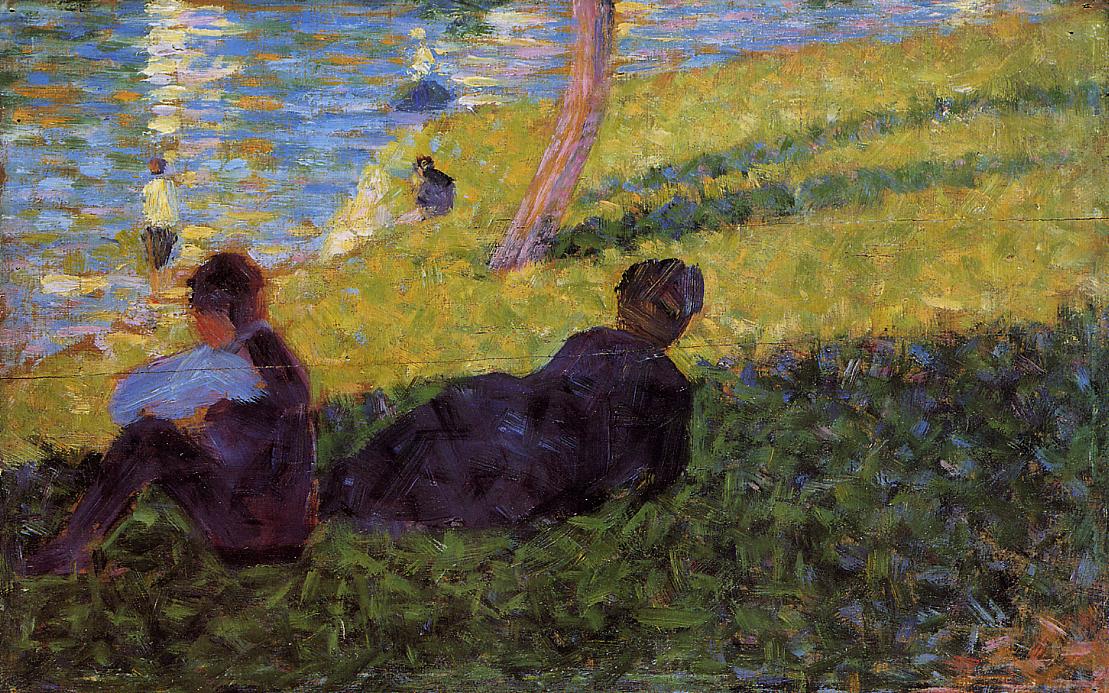
Study for La Grande Jatte (two figures) is an oil study that Seurat painted on a small wooden panel in 1884: two darkly dressed figures rest in the shade on the grass of the island of La Grande Jatte, one sitting, one lying; behind them a sunlit slope rises among the tree trunks, and at the upper left the Seine glitters. The original, 25 x 15.5 cm, is held by the Musée d’Orsay in Paris under number RF 1948 1. With us it becomes a canvas painting, hand-painted in oils, in five sizes or to your own measurements; before dispatch you receive a photograph of the finished work for approval.
| Title: | Study for La Grande Jatte (two figures) |
| Other titles: | Etude pour »Un dimanche après-midi à l’île de la Grande Jatte« |
| Painter: | Georges Seurat (1859–1891) |
| Year painted: | 1884 |
| Original size: | 25 cm x 15.5 cm |
| Original technique: | Oil on wood |
| Painting style: | Oil study – short strokes before the finished painting |
| Located at: | Musée d’Orsay, Paris (inv. no. RF 1948 1) |
| Our reproduction: | hand-painted in oils on canvas, 5 sizes from 25 x 16 cm to 80 x 50 cm, custom sizes on request |
Study for La Grande Jatte (two figures) – Georges Seurat
Who is in the painting?
Two figures in dark clothes whom the museum record does not name. On the left a figure with a white collar or scarf sits on the grass, turned to the right, and beside this figure a second one lies in the shade, propped on one elbow. Both are in the deep shadow of a tree that we see only as a trunk in the middle of the scene. At the upper left the Seine opens up, a small pale figure stands beside it, and one more sits on the lawn in the distance. They are not portraits but Sunday guests of the island, the kind of people Seurat watched and studied for his large painting.
What is on the panel?
A horizontal wooden panel 25 cm wide. The lower half is filled with dark shade in deep green and blue strokes, in which the two dark figures almost disappear. At the upper right a slope glows in vivid yellowish green strokes, crossed by a slanting shadow. The water at the upper left is set down in patches of blue, white and pink. The strokes are short and dense and can be seen one by one, but they are not yet dots. The tree trunk in the middle is no more than a few pale vertical strokes, yet it splits the scene into a shaded half and a sunlit half. The strongest impression comes from the boundary between shade and light, which runs diagonally across the whole panel.
Why does this study matter?
Because it shows how Seurat used a small panel to check where to place people in the shade before he moved them onto the large canvas. The French painter made a whole series of studies for the island of La Grande Jatte; this one stands out because it puts two resting figures in the foreground and leaves the sunshine to the background. Pointillism has not arrived yet; the short strokes show the painter just before the discovery from which neo-impressionism later grew. The panel’s first owner was the painter Paul Signac. It is a quiet scene of great depth with a strong contrast.
What does the scene mean?
Two people resting in the shade while a summer day shines all around them. They are not talking, nor looking at each other; each enjoys the cool shade in their own way. That kind of stillness runs through all of Seurat’s Sunday scenes. Light is the real protagonist here: the sun falls not on the people but on the grass behind them, so we see them as two dark shapes against a bright background. At home it feels calm and warm, and the dark lower half gives the painting a solid footing.
What happened to the original?
The museum publishes the panel’s history. It was first in the collection of the painter Paul Signac in Paris, then in the collection of Jules Rivière in Paris and later of Mademoiselle Thérèse Rivière. In 1948 the State accepted it as a gift from Thérèse and Georges-Henri Rivière in memory of their parents and assigned it to the Louvre. From 1961 to 1977 it was at the Jeu de Paume gallery, and in 1977 it was assigned to the Musée d’Orsay. Every detail here is taken from the museum’s record.
What place does this study have among Seurat’s works?
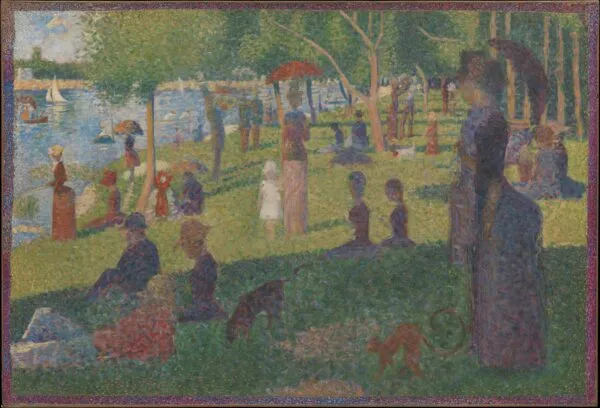
It is one of the preparatory studies for the large painting Sunday Afternoon on the Island of La Grande Jatte, held by the Art Institute of Chicago. From the Musée d’Orsay, which holds this panel, we also offer Study for La Grande Jatte (right), which shows another part of the same island. Further studies for the same painting are Oil Sketch for La Grande Jatte (Chicago) and Study for La Grande Jatte (London). Each is a separate product with us, so you can put together a small group of views of the same place.
How is our hand-painted version made?
With a brush and oil paint, never with a printer. Our painter works from an image of the original and keeps what makes this study special: the short strokes, the deep shade and the bright slope. A pointillist technique would be wrong here, since the panel was painted before Seurat developed it. Because everything is done by hand, no two canvases are ever exactly alike, and every hand-painted copy stays one of a kind. We do not yet have our own photographs of a finished canvas of this subject; when we paint it for the first time, we will photograph it and publish the photographs here.
Which size for which wall?
If you are not sure which to choose, take 60 x 40 cm. Our smallest size, 25 x 16 cm, is the same width as the original, which measures 25 x 15.5 cm, and 5 mm taller, so it is the size in our range closest to the original. The format is horizontal, so it sits well above a narrow chest of drawers, above a bed or in a group of smaller works. 50 x 30 and 60 x 40 cm suit a hallway or bedroom, while 70 x 45 and 80 x 50 cm hold a wall on their own above a desk or a sofa. We do not offer larger sizes for this subject, because the image of the original we work from is not sharp enough for them. Every oil painting reproduction of this subject is made to order.
Custom size, stretcher bar and frame
If none of the five sizes fits your wall, we paint to your measurements, up to 80 x 50 cm, and keep the proportions of the original, so the shade and the slope stay in balance; that is our custom size painting service. You can order the painting in three forms: as a rolled canvas without a stretcher, stretched on a wooden stretcher bar and ready to hang, or framed; you choose the form when you order. You choose the frame in our 3D frame viewer, which shows gold, silver, black, white and wooden profiles on this subject; it is there only for choosing the frame. If you would like to see the painting on your own wall, our room-visualisation service can be ordered separately.
Delivery and guarantee
Every canvas is painted to order in our studio in Slovenia, so allow 15 to 45 days depending on the size. It travels in the form you chose when ordering — rolled, stretched or framed — protected for transport, within Slovenia and across the EU with no customs duty. Before dispatch you receive a photograph of the finished work for approval, and our returns policy applies to every order. All of Seurat’s subjects are gathered in the Georges Seurat gallery, and in our article about Georges Seurat you can read what a good reproduction of a famous painting looks like.
Frequently asked questions
Where is the original?
In the Musée d’Orsay in Paris, under number RF 1948 1, a gift from Thérèse and Georges-Henri Rivière in 1948.
Who are the two figures in the study?
The museum record does not name them; they are unknown visitors to the island, not portraits.
Is this the same work as Study for La Grande Jatte (right)?
No. Both are in the Musée d’Orsay, but they are separate panels with different scenes; we offer them as separate products.
Is this a print?
No. The work is painted by hand in oil on canvas; the brushstrokes are visible and can be felt.
Which size should I choose?
For a hallway or bedroom, 60 x 40 cm; for the size closest to the original, 25 x 16 cm. The detailed guide is above.
Can I have a size that is not on the list?
Yes. We paint to measure, up to 80 x 50 cm, and keep the side ratio of the original.
Why is the largest size 80 x 50 cm?
Because the image of the original that we paint from is not sharp enough for larger sizes.
What does the study say in one sentence?
That two people resting in cool shade can make a complete, deep painting of a summer day.
Is the original for sale?
No. The panel is part of the Musée d’Orsay’s public collection and is not for sale; we can, however, paint a version of it by hand for your home.
How high should I hang it?
With its centre at eye level, about 145–150 cm from the floor. Hang the smaller sizes lower, closer to where you sit.
Is it suitable as a gift?
Yes, a quiet scene from the shade by the river suits almost any room. If you would rather leave the choice to the person receiving it, there is our gift voucher.
- Subject: two figures resting in the shade on the island of La Grande Jatte, with a sunny slope and the Seine behind – 1884
- Original: 25 x 15.5 cm, oil paint on wood, Musée d’Orsay (inv. no. RF 1948 1)
- Ours: a fine art reproduction painted by hand in oils on canvas, five sizes from 25 x 16 to 80 x 50 cm, as a rolled canvas, stretched or framed — your choice
- Worth knowing: the panel first belonged to the painter Paul Signac