







































Description
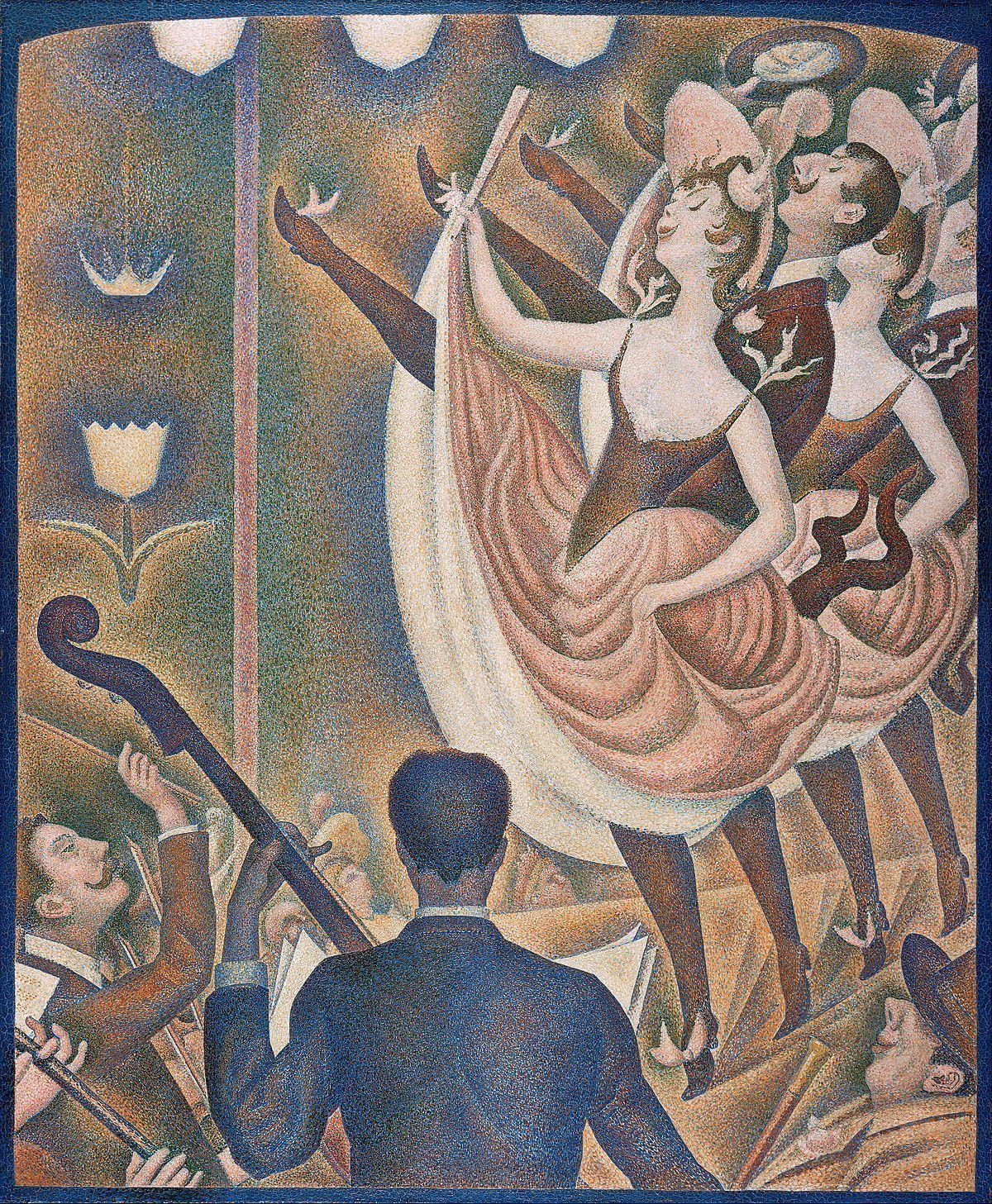
Le Chahut is Seurat’s large canvas of 1889–1890: women and men dancing the chahut, or cancan, a risqué dance for the period in which the dancers lift their skirts and wave their legs in the air. The original measures 141 x 170 centimetres and is held in Otterlo by the Kröller-Müller Museum under the identifier KM 107.757. From us it is painted entirely by hand, oil on canvas, in eight sizes or to your own measurements, and before dispatch you receive a photograph of the finished work for approval.
| Title: | Le Chahut |
| Other titles: | Chahut · The Can-can |
| Painter: | Georges Seurat (1859–1891) |
| Year painted: | 1889–1890 |
| Original size: | 141 cm x 170 cm |
| Original technique: | Oil on canvas |
| Painting style: | Pointillism |
| Located at: | Kröller-Müller Museum, Otterlo (inv. no. KM 107.757) |
| Our reproduction: | hand-painted oil on canvas, 8 sizes from 40 x 50 cm to 141 x 168 cm, custom size on request |
Le Chahut – Georges Seurat
Who is in the painting?
Nobody the museum record names. Four dancers are on the stage, a double bass player is at the lower left with the conductor’s hand beside him, and a male spectator looks out of the dark at the right. The museum says the dancers appear more archetypes than people of flesh and blood and that they move in a rhythmic repetition; nobody here is a portrait. This French painter made the work in the last two years of his life, and the scene is not a fleeting glimpse of Parisian nightlife but, as the record puts it, a painstakingly deliberated painting.
What is on the canvas?
An upright canvas built from countless minute dots. The dancehall is bathed in warm colours and glowing artificial light. The museum points to a single formal rule that holds the whole thing together: all the lines and movements are directed upwards, to evoke the excited atmosphere of the dance and the music — the dancers’ legs, the conductor’s hand, the men’s moustaches, the corners of the ladies’ mouths and eyes, the neck of the double bass, even the flowers in the background. Once you have seen it you cannot look at the work any other way: this is not a scene, it is a system.
Why does this painting matter?
Because it shows that pointillism was a method for Seurat and not a style. The museum record says so plainly: he was fascinated by the effect of light and colour and purposefully sought a systematic method by which to render it. He caught the flamboyant dance in a strict system of countless minutely applied dots of paint, lines and colour combinations. The contrast between subject and execution is the heart of the work: the wildest scene imaginable, painted with the greatest possible discipline.
What does the work mean?
Less fun and more mechanism than the subject promises. The cancan was a provocation at the time, but here the dancers are not seductresses; they are equal, repeatable forms. The smiles are identical, the legs sit at the same angle, even the moustaches follow the same upward curve. The canvas painting that results is about how excitement can be assembled out of rules. That is why the work is cheerful and slightly cold at once — and why it has stayed interesting longer than many more sentimental scenes of the same decade.
Where does it sit in Seurat’s work?
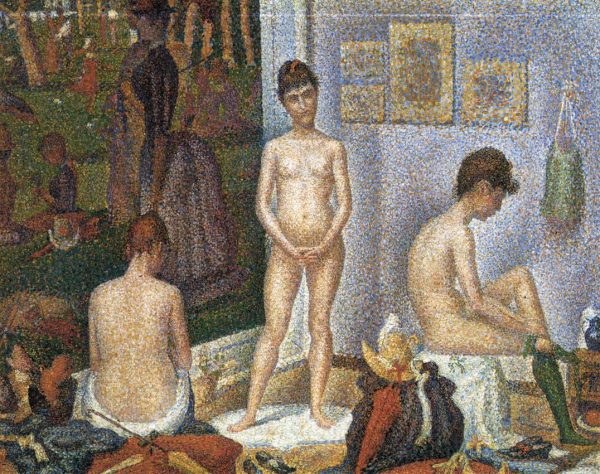
Among the last, beside Young Woman Powdering Herself, also a scene under artificial light, and Invitation to the Sideshow (La Parade de Cirque), where the same night world is seen from outside. A few years earlier came The Models (Les Poseuses), the large studio composition, and the Art Institute of Chicago holds Sunday Afternoon on the Island of La Grande Jatte, the daylight counterpart to this night scene. The neo-impressionism is the same in all of them; the light is not.
How is our hand-painted version made?
By hand and with a brush, never with a printer. Our painter works in oil paint on linen and builds the surface the way it is built on the original: dot beside dot, the warm tones of the hall against the cooler dots of the shadow, so the colour assembles only in the eye. On this subject the work is demanding, because every direction has to keep pointing upwards; turn one stroke and the scene loses its drive. Every hand-painted copy is therefore one of a kind and no two are quite alike; this is not an oil painting reproduction printed onto canvas but a painting made from scratch. Before dispatch we photograph the piece and send you the photograph for approval.
We hold no studio photographs of the finished work for this subject at present. When it is next painted we will photograph it and the shots will appear on this page.
Which size for which wall?
If you do not know which: 70 x 90 cm. The original measures 141 x 170 cm, so our largest size, 141 x 168 cm, is practically one to one with it — the width matches to the centimetre. The format is upright, close to a 5 : 6 ratio: 40 x 50 and 50 x 60 cm work in a hallway or beside a door, 60 x 70 and 70 x 90 cm are the everyday choice for a living room, 80 x 100 and 90 x 110 cm ask for a wall of their own, and 120 x 150 and 141 x 168 cm belong in large rooms where the dancers reach almost life size and the dots can be read close up. Every fine art reproduction of this subject is made to order.
Custom size, stretcher bar and frame
If none of the eight sizes fits your wall, we paint the work to your measurements and keep the ratio of the original so the dancers are never stretched; that is our custom size painting service. You can order the painting in three forms: as a rolled canvas without a stretcher, stretched on a wooden stretcher bar and ready to hang, or framed; you choose the form when you order. You choose the frame in our 3D frame viewer: on this subject it shows every frame profile we carry, so you can compare gold, silver, black, white and natural wood — it is for choosing a frame and nothing else. To see how the work will look on your own wall, use our separate room-visualisation service.
Delivery and guarantee
Every copy is made to order in our studio in Slovenia, so allow 15 to 45 days depending on the size you choose. We ship it in the form you chose when ordering — rolled, stretched or framed — protected for transport, across the EU, customs-free. Before dispatch you receive a photograph of the finished work for approval, and our returns policy applies to every order. The full range by this painter is in the Georges Seurat gallery, and his career is described in our article about Georges Seurat, which also explains what separates a good famous painting copy from a poor one.
Frequently asked questions
Where is the original?
In Otterlo in the Netherlands, at the Kröller-Müller Museum, under the identifier KM 107.757. The museum lists it as on display.
Who are the dancers?
The record does not name them. The museum says they appear more archetypes than people of flesh and blood; the work is not a portrait of particular people.
Is “Chahut” the same work?
Yes. The museum itself uses the shorter form “Chahut”; in English it also appears as “The Can-can”. It is one and the same canvas.
Is this a print?
No. The work is painted by hand in oil on linen; the dots are visible and can be felt, which a print cannot imitate.
Which size should I choose?
For a living room, 70 x 90 cm; if you want the size of the original, choose 141 x 168 cm. The full size guide is above.
Can I have a size that is not listed?
Yes. We paint to measure, keeping the side ratio of the original.
How is it delivered?
In the form you chose (rolled, stretched on a stretcher or framed), 15 to 45 days after you approve the photograph of the finished work.
What is the work about, in one sentence?
The most unrestrained dance of its day, painted with the greatest possible discipline.
Why does everything point upwards?
Because it is built that way. The museum lists them: the dancers’ legs, the conductor’s hand, the men’s moustaches, the corners of the mouths and eyes, the neck of the double bass and the flowers in the background — every direction is turned upwards, to evoke the excited atmosphere of the dance and the music.
Is the original for sale and what is it worth?
No. The canvas is in the public collection of the Kröller-Müller Museum and is not for sale; a hand-painted canvas is the only way to have the subject at home.
Is it suitable as a gift?
The larger sizes work as a gift because the scene lives on scale. If you would rather leave the choice to the person receiving it, there is a gift voucher.
- Subject: four dancers, a double bass player and the conductor’s hand – the cancan in glowing artificial light
- Original: 141 x 170 cm, oil paint on canvas, Kröller-Müller Museum, Otterlo (KM 107.757)
- Ours: a hand-painted oil, eight sizes from 40 x 50 to 141 x 168 cm, as a rolled canvas, stretched or framed — your choice
- Worth knowing: every line points upwards – legs, the conductor’s hand, moustaches, mouth corners, the double bass neck and the flowers