Description
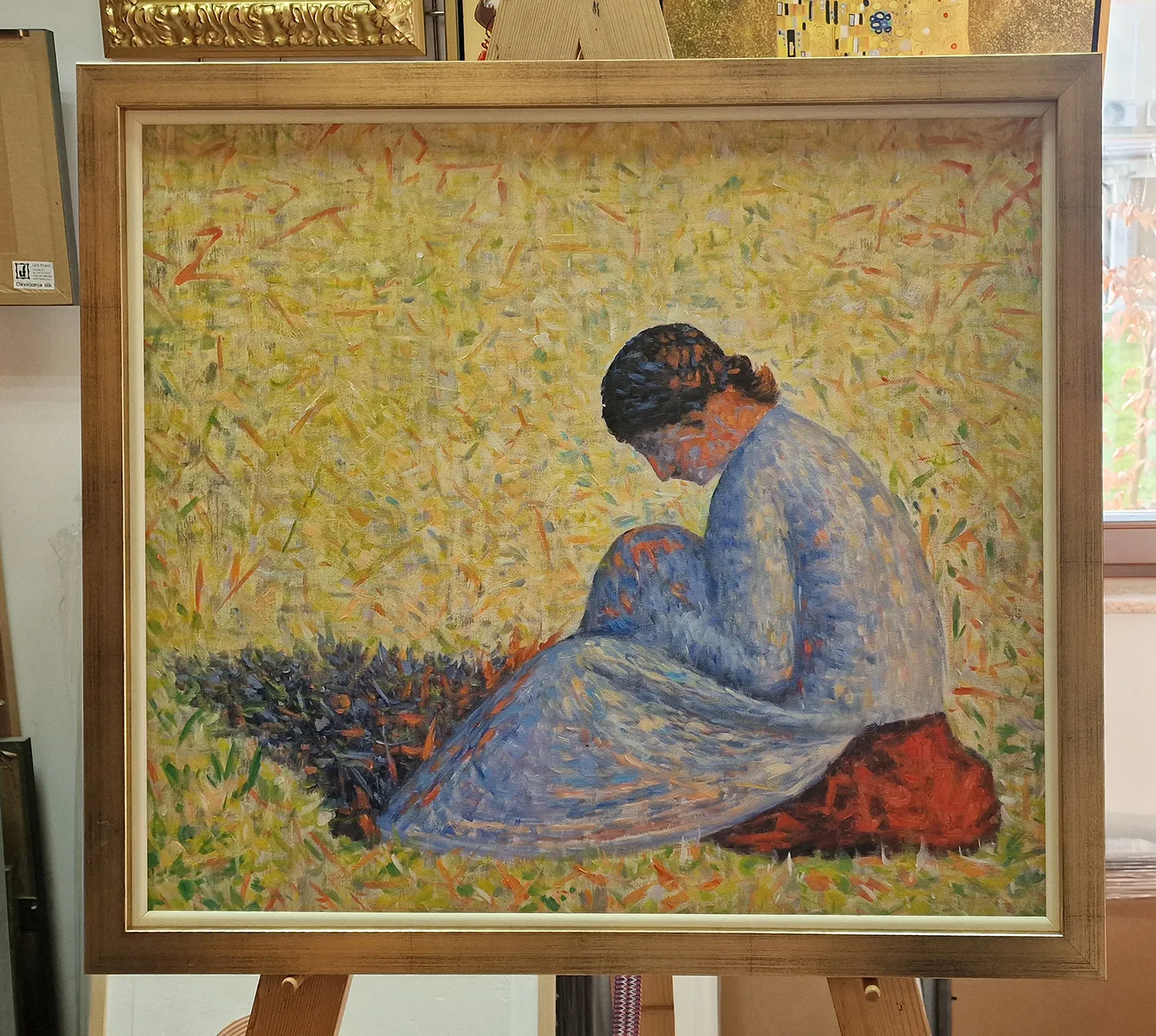
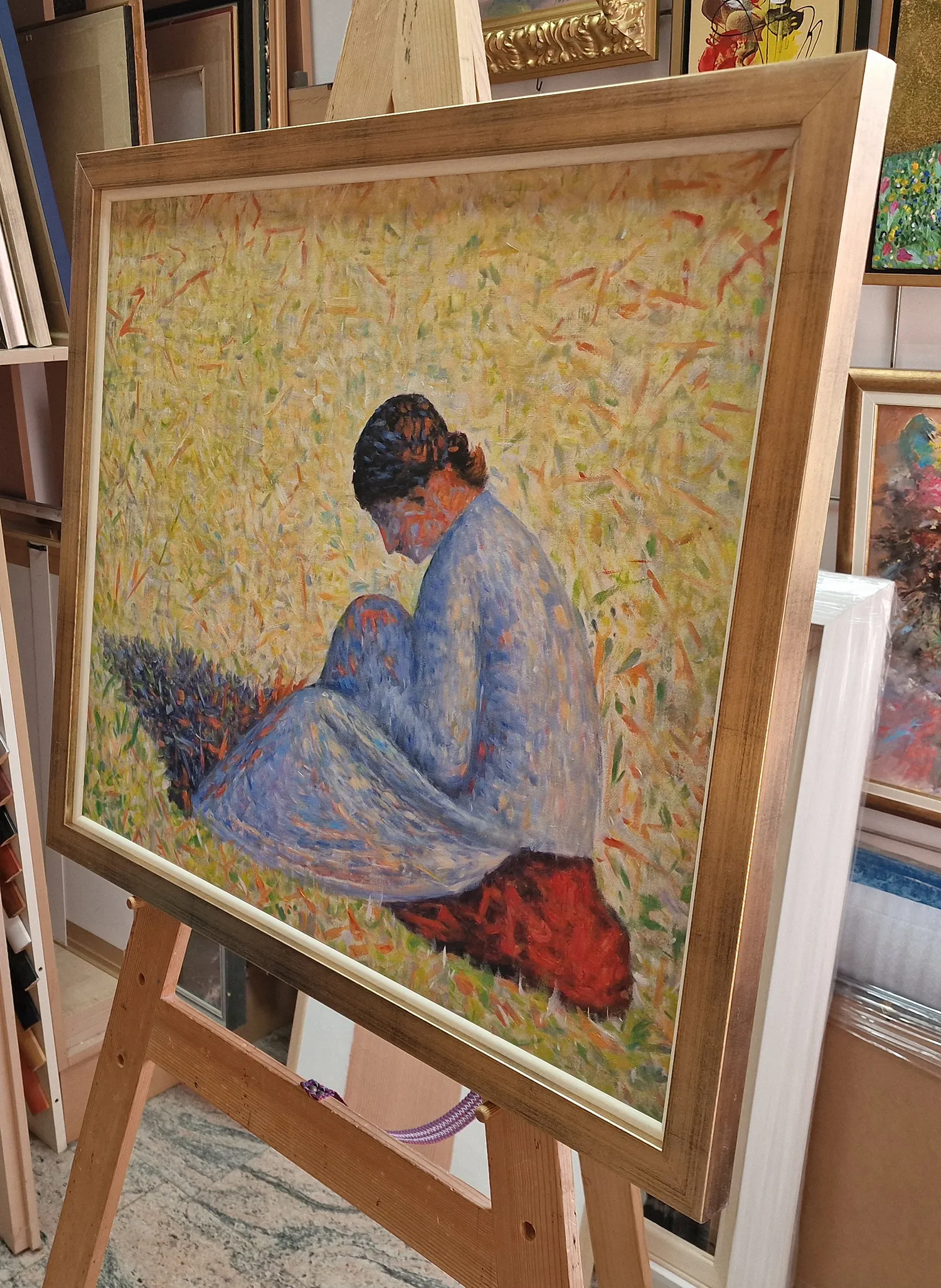
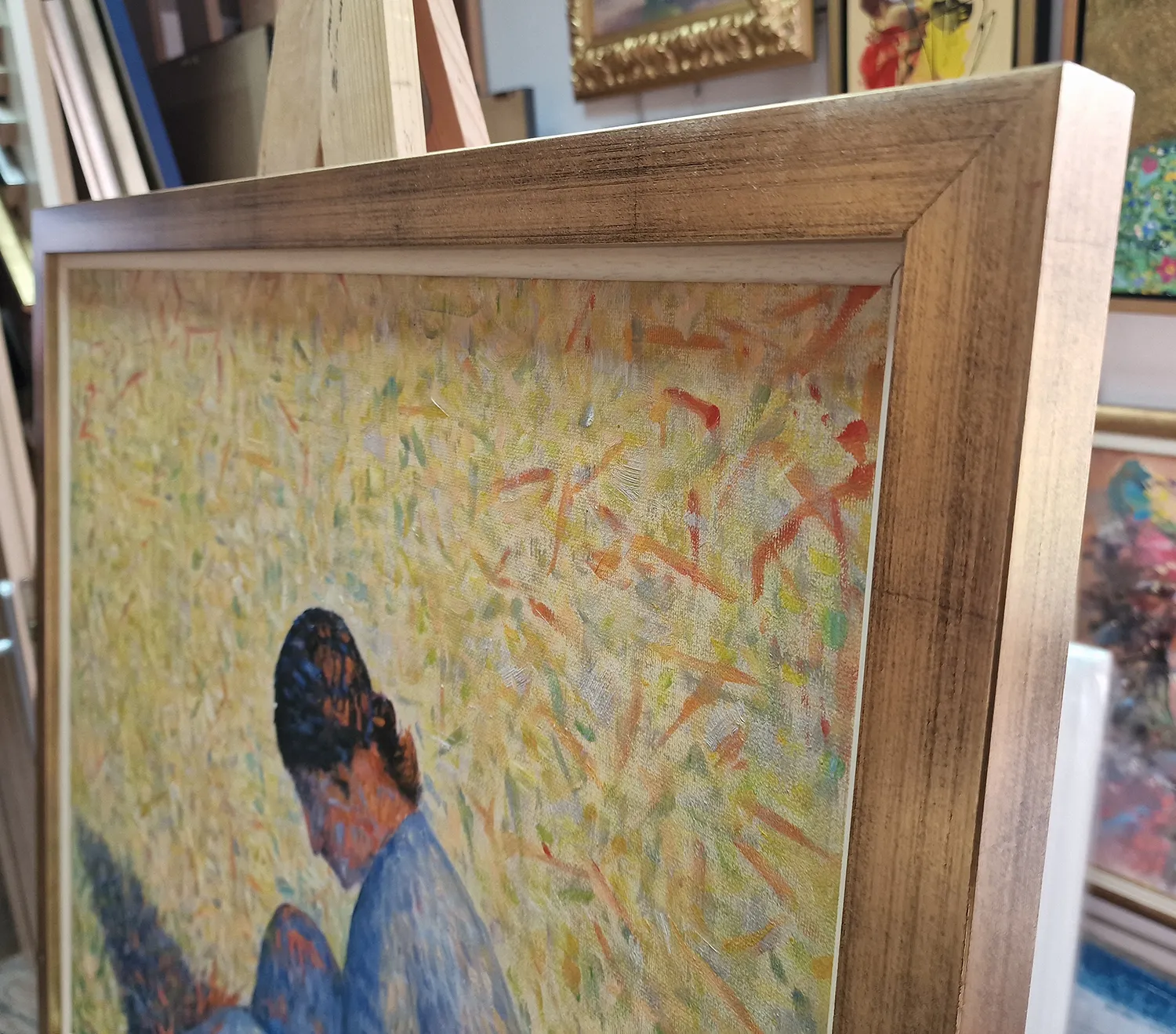
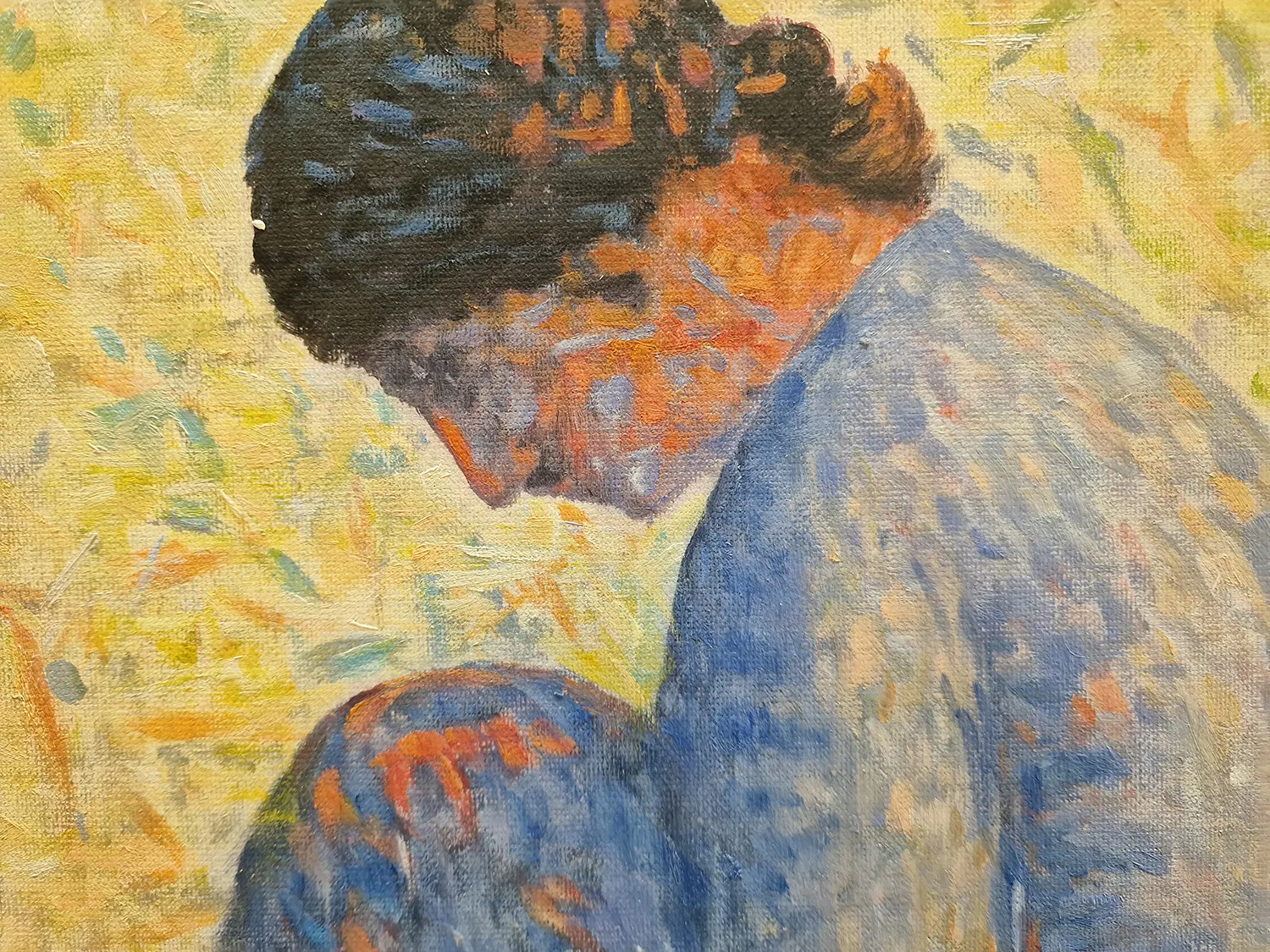
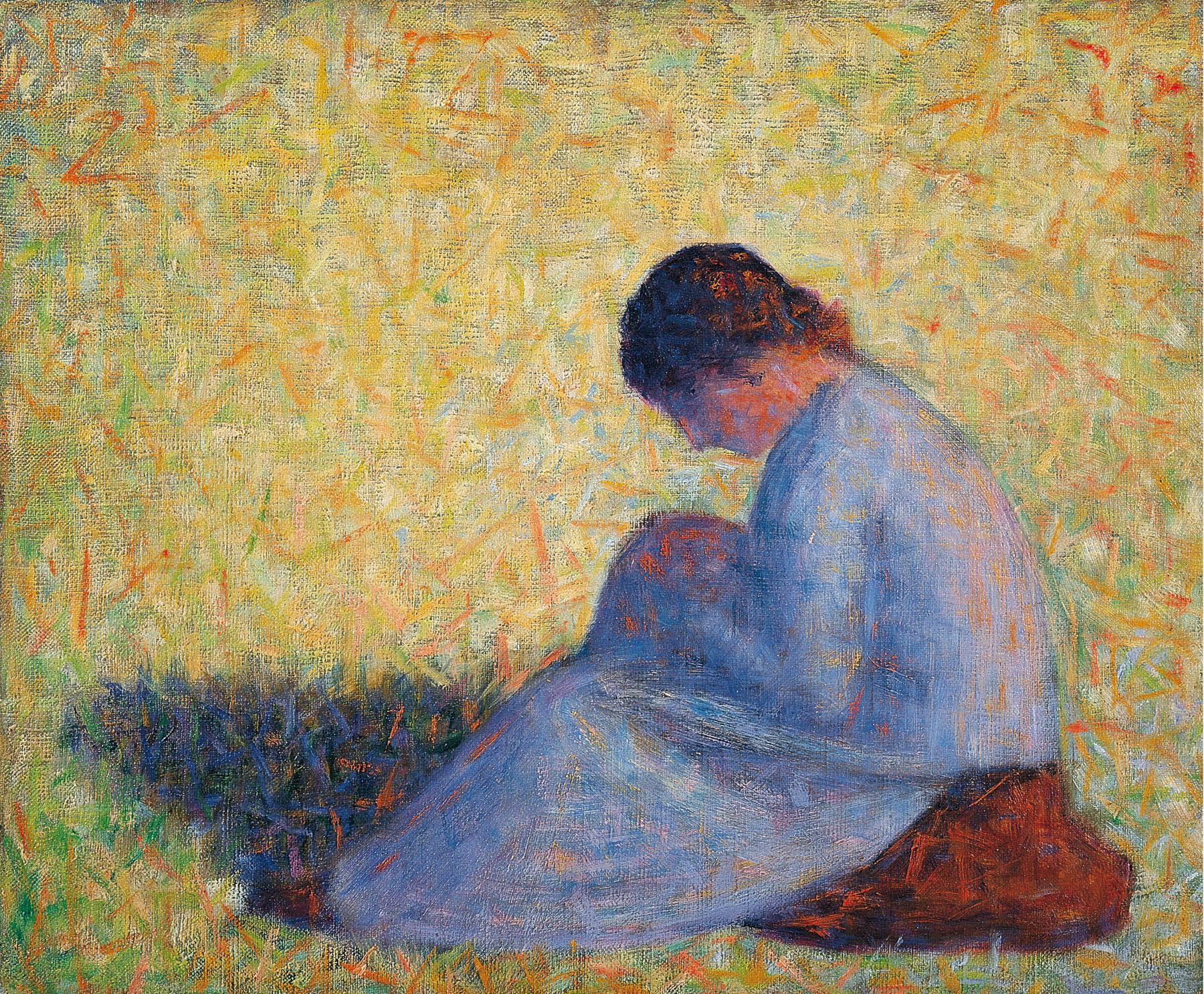
Peasant Woman Seated in the Grass (Paysanne assise dans l’herbe) is Seurat’s oil on canvas of 1883: a woman in a blue dress sits in tall grass, bent forward, her head in profile, a red skirt spreading beneath her. The original is held by the Solomon R. Guggenheim Museum in New York under accession number 37.714. We make it as a hand-painted canvas painting in oils, in eight sizes or to your own measurements; the photographs on this page show our canvas, not the museum’s.
| Title: | Peasant Woman Seated in the Grass (Paysanne assise dans l’herbe) |
| Other titles: | Peasant Woman Seated in the Grass · Paysanne assise dans l’herbe |
| Painter: | Georges Seurat (1859–1891) |
| Year painted: | 1883 |
| Original size: | 46.2 cm x 38.1 cm |
| Original technique: | Oil on canvas |
| Painting style: | Early period, before Pointillism |
| Located at: | Solomon R. Guggenheim Museum, New York (acc. no. 37.714) |
| Our reproduction: | hand-painted in oil on linen, 8 sizes from 46 x 38 cm to 150 x 120 cm, custom sizes on request |
Peasant Woman Seated in the Grass (Paysanne assise dans l’herbe) – Georges Seurat
Who is in the painting?
A countrywoman the museum record does not name. She sits on the ground, turned to the left, bent forward as if working or resting mid-task; the head reads in profile, the dark hair tied low. The upper part of the dress is blue and light, and beneath her a red-orange skirt spreads out, the strongest colour on the canvas. The hands are summarised in a few strokes and the face cannot be read as a portrait. This is not a studio model but a figure as the painter saw one in the fields. That is exactly why the pose convinces: nobody arranged it, and even turned away from us the woman looks as though our gaze means nothing to her.
What is on the canvas?
Almost nothing but grass. The background is a dense carpet of short strokes in yellow, green, orange and blue, with no horizon, no sky and not a single straight line; the eye has nowhere to escape and stays with the figure. To her left lies a darker blue-violet mass, perhaps a bundle or a basket, which the painter left undefined. The colours are not mixed on the palette but set side by side, so that green and orange only come together in the eye. That is exactly what the painter was testing before he carried the method onto large canvases. The grass is therefore livelier than the figure, and the centre of the work is not where you expect it — it is in the landscape, not in the person.
Why does this work matter?
Because it stands at the turn. It was made in 1883, before the large scenes, and shows a painter still working peasant subjects in the spirit of Millet while already breaking the surface into separate strokes of pure colour. A French painter of method, Seurat worked in these years on small panels and on a few larger canvases like this one; out of them came the pointillism we know from the Grande Jatte. Neo-impressionism was not born in a studio with models, then, but in a field, at a woman sitting in the grass.
What does the scene mean?
Work without pathos. Seurat shows neither hardship nor idyll; he shows a person who is part of the landscape and takes up exactly as much room in it as a body takes. Because there is no horizon there is no story either — what remains is observation. At home it reads warm and quiet: green and yellow fill the wall, and the red skirt keeps the scene from dissolving. Its almost square format sits well above a chest of drawers or between two windows.
Where does this work sit in Seurat’s work?
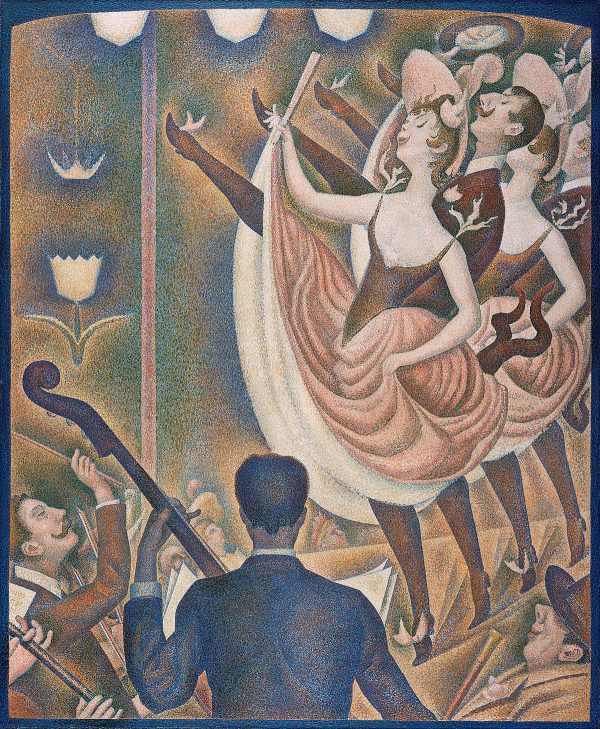
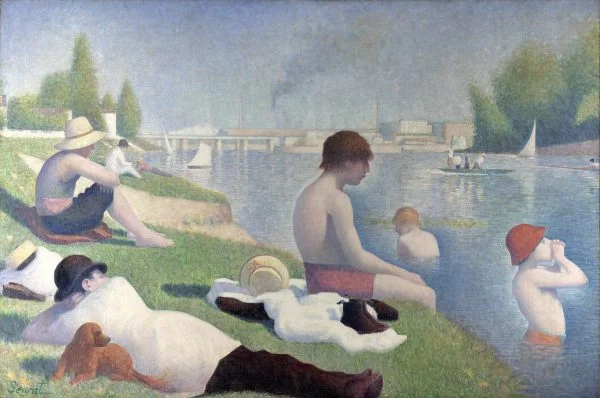
Among the early canvases, before the large scenes. Bathers at Asnières came a year later and is the first large proof of the same direction, while Sunday Afternoon on the Island of La Grande Jatte, held by the Art Institute of Chicago, is the method at its height. We also sell Figure in a Landscape at Barbizon and The Circus, the painter’s last, unfinished canvas.
How is our hand-painted version made?
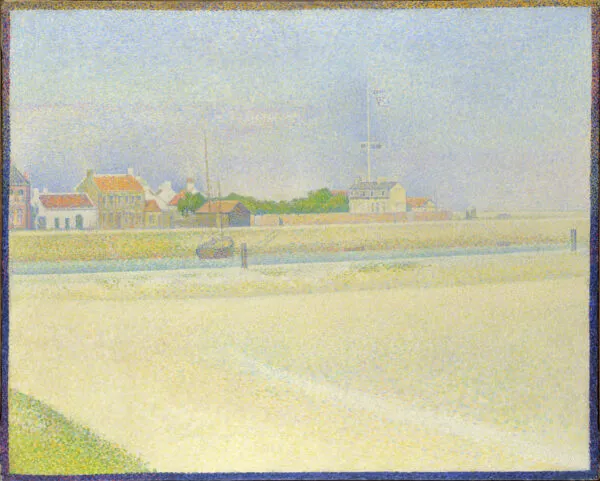
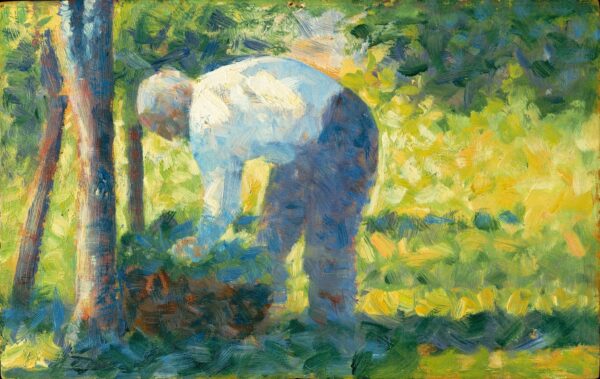
It is made with a brush and oil paint, never a printer. The photographs at the top of the page are our own: in the first photograph the finished canvas stands framed on the easel in the studio, and in the fourth photograph the woman’s head and shoulder are seen close up, where you can make out how the strokes are set one by one and how the colours only come together at a distance. Our painter works from a high-resolution museum file and keeps the direction and length of the strokes; a smoothed surface would make a different work. Because everything is done by hand, no two canvases are ever quite alike and every hand-painted copy stays a one-off.
Which size for which wall?
If you do not know which: 70 x 60 cm. The original measures 46.2 x 38.1 cm, so our smallest size, 46 x 38 cm, is effectively one to one with it. The format is horizontal and nearly square, close to a 6 : 5 ratio, so it needs no wide wall and takes a place above a chest, a desk or a bed. 50 x 40 and 60 x 50 cm suit smaller rooms; 70 x 60 and 80 x 65 cm are the everyday sizes; 90 x 75 cm works in a living room, and 120 x 100 and 150 x 120 cm are the sizes for a large, unbroken wall. Every oil painting reproduction of this subject is made to order.
Custom size, stretcher bar and frame
If none of the eight sizes fits your wall, we paint to your measurements and keep the ratio of the original so the figure stays in the same relation to the grass around her; that is our custom size painting service. You can order the painting in three forms: as a rolled canvas without a stretcher, stretched on a wooden stretcher bar and ready to hang, or framed; you choose the form when you order. You choose the frame in our 3D frame viewer: on this subject it shows every profile we carry — gold, silver, black, white and natural wood — and it is for choosing a frame and nothing else. To see how the work looks on your own wall, use our separate room-visualisation service, ordered on its own.
Delivery and guarantee
Every copy is made to order in our Slovenian studio, so allow 15 to 45 days depending on the size. We ship it in the form you chose when ordering — rolled, stretched or framed — protected for transport, across the EU, customs-free. Before dispatch you approve a photograph of the finished work, and our returns policy applies to every order. The full range is in the Georges Seurat gallery, and his career is described in our article about Georges Seurat, which also explains what separates a good fine art reproduction from a poor one.
Frequently asked questions
Where is the original?
In the Solomon R. Guggenheim Museum in New York, under accession number 37.714. The museum gives it as an oil painting on canvas, 38.1 x 46.2 cm, of 1883.
Do the photographs on this page show the museum’s work?
No. All four show our own hand-painted canvas in our studio, partly framed and partly close up.
Why are the strokes so visible?
Because they are part of the work. Seurat set the colours side by side instead of mixing them, and it is that separated stroke which gives the surface its light.
Is this a print?
No. The work is painted by hand in oils on linen; the brushwork is visible and can be felt.
Which size should I choose?
For a living room or bedroom, 70 x 60 cm; for the size of the original, 46 x 38 cm. The full guide is above.
Can I have a size that is not listed?
Yes. We paint to measure, keeping the side ratio of the original.
Is this already a pointillist work?
Not quite. It dates from 1883, when the painter was already separating his colours; the fine dots came later, and the method proper arrives with the large canvases.
What is that dark mass beside the woman?
An undefined dark blue-violet shape at her left. The museum record does not explain it, so neither do we.
Is the original for sale and what is it worth?
No. The canvas is in the public collection of the Solomon R. Guggenheim Museum and is not for sale; a hand-painted canvas from us is the only way to have it at home.
How high should I hang it?
Centre at eye level, about 145–150 cm from the floor. With a nearly square format it matters more that it is centred on the furniture beneath it.
Is it suitable as a gift?
Yes; the subject is warm and undemanding, and the smaller sizes fit almost any wall. If you would rather leave the choice to the person receiving it, there is our gift voucher.
- Subject: a woman sitting bent forward in tall grass, in a blue dress and red skirt – 1883
- Original: 46.2 x 38.1 cm, oil colour on canvas, Solomon R. Guggenheim Museum (acc. no. 37.714)
- Ours: a famous painting recreated by hand in oils, eight sizes from 46 x 38 to 150 x 120 cm, as a rolled canvas, stretched or framed — your choice
- Worth knowing: every photograph on this page shows our canvas, not the museum’s