

Description
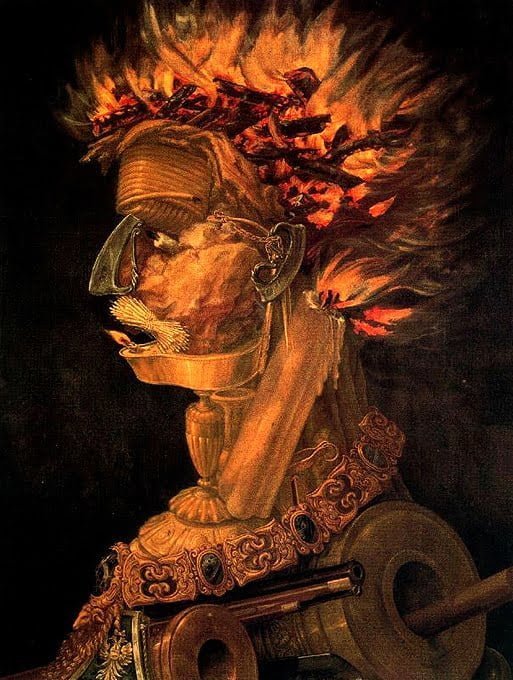
Fire is the head of a man in profile that Giuseppe Arcimboldo assembled from the things that strike fire, feed it, hold it and use it: burning logs are the hair, a fire-steel the nose, an oil lamp the chin, a candlestick the neck, and cannon barrels and a gun make up the chest. The original, dated 1566 and painted on a limewood panel, is held by the Kunsthistorisches Museum in Vienna under inventory number GG 1585, and the museum gives its size as 66.5 x 51 cm. We make it as a hand-painted reproduction in oil on canvas, in two sizes or a size of your own, and you receive a photograph of the finished painting for approval before dispatch.
| Title: | Fire |
| Other titles: | Das Feuer · Ignis · Ogenj · Vatra · Il fuoco · A tűz |
| Painter: | Giuseppe Arcimboldo (1527–1593) |
| Year: | 1566 (the back of the panel reads IGNIS 1566) |
| Original size: | 66.5 x 51 cm, as the museum gives it |
| Original technique: | painted on a limewood panel |
| Style: | Mannerism |
| Location: | Kunsthistorisches Museum, Vienna (inv. GG 1585) |
| Our reproduction: | hand-painted oil on canvas, two sizes, 30 x 40 and 40 x 50 cm, custom size on request |
Fire – Giuseppe Arcimboldo
What does the painting show?
The head and shoulders of a man in profile, facing the left edge, on a dark ground. Here the figure is not a person with a name but an element: fire, built from the tools that strike it, the fuel that feeds it, the lights that hold it and the guns that use it. The museum places the work in the series of the four elements, which it reads together with the painter’s earlier series of the seasons, and notes that of all of them Fire alludes most clearly to the Emperor Maximilian II, through the chain of the Order of the Golden Fleece and the medallion with the double-headed eagle. On the back of the panel, the museum records the inscription IGNIS 1566; ignis is the Latin word for fire.
What is the head made of?
The hair is a heap of burning logs and sticks, with flames flaring upwards and wisps of smoke drifting forward over the forehead. Under the hair, the forehead is a tightly coiled cord with a frayed piece of cloth laid over it. The nose is a fire-steel, the curved iron that was struck against stone to make sparks, and the ear is a second fire-steel, with a thin gold chain hanging from it. The cheek is a large pale stone, veined in pink and ochre. Where the eye would be sits a small white stub with a blackened end. The moustache is a tied bundle of thin sticks, and the lips and chin are an oil lamp whose wick burns at the spout. The neck is a gilded candlestick, with a second one behind it. The chest is made of arms: two cannon barrels, both with their muzzles towards us, and a long gun lying across them. Over them hangs the gold chain of the Golden Fleece, set with dark stones, with the ram of the Fleece hanging from it, and below, on a green medallion, is the double-headed eagle. At lower right, on a cannon barrel, is the painter’s Latin signature.
Why does this painting matter?
Because it is one of the two elements that the museum in Vienna holds from the series of the four elements; the other is Water. The museum reads the elements together with the seasons Arcimboldo had painted earlier, in 1563, and pairs them: Summer corresponds to Fire, Winter to Water, Spring to Air and Autumn to Earth. Its records also note that Arcimboldo was imperial court painter in Vienna and Prague from 1562, and that his posthumous fame rests on the series of the seasons. How the painter built his heads is the subject of our article about Arcimboldo.
What does the painting mean?
At first glance Fire is a joke made of everyday objects and weapons; at a second, it is a portrait of power. The museum singles out two signs, the chain of the Order of the Golden Fleece and the medallion with the double-headed eagle, and says that through them Fire points to Maximilian II most clearly of the series. Reading the guns on the chest is our own interpretation, not the museum’s: fire here is not only light and warmth, from the lamp and the candlestick, but also the force behind the cannon.
From the imperial collection to the painting gallery
The museum gives the painting’s history, with a question mark on its first stage: it may have been painted for the Emperor Maximilian. It was then in the Kunstkammer of the Emperor Rudolf II, in 1748 in the imperial treasury in Vienna, and from 1830 in the painting gallery, where the museum still holds it.
Fire and Summer
The museum pairs Fire with Summer, painted three years earlier and also held in Vienna; the museum’s record for Summer is public. Summer is a head of fruit and vegetables, Fire a head of tools and weapons, but both are painted on limewood panels of almost the same size: the museum gives Summer as 67 x 50.8 cm and Fire as 66.5 x 51 cm, so Summer is 5 mm longer on one side and 2 mm shorter on the other. Neither record says which figure is the height.
The Four Elements
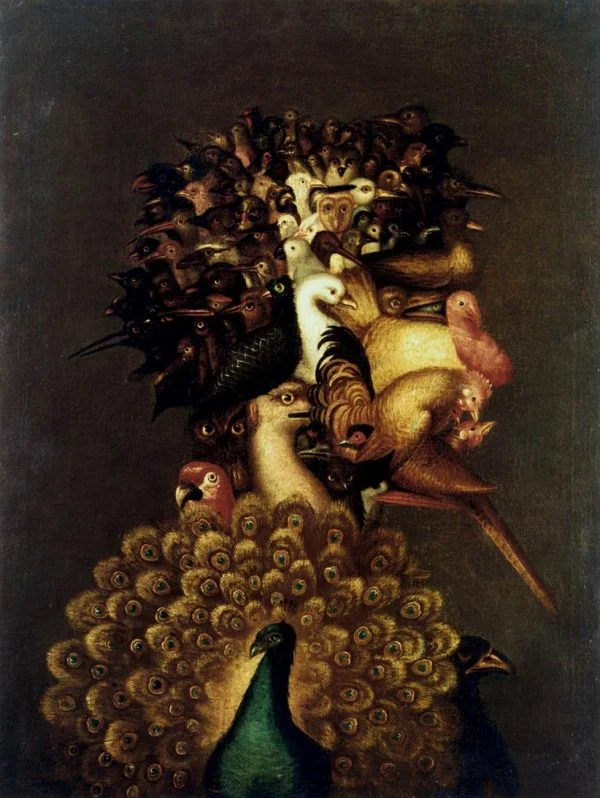
This painting belongs to a cycle. All four are available here:
- Giuseppe Arcimboldo – Fire
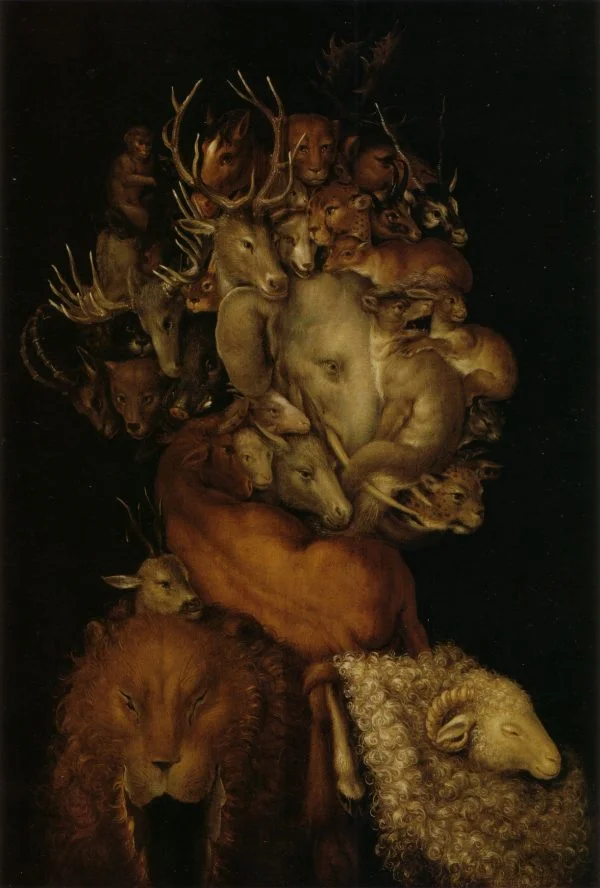
- Giuseppe Arcimboldo – Air
- Giuseppe Arcimboldo – Earth
- Giuseppe Arcimboldo – Water
As a matched group of four there is a single shared size today: 30 × 40 cm. Larger sizes exist for individual paintings, but not across all four at once.
More on both cycles as a wall group: Arcimboldo’s Four Seasons and Four Elements as a wall group
How is our hand-painted version made?
Every copy is hand-painted in oil on canvas; none is printed. Fire is demanding because it mixes two kinds of painting: the flames in the hair have to be loose and bright, while the metal below, the steels, the lamp, the chain and the cannon, has to be exact and hard-edged. Our painter first lays in the dark ground and the outline of the profile, then models the metal objects from the deepest shadows to the highlights, and paints the chain link by link. The flames come last, in thin warm layers over a lighter underpainting, so that they glow against the dark. The original is painted on a wooden panel, while our version is made on canvas, as is usual for work of this kind. The brushstrokes stay visible close up, and no two copies are ever quite the same.
Which size for which wall?
Fire is offered in two sizes. 30 x 40 cm suits a hallway, a shelf or the wall above a desk, where the chain and the steels can be seen close up. 40 x 50 cm suits a wall above a chest of drawers or beside a door, and holds its own from across a room. Our larger size is smaller than the 66.5 x 51 cm original: 16.5 cm shorter on the long side and 11 cm shorter on the short side. For the four elements hung as a group, 30 x 40 cm is the size all four share.
Custom size, stretcher bar and frame
If neither size fits, we paint in the size you ask for; send width and height through the paintings made to order page and we will prepare a quote. The painting is delivered stretched on a wooden stretcher bar and ready to hang, or rolled in a tube. You choose the frame on this page: the 3D frame selector offers 62 profiles, and the painting can also be ordered without a frame.
Delivery and guarantee
We paint to order, so it takes a few weeks, depending on size and on how busy the workshop is. We ship to sixteen countries in the European Union. Before dispatch you receive a photograph of the finished painting; if something is not as you expected, we correct it before it goes out, at no extra cost.
Frequently asked questions
Where is the original?
At the Kunsthistorisches Museum in Vienna, inventory number GG 1585. The year, size, material and history on this page come from the museum’s public record.
Who is shown in the work?
No one in particular: fire in the figure of a man. The museum names no sitter; it reads the chain of the Golden Fleece and the double-headed eagle as pointing to the Emperor Maximilian II.
What is the chain on the chest?
The chain of the Order of the Golden Fleece, with the ram of the Fleece hanging from it. Through it and the double-headed eagle, the museum says, Fire alludes most clearly of the series to the Emperor Maximilian II.
Is this a print?
No. Every painting we sell is painted by hand, in oil on canvas.
Which size should I choose?
For a wall seen close up, 30 x 40 cm; for a wall seen from across a room, 40 x 50 cm.
Can I have a size that is not listed?
You can. We paint in any size; send width and height through the custom order page.
How is it delivered?
Stretched on the bar and ready to hang, or rolled in a tube.
What is the work about, in one sentence?
That fire, assembled from the things that strike, feed and use it, points through the chain and the eagle to the Emperor Maximilian II.
Is the original for sale and what is it worth?
It is not for sale: it belongs to the museum’s collection in Vienna. We give no value, because the record carries none.
How high should I hang it?
Centre it about 145 cm from the floor, the eye height of an average adult; over furniture, with the lower edge 20 to 30 cm above it.
Is it suitable as a gift?
It is, and if you cannot pick a size you can give a gift voucher instead, leaving the choice to whoever receives it.
- Subject: a man made of fire and its tools, with burning logs for hair, fire-steels for nose and ear, an oil lamp for a chin and cannon barrels for a chest.
- Original: painted on a limewood panel, 66.5 x 51 cm as the museum gives it, dated 1566, Kunsthistorisches Museum, Vienna (inv. GG 1585).
- Ours: each oil painting reproduction is hand-painted on canvas, in two sizes or your own, with a photograph for approval before dispatch. You choose the frame on this page, or order the painting without one.
- Worth knowing: the back reads IGNIS 1566, and the museum pairs Fire with Summer, which it also holds.