





Description
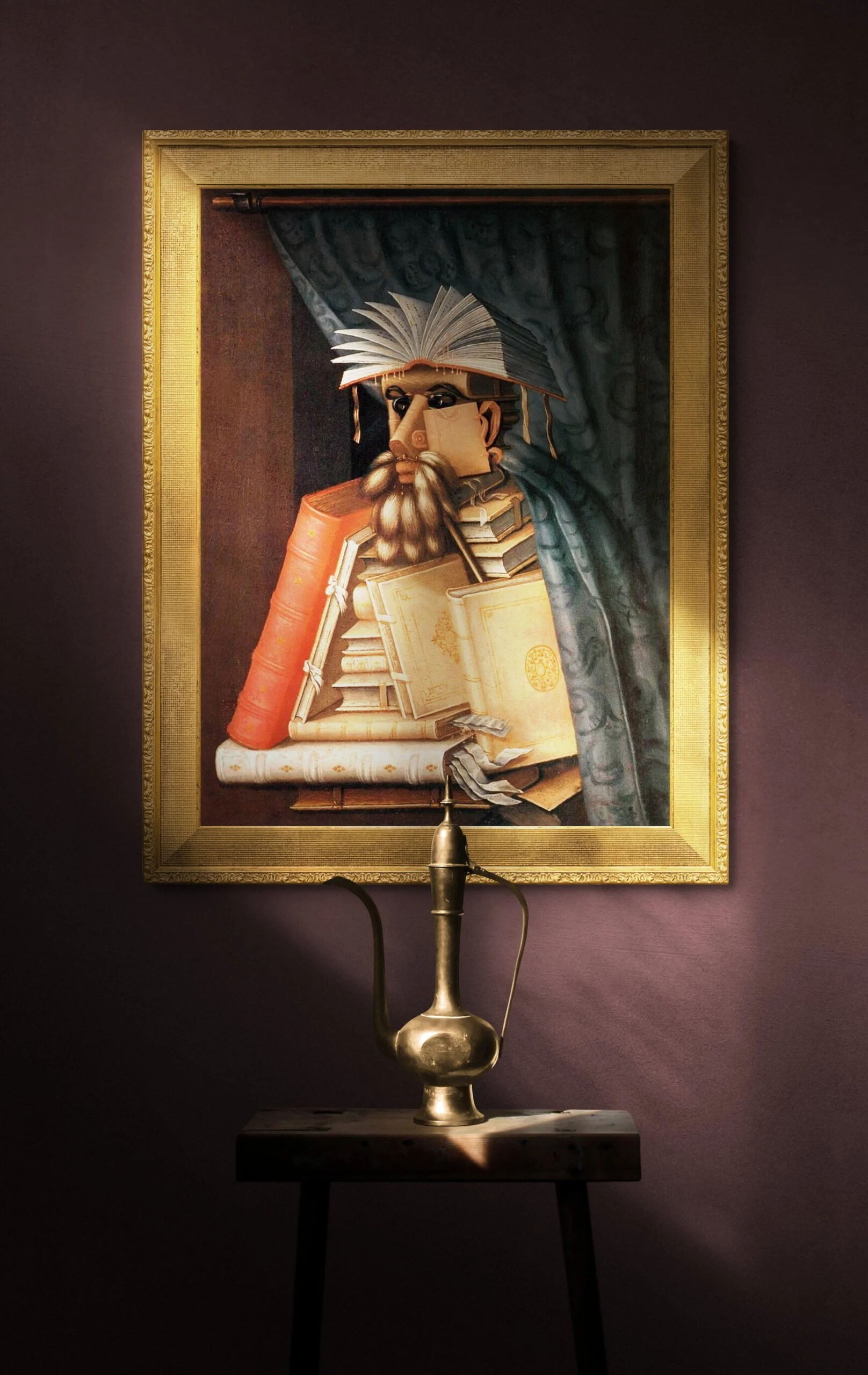
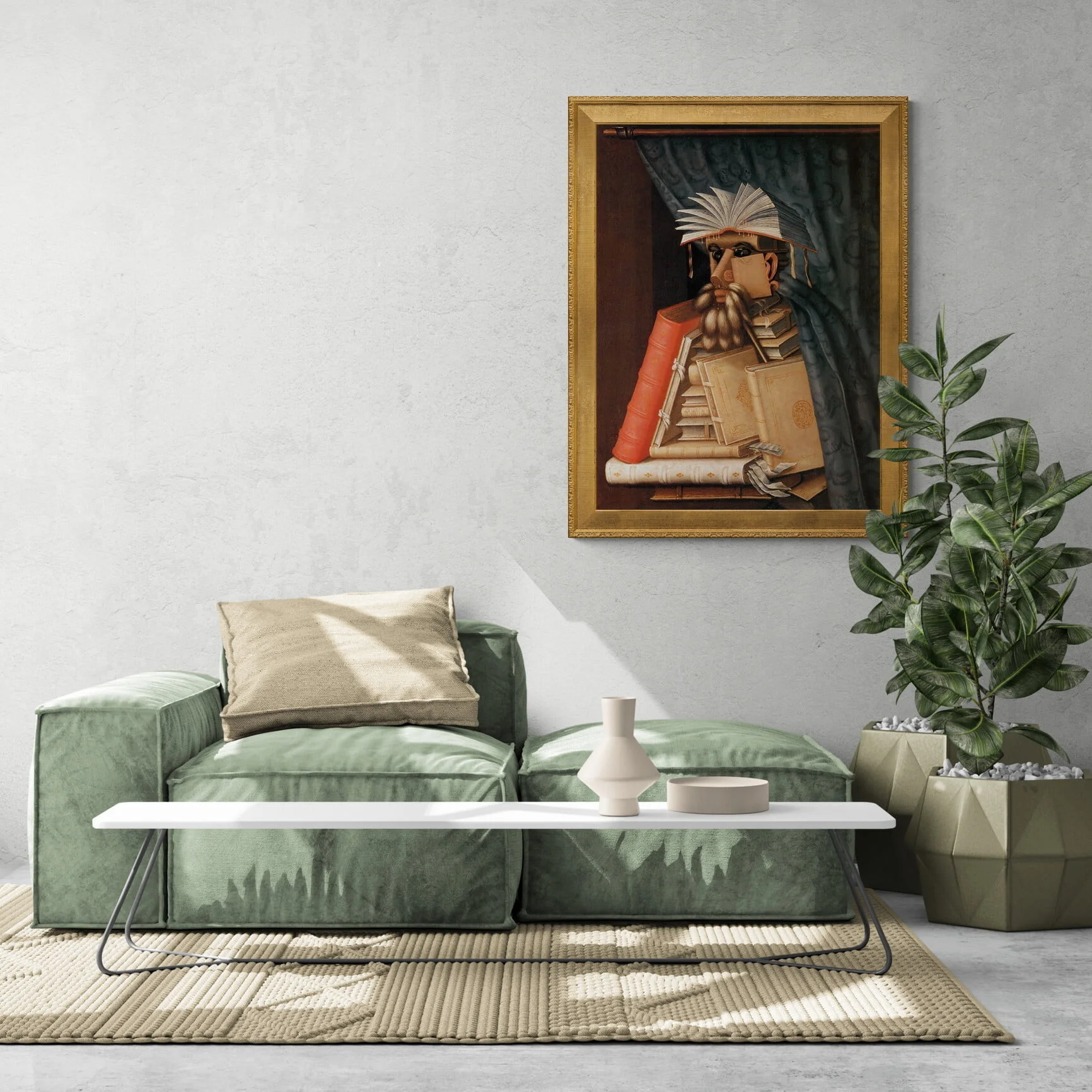
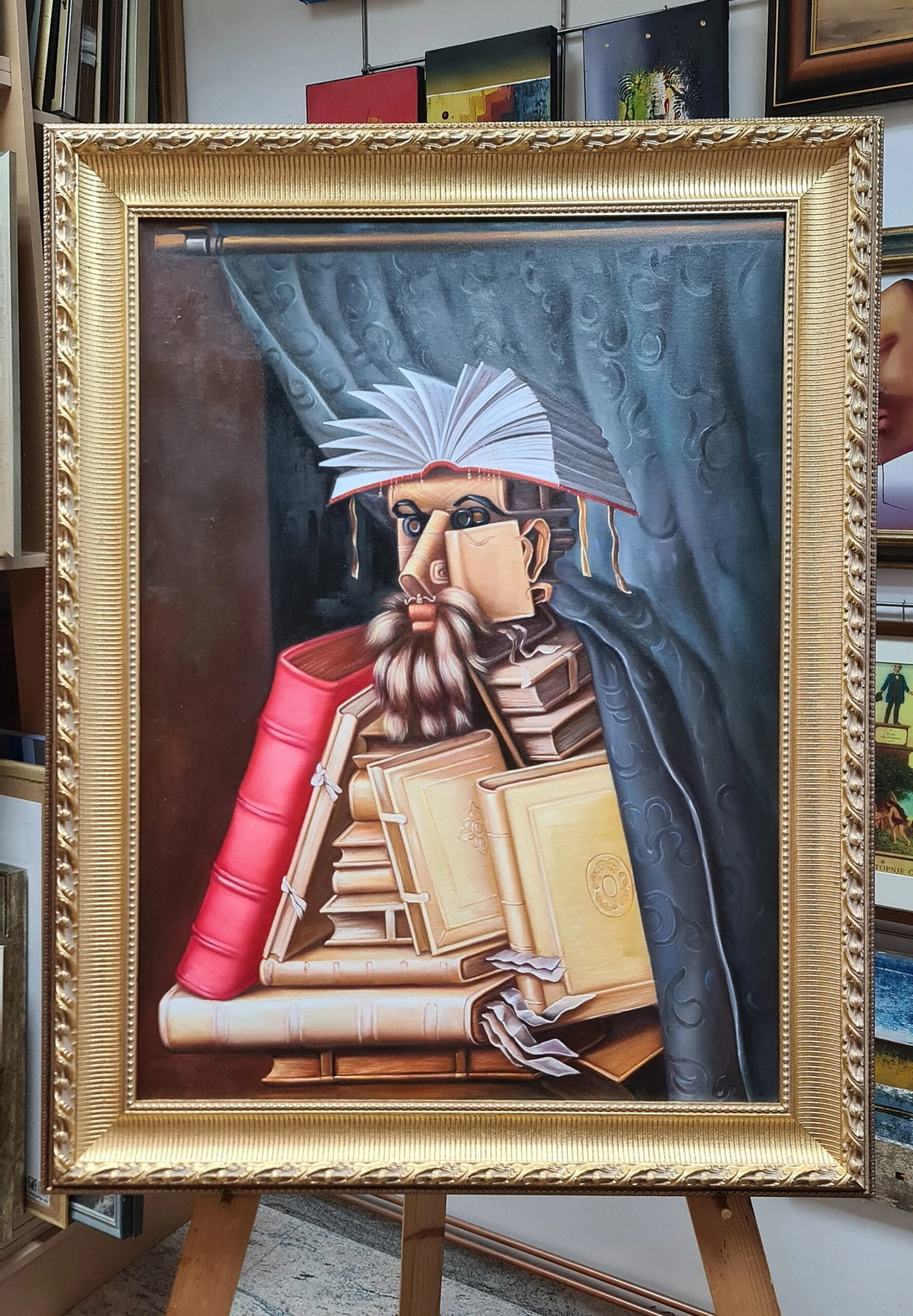
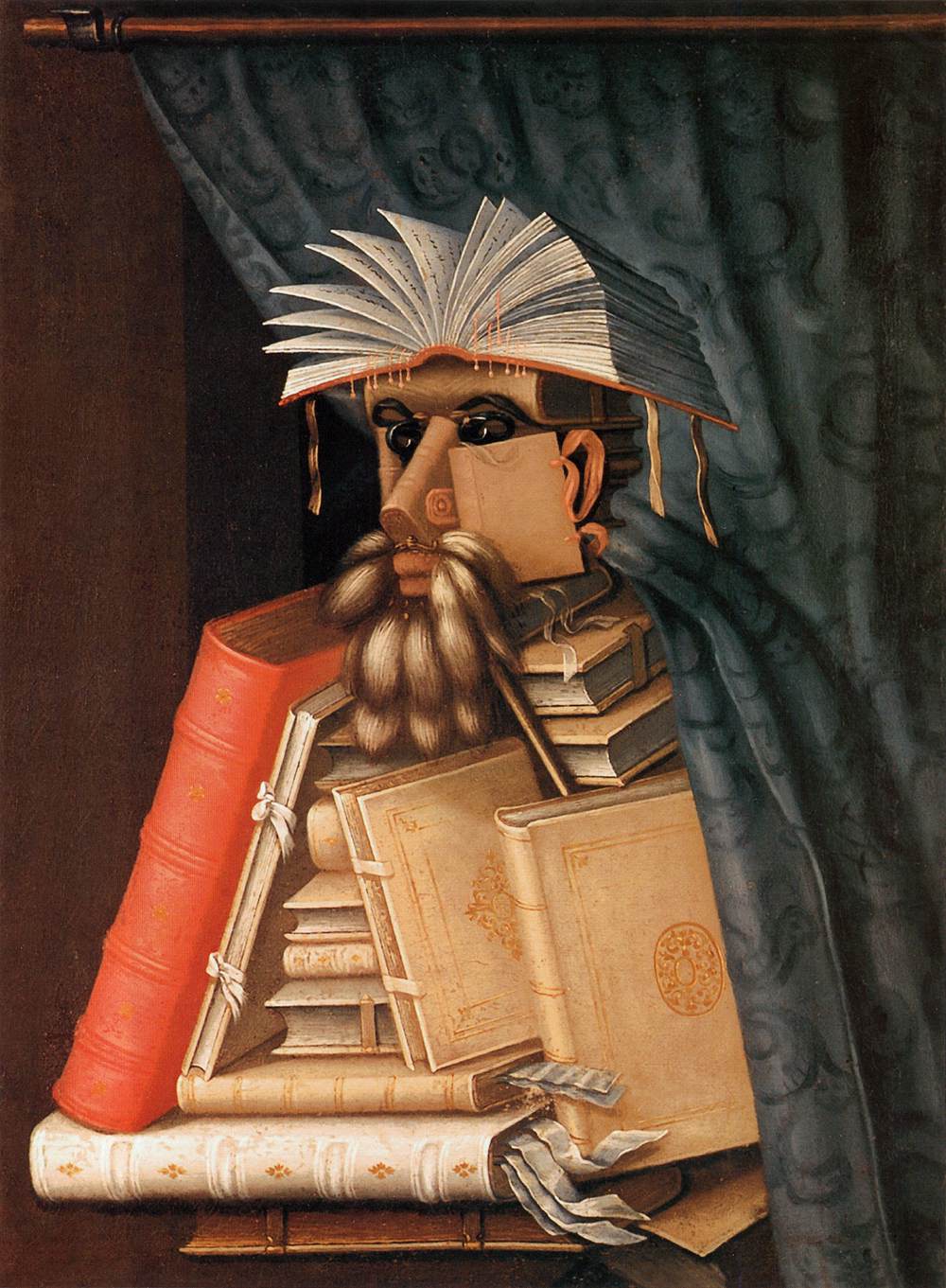
The Librarian is a portrait built entirely out of books: an open volume for hair, stacked spines for a torso, a bundle of animal hair for a beard. The original of 1562 is held by Skokloster Castle in Sweden under inventory number 11616_SKO and measures 98 x 71 cm. With us it is made as a hand-painted reproduction in oil on canvas, in six sizes or a size of your own, and you receive a photograph of the finished work for approval before it leaves the workshop.
| Title: | The Librarian |
| Other titles: | Bibliotekarien · Der Bibliothekar · Il bibliotecario · Knjižničar · A könyvtáros |
| Painter: | Giuseppe Arcimboldo (1527–1593) |
| Year: | 1562; the same institution notes a questioning »1566?« beside it |
| Original size: | 71 cm x 98 cm (width x height; 710 x 980 mm) |
| Original technique: | oil on canvas |
| Style: | Mannerism |
| Location: | Skokloster Castle, Sweden (inv. 11616_SKO) |
| Our reproduction: | hand-painted oil on canvas, six sizes from 30 x 40 to 80 x 110 cm, custom size on request |
The Librarian – Giuseppe Arcimboldo
Who is in the painting?
The Skokloster Castle collection records the work under a title it unpacks itself as a portrait caricature, most likely of the scholar Wolfgang Lazius (1514–1565), and names him among the people depicted. The museum holds the identification carefully – the title carries the Swedish for »most likely« – and we pass it on as carefully: it is the institution’s record, not a signature on the canvas.
What is on the canvas?
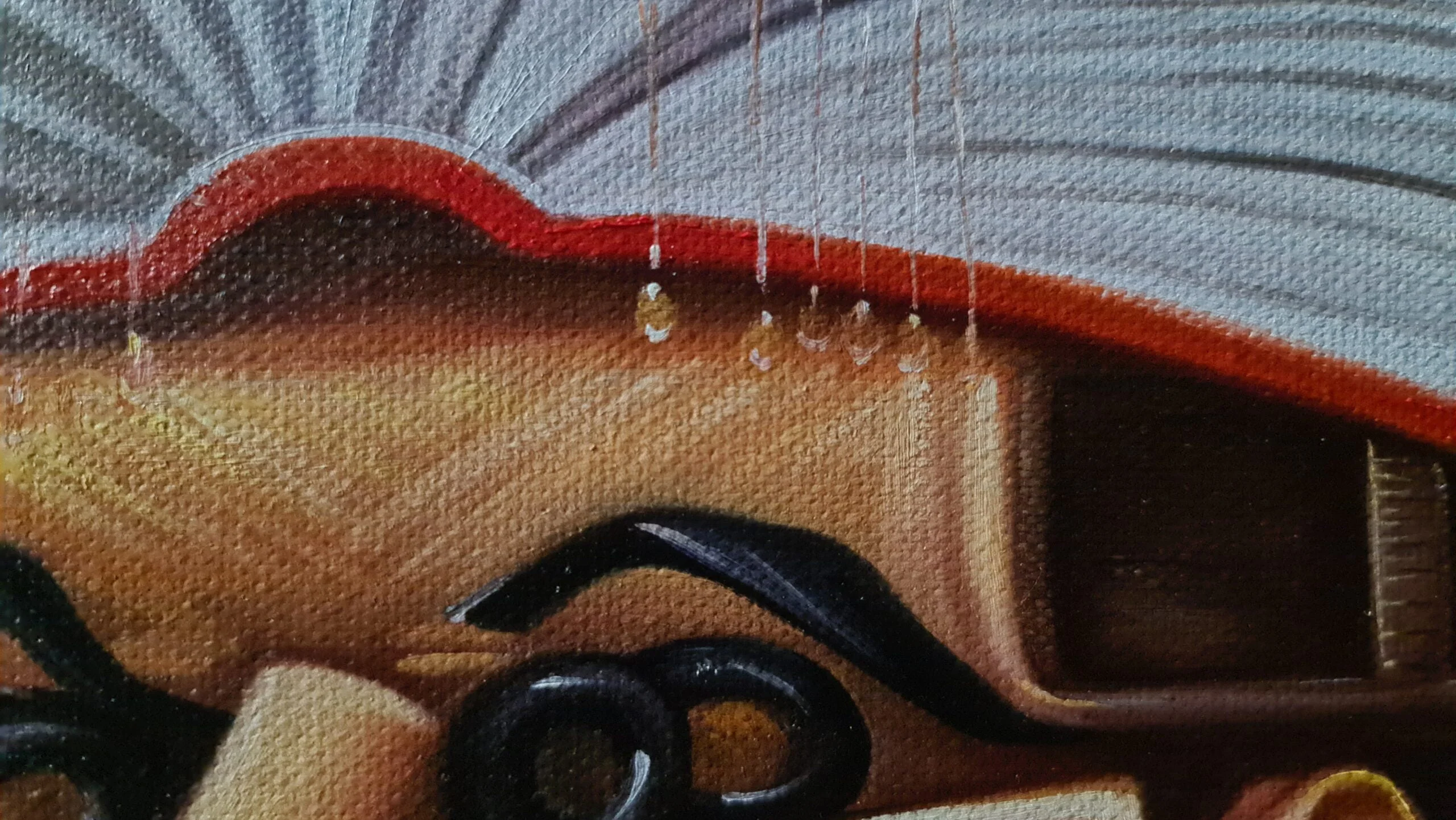
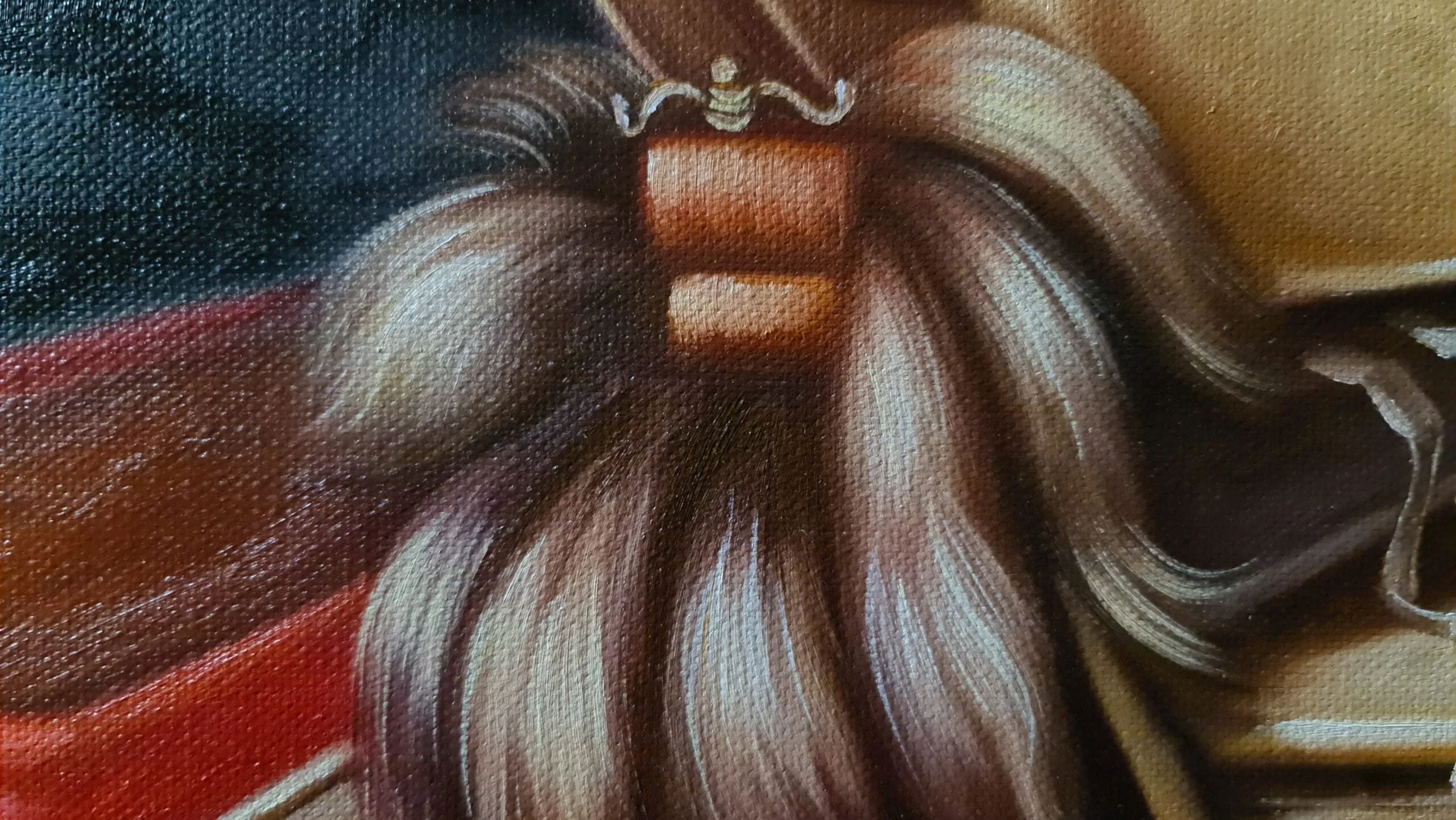
Hair and headgear are an open volume laid spine upwards, the leaves sticking out like a dishevelled head of hair, a red ribbon across them hung with the paper strips binders left between gatherings. The face is closed boards and page edges: the nose a book corner, the eye a circle on a leather spine, the cheek a dusty board. The torso is a stack of spines, upright and crosswise, one red volume glowing between them, the only strong colour on an otherwise brown-ochre canvas. The beard is a bundle of animal hair with a metal clasp – a duster of the sort drawn across page edges in libraries. Ribbons hang at the side; behind him a grey-blue curtain, pulled aside as though someone had just opened the space to view.
Why does this painting matter?
Because it is portrait and still life at once and refuses to settle for either. Arcimboldo worked at the Habsburg court, where cabinets of rarities and libraries were part of how a ruler was seen, and from those collections he assembled his heads. The Librarian is tied most directly to the object rather than to nature: no fruit, no fish, no flames, only books, paper and leather.
What does the painting mean?
The readings diverge, and we will not declare one right. One reads the canvas as mockery: a man who collects books and does not read them ends up made of books. The other reads it as homage: knowledge really is the stuff a person is assembled from. What is certain is that it works at two distances: close up a shelf, far off a portrait, and the eye switches between them without stopping. Mannerism went looking for exactly this doubleness, and The Librarian is its most legible example.
The road from Prague to Skokloster
The canvas was made in Prague, at the court the painter worked for. In 1648 the Swedish army carried it out of the city as war booty; the museum record names that event and files it under war booty. Among earlier owners it lists Hans Christoffer von Königsmarck. From there the trail runs into the castle inventories: the lists of 1756 and 1793 already carry it, and the list of 1823 gives it a house joke of a name made out of book words. Today it is at Skokloster Castle under inventory number 11616_SKO.
The motif among the painter’s works
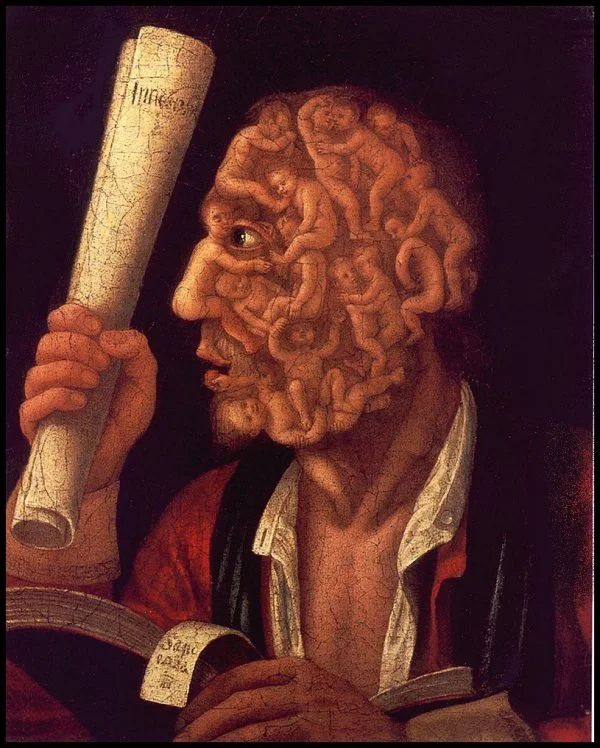
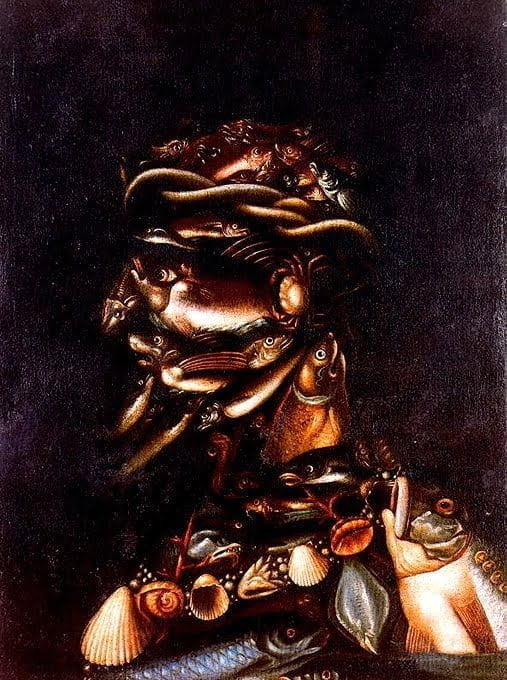
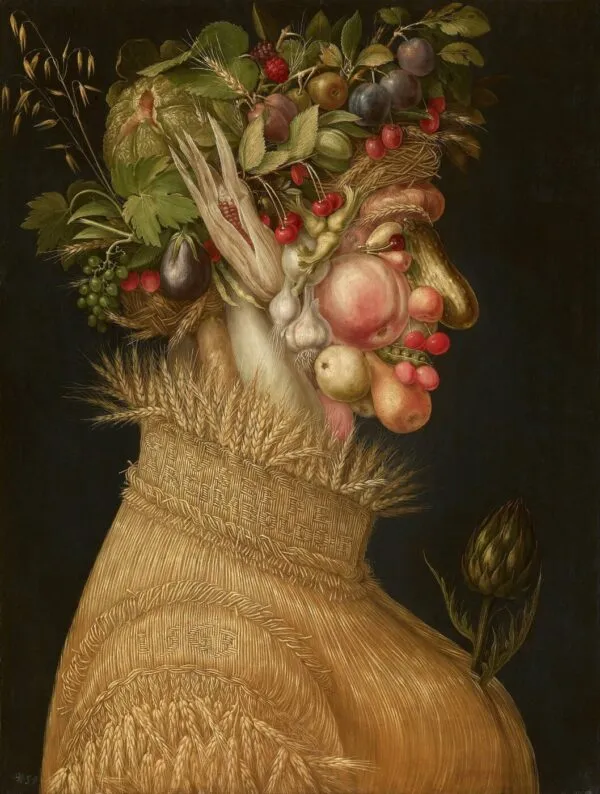
The assembled head is Arcimboldo’s constant: out of fruit and flowers he built Spring, out of sea creatures Water, out of flames and weapons Fire, and out of garden vegetables Portrait with Vegetables. The Librarian is the exception: it alone is assembled from things made by human hands rather than from nature. The Skokloster record lines it up with The Lawyer and The Cook, now at the Nationalmuseum in Stockholm, matching it in construction and style; The Lawyer is recorded in that collection as oil on canvas, 64 x 51 cm. The whole group is on the Giuseppe Arcimboldo page, and how the painter assembled his heads is described in our article about Arcimboldo.
How is our hand-painted version made?
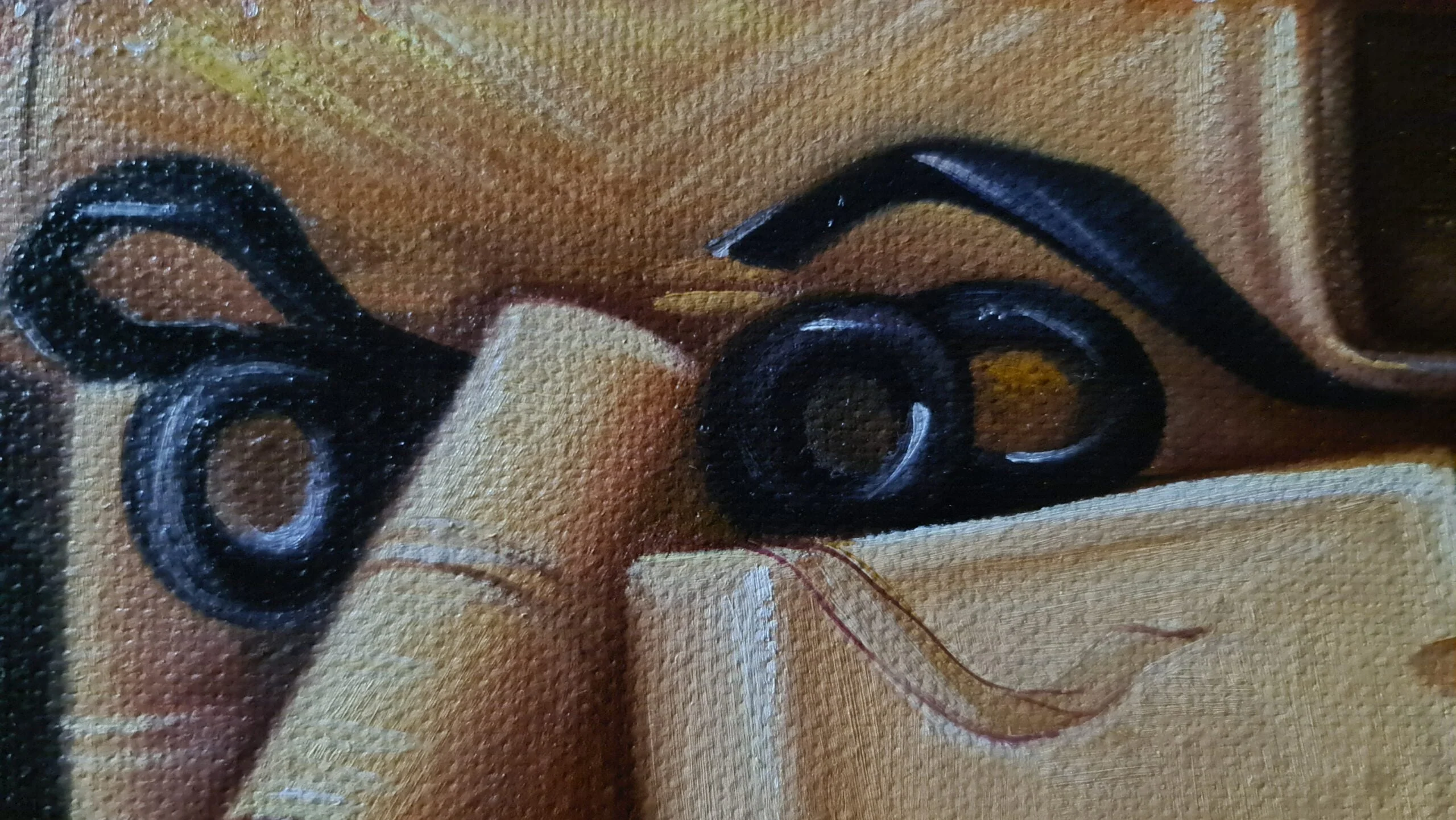
Every copy is painted by hand, in oil on canvas. The photographs above this text are not of the museum original, and not all of one kind: the first and the second are room views, the format placed on a wall, not workshop shots. From the third onwards it is the workshop. In the third photograph our finished canvas stands in a gold frame on a wooden easel among framed works waiting to be collected – the product as it is before we pack it. The fourth photograph is a macro of the eyes: under the paint the weave of the canvas is plain and the strokes lie one over another, which no print can give. The fifth photograph shows the open volume on the head with its red ribbon and strips, the sixth the hair beard with its clasp, every strand drawn separately.
Which size for which wall?
For most rooms 60 x 80 cm is right. The smaller sizes, 30 x 40 cm and 40 x 55 cm, suit a hallway, a desk or a shelf among books, where the fine strokes show. The middle sizes, 50 x 70 cm and 60 x 80 cm, go over a chest of drawers, a desk or a bed. The 71 x 97 cm and 80 x 110 cm sizes belong on a large free wall or a stairwell, seen from several metres – there the two-distance effect tells most. The original measures 71 x 98 cm (width x height), so our 71 x 97 cm comes closest to it in size: the painting is then the same width as the original, both 71 cm, and 1 cm shorter in height. If the original’s proportions matter to you more than its size, 80 x 110 cm and the much smaller 40 x 55 cm have the same proportions as each other and come nearest to the original’s: at their own widths they are 4 mm and 2 mm shorter in height than its 71 : 98 would give.
Custom size, stretcher bar and frame
If none of the six sizes fits, we paint in the size you ask for – send width and height for a quote on the paintings made to order page. A frame is not included in the price here: the canvas in the third photograph is framed because that is how it was photographed in the workshop, and it appears framed in both room views too. A frame is agreed separately.
Delivery and guarantee
We paint to order, so it takes a few weeks, depending on size and workshop load. We ship to sixteen countries in the European Union. Before dispatch you receive a photograph of the finished work; if something is not as you expected, we correct it before it goes out, at no extra cost. An oil painting reproduction made to order is always a single copy, which is why we take time over that check.
Frequently asked questions
Where is the original?
At Skokloster Castle in Sweden, inventory number 11616_SKO. The object record is public and linked in the table; the year 1562, the size 98 x 71 cm and the technique come from it.
Who is shown in the work?
The museum names Wolfgang Lazius, imperial historian and keeper of the court library, among those depicted, but puts »most likely« into the title.
Is Der Bibliothekar the same work as The Librarian?
Yes. The same canvas: The Librarian in English, Bibliotekarien in Sweden, and Der Bibliothekar, Il bibliotecario, Knjižničar and A könyvtáros elsewhere.
Is this a print?
No. Every copy is painted by hand, in oil on canvas.
Which size should I choose?
If you cannot decide, take 60 x 80 cm: smaller for a wall seen close up, larger for a free living-room wall. For the size closest to the original, choose 71 x 97 cm – the same width, 1 cm shorter. For proportions nearest the original’s, 80 x 110 cm or 40 x 55 cm: the two share the same proportions as each other and at their own widths are 4 mm and 2 mm shorter in height than the original’s 71 : 98 would give.
Can I have a size that is not listed?
You can. We paint in any size; send width and height through the custom order page.
How is it delivered?
Stretched on the bar and ready to hang, or rolled in a tube.
What is the work about, in one sentence?
That a person who lives among books ends up looking like the books – and that the canvas leaves it to the reader whether that is mockery or homage.
Is the original for sale and what is it worth?
It is not for sale: it belongs to the museum collection at Skokloster Castle. We give no value, because the record carries no verifiable figure.
How high should I hang it?
Centre it about 145 cm from the floor, the eye height of an average adult; over furniture, with the lower edge 20 to 30 cm above it.
Is it suitable as a gift?
It is, and if you cannot pick a size you can give a gift voucher instead, leaving the choice to whoever receives it.
- Subject: a man assembled from books, spines, paper strips and a duster; a shelf close up, a portrait across the room.
- Original: oil on canvas, 98 x 71 cm, 1562, Skokloster Castle, Sweden (inv. 11616_SKO); painted in Prague, taken as war booty in 1648.
- Ours: a hand-painted copy in oil on canvas, six sizes or your own, with a photograph for approval before dispatch. You choose the frame on this page: the 3D frame selector offers 62 profiles, and the painting can also be ordered without a frame.
- Worth knowing: the only Arcimboldo head assembled from things made by human hands rather than from nature; the museum calls it caricature and portrait in the same breath.