Description
Beethoven Frieze II (detail) shows the darkest corner of Klimt’s great wall painting: the ape-like giant Typhoeus and, beside him, three women who stand for Lust, Unchastity and Excess. The original was painted in 1901–1902 in casein and gold straight onto the plaster of the Vienna Secession, where it can still be seen today. We paint this detail by hand in oil on canvas, in eight sizes or to measure, and send you a photograph of the finished work before dispatch.
| Title: | Beethoven Frieze II (detail) |
| Other titles: | Beethovenfries · The Hostile Powers · Typhoeus with Lust, Unchastity and Excess · Fregio di Beethoven |
| Painter: | Gustav Klimt (1862–1918) |
| Year painted: | 1901–1902, shown in 1902 at the Secession’s Beethoven exhibition |
| Original size: | 215 cm x 630 cm (the whole short wall, Belvedere panels 5 and 6) |
| Original technique: | Casein paint with stucco, pencil, glass and mother-of-pearl inlays and gold on plaster |
| Painting style: | Vienna Secession, Golden Period |
| Located at: | Secession, Vienna, basement room; owned by the Belvedere, on permanent loan |
| Our reproduction: | Hand-painted oil on canvas after the wall painting, gold accents in gold paint, eight sizes or made to measure |
Beethoven Frieze II (detail) – Gustav Klimt
What does this detail show?
On the left a huge dark mass of fur fills almost a third of the painting. Out of it looks the head of the giant Typhoeus, more ape than man, with one staring eye and bared teeth. Next to this monster stand three women, painted pale and slender against the gold. At the top of the group, with red hair full of small blue flowers, kneels Lust. Beside her, head bowed and long fair hair falling down, is Unchastity. In front of them, in profile, stands a heavy woman with a jewelled headdress and a long blue skirt covered in round patterns: Excess.
Behind the figures Klimt scattered gold: spirals, small squares and bands of ornament that glint between the bodies. On the right the background turns into a deep blue field of tiny dots. The contrast is deliberate. Soft skin and shining jewellery sit right next to the rough, almost animal darkness of the giant, so the beauty here is never quite safe.
Which part of the Beethoven Frieze is this?
The Beethoven Frieze runs around three walls of one room, about 34 metres in all and roughly two metres high. The two long walls tell of the longing for happiness and of its fulfilment. Between them, on the short wall, Klimt painted The Hostile Powers: everything that stands in the way of human happiness. The Belvedere lists the whole cast of that wall: Typhoeus and his daughters the three Gorgons, Sickness, Madness and Death, Lust, Unchastity and Excess, and Gnawing Grief crouching in front of the giant’s serpent body.
Our Beethoven Frieze II is the part with Typhoeus and the three women. It is not the famous embrace with the choir of angels; that “kiss to the whole world” closes the opposite long wall. The neighbouring part of the same short wall, with the three Gorgons, is our Beethoven Frieze I.
Who are Typhoeus and the three women?
Typhoeus comes from Greek myth: a monstrous giant, so powerful that even the gods had to fight him. Klimt gave him the body of a gigantic ape, wings and a long serpent tail that winds across the wall. On the frieze he is the father of the hostile powers, the source of everything that threatens people on their way to happiness.
The three women next to him are not monsters at all, and that is the point. Lust, Unchastity and Excess are temptations, beautiful and adorned, which is why they are so dangerous. Read together with the other figures of the wall, they say that people are threatened not only by illness and death but also by their own desires. According to the Belvedere, the genii, the floating figures of longing, fly past all of this untouched: the hostile powers are an obstacle, not the end of the story.
How was the frieze made, and how did it survive?
Klimt painted the frieze for the 14th exhibition of the Vienna Secession, open from April to June 1902 and dedicated entirely to Beethoven; at its centre stood Max Klinger’s statue of the composer. The programme followed Richard Wagner’s interpretation of Beethoven’s Ninth Symphony, from longing through struggle to the Ode to Joy. Klimt worked in casein paint directly on the plaster, added stucco and pencil, set in pieces of glass and mother-of-pearl and laid gold on the surface.
The frieze was meant to last only as long as the exhibition. It survived anyway: it was later taken off the wall in sections, and in 1973 the Austrian state bought it. After a long restoration it has been on show since 1986 in a basement room of the Secession building, prepared especially for it. The Belvedere owns it and lends it to the Secession permanently. More about the whole cycle is on Wikipedia.
Beethoven Frieze I or II – which to choose?
Both paintings come from the same short wall and both are about danger, but they feel different. Beethoven Frieze I (detail) shows the three Gorgons standing upright with snakes in their hair and the pale faces of Sickness, Madness and Death above them: cooler, stiller, almost solemn. Beethoven Frieze II is warmer and more crowded, with the red hair of Lust, the blue skirt of Excess and the dark fur of the giant.
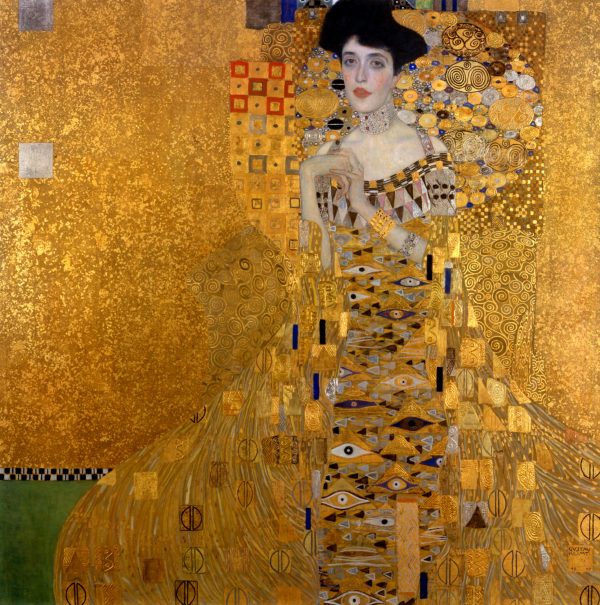
Choose part I if you want calm vertical lines and a mysterious mood; choose part II if you love colour, pattern and a dramatic contrast of light and dark. Hung side by side, the two details show a large piece of the original wall. If you prefer Klimt’s gold in a gentler subject, look at The Kiss, Portrait of Adele Bloch-Bauer I or Tree of Life.
How is our hand-painted version made?
The original is a wall painting: casein paint, stucco and gold on plaster. Ours is a hand-painted oil copy after it, on canvas, so it can hang in a home and travel. The painter first draws the outlines of the giant, the three women and the main ornaments, then paints the bodies in thin, smooth layers so the skin keeps the pale, matt look of the wall. The fur of Typhoeus is built up from many short, dark strokes.
The gold comes last. We do not print it and we do not use leaf: the painter applies gold paint by hand with a fine brush, spiral by spiral, so the ornaments catch the light as you walk past. The blue dotted field on the right is also set down dot by dot.
Because every piece is a hand-painted copy made for one order, no two are identical. That is the difference between our work and a printed oil painting reproduction: you can see the brushwork and feel the slight relief of the gold paint.
Which size for which wall?
Short answer: 80 x 100 cm for most living rooms, 60 x 75 cm for a bedroom or a smaller wall, and 120 x 150 cm or larger for a big wall where the painting is to be the main piece. All eight sizes are upright: 50 x 60, 60 x 75, 70 x 90, 80 x 100, 90 x 110, 100 x 120, 120 x 150 and 150 x 190 cm.
The sizes follow the upright shape of this detail, not the shape of the whole wall, which is very long and low. With its many dark tones it needs good light. The figures are nude and the giant is dark and fierce, so it suits a study, a hallway or a dining room better than a child’s room. As a painting for the living room it works best above a sofa or a sideboard, at about two thirds of the furniture’s width.
Keep the centre of the canvas about 150 cm above the floor and leave 20 to 30 cm between the furniture and the lower edge.
Custom size, stretcher and frame
If none of the eight sizes fits your wall, we paint the detail to measure, or even a wider section of the short wall. Send us the width and height you need and we will quote a price and a lead time. Every Klimt reproduction we make is stretched over a wooden stretcher and ready to hang.
For the moulding, use our 3D application: it shows every one of our frame profiles on this subject, so you can compare gold, silver, black, white and natural wood before deciding – the application is for choosing the frame only. If you would like to see how the painting will look on your own wall, that is our separate room placement service. A narrow gold or a dark wooden frame suits the mix of gold and deep blue.
Delivery and guarantee
Every painting is made to order in our studio in Slovenia, so allow 15 to 45 days depending on the size. We ship it stretched and protected for transport, framed if you chose a frame, across the EU with no customs. Before dispatch you receive a photograph of the finished work to approve, and our returns policy applies to every order.
All our Klimt subjects are in the Gustav Klimt gallery, and our ten facts about Klimt tell you more about the painter. If the painting is meant as a present and you are not sure about the size, a wall art voucher lets the recipient choose.
Frequently asked questions
Where can I see Beethoven Frieze II today?
In Vienna, in a basement room of the Secession building near Karlsplatz, where the whole Beethoven Frieze has been on show since 1986. The Belvedere owns the frieze and lends it to the Secession permanently. The detail with Typhoeus and the three women is on the short wall, between the two long walls, so you meet it halfway round the room.
What does Beethoven Frieze II show?
It shows the giant Typhoeus, an ape-like monster with dark fur, and three women beside him who embody Lust, Unchastity and Excess. Lust has red hair with blue flowers, Unchastity bows her fair head, and Excess is a heavy woman in a blue patterned skirt. Gold ornaments and a blue dotted background frame the group.
Who is the monster in Beethoven Frieze II?
The monster is Typhoeus, a giant from Greek myth so strong that even the gods had to fight him. Klimt painted him as a huge ape with wings and a serpent tail, the father of all the hostile powers on the short wall. His daughters, the three Gorgons, stand on his other side, in the part we sell as Beethoven Frieze I.
What is the meaning of Beethoven Frieze II?
The detail belongs to The Hostile Powers, the part of the frieze about everything that keeps people from happiness. Next to the giant, Lust, Unchastity and Excess show that danger also comes from our own desires, not only from illness or death. The story goes on: on the next wall the longing for happiness ends in poetry and the Ode to Joy.
How is Beethoven Frieze II linked to Beethoven’s Ninth Symphony?
Klimt painted the frieze for the Secession’s Beethoven exhibition of 1902 and followed Richard Wagner’s reading of the Ninth Symphony. The music moves from longing through struggle to joy, and so does the wall. This detail is the struggle: the dark middle part before the final chorus, which Klimt painted as a choir of angels and an embracing couple.
Is Beethoven Frieze II painted on canvas or on a wall, and is your gold real?
The original is painted on the wall itself: casein paint on plaster with stucco, glass, mother-of-pearl and gold. Our version is painted in oil on canvas. Its gold accents are neither leaf nor printed; the painter applies gold paint by hand with a brush, so the spirals shine warmly, as they do on the wall in Vienna.
What is the difference between Beethoven Frieze I and Beethoven Frieze II?
Both are details of the same short wall, The Hostile Powers. Beethoven Frieze I shows the three Gorgons with Sickness, Madness and Death above them, a cooler and stiller scene. Beethoven Frieze II shows the giant Typhoeus with Lust, Unchastity and Excess, warmer in colour and more dramatic. Hung side by side, they show a large part of the same wall.
In which sizes can I order Beethoven Frieze II?
There are eight upright sizes, from 50 x 60 cm up to 150 x 190 cm, including 80 x 100 and 100 x 120 cm. They follow the shape of this detail. If your wall needs something else, we paint it to measure, also as a wider section of the frieze, and tell you the price and lead time first.
Where should I hang Beethoven Frieze II?
Hang this canvas painting where it has room and good light, for example in a study, a dining room, a hallway or above a sofa. The nude figures and the dark giant make a strong statement, so an adult space suits it better than a child’s room. Give it a calm wall of its own so the gold and blue can work.
- Subject: the giant Typhoeus with Lust, Unchastity and Excess from the short wall of the Beethoven Frieze.
- Original: 1901–1902, casein and gold on plaster, Secession, Vienna.
- Ours: hand-painted in oil on canvas, gold accents in gold paint, eight sizes or made to measure.
- Good to know: before dispatch you receive a photograph of the finished work for approval.