Description
| Title: | A Centennial of Independence |
| Other titles: | A Centennial of Independence (the museum’s title) |
| Painter: | Henri Rousseau |
| Year painted: | 1892 (signed and dated) |
| Original size: | 111.8 cm x 158.1 cm (height x width, as published) |
| Original technique: | oil on canvas |
| Painting style: | naive art (primitivism) |
| Held at: | J. Paul Getty Museum, Los Angeles, USA |
| Our reproduction: | hand-painted oil on canvas, ten sizes or a size made to order |
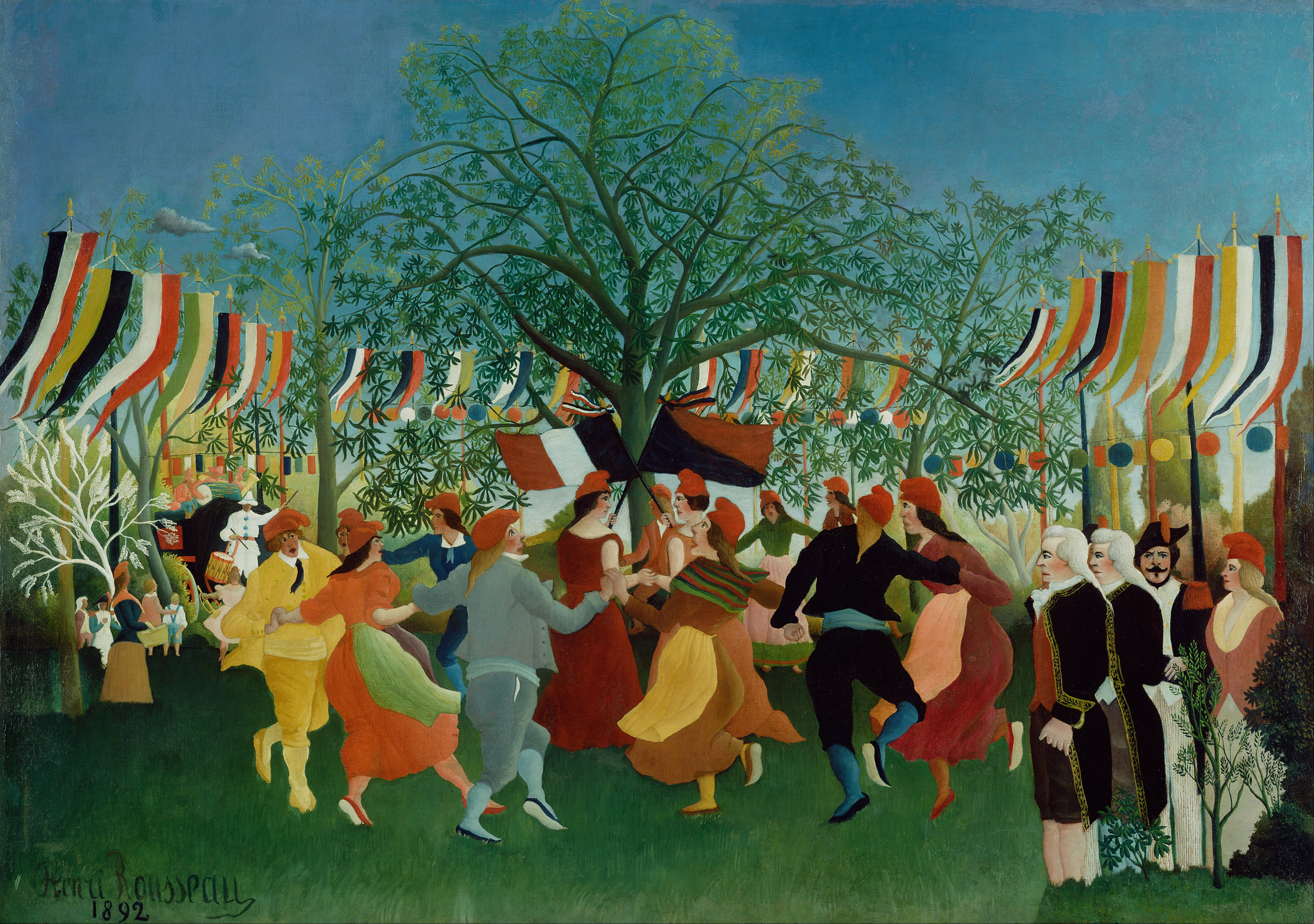
A Centennial of Independence is a painting by Henri Rousseau, oil on canvas, signed and dated 1892 by the painter; it is held by the J. Paul Getty Museum in Los Angeles. What you see: people in red caps dancing in a ring round a great tree hung with two crossed flags, with bright pennants fluttering on poles all around them. We paint it by hand in oils, in ten sizes or to measure, and send you a photograph of the finished painting before dispatch.
A Centennial of Independence
What is on the canvas?
In the middle of a green meadow grows a great tree with spreading branches, and on its trunk two flags are crossed, the French tricolour and a red-and-black one. Round the tree whirls a ring of dancers in yellow, red, orange, grey and black, nearly all in red caps, hand in hand and with their feet lifted in the dance. Tall poles with striped pennants and coloured lanterns stand at the left and right. At the right a group of men in 18th-century dress with white wigs watch the dance, and more onlookers stand at the back on the left. Above is a blue sky. The signature and year, Henri Rousseau 1892, are at the lower left. Another large painting by Rousseau on a historical theme is La Guerre.
What does the painting mean?
1892 marked a hundred years since the First French Republic was proclaimed in 1792, and Rousseau painted the anniversary as a popular festival. The red caps are a sign of liberty, the tree with its flags is the centre of the dance, and at the side stand men dressed as in the time of the Revolution, as if they had come to watch the celebration. The colours are bright and festive and the rhythm of the dance repeats from figure to figure, so on a wall the painting feels cheerful and lively. Another festive scene by Rousseau is The Wedding Party.
Which size suits which wall?
The published size of the original is 111.8 cm high and 158.1 cm wide, a large painting; 87 x 62 and 105 x 75 cm keep its proportion most exactly. Ten sizes are available: 70 x 52, 80 x 54, 87 x 62, 100 x 68, 105 x 75, 110 x 80, 120 x 83, 130 x 88, 140 x 95 and 150 x 102 cm. Because the painting holds many figures and details, we recommend it for a living or dining room from 120 x 83 cm upward; 87 x 62 cm is enough for a smaller wall. Above a sofa the painting usually takes about two thirds of the width of the furniture; above a bed it should stay narrower than the headboard. Custom sizes are ordered through the made-to-order painting page, where you enter the width and height; we suggest keeping the proportion of the original and changing only the scale. A Rousseau scene with soldiers is Artillerymen.
How is the painting made, and does it come framed?
Your canvas is begun only after you order it, and is painted by hand in oils in our workshop in Slovenia, at the size you choose. The painter lays in the sky and the meadow first, then the tree with its branches and flags, then the poles with their pennants and the lanterns, and last the dancers and the men at the side, each in their own colours. We do not print, and no machine application is used, so no two versions are exactly alike. The canvas is stretched on a wooden frame and arrives ready to hang; a picture frame is not included in the price and is chosen separately. Before packing we photograph the finished painting and send you the photograph for approval; only then does it travel. A Rousseau scene with players out of doors is The Football Players. The whole collection is in the Henri Rousseau gallery.
How is it delivered, and what do we guarantee?
We deliver to Slovenia, Croatia, Italy, Austria, Hungary and Germany. Depending on its size, the canvas travels rolled in a rigid tube or stretched on its frame, always in protective wrapping and as a tracked parcel. The making time depends on the size and is confirmed when you order. We guarantee that every painting is painted by hand and that you see a photograph of the finished work before dispatch; if anything in it is not as you wish, we correct it before it leaves the workshop.
Frequently asked questions
Where is the original kept?
At the J. Paul Getty Museum in Los Angeles, USA.
When was it painted?
In 1892; Rousseau signed and dated it at the lower left.
Is a frame included?
No. The canvas is stretched on a wooden frame and ready to hang without a picture frame; a frame can be chosen separately.
Is this a print?
No. It is painted by hand in oils, and the layers of paint can be seen and felt.
Is the painting suitable as a gift?
Yes, especially for a happy occasion, a celebration, or for someone who loves history and dancing. If you would rather the recipient chose, there is a gift voucher.
- Subject: a ring dance round a great tree with flags, red caps, bright pennants on poles and onlookers at the side.
- Original: oil on canvas, 111.8 x 158.1 cm (as published), J. Paul Getty Museum, Los Angeles; 1892.
- Our version: hand-painted oil, ten sizes from 70 x 52 to 150 x 102 cm or to measure, unframed, photograph before dispatch.
- Of note: 1892 marked a hundred years since the First French Republic was proclaimed.