



Description
| Title: | La Guerre |
| Other titles: | La Guerre; La chevauchée de la Discorde (the museum’s titles) |
| Painter: | Henri Rousseau |
| Year painted: | about 1894 |
| Original size: | 114.5 cm x 195 cm (height x width) |
| Original technique: | oil on canvas |
| Painting style: | naive art (primitivism) |
| Held at: | Musée d’Orsay, Paris, France |
| Our reproduction: | hand-painted oil on canvas, ten sizes or a size made to order |
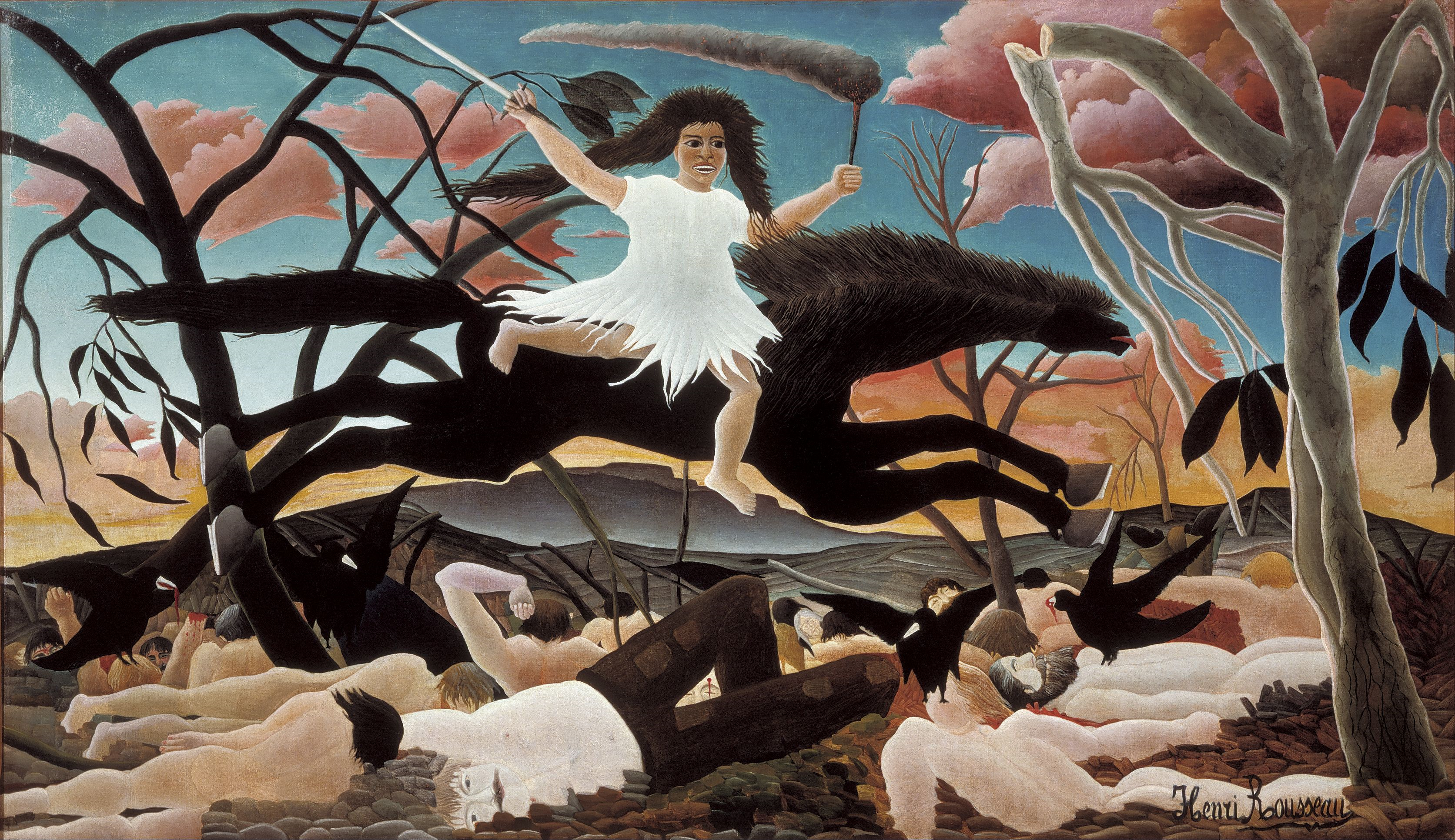
La Guerre is a painting by Henri Rousseau, oil on canvas, dated about 1894 by the Musée d’Orsay in Paris. What you see: a woman in a torn white dress, holding a sword and a burning torch, racing on a black horse over ground strewn with the fallen, among whom crows are pecking. We paint it by hand in oils, in ten sizes or to measure, and send you a photograph of the finished painting before dispatch.
La Guerre
What is on the canvas?
Across the middle a black horse with a long mane and tail flies in mid-leap, all four legs stretched forward and back. On it sits a woman with long black hair in a white dress with a torn hem; in one hand she raises a sword, in the other a smoking torch. Below lies a heap of pale bodies, with black crows pecking among them. At the left black, bare trees twist; at the right stands a pale grey trunk stripped of bark. The sky is blue, with pink and red clouds. The signature, Henri Rousseau, is at the lower right. Another Rousseau scene with soldiers is Artillerymen.
What does the painting mean?
The Musée d’Orsay writes that more than twenty years after the Franco-Prussian War of 1870 and the Paris Commune of 1871, Rousseau was still deeply affected by those events. The woman with the sword and torch is, the museum says, a kind of Bellona, the Roman goddess of war, and her horse is more a hybrid monster than an animal. The green of hope is entirely absent: black and red, the colours of mourning and blood, dominate. The museum points out that the horse’s “flying gallop” matches Géricault’s Epsom Derby of 1821 exactly, although photography had already shown that no horse ever runs that way. At the Salon des Indépendants of 1894 it was met with either sarcasm or enthusiasm. Another large painting by Rousseau on a historical theme is A Centennial of Independence.
Which size suits which wall?
The original is 114.5 cm high and 195 cm wide, a very wide format; 170 x 100 and 116 x 68 cm keep its proportion most exactly. Ten sizes are available: 80 x 45, 87 x 50, 100 x 58, 110 x 62, 116 x 68, 130 x 73, 139 x 80, 150 x 84, 157 x 90 and 170 x 100 cm. Because of its serious subject and dramatic composition, the painting belongs in a study, a library or on a long hallway wall rather than in a bedroom or a child’s room; for a long wall we recommend 139 x 80 cm or larger. Above a sofa the painting usually takes about two thirds of the width of the furniture; above a bed it should stay narrower than the headboard. Custom sizes are ordered through the made-to-order painting page, where you enter the width and height; we suggest keeping the proportion of the original and changing only the scale. A dramatic struggle by the same painter is also The Hungry Lion Throws Itself on the Antelope.
How is the painting made, and does it come framed?
Your canvas is begun only after you order it, and is painted by hand in oils in our workshop in Slovenia, at the size you choose. The painter lays in the sky with its clouds and the dark hills first, then the trees, then the horse and its rider with sword and torch, and last the bodies on the ground and the crows. We do not print, and no machine application is used, so no two versions are exactly alike. The canvas is stretched on a wooden frame and arrives ready to hang; a picture frame is not included in the price and is chosen separately. Before packing we photograph the finished painting and send you the photograph for approval; only then does it travel. Rousseau’s Paris from the same years is View of the Eiffel Tower and the Trocadéro. The whole collection is in the Henri Rousseau gallery.
How is it delivered, and what do we guarantee?
We deliver to Slovenia, Croatia, Italy, Austria, Hungary and Germany. Depending on its size, the canvas travels rolled in a rigid tube or stretched on its frame, always in protective wrapping and as a tracked parcel. The making time depends on the size and is confirmed when you order. We guarantee that every painting is painted by hand and that you see a photograph of the finished work before dispatch; if anything in it is not as you wish, we correct it before it leaves the workshop.
Frequently asked questions
Where is the original kept?
At the Musée d’Orsay in Paris.
When was it painted?
About 1894, the dating the museum gives; it was shown at the Salon des Indépendants that year.
Is a frame included?
No. The canvas is stretched on a wooden frame and ready to hang without a picture frame; a frame can be chosen separately.
Is this a print?
No. It is painted by hand in oils, and the layers of paint can be seen and felt.
Is the painting suitable as a gift?
For lovers of art history, collectors and anyone drawn to a strong, serious painting; as a gift, choose it with care. If you would rather the recipient chose, there is a gift voucher.
- Subject: a woman with a sword and torch on a leaping black horse above a battlefield of the fallen and crows; bare trees, red clouds.
- Original: oil on canvas, 114.5 x 195 cm, Musée d’Orsay, Paris; about 1894.
- Our version: hand-painted oil, ten sizes from 80 x 45 to 170 x 100 cm or to measure, unframed, photograph before dispatch.
- Of note: according to the museum, the green of hope is absent; black and red dominate.