









Description
The Birth – the museum says the Christian motif is not piety
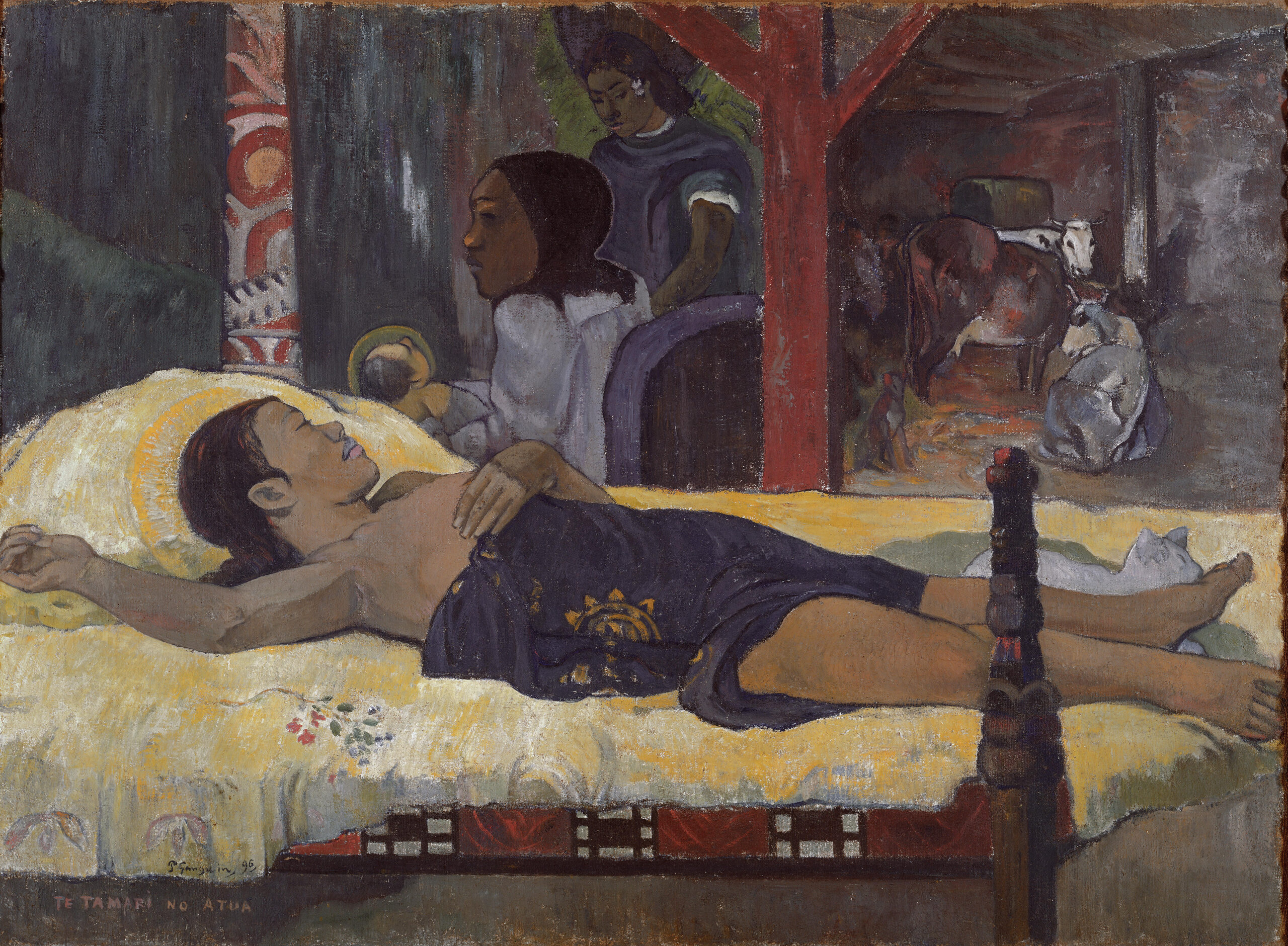
Across the lower half of the canvas a woman lies on a pale yellow bed, her head at the left and her eyes closed; over her hips is a dark blue cloth with a yellow ornament, and behind her head a pale yellow halo. Behind her a figure in a white garment with a dark cap sits holding a child in her lap, and the child has a halo too. Above them stands a figure in a blue-violet robe with a white collar. A red beam cuts the middle vertically. To the right a dark stable opens, with a brown cow and a pale animal lying down. A patterned ornamental band runs along the left edge. At the lower left a signature and the year are painted onto the canvas. The work is held by the Neue Pinakothek in Munich under inventory number 8652; it was painted in 1896.
The museum says expressly what this scene is not
The museum record does something unusual here: it explains how the painted Christian scene is NOT to be understood. The angel, the stable interior and the haloes of mother and child are, by the record, means of giving the depiction a Christian sense. But the allusion to the birth in the stable at Bethlehem, the museum says, is explained neither by any piety on the painter’s part nor by a possible intention of acquainting the local population with Christian teaching. It is an already proven device for heightening significance, one the painter reached for more than once.
What else the record says
The record ties the scene to a personal experience: at the end of 1896 the Tahitian woman who lived with him bore a child, which died after a few days. The figure in the dark cap is called the nurse in the record, which adds that in appearance she stands very close to depictions of the spirit of the dead on Tahiti. The child is taken from the mother and handed to the angel. That is the museum’s reading, and we give it as such.
Two independent sources on the same canvas
The facts of the work are confirmed by two separate records. The museum gives the measurement as 96 x 131,1 cm and the support as coarse sacking. The Wildenstein catalogue lists the work under the number W541, gives the same year and the same measurement and likewise a coarse sackcloth support; beside the Tahitian title it records a French one, L’Enfant de Dieu. The two records agree.
How the canvas came to Munich
The museum gives the route as well: the work was acquired in 1912 as a gift from Eduard Arnhold and Robert von Mendelssohn within the Tschudi donation. It was not bought but given, and a good fifteen years after it was painted.
How a hand-painted reproduction is made
Every painting here is made by hand in oil on canvas, stroke by stroke. In this motif the yellow bed is the hardest part: it is the largest light area on the canvas and it has to stay warm rather than becoming bare yellow, or the reclining figure loses its weight. Before dispatch you receive a photograph of the finished work for approval. Nothing on these pages is printed; the colour is mixed and laid on again for each canvas.
- Subject: a woman reclining on a yellow bed, with a figure holding a child and a stable behind.
- Technique: oil on a coarse weave, a yellow area beneath a dark ground.
- Sizes: landscape format, from 40 x 30 cm to 200 x 150 cm; 80 x 60 cm and 100 x 75 cm are often chosen.
- Of note: by the Wildenstein catalogue the work also carries a French title.
From the same Tahitian years, see also Ia Orana Maria, Te arii vahine (The King’s Wife) and Mata Mua (In Olden Times). The museum record gives the measurement as height by width: 96 x 131,1 cm.